Within Rwanda Cryptids
Which Real Animals Created Rwanda's Monster Stories?
Gorillas, leopards, young lions and fleeting forest sightings offer grounded explanations for many of Rwanda's mystery-beast stories.
On this page
- Leopards and young lions seen in poor conditions
- Gorillas and golden monkeys in dense mountain forest
- How camera traps and conservation change old legends
Page outline Jump by section
Introduction
Many of Rwanda’s monster stories become less mysterious when viewed through the country’s wildlife and landscape. Unlike places where legends centre on a single famous lake monster or unknown beast, Rwanda’s reports of strange animals often emerge from brief encounters in misty forests, volcanic slopes and dense vegetation. A glimpse of a large cat at dawn, the silhouette of a gorilla moving through bamboo, or a monkey seen under poor lighting can easily grow into a tale of an unknown creature. Modern conservation has made this process easier to study because camera traps, ranger patrols and wildlife monitoring now reveal which animals actually inhabit areas once associated with mystery-beast stories.[AP News]apnews.comAP News How collecting DNA samples in the wild could transform conservationThis method uses genetic material like fur or feces left in the environment to identify species, offering a more cost-effective and less…
The result is not that Rwanda’s legends become boring. Rather, they show how real wildlife, folklore and human perception interact. In many cases, the most convincing explanation for a supposed monster is an entirely genuine animal seen in unusual circumstances.
Why Rwanda Is Perfect for Misidentifications
Rwanda’s terrain encourages uncertainty. Volcanoes National Park and the wider Virunga region are famous for steep slopes, rapidly changing weather and thick vegetation. Even experienced trackers can lose sight of large animals within seconds. Scientists working in the area note that dense forest and mist often make wildlife difficult to detect directly, which is one reason new monitoring methods such as environmental DNA surveys are being adopted.[AP News]apnews.comAP News How collecting DNA samples in the wild could transform conservationThis method uses genetic material like fur or feces left in the environment to identify species, offering a more cost-effective and less…
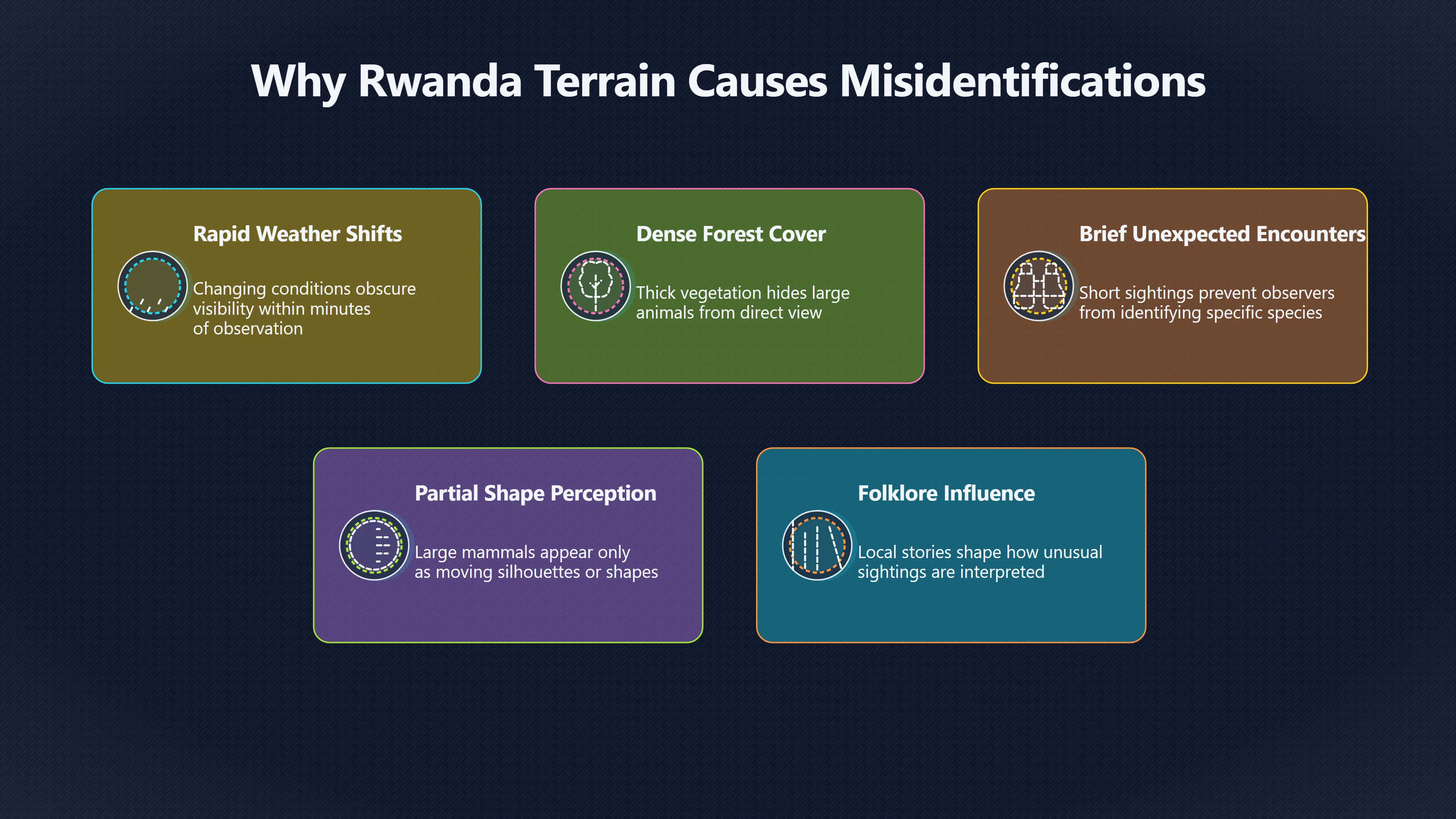
Several factors combine to create ideal conditions for mistaken sightings:
- Visibility can change dramatically within minutes.
- Animals are often observed at a distance through vegetation.
- Encounters are brief and unexpected.
- Large mammals may be seen only as partial shapes or movements.
- Local stories can influence how unusual sightings are interpreted.
When people encounter something they cannot immediately identify, memory often fills the gaps. Over time, a leopard may become a mystery cat, while a fleeting primate silhouette may acquire more unusual features in retellings.
Leopards and Young Lions Seen in Poor Conditions
The strongest zoological explanation for many reports of mysterious cats in Rwanda involves ordinary large carnivores.
Historically, Rwanda supported lions and leopards, although lion populations disappeared from Akagera National Park after the upheavals that followed the 1994 genocide before being reintroduced in 2015. Today both species occur in Akagera, while leopards remain among the country’s most elusive predators.[African Parks]africanparks.orgafrican parks translocate reintroduce lions into akagera national park rwandaAfrican ParksAfrican Parks Reintroduces Lions to Akagera National Park26 Jun 2015 — African Parks is to translocate seven lions from Sout…
This matters because several descriptions associated with Rwanda’s alleged mystery cat, the ikimizi, resemble situations in which observers might misidentify a young lion or an unusually viewed leopard. Young male lions often possess incomplete manes and can retain traces of juvenile spotting. Seen at a distance, such an animal can appear neither fully lion nor fully leopard. In poor light, observers may perceive an unfamiliar hybrid-looking creature rather than a normal big cat.
Leopards create additional confusion. They are solitary, secretive and most active when visibility is poor. Their spotted coats break up their outline in vegetation, making it difficult to judge size accurately. A startled observer may greatly overestimate how large the animal was. Reports of oversized cats are a common feature of mystery-animal traditions worldwide, and Rwanda’s forests provide many opportunities for such mistakes.[africanparks.org]africanparks.orgAfrican ParksAkagera Biodiversity ConservationFollowing the implementation of conservation and management measures as well as reintroduct…
The combination of a rare sighting, poor visibility and a powerful predator is often enough to create a lasting monster story without requiring any unknown species.
Gorillas and Golden Monkeys in Dense Mountain Forest
Large primates can be equally deceptive when seen briefly.
Mountain gorillas are among the largest living primates, yet even they can disappear rapidly into forest cover. Researchers and guides working in Rwanda’s volcano forests regularly describe how vegetation obscures animals, while tourists often spend hours searching before obtaining a clear view.[apnews.com]apnews.comAP News How collecting DNA samples in the wild could transform conservationThis method uses genetic material like fur or feces left in the environment to identify species, offering a more cost-effective and less…
A silverback glimpsed through fog may appear much larger than it truly is. Seen standing momentarily upright or moving behind vegetation, a gorilla can create an impression very different from its actual appearance. This effect is amplified for people unfamiliar with gorilla behaviour.
Golden monkeys present a different kind of challenge. Their quick movements and striking colouring can create brief, confusing visual impressions in the forest canopy. In low light, observers may notice movement and unusual colour patterns without obtaining a complete view of the animal. Such encounters can encourage stories about strange forest beings, particularly when combined with local folklore about hidden creatures.[AP News]apnews.comAP News How collecting DNA samples in the wild could transform conservationThis method uses genetic material like fur or feces left in the environment to identify species, offering a more cost-effective and less…
Importantly, these explanations do not dismiss local traditions. They simply show how real wildlife can provide the raw material from which unusual stories develop.
The Problem of Judging Size in the Forest
One of the most common features of monster reports is exaggerated size. Rwanda’s environment encourages this error.
In open grassland, observers can compare an animal with nearby objects. In dense forest, that reference system disappears. A leopard crossing a narrow opening may appear much larger than it actually is. A gorilla partly concealed by vegetation may seem gigantic. Distance is also difficult to estimate when trees and mist obscure the landscape.
Psychologists studying eyewitness testimony have long noted that surprise and fear affect perception. When an encounter lasts only a few seconds, the brain often remembers the emotional impact more vividly than the exact details. That process helps explain why reports of mystery animals frequently emphasise extraordinary size, unusual proportions or strange behaviour.
In Rwanda’s mountainous forests, those conditions are common rather than exceptional.
How Camera Traps and Conservation Change Old Legends
Modern conservation has transformed the way wildlife is documented in Rwanda.
Akagera National Park, Volcanoes National Park and other protected areas now use extensive monitoring programmes. Camera traps, ranger patrols, scientific surveys and genetic techniques provide a far clearer picture of which species live in these landscapes than was available in earlier decades.[apnews.com]apnews.comAP News How collecting DNA samples in the wild could transform conservationThis method uses genetic material like fur or feces left in the environment to identify species, offering a more cost-effective and less…
This has had an important effect on monster stories. Areas once associated with rumours of unknown predators can now be checked against photographic evidence. Instead of relying solely on eyewitness descriptions, conservationists can compare claims with records of lions, leopards, gorillas and other wildlife known to inhabit the region.
The pattern is revealing. As monitoring improves, many mysterious sightings turn out to involve recognised species rather than undiscovered animals. That does not eliminate folklore, but it narrows the space in which unknown beasts might plausibly exist.
At the same time, conservation success has increased wildlife populations in some areas. Akagera now supports healthy populations of lions, leopards and other large mammals following decades of restoration and reintroduction efforts. As more people encounter these animals, there are also more opportunities for surprising sightings that can feed local stories.[African Parks]africanparks.orgOpen source on africanparks.org.
What Rwanda’s Monster Stories Reveal
The most convincing explanation for many of Rwanda’s mystery-beast reports is not an undiscovered species but the interaction between elusive wildlife and challenging terrain. Leopards seen briefly at dusk, young lions with unusual markings, gorillas emerging from mist and fast-moving monkeys in dense forest can all appear far stranger than they really are.
That does not make the stories unimportant. On the contrary, they show how legends often grow from genuine encounters with remarkable animals. Rwanda’s forests contain creatures that can seem almost mythical even when they are completely real. In a landscape of volcanoes, cloud forest and hidden valleys, the boundary between wildlife observation and monster tale has always been thin.
Amazon book picks
Further Reading
Books and field guides related to Which Real Animals Created Rwanda's Monster Stories?. Use these as the next step if you want deeper reading beyond the article.
Gorillas in the Mist
Focuses on the real animals and habitats often linked to mystery sightings.
The Kingdon Field Guide to African Mammals
Helps identify animals commonly mistaken for monsters.
eBay marketplace picks
Marketplace Samples
Live-tested eBay searches with available results related to this page.




Endnotes
1.
Source: apnews.com
Title: AP News How collecting DNA samples in the wild could transform conservation
Link:https://apnews.com/article/bf030203dd1243fd5866461a94dd16e5
Source snippet
This method uses genetic material like fur or feces left in the environment to identify species, offering a more cost-effective and less...
2.
Source: nationalgeographic.com
Title: rwanda searching for gorillas in mist
Link:https://www.nationalgeographic.com/travel/article/rwanda-searching-for-gorillas-in-mist
Source snippet
As one of only two countries in the world where it's safe to go gorilla tracking, Rwanda is leading...Read more...
3.
Source: africanparks.org
Title: african parks translocate reintroduce lions into akagera national park rwanda
Link:https://www.africanparks.org/newsroom/press-releases/african-parks-translocate-reintroduce-lions-into-akagera-national-park-rwanda
Source snippet
African ParksAfrican Parks Reintroduces Lions to Akagera National Park26 Jun 2015 — African Parks is to translocate seven lions from Sout...
4.
Source: africanparks.org
Link:https://www.africanparks.org/the-parks/akagera/biodiversity-conservation
Source snippet
African ParksAkagera Biodiversity ConservationFollowing the implementation of conservation and management measures as well as reintroduct...
5.
Source: africanparks.org
Link:https://www.africanparks.org/the-parks/akagera
Source snippet
African ParksAkagera National ParkAkagera National Park is Central Africa's largest protected wetland and the last remaining refuge for s...
6.
Source: akagerasafari.com
Link:https://www.akagerasafari.com/akagera-national-park
Source snippet
Akagera SafariAkagera RwandaLeopards are most commonly found here and almost never in the open north. Our Live Sightings Network shows th...
7.
Source: nyungweforest.com
Title: Nyungwe Forest Rwanda Conservation Safaris
Link:https://www.nyungweforest.com/rwanda-conservation-safaris/
8.
Source: africanparks.org
Link:https://www.africanparks.org/akagera-ninety-years-renewal-and-restoration
9.
Source: Wikipedia
Title: Akagera National Park
Link:https://en.wikipedia.org/wiki/Akagera_National_Park
10.
Source: Wikipedia
Link:https://en.wikipedia.org/wiki/Africa
11.
Source: akagerasafari.com
Link:https://www.akagerasafari.com/akagera-national-park/wildlife
Additional References
12.
Source: benchafrica.com
Link:https://benchafrica.com/destinations/rwanda/
Source snippet
Bench AfricaRwanda Gorilla & WildlifeGuided treks lead through thick jungle to observe mountain gorilla families... Gorillas are wild an...
13.
Source: insideakageranationalpark.com
Link:https://www.insideakageranationalpark.com/leopards-in-akagera-national-park/
Source snippet
Inside Akagera National ParkLeopards in Akagera National ParkLeopards in Akagera National Park can be tracked around the Magashi camp are...
14.
Source: youtube.com
Title: How Rwanda is using DNA traces to protect endangered mountain gorillas
Link:https://www.youtube.com/watch?v=oehOghOMfQA
Source snippet
How This Tracker Learned To Understand Gorilla Communication...
15.
Source: hemingways-collection.com
Link:https://www.hemingways-collection.com/stories/akagera-nyungwe-rwandas-lesser-known-wildlife-wonders/
16.
Source: instagram.com
Link:https://www.instagram.com/reel/C-e19imNChB/?hl=en
17.
Source: akageranationalpark.net
Link:https://www.akageranationalpark.net/attractions/animals-wildlife/
18.
Source: jackalwildadventures.com
Link:https://www.jackalwildadventures.com/are-you-guaranteed-to-see-gorillas-in-rwanda/
19.
Source: visitrwanda.com
Link:https://visitrwanda.com/interests/gorilla-tracking/
20.
Source: facebook.com
Link:https://www.facebook.com/groups/1881865772093653/posts/4346238808989658/
21.
Source: facebook.com
Link:https://www.facebook.com/AfricanParks/videos/here-be-lions-leopard-and-rhinos-too-rwanda-is-rarely-considered-a-classic-safar/308589686650862/
Topic Tree