Cryptid Reports from Mongolia's Wildest Landscapes
Mongolia’s monster lore is dominated by two very different figures: the desert worm of the Gobi and the wild, man-like Almas of the western mountains. Neither has produced the kind of specimen, photograph, DNA evidence, or repeatable observation that would make it a confirmed animal.
Page outline Jump by section
Introduction
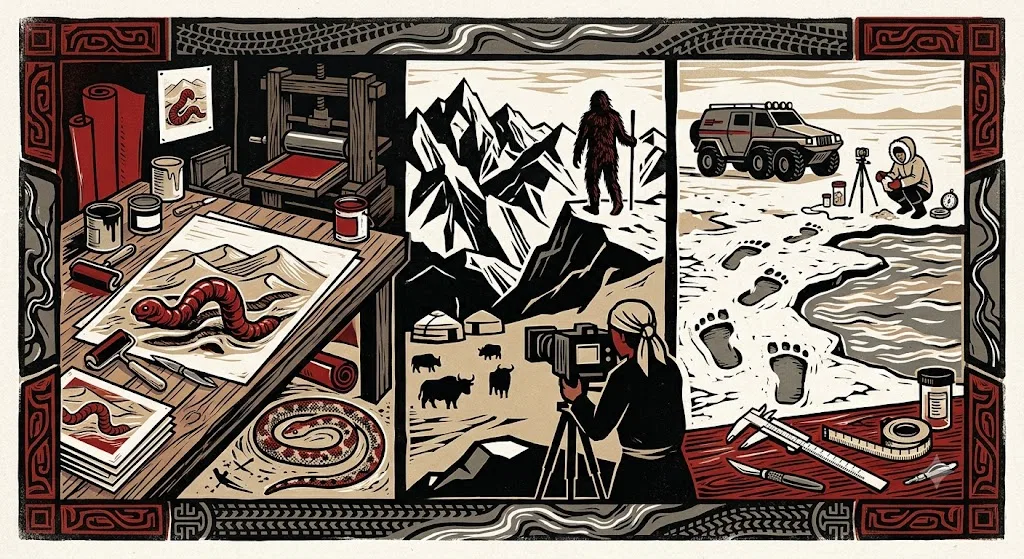
Mongolia’s monster lore is dominated by two very different figures: the desert worm of the Gobi and the wild, man-like Almas of the western mountains. Neither has produced the kind of specimen, photograph, DNA evidence, or repeatable observation that would make it a confirmed animal. What makes Mongolia interesting, though, is that its cryptid traditions are tied very closely to real landscapes: arid sand, salt lakes, fossil beds, remote mountain valleys, nomadic routes, and places where a strange track or second-hand tale can travel a long way. The most useful way to read these stories is not as proof of hidden monsters, but as a layered mix of folklore, environmental fear, misidentified wildlife, traveller reports, expedition culture, and modern media afterlives.
The Gobi creature most readers come looking for
The best-known Mongolian cryptid is the so-called Mongolian death worm, usually described in English as a thick, red, limbless creature said to live in the Gobi Desert. Its Western paper trail is unusually clear. Roy Chapman Andrews, leader of the American Museum of Natural History’s Central Asiatic Expeditions, wrote in 1932 that a Mongolian premier had asked him to capture a specimen. Andrews called it “probably an entirely mythical animal”, but noted that Mongols he met gave a consistent description: about two feet long, sausage-shaped, without head or legs, dangerously poisonous, and said to live in the most arid sandy parts of the western Gobi. He also observed a classic feature of elusive-beast folklore: people believed in it firmly, but sightings were always attributed to someone else or to a place just beyond the present camp.[Internet Archive]archive.orgInternet ArchiveFull text of "The new conquest of central Asia: a narrative of the explorations of the Central Asiatic expeditions in Mo…
That early account matters because it shows the legend was not invented by internet-era monster culture. It was already strong enough in the early twentieth century to be discussed with a foreign scientific expedition, yet it was already second-hand. Andrews’ wording is careful: he did not claim to have seen the animal, and he treated the story as a belief that might have “some little basis in fact” rather than as evidence of a new species.[Internet Archive]archive.orgInternet ArchiveFull text of "The new conquest of central Asia: a narrative of the explorations of the Central Asiatic expeditions in Mo…
Later retellings made the creature more dramatic. Modern accounts often add acid, venom sprayed at a distance, electric shock, sudden eruptions from sand, and a preference for appearing after rain. Those details make the death worm ideal for television, games, and horror art, but they also push it further from ordinary zoology. A small burrowing reptile or snake can be hard to see and alarming at close range; a large animal that reliably kills by touch or electricity would be much harder to hide from biology, veterinary knowledge, local herders, and the physical record.
Why the Gobi is perfect for a hidden-beast story
The Gobi is not an empty stage. It is a harsh but living landscape, with oases, reptiles, birds, mammals, fossils, and long human use. UNESCO’s description of the Mongolian Great Gobi records more than 50 oases in the Altai Inner desert, 10 in the Dzungarian desert, and 20 in the Alashaa desert; the Great Gobi Strictly Protected Area alone has recorded 49 mammal species, 15 reptile and amphibian species, and more than 150 bird species.[UNESCO World Heritage Centre]whc.unesco.orgWorld Heritage Centre Desert Landscapes of the Mongolian Great GobiUNESCO World Heritage CentreDesert Landscapes of the Mongolian Great Gobi - UNESCO World Heritage Centre…
That matters for the death worm because the legend sits at the overlap between ecological reality and imaginative exaggeration. The desert is difficult to search, animals may be seasonal or rare, and travellers can encounter unfamiliar tracks, carcasses, snakes, lizards, or wind-shaped sand marks. At the same time, Mongolia’s desert has been heavily studied by palaeontologists and naturalists. The Gobi is famous for fossils and prehistoric traces, and recent heritage research describes it as a region with at least 5,000 years of human activity, major fossil importance, and significant natural and cultural value.[ScienceDirect]sciencedirect.comPreserving the Gobi: Identifying potential UNESCO world heritage in Mongolia’s Gobi Desert - ScienceDirect…
A plausible explanation often suggested for at least some worm reports is a sand boa. The Reptile Database lists the dwarf or desert sand boa, also associated with the name Tartar sand boa, among the relevant Central Asian snake complex. Its common names and burrowing habits make it a better fit for “mysterious thick desert snake” than for “electric acid worm”, but it shows why a real animal can sit underneath a much stranger story.[Reptile Database]reptile-database.reptarium.czReptile Database Eryx miliaris | The Reptile DatabaseReptile Database Eryx miliaris | The Reptile Database
Andrews himself noticed the same basic problem from another angle. In his expedition narrative he recorded venomous snakes in Mongolia, including a brown pit-viper, but also commented that the country’s long cold winters and dryness limited its reptile fauna. That does not make a strange animal impossible, but it makes a large, common, lethally unusual desert creature less likely to have escaped all physical confirmation.[Internet Archive]archive.orgInternet ArchiveFull text of "The new conquest of central Asia: a narrative of the explorations of the Central Asiatic expeditions in Mo…
Expeditions, television, and the missing specimen
The death worm’s modern life depends heavily on searches that failed but still kept the legend alive. Czech explorer Ivan Mackerle helped popularise the hunt after Mongolia became more accessible to outside visitors in the 1990s. Later, Richard Freeman and colleagues from the Centre for Fortean Zoology carried out a 2005 Gobi search, and a New Zealand expedition associated with television presenter David Farrier followed in 2009. Atlas Obscura’s 2024 account describes Freeman’s team hiring locals, circulating reward flyers, and focusing on conditions said to draw the creature out, while Time noted Farrier’s 2009 expedition as part of the creature’s renewed media profile.[Atlas Obscura]atlasobscura.comAtlas Obscura Is the Mongolian Death Worm Real?Atlas ObscuraIs the Mongolian Death Worm Real?May 1, 2024 — 30 Apr 2024 — Freeman and three CFZ associates organized their own expedition…
The pattern is important: these searches generated interviews, publicity, sketches, and travel narratives, but not a body, clear photograph, reliable tissue sample, trackway, or repeatable observation. That is why the death worm works best as a Mongolian desert legend with possible roots in real reptiles, not as a confirmed hidden species.
It also explains why the creature has travelled so well in pop culture. A hidden desert animal with a lethal touch is simple to visualise, easy to dramatise, and flexible enough to become a sandworm, horror monster, or monster-of-the-week adversary. The more it moves into entertainment, however, the more readers should separate the early report — a second-hand belief described by Andrews — from later embellishments.
The Almas belongs to the mountains, not the sandworm tradition
Mongolia’s other major cryptid tradition is the Almas: a wild, man-like being associated with Mongolia and wider Central Asia, especially western mountain regions such as the Altai. Unlike the death worm, the Almas belongs to a broad “wildman” family of stories that also overlaps with Himalayan, Caucasus, and Central Asian traditions. It is usually discussed as hairy, human-shaped, elusive, and more folk-human than giant ape.
The most valuable point for readers is that the Almas tradition has a complicated paper trail. Oxford’s record for Michael Heaney’s peer-reviewed historical re-evaluation explains that Almas research was said to have begun after Badzar Baradiin allegedly saw one during a 1906 expedition to Tibet and reported it to Tsyben Zhamtsarano. Heaney’s archival examination, including Baradiin’s unpublished expedition diaries, cast doubt on that origin story.[Oxford University Research Archive]ora.ox.ac.ukford University Research ArchiveTHE MONGOLIAN ALMAS: A HISTORICAL REEVALUATION OF THE SIGHTING BY BARADIIN - ORA - Oxford University Re…
That does not erase Almas folklore. It does weaken one famous “historical sighting” often used to give the tradition a firm starting point. The distinction is crucial: a folklore tradition can be culturally real and locally meaningful even when a celebrated eyewitness anchor turns out to be uncertain, misremembered, or unsupported by the documents that should contain it.
The Almas also shows how cryptids change when investigators look for animals inside older spirit or wild-person traditions. A being from mountain folklore can be reframed as a relict hominin, a surviving prehistoric human, a bear seen upright, an isolated feral person, or a misreported encounter. Each version answers a different need. Folklore explains the dangerous outside world; cryptozoology turns the story into a biological puzzle; scepticism asks what evidence would be expected if such beings really existed.
Mongolia’s lake monsters are smaller traditions with thinner evidence
Mongolia is landlocked, but it has large salt lakes and enclosed basins that invite lake-monster comparisons. Khyargas Nuur in western Mongolia is the clearest example in the available English-language record. A lake-regions profile notes a local legend that a huge reptile lives in the lake, sometimes comes ashore to bask, and leaves strange footprints on the shore.[Interlaker]interlaker.orgLake Khyargas-Nuur – Ассоциация озерных регионовLake Khyargas-Nuur – Ассоциация озерных регионов…
The strongest caution is that these reports are much thinner than the death worm tradition. They often appear as travel-lore snippets, local legends, or short news-style retellings rather than as a deep body of dated witness statements. A 2017 article comparing Mongolian lake stories to Loch Ness referred to alleged large tracks near Khyargas Lake and later mentions of similar traces, but it relied partly on older media claims that are not easy to verify independently.[Pressenza]pressenza.comMongolia’s Loch Ness? – Strange Sighting in the Uureg LakeMongolia’s Loch Ness? – Strange Sighting in the Uureg Lake
There is a real environmental context, though. The Uvs Nuur Basin, also in western Mongolia, is described by UNESCO as the northernmost enclosed basin of Central Asia, with a large, shallow, very saline lake important for migrating birds, waterfowl, and seabirds. Such basins can produce striking shore marks, carcass movements, bird activity, mirages, and unfamiliar silhouettes on water. None of that “solves” every lake story, but it gives a grounded reason to be cautious before turning every footprint or surface disturbance into a reptile.[UNESCO]unesco.orgUvs Nuur BasinUvs Nuur Basin
Mongolia’s fossil landscape adds another twist. The Gobi has yielded vast numbers of dinosaur tracks, with one Geological Quarterly study reporting 18 Upper Cretaceous footprint localities and more than 20,000 dinosaur footprints. In a country where genuine prehistoric traces exist in abundance, it is easy to see how “giant footprint” language can slide between palaeontology, local wonder, and monster speculation.[Geological Quarterly]gq.pgi.gov.plDinosaur footprints from the Upper Cretaceous of Mongolia | Geological Quarterly…

What probably explains the reports?
The best explanations differ by creature.
For the death worm, the most plausible core is a mixture of desert cautionary folklore, second-hand traveller testimony, and misidentified or exaggerated reptiles such as sand boas or vipers. The “no head or legs” description fits the way a thick snake partly buried in sand might be perceived, while the poisonous-touch motif belongs more to warning tale than to known biology. Andrews’ own account already contains the key sceptical clue: firm belief, consistent description, but no direct witness who would admit seeing it personally.[Internet Archive]archive.orgInternet ArchiveFull text of "The new conquest of central Asia: a narrative of the explorations of the Central Asiatic expeditions in Mo…
For the Almas, the explanation is more cultural and historical. It belongs to the widespread human habit of imagining wild people at the edge of known settlement, especially in mountains, forests, and frontier zones. Some reports may fold in bears, hermits, exaggerated human encounters, or stories reshaped by Russian, European, and cryptozoological expectations. Heaney’s archival caution over the famous Baradiin sighting shows why the Almas should be treated as a serious folklore subject, but not as a demonstrated surviving hominin.[Oxford University Research Archive]ora.ox.ac.ukford University Research ArchiveTHE MONGOLIAN ALMAS: A HISTORICAL REEVALUATION OF THE SIGHTING BY BARADIIN - ORA - Oxford University Re…
For lake monsters, the evidence is currently too fragmentary for strong claims. Khyargas and Uureg-style stories are interesting as local lake lore and as part of a global pattern in which large, remote bodies of water develop resident monsters. But without clear dated observations, biological traces, or reliable imagery, they remain legends and media curiosities rather than zoological cases.
Why Mongolia’s cryptids still matter
Mongolia’s cryptids endure because they are attached to memorable places. The death worm belongs to the Gobi: dry, fossil-rich, difficult, and full of real animals that most outsiders rarely see. The Almas belongs to western mountain imagination: remote valleys, borderlands, old wildman motifs, and the question of what might live beyond ordinary routes. The lake monsters belong to salt basins and shorelines where strange marks can become stories.
Their value is not that they prove hidden monsters are waiting to be catalogued. It is that they show how landscapes generate legends, how rumours become expedition targets, and how a country’s real ecology can feed stories without confirming them. Mongolia gives cryptid readers something better than a simple yes-or-no mystery: a set of strange claims that become more interesting when kept in contact with folklore, field history, scepticism, and the land itself.
eBay marketplace picks
Marketplace Samples
Live-tested eBay searches with available results related to this page.


Endnotes
1.
Source: archive.org
Link:https://archive.org/stream/newconquestofcen00andr/newconquestofcen00andr_djvu.txt
Source snippet
Internet ArchiveFull text of "The new conquest of central Asia: a narrative of the explorations of the Central Asiatic expeditions in Mo...
2.
Source: whc.unesco.org
Title: World Heritage Centre Desert Landscapes of the Mongolian Great Gobi
Link:https://whc.unesco.org/en/tentativelists/5943/
Source snippet
UNESCO World Heritage CentreDesert Landscapes of the Mongolian Great Gobi - UNESCO World Heritage Centre...
3.
Source: sciencedirect.com
Link:https://www.sciencedirect.com/science/article/pii/S2287884X22000905
Source snippet
Preserving the Gobi: Identifying potential UNESCO world heritage in Mongolia’s Gobi Desert - ScienceDirect...
4.
Source: content.time.com
Title: Mongolian Death Worm
Link:https://content.time.com/time/specials/packages/article/0%2C28804%2C1916160_1916151_1916119%2C00.html
Source snippet
Mongolian Death Worm - Top 10 Famous Mysterious...14 Aug 2009 — In August 2009... "I have no intention of grabbing it, stuffing it...
Published: August 2009
5.
Source: interlaker.org
Title: Lake Khyargas-Nuur – Ассоциация озерных регионов
Link:https://interlaker.org/lakes-and-regions/mongolia/lake-khyargas-nuur/
Source snippet
Lake Khyargas-Nuur – Ассоциация озерных регионов...
6.
Source: pressenza.com
Title: Mongolia’s Loch Ness? – Strange Sighting in the Uureg Lake
Link:https://www.pressenza.com/2017/11/mongolias-loch-ness-strange-sighting-uureg-lake/
7.
Source: unesco.org
Title: Uvs Nuur Basin
Link:https://www.unesco.org/en/mab/uvs-nuur-basin
8.
Source: gq.pgi.gov.pl
Title: Geological Quarterly
Link:https://gq.pgi.gov.pl/article/view/7533
Source snippet
Dinosaur footprints from the Upper Cretaceous of Mongolia | Geological Quarterly...
9.
Source: archive.org
Link:https://archive.org/stream/Cryptozoology_201608/Cryptozoology_djvu.txt
10.
Source: archive.org
Link:https://archive.org/stream/naturalhistory3615newy/naturalhistory3615newy_djvu.txt
11.
Source: archive.org
Title: morebooks1930bost djvu.txt
Link:https://archive.org/stream/morebooks1930bost/morebooks1930bost_djvu.txt
12.
Source: archive.org
Link:https://archive.org/stream/naturalhistory1936newy/naturalhistory1936newy_djvu.txt
13.
Source: archive.org
Link:https://archive.org/download/olddircksbookbri00stor/olddircksbookbri00stor.pdf
14.
Source: ia801702.us.archive.org
Link:https://ia801702.us.archive.org/27/items/in.ernet.dli.2015.105244/2015.105244.Annual-Report-Of-The-Board-Of-Regents-Of-The-Smithsonian-Institution-1946_text.pdf
15.
Source: archive.org
Link:https://archive.org/stream/dli.bengal.10689.11674/10689.11674_djvu.txt
16.
Source: archive.org
Link:https://archive.org/stream/americanmuseumjo18amer/americanmuseumjo18amer_djvu.txt
17.
Source: archive.org
Link:https://archive.org/details/ontrailofancient00andr
18.
Source: archive.org
Link:https://archive.org/stream/brewersdictionar000544mbp/brewersdictionar000544mbp_djvu.txt
19.
Source: sciencedirect.com
Link:https://www.sciencedirect.com/science/article/pii/S235198942500441X
20.
Source: digitalcollections.sit.edu
Link:https://digitalcollections.sit.edu/cgi/viewcontent.cgi?article=1780&context=isp_collection
21.
Source: observation.org
Title: Tartar Sand Boa
Link:https://observation.org/species/99428/
22.
Source: animal.photos
Title: Tartar Sand Boa
Link:https://www.animal.photos/reptamph5/boa-tartar.htm
23.
Source: reptile-database.reptarium.cz
Title: Reptile Database Eryx miliaris | The Reptile Database
Link:https://reptile-database.reptarium.cz/Eryx/miliaris
24.
Source: atlasobscura.com
Title: Atlas Obscura Is the Mongolian Death Worm Real?
Link:https://www.atlasobscura.com/articles/mongolian-death-worm
Source snippet
Atlas ObscuraIs the Mongolian Death Worm Real?May 1, 2024 — 30 Apr 2024 — Freeman and three CFZ associates organized their own expedition...
Published: May 1, 2024
25.
Source: ora.ox.ac.uk
Link:https://ora.ox.ac.uk/objects/uuid%3A85d4d3f6-d0be-4c8d-839a-3a6736ceeec6
Source snippet
ford University Research ArchiveTHE MONGOLIAN ALMAS: A HISTORICAL REEVALUATION OF THE SIGHTING BY BARADIIN - ORA - Oxford University Re...
26.
Source: Wikipedia
Title: Mongolian death worm
Link:https://en.wikipedia.org/wiki/Mongolian_death_worm
27.
Source: Wikipedia
Link:https://en.wikipedia.org/wiki/Mongolia
28.
Source: Wikipedia
Title: Khyargas Nuur
Link:https://en.wikipedia.org/wiki/Khyargas_Nuur
29.
Source: ora.ox.ac.uk
Link:https://ora.ox.ac.uk/objects/uuid%3A85d4d3f6-d0be-4c8d-839a-3a6736ceeec6/files/mfc46cc4661f4477cdd7469b1cc5839df
30.
Source: ora.ox.ac.uk
Link:https://ora.ox.ac.uk/objects/uuid%3A5a72cd9a-26ca-4b26-ad21-b0fc71480f73/files/m70cbb26bc0d73fcbf43293aca003bd04
31.
Source: cryptidz.fandom.com
Link:https://cryptidz.fandom.com/wiki/Almas
32.
Source: cryptidz.fandom.com
Title: Mongolian Death Worm
Link:https://cryptidz.fandom.com/wiki/Mongolian_Death_Worm
33.
Source: cryptid-that-you-saw.fandom.com
Link:https://cryptid-that-you-saw.fandom.com/wiki/Almas
34.
Source: cryptozoologycryptids.fandom.com
Title: Mongolian Death Worm
Link:https://cryptozoologycryptids.fandom.com/wiki/Mongolian_Death_Worm
35.
Source: itsmth.fandom.com
Title: Mongolian Death Worm
Link:https://itsmth.fandom.com/wiki/Mongolian_Death_Worm
36.
Source: mongolianstore.com
Title: mongolian death worm
Link:https://mongolianstore.com/mongolian-death-worm/?srsltid=AfmBOoqIqb0wK9Hnu-bhUrocSKvDFcMhZmM3rmEnn3_JwkE3jx9qPKcC
37.
Source: mongoliaguide.com
Title: Khyargas Lake
Link:https://mongoliaguide.com/index.php/khyargas-lake/
38.
Source: cbd.int
Link:https://www.cbd.int/countries/profile/?country=mn
39.
Source: science.howstuffworks.com
Title: mongolian death worm
Link:https://science.howstuffworks.com/science-vs-myth/strange-creatures/mongolian-death-worm.htm
40.
Source: mongolia-trips.com
Title: Khyargas Lake
Link:https://www.mongolia-trips.com/guide-mongolia/destination/khyargas-lake
41.
Source: cryptidatlas.com
Link:https://cryptidatlas.com/cryptid/almas/
Additional References
42.
Source: youtube.com
Title: The Mongolian Bigfoot: a firsthand encounter with the Almas
Link:https://www.youtube.com/watch?v=-JG4IAJdu7I
Source snippet
The Almas: Wild Men of Central Asia Unveiled...
43.
Source: facebook.com
Link:https://www.facebook.com/centerforinquiry/posts/a-brief-timeline-of-bigfoots-demise-in-the-21st-century-courtesy-of-scientific-p/768849635285057/
44.
Source: centerforinquiry.org
Link:https://centerforinquiry.org/blog/authors/radford-benjamin/
45.
Source: reddit.com
Link:https://www.reddit.com/r/mongolia/comments/1igmg8p/about_the_almas_the_mongolian_wildman/
46.
Source: reddit.com
Link:https://www.reddit.com/r/Cryptozoology/comments/1p828kt/about_the_western_mongolian_almas_tradition_and/
47.
Source: nightbringer.se
Link:https://nightbringer.se/myths-and-legends/mythic-almas/
48.
Source: studocu.vn
Link:https://www.studocu.vn/vn/document/dai-hoc-ha-noi/ielts/almas-the-mongolian-man-beast/65304848
49.
Source: skepticalinquirer.org
Link:https://skepticalinquirer.org/authors/benjamin-radford/
50.
Source: livescience.com
Link:https://www.livescience.com/author/benjamin-radford/page/2
51.
Source: scispace.com
Link:https://scispace.com/pdf/bibliography-of-classical-folklore-scholarship-myths-legends-3zhe07c726.pdf
Topic Tree
Follow this branch
Related pages 192
- Antigua Cryptids
- Maldives Monsters
- Malta Monsters
- Qatar Monsters
- Argentina Monsters
- +187 more in sidebar