Cryptids of Malaysia's Wild Places
Malaysia’s mystery-creature tradition is strongest where forest, river and lake meet local memory.
Page outline Jump by section
Introduction
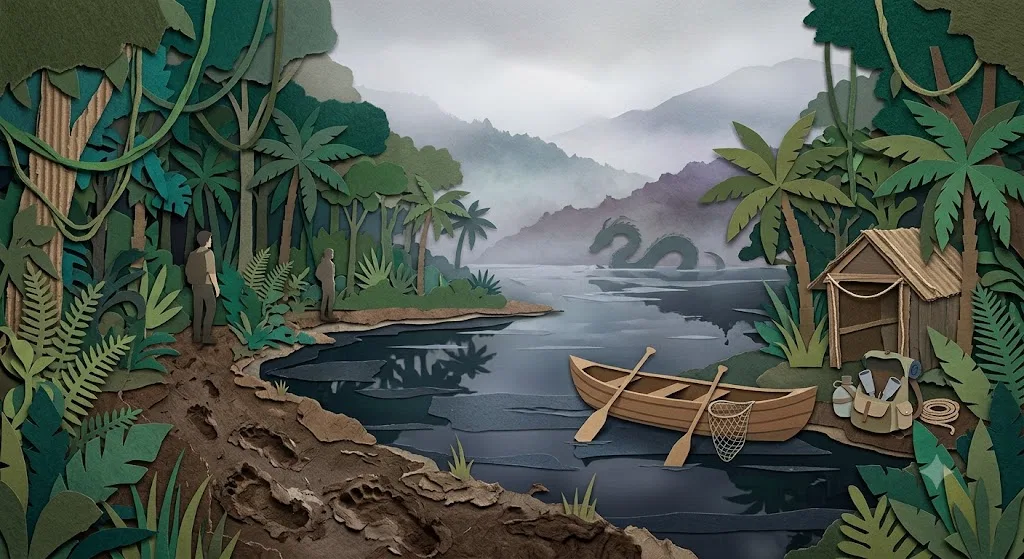
The most useful way to read Malaysia’s cryptid lore is therefore not as a catalogue of “monsters”, but as a set of claims moving between folklore, eyewitness testimony, tourism, conservation anxiety and misidentification. A muddy footprint in Johor, a dragon said to live under a lake, or a fake-looking giant snake photograph from Borneo can all become part of the same national conversation: what might still be out there, what people remember, and what forests and waters are losing.
The Johor “Bigfoot”: what was Orang Mawas supposed to be?
The Orang Mawas is Malaysia’s most recognisable Bigfoot-like creature. Reports usually place it in Johor, especially around forested areas linked in the press to Endau-Rompin and Kota Tinggi. The creature is described as tall, hairy and upright, sometimes as a family group rather than a lone animal. In the 2005–06 flap, fish-farm workers claimed to have seen three giant human-like beings near the edge of forest, and newspapers printed photographs of supposed large footprints. Johor officials treated the claims seriously enough to discuss scientific checks, interviews and camera traps, while also stressing the need to verify information rather than simply accept every sighting.[ABC News]abc.net.auABC News'Bigfoot' excitement builds in MalaysiaABC News'Bigfoot' excitement builds in Malaysia
That 2006 moment matters because it shows how quickly a local forest story can become a national media event. Reports described a hotline for sightings, searches by wildlife authorities, and discussion of whether the attention could boost tourism around Johor’s forests. Reuters, carried by China Daily, reported that Johor’s chief minister wanted a team of scientists and experts to look for evidence after late-2005 sightings near Endau Rompin; the same report noted that park officials had not found physical proof at the claimed site.[China Daily]chinadaily.com.cncontent 515865content 515865
The creature’s name also complicates the story. In some Malay and regional usage, “mawas” has been associated with apes or orangutans, while Malaysian cryptid accounts use Orang Mawas for a mysterious hairy hominoid of the Johor forest. Orangutans do exist in Malaysian Borneo, with patchy distribution in Sabah and Sarawak, but they are not native to Peninsular Malaysia, where the Johor sightings cluster. That makes a literal orangutan explanation for Johor reports unlikely, though it may help explain why ape-like language is so easily available in the region’s monster vocabulary.[IUCN Red List]nc.iucnredlist.orgIUCN Red List Amazing Species: Bornean OrangutanIUCN Red List Amazing Species: Bornean Orangutan
Sceptical explanations usually start with known wildlife and difficult conditions. Malaysia has sun bears, the smallest bears in the world, living in tropical forest across mainland Southeast Asia and Peninsular Malaysia; a bear glimpsed briefly, partly upright, in poor light or through vegetation could help generate some “hairy upright creature” reports, although it would not match every detail witnesses give.[Bear Research Association]bearbiology.orgBear Research Association Helarctos malayanus (Sun bearBear Research Association Helarctos malayanus (Sun bear
The strongest caution is that no accepted body, clear photograph, DNA sample or repeatable camera-trap evidence has established Orang Mawas as a real unknown primate. The story survives because it is plausible enough in setting — dense forest, Indigenous knowledge, large mammals, fragmentary tracks — but weak in proof. That is exactly the space where many cryptids live: not confirmed animals, not merely jokes, but claims that keep returning because the landscape feels credible.
Tasik Chini’s dragon: lake monster, origin myth and environmental symbol
Tasik Chini in Pahang gives Malaysia a very different kind of mystery creature. Here the central figure is the dragon or giant serpent associated with the lake, often called the Seri Gumum dragon. Unlike Orang Mawas, this is not mainly a modern “hunt for an animal” story. It is a lake-origin legend, a place-based tradition and, in modern retellings, sometimes Malaysia’s answer to a lake monster.[Wikipedia]WikipediaSeri Gumum DragonSeri Gumum Dragon
The lake itself is real and ecologically important. UNESCO describes Tasik Chini as the second-largest of the two natural lakes in Peninsular Malaysia, about 100 km from Kuantan in Pahang. It was recognised under UNESCO’s Man and the Biosphere programme, and Malaysian scientific and policy sources also describe it as Malaysia’s first biosphere reserve under that programme in 2009.[UNESCO]unesco.orgTasik ChiniTasik Chini
The usual legend tells of people clearing land, an old woman’s warning, a forbidden marker, and a log that bleeds when struck. The “log” is revealed as the dragon or serpent, and the resulting flood creates the lake. Other retellings link the dragon to a love story involving Seri Gumum and Seri Kemboja, with journeys through river and sea and connections to island origins. The details vary by teller, which is normal for oral folklore, but the pattern is stable: the lake is not just scenery, but the consequence of a broken boundary between people, land and powerful non-human presence.[Wikipedia]WikipediaSeri Gumum DragonSeri Gumum Dragon
As a cryptid, the Tasik Chini dragon is slippery. There are occasional sighting traditions, including a frequently repeated 1959 account in which a British engineer and others claimed to see a dragon-like creature at the lake, but the better-attested public role of the creature is symbolic and folkloric rather than evidential. The dragon explains the lake, warns against disrespecting the landscape, and gives the area a memorable identity.[Wikipedia]WikipediaSeri Gumum DragonSeri Gumum Dragon
Modern environmental pressure has changed how the story reads. Reports and conservation commentary about Tasik Chini often discuss pollution, mining, altered water levels, Indigenous communities and ecological damage. In that context, the dragon becomes more than a monster rumour: it is a cultural shorthand for the lake’s health. A “dying dragon” or “weakening dragon” is not zoological evidence, but it is a powerful way of saying that a storied landscape is under stress.[akademisains.gov.my]akademisains.gov.myOpen source on akademisains.gov.my.
Nabau of Sarawak: the giant snake that moved from textile and river lore into internet hoax culture
In Sarawak, the Nabau belongs to Iban tradition as a water-dragon or great serpent. Anthropologist Monica Janowski, writing through the Sarawak Museum, describes the Nabau as a being with protective significance among the Iban, appearing in woven cloths and associated with the semi-spirit world of Panggau Libau. That makes it much deeper than a simple “giant snake sighting”: it is part of ritual, art, protection and landscape imagination.[museum.sarawak.gov.my]museum.sarawak.gov.mywebpage viewwebpage view
The Nabau became internationally visible in 2009 when photographs circulated claiming to show a huge snake-like creature in the Baleh River in Borneo. The images were widely compared to lake-monster photographs and quickly drew sceptical analysis. Mongabay noted that the photograph appeared doctored, pointing to the colour of the river, suspicious ripples and scale problems; the Guardian treated the “100-foot snake” story as an example of picture fakery rather than a credible zoological discovery.[Mongabay News]news.mongabay.comNews Photos of '100-foot monster snake' surfaceNews Photos of '100-foot monster snake' surface
That does not mean the Nabau tradition itself is fake. It means a modern viral image attached itself to an older water-dragon tradition. This distinction is important across Malaysian cryptid history: folklore can be culturally real even when a particular photograph is not. A forged or altered image may damage the credibility of a sighting claim, but it does not erase the older role of the creature in Iban storytelling and protective symbolism.[museum.sarawak.gov.my]museum.sarawak.gov.mywebpage viewwebpage view
Known snakes also explain why giant-serpent stories feel plausible in Malaysia. Reticulated pythons are native to Southeast Asia and are among the world’s longest snakes; genuinely large individuals are rare but real. That gives local giant-snake lore a natural anchor. The jump from a large python to a 100-foot river monster, however, is enormous. Verified biology supports impressive snakes, not the colossal photographed Nabau of the 2009 internet flap.[Wikipedia]WikipediaReticulated pythonReticulated python

Tigers, were-tigers and the real animals behind phantom-cat stories
Malaysia does not need invented big cats to have powerful cat folklore. The Malayan tiger is a national symbol and a real endangered animal of Peninsular Malaysia. WWF-Malaysia says the country may have had around 3,000 tigers in the 1950s, but fewer than 150 remained in the wild as of 2022 because of habitat loss, poaching, prey decline and other pressures.[WWF-Malaysia]wwf.org.myOpen source on wwf.org.my.
That reality gives tiger folklore a sharper edge. Stories of shape-shifting tigers, tiger-people or uncanny tiger encounters belong to a wider Malay and Indonesian world of animal transformation beliefs. They are not cryptids in the narrow sense of “unknown species”, but they are part of Malaysia’s mystery-beast tradition because they turn a known predator into a moral and supernatural figure.[Wikipedia]WikipediaMalay folkloreMalay folklore
The key difference is that phantom cats in some countries are built around animals that supposedly should not be there. In Malaysia, the tiger was there, and still barely is. The folklore does not need to prove an unknown cat; it reflects the fear, respect and social meaning of a real apex predator. Today, the more haunting question is not whether Malaysia hides a mysterious tiger-like beast, but whether the actual Malayan tiger can survive in the forests where tiger legends were born.[WWF-Malaysia]wwf.org.myOpen source on wwf.org.my.
Forest beings, oily men and the boundary with non-animal folklore
Malaysia also has many famous supernatural beings that sometimes appear in monster lists but sit outside cryptozoology. The Orang Minyak, for example, is usually described as an “oily man” who enters communities at night, slippery with oil and difficult to catch. It is a social fear legend and horror figure, with reports and pop-culture afterlives from the mid-20th century onward, rather than a mystery animal claim.[Wikipedia]WikipediaOrang MinyakOrang Minyak
This boundary matters for a country-level cryptid page. A creature such as Orang Mawas is framed as a possible unknown primate or misidentified animal. The Nabau can be read both as water-dragon folklore and as a giant-snake claim when attached to modern photographs. The Orang Minyak, by contrast, belongs more to ghost, crime-panic and horror traditions. It may be relevant to Malaysian monster culture, but it should not be treated as evidence for an undiscovered species.[Wikipedia]WikipediaOrang MinyakOrang Minyak
The same caution applies to hidden forest people, spirits and shapeshifters. They are essential to Malaysian folklore, but they answer different questions from cryptid reports. A cryptid-style investigation asks whether a claim might involve a real unknown or misidentified animal. A folklore reading asks what the story does for a community: warn, explain, entertain, protect, mark sacred space or express fear.
Why Malaysian cryptid stories keep returning
Malaysia is well suited to mystery-beast storytelling because it combines biodiversity, difficult terrain and rapid environmental change. Peninsular Malaysia’s Central Forest Spine, for example, links major forest landscapes and supports wildlife and Indigenous communities, while Malaysian Borneo contains orangutans, sun bears, large reptiles and river systems that remain culturally and ecologically powerful.[worldwildlife.org]worldwildlife.orgwwf and pg partner for landscape conservation in peninsular malaysiawwf and pg partner for landscape conservation in peninsular malaysia
Three forces keep the stories alive.
First, the animals are already extraordinary. A sun bear standing up, a reticulated python crossing water, a tiger moving at the edge of a village, or an orangutan glimpsed in Borneo can feel uncanny without requiring a new species. Malaysia’s known fauna gives folklore a strong sensory base.[bearbiology.org]bearbiology.orgBear Research Association Helarctos malayanus (Sun bearBear Research Association Helarctos malayanus (Sun bear
Second, evidence often arrives in ambiguous forms. Footprints in mud, distant sightings, oral testimony and blurred photographs are easy to circulate but hard to verify. The Johor Bigfoot flap had witnesses, official interest and press attention, but no accepted specimen or clear camera-trap proof. The Baleh River giant-snake image had drama, but visible reasons for scepticism.[abc.net.au]abc.net.auABC News'Bigfoot' excitement builds in MalaysiaABC News'Bigfoot' excitement builds in Malaysia
Third, folklore adapts to modern concerns. The Tasik Chini dragon once explained a lake and its sacred danger; now it can also symbolise ecological decline. The Nabau can be a protective Iban water-dragon in textile and ritual context, then become an internet “monster snake” when a viral image needs a name. The creature changes because the audience changes.[wixsite.com]miklweb.wixsite.comtasik chini the dragon is weakeningtasik chini the dragon is weakening
How to judge the main Malaysian cases
The strongest Malaysian cases are not strongest because they prove monsters. They are strongest because they have clear places, repeated tellings and enough documentation to show how the legend works.
Creature or traditionMain areaBest readingEvidence statusOrang MawasJohor forests, especially reports around Endau-Rompin and Kota TinggiBigfoot-like forest hominoid claim, possibly shaped by wildlife misidentification and local loreWitness reports, footprints and official interest, but no accepted biological proofSeri Gumum dragonTasik Chini, PahangLake-origin dragon or serpent folklore with modern lake-monster overtonesStrong as folklore and place tradition; weak as zoological evidenceNabauSarawak, especially Iban river traditionsWater-dragon and protective serpent tradition later linked to giant-snake claimsStrong cultural documentation; 2009 photo claims widely treated as doubtfulTiger and were-tiger lorePeninsular Malaysia and wider Malay worldFolklore built around a real apex predatorReal animal base, supernatural transformation element not zoologicalOrang MinyakMalay horror and social-panic traditionSupernatural or criminal folklore, not an animal cryptidImportant monster folklore, but outside mystery-animal evidence
A fair reading leaves room for wonder without pretending the record is stronger than it is. Malaysia’s cryptid landscape is not a hidden bestiary waiting to be confirmed. It is a living borderland between rainforest ecology, Indigenous and Malay storytelling, sensational newspapers, conservation worries and the human habit of turning uncertain glimpses into memorable creatures.
Conclusion
Malaysia’s monster traditions are most interesting when treated as layered stories rather than yes-or-no puzzles. Orang Mawas shows how a few sightings and footprints can make a forest feel suddenly full of possibility. Tasik Chini’s dragon shows how a lake monster can also be an origin myth and an environmental symbol. The Nabau shows how deep Iban water-dragon traditions can be flattened into a viral “giant snake” photograph, then restored by looking back at their cultural setting.
The sceptical bottom line is simple: no Malaysian cryptid discussed here has been confirmed as an unknown large animal. The richer conclusion is that Malaysia’s cryptids endure because they are attached to real places and real creatures. Forests still hold sun bears, tigers and pythons; lakes and rivers still carry old stories; and the boundary between animal encounter, folklore and media invention remains porous enough for monsters to slip through.
Amazon book picks
Further Reading
Books and field guides related to What Monsters Haunt Malaysia's Wild Places?. Use these as the next step if you want deeper reading beyond the article.
Abominable Science!
Provides tools for evaluating Bigfoot-like and lake-monster claims.
The Element Encyclopedia of Magical Creatures
Offers comparisons with dragons, serpent spirits, and wild beings.
The Rough Guide to Unexplained Phenomena
Places Malaysian cryptid reports in a wider global context.
Encyclopedia of Things that Never Were
Excellent overview book for readers exploring Malaysian monster lore.
eBay marketplace picks
Marketplace Samples
Live-tested eBay searches with available results related to this page.


Endnotes
1.
Source: unesco.org
Title: Tasik Chini
Link:https://www.unesco.org/en/mab/tasik-chini
2.
Source: museum.sarawak.gov.my
Title: webpage view
Link:https://museum.sarawak.gov.my/web/subpage/webpage_view/295
3.
Source: Wikipedia
Title: Seri Gumum Dragon
Link:https://en.wikipedia.org/wiki/Seri_Gumum_Dragon
4.
Source: akademisains.gov.my
Link:https://www.akademisains.gov.my/ar22/sustainability-assessment-of-the-tasik-chini-basin-tcb-and-tasik-chini-biosphere-reserve-tcbr/
5.
Source: news.mongabay.com
Title: News Photos of ‘100-foot monster snake’ surface
Link:https://news.mongabay.com/2009/02/photos-of-100-foot-monster-snake-surface/
6.
Source: Wikipedia
Title: Reticulated python
Link:https://en.wikipedia.org/wiki/Reticulated_python
7.
Source: Wikipedia
Title: Malay folklore
Link:https://en.wikipedia.org/wiki/Malay_folklore
8.
Source: Wikipedia
Link:https://en.wikipedia.org/wiki/Werecat
9.
Source: Wikipedia
Title: Orang Minyak
Link:https://en.wikipedia.org/wiki/Orang_Minyak
10.
Source: Wikipedia
Title: Orang Mawas
Link:https://en.wikipedia.org/wiki/Orang_Mawas
11.
Source: Wikipedia
Title: Orang Mawas
Link:https://ms.wikipedia.org/wiki/Orang_Mawas
12.
Source: Wikipedia
Title: Sun bear
Link:https://en.wikipedia.org/wiki/Sun_bear
13.
Source: Wikipedia
Title: Bornean orangutan
Link:https://en.wikipedia.org/wiki/Bornean_orangutan
14.
Source: harimau.gov.my
Title: Malayan Tiger
Link:https://harimau.gov.my/malayantiger/
15.
Source: portals.iucn.org
Link:https://portals.iucn.org/library/sites/library/files/documents/2019-041-En.pdf
16.
Source: tourism.gov.my
Link:https://www.tourism.gov.my/media/view/the-malayan-sun-bear-the-iconic-face-of-visit-malaysia-2026-explore-the-natural-habitat-of-wira-and-manja-across-malaysia-s-premier-tourism-destinations
17.
Source: phbr.penanghill.gov.my
Link:https://phbr.penanghill.gov.my/biosphere-reserve/
18.
Source: says.com
Title: Who Are Orang Minyak And What Is Their Backstory?
Link:https://says.com/my/lifestyle/who-are-orang-minyak
19.
Source: mybis.gov.my
Link:https://www.mybis.gov.my/pd/1
20.
Source: youtube.com
Title: Mawas; The Asian Bigfoot [Firdaus Family Fables Part 1 of 3]
Link:https://www.youtube.com/watch?v=d22aRk8d794
Source snippet
Nabau - Mythical Monster of Borneo (In HD)...
21.
Source: youtube.com
Link:https://www.youtube.com/watch?v=1LDPlXX8hQM
Source snippet
5 Mythological Creatures of Malaysia! How scary! Hopefully they won't appear again #HORRORTIME...
22.
Source: abc.net.au
Title: ABC News’Bigfoot’ excitement builds in Malaysia
Link:https://www.abc.net.au/news/2006-01-08/bigfoot-excitement-builds-in-malaysia/774900
23.
Source: wwf.org.my
Link:https://www.wwf.org.my/tiger_facts/status_of_malayan_tigers/
24.
Source: chinadaily.com.cn
Title: content 515865
Link:https://www.chinadaily.com.cn/english/home/2006-01/27/content_515865.htm
25.
Source: nc.iucnredlist.org
Title: IUCN Red List Amazing Species: Bornean Orangutan
Link:https://nc.iucnredlist.org/redlist/amazing-species/pongo-pygmaeus/pdfs/original/pongo-pygmaeus.pdf
26.
Source: bearbiology.org
Title: Bear Research Association Helarctos malayanus (Sun bear)
Link:https://www.bearbiology.org/the-eight-bear-species/helarctos-malayanus-sun-bear/
27.
Source: miklweb.wixsite.com
Title: tasik chini the dragon is weakening
Link:https://miklweb.wixsite.com/icomosmalaysia/single-post/tasik-chini-the-dragon-is-weakening
28.
Source: worldwildlife.org
Title: wwf and pg partner for landscape conservation in peninsular malaysia
Link:https://www.worldwildlife.org/news/sustainability-works/wwf-and-pg-partner-for-landscape-conservation-in-peninsular-malaysia/
29.
Source: facebook.com
Title: Tasik Chini
Link:https://www.facebook.com/HarbX/posts/tasik-chini-malaysias-first-unesco-biosphere-reserve-site-closed-for-years-but-h/10165676951731410/
30.
Source: wwf.org.my
Link:https://www.wwf.org.my/?27966%2Fthe-last-days-of-the-malayan-tiger=
31.
Source: wwf.org.my
Link:https://www.wwf.org.my/how_you_can_help/donate_now/save_our_malayan_tigers/
32.
Source: cryptidz.fandom.com
Title: Orang Mawas
Link:https://cryptidz.fandom.com/wiki/Orang_Mawas
33.
Source: cryptidz.fandom.com
Title: Seri Gumum
Link:https://cryptidz.fandom.com/wiki/Seri_Gumum
34.
Source: cryptidz.fandom.com
Link:https://cryptidz.fandom.com/wiki/Nabau
35.
Source: itsmth.fandom.com
Link:https://itsmth.fandom.com/wiki/Nabau
36.
Source: monster.fandom.com
Title: Orang Minyak
Link:https://monster.fandom.com/wiki/Orang_Minyak
37.
Source: villains.fandom.com
Title: Orang Minyak
Link:https://villains.fandom.com/wiki/Orang_Minyak
38.
Source: bigfootencounters.com
Link:https://www.bigfootencounters.com/articles/johor.htm
39.
Source: worldwildlife.org
Link:https://www.worldwildlife.org/species/tiger/continental-tiger/
40.
Source: library.eshikshya.org
Title: Orang Mawas
Link:https://library.eshikshya.org/kiwix/content/wikipedia_en_all_maxi_2023-05/A/Orang_Mawas
41.
Source: ecologyasia.com
Title: Tasik Chini
Link:https://www.ecologyasia.com/html-loc/tasik-chini.htm
Additional References
42.
Source: youtube.com
Link:https://www.youtube.com/watch?v=6uX4teJbTKg
Source snippet
A Bao A Qu: The Forgotten Spirit of Malaysian Myth...
43.
Source: youtube.com
Title: A Bao A Qu: The Forgotten Spirit of Malaysian Myth
Link:https://www.youtube.com/watch?v=qaLCGPIxLu4
Source snippet
Top 10 Bigfoots from Around the World | Stories of Legend...
44.
Source: researchgate.net
Link:https://www.researchgate.net/publication/309386559_Pongo_pygmaeus_Bornean_orangutan
45.
Source: academia.edu
Link:https://www.academia.edu/36349886/Sea_Snakes_of_Borneo
46.
Source: facebook.com
Link:https://www.facebook.com/GuinnessWorldRecords/posts/a-giant-female-reticulated-python-malayopython-reticulatus-discovered-in-the-mar/1323648746463845/
47.
Source: apnews.com
Link:https://apnews.com/article/a29f199ab2c40d03faae7e4390779f3c
48.
Source: instagram.com
Link:https://www.instagram.com/p/CRLsk4uhUdM/?hl=en
49.
Source: facebook.com
Link:https://www.facebook.com/groups/HerpingTheGlobe/posts/1842322849354252/
50.
Source: ifaw.org
Link:https://www.ifaw.org/animals/bornean-orangutans
51.
Source: instagram.com
Link:https://www.instagram.com/reel/C8GdDr1x6qH/
Topic Tree
Follow this branch
Related pages 192
- Antigua Cryptids
- Maldives Monsters
- Malta Monsters
- Qatar Monsters
- Argentina Monsters
- +187 more in sidebar