Why Ethiopia's Monsters Keep Returning to Hyenas
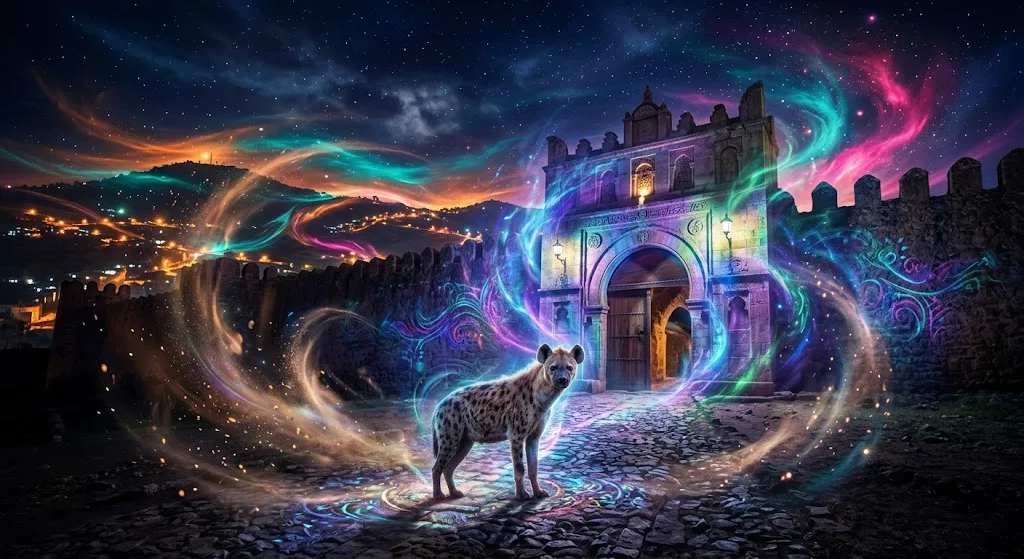
Ethiopia’s mystery-creature tradition is not built around a single Loch Ness-style lake monster or one famous “lost animal”. Its strongest thread is the hyena: real, dangerous, intelligent, noisy, night-walking, socially close to people, and therefore unusually good at becoming a monster in story.
Page outline Jump by section
Ethiopia’s monster map starts with the hyena
The spotted hyena is the creature that most clearly bridges Ethiopian wildlife, folklore and cryptid-style storytelling. It is a real large carnivore, but in Ethiopian and wider Horn of Africa traditions it often carries extra meanings: grave-robber, night caller, witch companion, shapeshifter, spirit-eater, and uneasy neighbour. Modern reporting from Harar describes how hyenas enter the city at night, feed on waste, and have become part of both local belief and tourism; the same account notes that elsewhere in Ethiopia they are often feared in stories of attacks, child-snatching and people with the evil eye turning into hyenas after dark.[The Guardian]theguardian.comOpen source on theguardian.com.
This matters because many “cryptid” reports are not clean claims of unknown animals. They are layered claims: a known animal seen in difficult conditions, a local explanation for misfortune, a moral story about envy or outsiders, and a memorable animal performance all at once. A hyena laughing near a house at night, digging around refuse, crossing graveyards, or dragging livestock away is already dramatic without inventing a new species. Add the animal’s powerful jaws, odd sloping body, bold scavenging and vocal range, and it becomes easy to see why hyenas are repeatedly pulled into monster traditions.
In Ethiopia, the hyena is also socially close. It is not simply a beast “out there” in wilderness. Hyenas enter towns, pass through religious imagination, appear in human-wildlife conflict, and in Harar have even become part of an urban identity. That proximity is the engine of the legend.
The voice-mimicking beast of ancient Ethiopia
One of the oldest creature traditions linked to Ethiopia is the corocotta or leucrocotta, a fabulous beast described by classical writers as a hyena-like or hybrid animal from “Aethiopia” or India. In Pliny’s account, the leucrocotta is a swift, composite beast with a huge mouth and bony ridges instead of normal teeth, said to imitate human voices; another passage describes the corocotta as born from a hyena and an Ethiopian lioness, able to mimic the voices of men and cattle.[Theoi]theoi.comLEUCROCOTTA (LeukrokottasLEUCROCOTTA (Leukrokottas
For modern readers, the important caution is that ancient “Aethiopia” did not always map neatly onto the borders of present-day Ethiopia. Classical authors often used it for lands south of Egypt or the wider imagined African interior. Even so, Ethiopia became one of the places attached to the monster in the European bestiary tradition, and that association helped give the country a long afterlife in monster catalogues.
The likely animal behind much of this is the hyena, especially when filtered through distance and hearsay. Specialist folklore summaries note that ancient writers were often uncertain about whether the corocotta was separate from the hyena at all, and that the creature’s supposed voice-mimicry, bone-crushing power and graveyard associations overlap strongly with old ideas about hyenas.[A Book of Creatures]abookofcreatures.comA Book of Creatures Ethiopia | A Book of CreaturesA Book of Creatures Ethiopia | A Book of Creatures The name of the spotted hyena, Crocuta crocuta, even preserves that classical monster-word in scientific form, a neat reminder that old legend and zoology sometimes share a vocabulary.
The sceptical explanation is not dull. Hyenas really are strange animals to human ears. Their whoops, giggles and calls can sound disconcertingly human in the dark, and their habit of approaching settlements or scavenging human remains in some contexts made them ideal raw material for stories about a beast that calls your name and lures you outside. The monster is probably not an undiscovered Ethiopian animal. It is a literary exaggeration of a real predator that already behaved, to ancient observers, like something between a dog, a wolf, a lion and a speaking demon.

The buda: when the monster is also a person
The most Ethiopia-specific shapeshifting tradition connected to hyenas is the buda complex, often described in English as an evil-eye or werehyena belief. In Amhara material collected by anthropologist Ronald Reminick, people accused of buda power were believed able to change into hyenas, roam at night, attack victims through the evil eye, and conceal their human identity while causing illness or death.[Rights in Exile]rightsinexile.orgRights in Exile The Evil Eye Belief among the Amhara of EthiopiaRights in Exile The Evil Eye Belief among the Amhara of Ethiopia
This is not just a monster tale in the simple sense. It is also a social belief about envy, status, craft labour, outsiders and vulnerability. Reminick’s account presents buda people as socially marked figures associated with manual skills such as smithing, tanning, weaving and pottery, and interprets the belief in relation to inherited status and tensions over land, wealth and social difference.[Rights in Exile]rightsinexile.orgRights in Exile The Evil Eye Belief among the Amhara of EthiopiaRights in Exile The Evil Eye Belief among the Amhara of Ethiopia Marcus Baynes-Rock’s later article on Ethiopian buda as hyenas likewise argues that accounts focused only on “evil eye” miss how important the hyena transformation itself is: the social world in the belief extends beyond humans into animal form.[JSTOR]jstor.orgOpen source on jstor.org.
For a cryptid page, the buda is best treated as folklore and social belief, not as an eyewitness file for a hidden animal. The creature claim is not “there is an unknown hyena species in Ethiopia”. It is that certain people may be more-than-human, able to become hyenas or operate through hyena form. The story answers different questions from zoology: Why did someone fall ill? Who is dangerous? What does envy do? Why are some people feared? Why does the night animal seem to know human business?
That makes the buda tradition darker and more consequential than a campfire monster. Accusations of supernatural harm can stigmatise real communities, and older accounts connect such beliefs with social exclusion. The evidence-aware reading is therefore double: the tradition is culturally important, but it should not be romanticised as harmless fantasy or treated as proof of literal shapeshifting.
Harar’s hyenas: monsters, neighbours and tourist stars
Harar is the clearest place where Ethiopia’s hyena lore can be seen as a living public performance. UNESCO lists Harar Jugol as a fortified historic town inscribed in 2006, with a 48-hectare walled core and a 16th-century surrounding wall; it describes the city as a rare, well-preserved historic town retaining Harari Muslim cultural heritage.[UNESCO World Heritage Centre]whc.unesco.orgWorld Heritage Centre Harar Jugol, the Fortified Historic TownWorld Heritage Centre Harar Jugol, the Fortified Historic Town In that setting, hyenas are not merely animals beyond the walls. They are part of the city’s night-time ecology and folklore.
Recent reporting describes hyenas entering through “hyena doors” in the walls, feeding on entrails and scraps, and acting as a form of informal waste disposal. The same account presents the famous hyena men, including Abbas Yusuf, who feed the animals and invite tourists to watch the encounter.[The Guardian]theguardian.comOpen source on theguardian.com. What makes Harar unusual is not that hyenas approach people — human-wildlife conflict is common in many places — but that a ritualised relationship has grown around their presence.
In Harari belief as reported by scholars and journalists, hyenas may protect people from spirits, communicate with saints, and act as intermediaries between the visible and invisible worlds. The Guardian account records the local idea that hyenas can keep troublesome spirits away, while Notre Dame Magazine’s discussion of Baynes-Rock’s work notes that Harari traditions treat hyenas as spirit-world emissaries and “newsmen” who can carry messages from saints.[The Guardian]theguardian.comOpen source on theguardian.com.
There is also an origin legend of truce rather than conquest. The Harar story says that during famine, hungry hyenas attacked vulnerable people; saints then arranged a pact in which townspeople would feed porridge to the hyenas, ending the attacks. That memory continues in annual porridge offerings, where the amount eaten may be read as an omen for the coming year.[The Guardian]theguardian.comOpen source on theguardian.com.
For visitors, this can look like a staged animal show. For cryptid and folklore readers, it is more interesting than that. Harar shows a monster tradition becoming coexistence: the feared night predator is not debunked, destroyed or banished, but negotiated with. The hyena remains dangerous, yet it also becomes useful, charismatic and symbolically protective.

Ethiopia’s “mystery animals” are often real animals seen through dramatic conditions
Ethiopia has no strong, well-documented national tradition of a single lake monster comparable to Nessie or a widely reported ape-man comparable to Central African forest cryptids. When searches turn up Ethiopian monster material, it clusters instead around hyenas, ancient bestiary creatures, shapeshifters and striking endemic wildlife. That absence is itself useful: it prevents the page from pretending that every country has the same kind of cryptid history.
Several real Ethiopian animals can create cryptid-like impressions without requiring unknown species. Geladas, for example, are large, shaggy, ground-dwelling primates found in the Ethiopian highlands. The Wisconsin National Primate Research Center describes them as stocky primates with heavy male capes of hair, dark faces, pale eyelids and a distinctive red hourglass-shaped chest patch; Africa Geographic notes that they are endemic to Ethiopia’s highlands and sleep on cliff ledges after feeding on high grasslands.[Primate Research Center]primate.wisc.eduOpen source on wisc.edu. A male gelada glimpsed on a cliff, baring teeth and flashing its pale eyelids, is not an unknown ape — but it is certainly a creature that looks built for legend.
The Ethiopian wolf sits in a different category. It is not a cryptid, but it is a rare endemic carnivore that can be mistaken for something more mysterious by outsiders expecting jackals or foxes. An IUCN-linked conservation strategy notes that the Ethiopian wolf has long been recognised in Ethiopia, with an early reference dating to the 13th century or earlier, and that fewer than 500 adult individuals survived when the plan was written, making it the rarest canid and most endangered African carnivore.[portals.iucn.org]portals.iucn.orgOpen source on iucn.org. Its actual conservation story is more important than any monster overlay: a beautiful, highly specialised highland predator reduced to isolated Afroalpine pockets.
Ethiopia’s lakes also offer impressive animals but little strong evidence of a distinct lake-monster tradition. Lake Tana is Ethiopia’s largest lake and a major source of the Blue Nile, while UNESCO’s tentative listing for Lake Tana’s island monasteries emphasises its religious and cultural importance rather than monster reports.[Wikipedia]WikipediaLake TanaLake Tana Farther south, Lake Chamo is known for hippopotamus and Nile crocodiles, both capable of producing frightening water encounters and exaggerated travel stories.[Wikipedia]WikipediaLake ChamoLake Chamo In this context, “lake monster” claims are better approached as misidentification possibilities than as a central Ethiopian legend.
Why Ethiopia’s creature lore became so hyena-shaped
The hyena dominates because it fits several roles at once. It is a scavenger, predator, corpse-handler, night-noise maker, boundary-crosser and settlement visitor. It moves between bush and city, waste and ritual, animal behaviour and moral imagination. Few animals are so well suited to become a cryptid without ceasing to be zoologically real.
There are practical reasons too. Studies of human-livestock predator conflict in Ethiopia list spotted hyena among the predators named by local communities, alongside olive baboon, jackal, aardvark, genet, Ethiopian wolf, lion and leopard.[PMC]pmc.ncbi.nlm.nih.govOpen source on nih.gov. Where livestock, children, night travel and large carnivores overlap, stories become part of risk management. A frightening tale may warn children indoors, explain losses, mark dangerous places, or turn unpredictable animal behaviour into a pattern people can talk about.
The same animal can support opposite meanings. In one village, a hyena may be the feared form of a witch. In Harar, a hyena may be a guardian against spirits. In ancient bestiaries, it becomes a voice-mimicking hybrid. In conservation writing, it is a misunderstood large carnivore with an image problem. These are not contradictions so much as different human answers to the same animal presence.
That is why Ethiopia’s creature tradition rewards an evidence-aware reading. The question is not only “Did the monster exist?” but “What real animal, social fear, landscape feature or ritual relationship made the story plausible?” In Ethiopia, the answer is usually close enough to hear at night.

A fair verdict on Ethiopia’s cryptids
Ethiopia’s strongest cryptid candidates are not hidden species waiting for scientific confirmation. They are folklore-creatures built around known animals, especially hyenas. The corocotta belongs to the ancient and medieval bestiary stream: a real predator inflated into a composite monster through hearsay, distance and literary repetition. The buda belongs to social and religious folklore: a shapeshifting hyena-person tied to evil eye, envy and marginality. Harar’s hyenas belong to living urban tradition: real animals made meaningful through ritual feeding, spirit beliefs, coexistence and tourism.
The sceptical explanation is therefore not a dismissal. It is the more interesting reading. Ethiopia’s monster lore shows how a country’s ecology can shape its imagination. A land of highland wolves, cliff-sleeping geladas, Rift Valley crocodiles and urban hyenas does not need invented dragons to feel strange. Its most memorable “cryptid” is an animal everyone knows exists — which is precisely why the stories have lasted.
Amazon book picks
Further Reading
Books and field guides related to Why Ethiopia's Monsters Keep Returning to Hyenas. Use these as the next step if you want deeper reading beyond the article.
The Mythology Book
Places Ethiopian creature lore within global myth-making traditions.


Monsters: A Bestiary of the Bizarre
Examines legendary creatures and their cultural origins.
African Mythology
Provides context for African supernatural beings, spirits and folklore.
eBay marketplace picks
Marketplace Samples
Live-tested eBay searches with available results related to this page.
Endnotes
1.
Source: theoi.com
Title: LEUCROCOTTA (Leukrokottas)
Link:https://www.theoi.com/Thaumasios/Leukrokotai.html
2.
Source: jstor.org
Link:https://www.jstor.org/stable/24774337
3.
Source: whc.unesco.org
Title: World Heritage Centre Harar Jugol, the Fortified Historic Town
Link:https://whc.unesco.org/en/list/1189/
4.
Source: portals.iucn.org
Link:https://portals.iucn.org/library/efiles/documents/2011-090.pdf
5.
Source: Wikipedia
Title: Lake Tana
Link:https://en.wikipedia.org/wiki/Lake_Tana
6.
Source: whc.unesco.org
Link:https://whc.unesco.org/en/tentativelists/6580/
7.
Source: Wikipedia
Title: Lake Chamo
Link:https://en.wikipedia.org/wiki/Lake_Chamo
8.
Source: pmc.ncbi.nlm.nih.gov
Link:https://pmc.ncbi.nlm.nih.gov/articles/PMC9531451/
9.
Source: Wikipedia
Title: Nandi bear
Link:https://en.wikipedia.org/wiki/Nandi_bear
10.
Source: Wikipedia
Title: Buda (folklore)
Link:https://en.wikipedia.org/wiki/Buda_%28folklore%29
11.
Source: Wikipedia
Link:https://en.wikipedia.org/wiki/Werehyena
12.
Source: Wikipedia
Link:https://en.wikipedia.org/wiki/Crocotta
13.
Source: Wikipedia
Link:https://en.wikipedia.org/wiki/Ethiopia
14.
Source: Wikipedia
Title: Ethiopian wolf
Link:https://en.wikipedia.org/wiki/Ethiopian_wolf
15.
Source: Wikipedia
Link:https://en.wikipedia.org/wiki/Gelada
16.
Source: Wikipedia
Link:https://en.wikipedia.org/wiki/Ethiopians
17.
Source: whc.unesco.org
Link:https://whc.unesco.org/en/activities/158/
18.
Source: jstor.org
Link:https://www.jstor.org/stable/10.5325/j.ctv14gpb8t
19.
Source: jstor.org
Link:https://www.jstor.org/stable/1178757
20.
Source: wolf.org
Link:https://wolf.org/wow/africa/ethiopia/
21.
Source: vocal.media
Title: The Terrifying Beast of Kenya | History
Link:https://vocal.media/history/the-terrifying-beast-of-kenya
22.
Source: theguardian.com
Link:https://www.theguardian.com/environment/2024/apr/05/hyenas-harar-ethiopia-how-city-fell-in-love-with-its-bone-crunching-scavengers-aoe
23.
Source: abookofcreatures.com
Title: A Book of Creatures Ethiopia | A Book of Creatures
Link:https://abookofcreatures.com/category/ethiopia/
24.
Source: rightsinexile.org
Title: Rights in Exile The Evil Eye Belief among the Amhara of Ethiopia
Link:https://rightsinexile.org/wp-content/uploads/2023/04/Reminick-TheEvilEyeBeliefAmongAmharaEthiopia_again.pdf
25.
Source: primate.wisc.edu
Link:https://primate.wisc.edu/primate-info-net/pin-factsheets/pin-factsheet-gelada-baboon/
26.
Source: abookofcreatures.com
Link:https://abookofcreatures.com/tag/river-and-lake-monsters/
27.
Source: abookofcreatures.com
Link:https://abookofcreatures.com/author/abookofcreatures/page/5/
28.
Source: abookofcreatures.com
Link:https://abookofcreatures.com/2021/02/22/corocotta/
29.
Source: mythus.fandom.com
Link:https://mythus.fandom.com/wiki/Werehyena
30.
Source: monster.fandom.com
Link:https://monster.fandom.com/wiki/Corocotta
31.
Source: hararhyenas.wordpress.com
Link:https://hararhyenas.wordpress.com/about/
32.
Source: youtube.com
Link:https://www.youtube.com/watch?v=alzoYpjRZCU
33.
Source: youtube.com
Link:https://www.youtube.com/watch?v=tw_qVmfceu0
34.
Source: clivebest.com
Title: Lake Tana
Link:https://clivebest.com/?p=126
35.
Source: theguardian.com
Link:https://www.theguardian.com/world/ethiopia
36.
Source: twlethiopia.org
Title: lake tana
Link:https://twlethiopia.org/blog/2010/05/28/lake-tana/
37.
Source: worldbank.org
Link:https://www.worldbank.org/ext/en/country/ethiopia
38.
Source: GOV.UK
Link:https://www.gov.uk/foreign-travel-advice/ethiopia
39.
Source: dgwildlife.com
Title: Ethiopian Wolf
Link:https://www.dgwildlife.com/blog/2019/6/ethiopian-wolf
40.
Source: aljazeera.com
Link:https://www.aljazeera.com/where/ethiopia/
Additional References
41.
Source: youtube.com
Title: Ethiopia’s Hyena Man – The Wildest Person I’ve Ever Met
Link:https://www.youtube.com/watch?v=s6BTw5UD8Hg
Source snippet
Feeding Wild Hyenas with My Bare Hands in Harar, Ethiopia...
42.
Source: youtube.com
Title: Feeding time with Harar’s Hyena Man
Link:https://www.youtube.com/watch?v=90kQAREM6jc
Source snippet
Facing the most Dangerous bite in the world | Hynea feeding in Harar,Ethiopia ENG SUBS...
43.
Source: youtube.com
Title: Harar’s Hyenas
Link:https://www.youtube.com/watch?v=YYhF_N_oRNU
Source snippet
Ethiopia's Hyena Man – The Wildest Person I've Ever Met...
44.
Source: facebook.com
Link:https://www.facebook.com/AllureEthiopia/videos/didyouknowdid-you-know-these-ancient-mythical-creatures-of-ethiopiaalluredyk-myt/481531790503213/
45.
Source: researchgate.net
Link:https://www.researchgate.net/publication/289474851_How_the_ancient_krokottas_evolved_into_the_modern_spotted_hyena_crocuta_crocuta
46.
Source: tourhq.com
Link:https://www.tourhq.com/tours/108945/3-days-harar-tour
47.
Source: facebook.com
Link:https://www.facebook.com/BBCCymruWales/videos/hippos-take-on-crocodiles-for-best-sunbathing-spot-serengeti-bbc/4014675985332731/
48.
Source: messybeast.com
Link:https://messybeast.com/genetics/anomalous-bigcats.html
49.
Source: ethioembassy.ca
Link:https://ethioembassy.ca/about-ethiopia/
50.
Source: psupress.org
Link:https://www.psupress.org/books/titles/978-0-271-06720-9.html?srsltid=AfmBOooOxb2ehY3G1ND7eFS2dtO8yLs15guRZVASX7BCoI2u_sBYmLiU
Topic Tree
Follow this branch
Related pages 192
- Antigua Cryptids
- Maldives Monsters
- Malta Monsters
- Qatar Monsters
- Argentina Monsters
- +187 more in sidebar