Cryptids of Tunisia's Stories and Landscapes
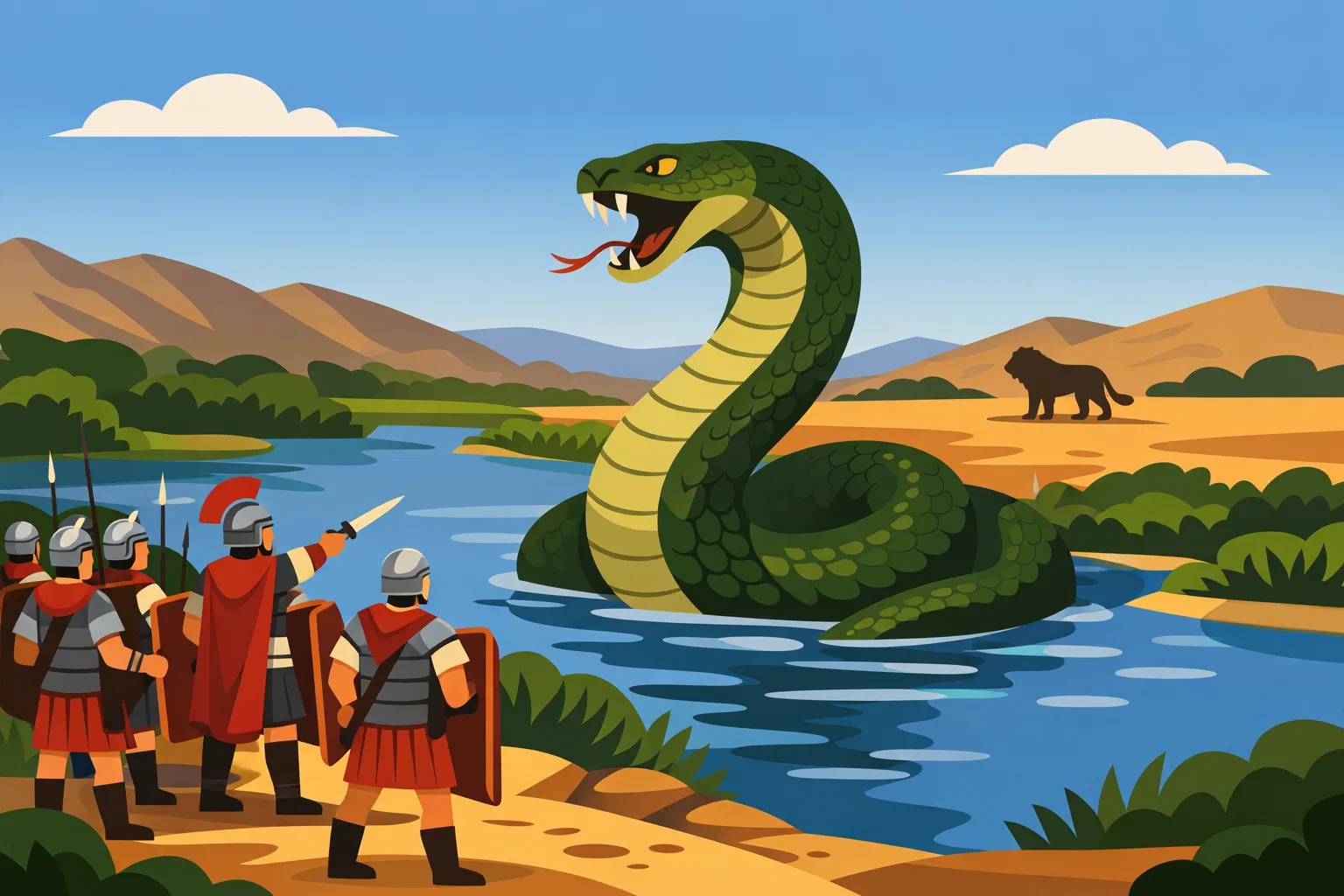
Tunisia does not have a modern cryptid tradition on the scale of Scotland’s Loch Ness Monster or North America’s Bigfoot. Its strongest mystery-beast story is far older: an enormous serpent allegedly fought by a Roman army beside the Bagradas, now the Medjerda River, during the First Punic War.
Page outline Jump by section
Introduction
Beyond that famous tale, Tunisia’s monster history is scattered across oral folklore, memories of vanished predators and occasional media excitement over unfamiliar animals or strange landscapes. The evidence is correspondingly uneven. Ancient authors wrote centuries after the supposed serpent incident; folktale monsters belong to storytelling rather than zoology; and modern “mysteries” usually lack specimens, sustained witness records or independent investigation. Tunisia is therefore most interesting not as a hidden-animal hotspot, but as a place where real wildlife, historical exaggeration and inherited monster imagery repeatedly overlap.
Tunisia’s great monster story: the Bagradas serpent
The story is set during Rome’s invasion of Carthaginian territory in about 256 BC. According to later Roman accounts, the army of Marcus Atilius Regulus camped beside the Bagradas River and encountered a serpent so large that it blocked access to the water. Ordinary missiles supposedly failed against it, forcing the soldiers to use stone-throwing artillery. Some versions claimed that the animal seized men in its mouth, crushed others with its tail and was killed only after a prolonged battle.
Aulus Gellius, writing in the second century AD, attributed the story to an earlier historian and said that the serpent’s skin measured 120 Roman feet and was sent to Rome. Valerius Maximus likewise described a creature capable of keeping an entire army away from the river. Florus made the symbolism even clearer, presenting the monster almost as a supernatural defender of Africa against the Roman invasion. Cassius Dio, or the later summary preserving his account, also repeated the story of an immense river serpent.[ToposText]topostext.orgOpen source on topostext.org.
The location is not imaginary. The ancient Bagradas is generally identified with Tunisia’s Medjerda, a major river flowing through the fertile north of the country towards the Gulf of Tunis. The monster episode therefore belongs to a recognisable landscape close to the central theatre of the First Punic War rather than to a vague African wilderness.[ToposText]topostext.orgBagradas river (Libya)§11.13 Now while Regulus was encamped beside the Bagradas river, there appeared a serpent of huge bulk, th…
What did the ancient writers mean by a dragon?
Calling the creature the “Bagradas Dragon” can be misleading to modern readers. The Latin accounts generally describe a serpent, while the Greek term later attached to it could mean a very large snake rather than a winged, fire-breathing reptile. Ancient Mediterranean dragons were often imagined as oversized serpents guarding springs, rivers, treasure or sacred ground.
That makes the story less like a medieval dragon hunt and more like an exaggerated dangerous-animal encounter. Its structure nevertheless contains all the ingredients of a monster legend: a blocked water source, an enemy too powerful for normal weapons, multiple human casualties and a trophy carried to the imperial capital. Modern retellings often emphasise those dramatic features while giving less attention to the long gap between the alleged event and the surviving texts.[Ancient World Magazine]ancientworldmagazine.comregulus bagradas dragonThat said, the descriptions we have make it out to be a large snake-like…Read more…

Could a real snake explain the story?
A real snake may lie somewhere behind the tradition, but the measurements cannot be accepted at face value. A skin 120 Roman feet long would represent an animal roughly 35 metres in length, far beyond any confirmed snake. Even Africa’s largest living snakes are only a fraction of that size.
The African rock python can exceed six metres in exceptional cases, but its established modern distribution is overwhelmingly south of the Sahara. Tunisia’s documented reptile fauna is diverse, including more than 20 snake species in one modern conservation assessment, yet it contains no native giant python capable of matching the ancient description.[Animal Diversity Web]animaldiversity.orgPython sebaePython sebae
Several possibilities remain:
- An unusually large snake was exaggerated. A memorable encounter could have grown with each retelling, particularly if the original animal attacked livestock or soldiers near water.
- The skin was stretched or wrongly measured. Preserved snake skins can be lengthened during removal and preparation, while ancient numerical claims often served rhetorical rather than scientific purposes.
- Several incidents became one story. Deaths from drowning, snakebite, crocodile stories from farther south or ordinary wartime losses may have been combined into a single dramatic episode.
- The account was literary invention. Roman authors regularly used prodigies and monsters to show that heroes had overcome both human enemies and hostile nature.
The possibility of a real animal cannot be eliminated, because the earliest version of the story is lost. Yet the extraordinary length, the battle-like behaviour and the late surviving accounts make a literal interpretation highly unlikely. The best reading is a legendary enlargement of either an animal encounter or a wartime anecdote, reshaped to glorify Roman endurance. A modern historical review reaches a similar conclusion: the creature is described as a legless snake, but its reported scale belongs to storytelling rather than credible zoological observation.[Ancient World Magazine]ancientworldmagazine.comregulus bagradas dragonThat said, the descriptions we have make it out to be a large snake-like…Read more…
Folklore monsters are not unidentified animals
Tunisia also shares in the broader North African tradition of ogres, dangerous wilderness beings and enchanted animals. These figures appear in oral tales as child-eaters, deceptive strangers, animal spouses or inhabitants of caves and isolated country. They are culturally important, but they should not automatically be relabelled as cryptids.
The distinction matters because a folktale monster does not normally begin with a claim that an unknown biological species has been observed. It exists within a narrative world where humans marry animals, magical transformations occur and heroes survive impossible trials. One published selection inspired by Tunisian oral culture, for example, includes the story of a woman who lives with a lion possessing strikingly human-like eyes. The interest lies in the boundary between civilisation and wildness, not in evidence for a half-human lion.[Google Books]books.google.comOpen source on google.com.
Tunisian storytelling was also carried into twentieth-century broadcasting. The journalist, playwright and popular storyteller Abdelaziz El-Aroui helped transmit folktales through radio and television, allowing village-style oral narratives to reach a national audience. That process preserved traditional plots but also detached them from any single locality, making it difficult to treat recurring monsters as reports of specific creatures seen in specific places.[ResearchGate]researchgate.netResearch Gate The Immortality of Folktales by Abdelaziz El-ArouiResearch Gate The Immortality of Folktales by Abdelaziz El-Aroui
In cryptid discussions, three categories are therefore best kept separate:
Folklore beings belong to inherited stories and may change form from one teller to another.
Historical monster claims describe an alleged event, such as the Bagradas serpent, but survive through uncertain or late documentation.
Mystery-animal reports begin with a claimed observation of an unfamiliar living creature and require evidence such as photographs, tracks, remains or consistent independent testimony.
Tunisia has rich material in the first category, one outstanding example in the second, but little well-documented evidence in the third.

When extinct wildlife starts to look legendary
Some Tunisian “phantom beast” possibilities are better understood through the disappearance of real animals. Lions once inhabited the forests, mountains and scrublands of the Maghreb, including northern Tunisia. Historical research suggests that persecution, habitat pressure and firearms sharply reduced the North African population during the nineteenth century. Reports indicate that lions had disappeared from Tunisia by around the end of that century, although rumours of survivors continued into the early twentieth century.[PMC]pmc.ncbi.nlm.nih.govPMCExamining the Extinction of the Barbary Lion and ItsPMCExamining the Extinction of the Barbary Lion and Its
This creates ideal conditions for lingering mystery stories. After an animal becomes extremely rare, people may continue to report it for years. Some witnesses may genuinely glimpse the last survivors; others may mistake dogs, jackals or smaller wild cats seen at poor angles. Memory also tends to preserve the dramatic animal more strongly than the date on which it vanished.
The same caution applies to claims of large cats in modern Tunisia. The country still has elusive carnivores and wild felids, while nocturnal observation, distance and unfamiliar scale can make an ordinary animal appear much larger. A fleeting sighting is therefore not meaningless, but it is not enough to establish that a lost lion population or unknown “phantom cat” survives.
This is one reason historical ecology is valuable to cryptid study. Old reports sometimes contain genuine information about species whose former ranges were wider than they are today. At the same time, the existence of lions in nineteenth-century Tunisia does not make every later big-cat story true. It provides a plausible cultural memory, not proof of survival.
Strange places without resident monsters
Tunisia’s most internationally reported modern natural mystery was not an animal but a body of water. In 2014, shepherds discovered a lake near Gafsa in an arid, phosphate-mining region. Its sudden appearance attracted swimmers and international headlines, while the water later changed from turquoise to green. Suggested explanations included groundwater reaching the surface, geological disturbance and accumulated rainwater; concerns were also raised about stagnation and possible contamination connected with the surrounding phosphate deposits.[theguardian.com]theguardian.comOpen source on theguardian.com.
The episode shows how quickly an unusual landscape can acquire the language of miracle, curse and mystery. Yet no substantial lake-monster tradition followed. There was no long-running sequence of creature sightings, no recurring description and no physical evidence. Treating the Gafsa lake itself as a Tunisian cryptid case would therefore confuse an unexplained environmental event with an alleged unknown animal.
The same principle applies to unusual marine animals appearing off Tunisia’s long Mediterranean coast. Large sharks, whales, rays, decomposing carcasses and deep-water fish can look monstrous when seen briefly or out of context. Without a recoverable specimen or clear imagery, online captions such as “mysterious creature found in Tunisia” provide very little evidential value. Social-media reposts commonly strip away the date, location and eventual identification that would allow a report to be checked.
Why Tunisia has no modern monster hotspot
No Tunisian lake, mountain or coastal district has developed a sustained, well-documented creature flap comparable to famous cryptid locations elsewhere. Several factors may explain the difference.
First, the country’s strongest monster story is anchored in antiquity rather than modern eyewitness culture. The Bagradas serpent is retold through classical history, not through local expeditions, tourist cruises or annual sighting seasons.
Second, Tunisia’s oral monsters are usually supernatural characters rather than supposedly undiscovered animals. Their purpose is moral, entertaining or cautionary. Asking for tracks and DNA misses the role they play in the story.
Third, modern reports are fragmented. A strange photograph or animal video may circulate briefly, but without a stable creature name, repeated location and archive of testimony, it rarely becomes a national legend.
Finally, Tunisia’s environments already contain animals capable of producing startling encounters. The country’s deserts, wetlands, forests and Mediterranean waters support snakes, wild cats, jackals, sharks and many less familiar species. The IUCN-backed assessment of one northern coastal region alone illustrates the breadth of Tunisia’s reptile life, while protected landscapes such as El Feija contain forest habitats quite unlike the stereotypical image of an entirely barren country.[IUCN Portals]portals.iucn.orgOpen source on iucn.org.
That ecological variety encourages mystery, but it also supplies ordinary explanations.
How the evidence should be judged
The Bagradas serpent deserves its place among the world’s great historical monster stories, but not because it proves that a gigantic unknown reptile lived in Tunisia. Its importance comes from the way an alleged animal encounter became military history, imperial propaganda and eventually dragon lore.
A sensible assessment asks four questions:
- How close is the source to the event? The surviving detailed accounts are much later than the First Punic War.
- Is the anatomy biologically plausible? A 35-metre land snake is not supported by zoological evidence.
- Does independent evidence survive? The reported skin, bones and original contemporary account are unavailable.
- Does the story serve a literary purpose? The serpent turns the Tunisian landscape itself into an opponent worthy of Roman conquest.
On that basis, the monster is best classed as a historical legend possibly built around a real snake, rather than as evidence for a lost species.
Tunisia’s wider mystery-beast tradition follows the same evidence-aware pattern. Ogres and enchanted animals belong to folklore; post-extinction lion rumours occupy the uncertain border between memory and misidentification; strange carcasses and viral clips require documentation before they become meaningful cases. The country’s monsters are most revealing when treated not as a hidden zoological catalogue, but as stories about dangerous nature, vanished wildlife and the human habit of enlarging the unfamiliar.
Amazon book picks
Further Reading
Books and field guides related to What Monsters Haunt Tunisia's Stories and Landscapes?. Use these as the next step if you want deeper reading beyond the article.
The Punic Wars
Explains the historical setting behind Tunisia's most famous monster story.
The Histories
Provides essential background on North Africa, antiquity and legendary accounts.
Endnotes
1.
Source: topostext.org
Link:https://topostext.org/work.php?work_id=208
2.
Source: topostext.org
Link:https://topostext.org/work/871
Source snippet
Valerius Maximus, Memorable Words and Deeds (Val.Max.)For he says that upon the banks of the river Bagradas in Africa, so great...
3.
Source: topostext.org
Link:https://topostext.org/work/559
Source snippet
Florus, Epitome of Roman History (Flor.)... serpent of wondrous size, which seemed to have been created for the defence of Afric...
4.
Source: topostext.org
Link:https://topostext.org/work/219
Source snippet
Dio Cassius, Histories (DC)§ 11.13 Now while Regulus was encamped beside the Bagradas river, there appeared a serpent of huge bu...
5.
Source: topostext.org
Link:https://topostext.org/place/370100WBag
Source snippet
Bagradas river (Libya)§11.13 Now while Regulus was encamped beside the Bagradas river, there appeared a serpent of huge bulk, th...
6.
Source: portals.iucn.org
Link:https://portals.iucn.org/library/sites/library/files/documents/2021-008-En.pdf
7.
Source: books.google.com
Link:https://books.google.com/books/about/Sabra_and_Sultan.html?id=UwgtngEACAAJ
8.
Source: researchgate.net
Title: Research Gate The Immortality of Folktales by Abdelaziz El-Aroui
Link:https://www.researchgate.net/publication/359941223_The_Immortality_of_Folktales_by_Abdelaziz_El-Aroui
9.
Source: pmc.ncbi.nlm.nih.gov
Title: PMCExamining the Extinction of the Barbary Lion and Its
Link:https://pmc.ncbi.nlm.nih.gov/articles/PMC3616087/
10.
Source: researchgate.net
Title: 266755974 The North African Barbary lion and the Atlas Lion Project
Link:https://www.researchgate.net/publication/266755974_The_North_African_Barbary_lion_and_the_Atlas_Lion_Project
11.
Source: researchgate.net
Link:https://www.researchgate.net/publication/8225997_Ancient_Scientific_Basis_of_the_Great_Serpent_from_Historical_Evidence
12.
Source: researchgate.net
Link:https://www.researchgate.net/publication/338227469_Effects_of_restoration_habitats_on_snake_species_of_Dghoumes_National_Park_Tunisia
13.
Source: researchgate.net
Title: 375552581 Biodiversity in Tunisia Fauna Flora threats and solutions
Link:https://www.researchgate.net/publication/375552581_Biodiversity_in_Tunisia_Fauna_Flora_threats_and_solutions
14.
Source: researchgate.net
Link:https://www.researchgate.net/profile/Zakher-Bouragaoui/publication/333799016_Biodiversity_survey_in_the_Medjerda_river_at_the_mouth_of_the_artificial_lake_Sidi_Salem_dam/links/5d04cfc4299bf12e7be09344/Biodiversity-survey-in-the-Medjerda-river-at-the-mouth-of-the-artificial-lake-Sidi-Salem-dam.pdf
15.
Source: researchgate.net
Title: Actual characteristics of the Gafsa lake Hamed et al 2014 fig3 323278175
Link:https://www.researchgate.net/figure/Actual-characteristics-of-the-Gafsa-lake-Hamed-et-al-2014_fig3_323278175
16.
Source: portals.iucn.org
Title: WCMC 008
Link:https://portals.iucn.org/library/sites/library/files/documents/WCMC-008.pdf
17.
Source: portals.iucn.org
Link:https://portals.iucn.org/library/sites/library/files/documents/1990-009.pdf
18.
Source: portals.iucn.org
Link:https://portals.iucn.org/library/sites/library/files/documents/1987-030.pdf
19.
Source: folktales.africa
Link:https://folktales.africa/category/african-folktales/north-african-folktales/tunisian-folktales/
20.
Source: ancientworldmagazine.com
Title: regulus bagradas dragon
Link:https://www.ancientworldmagazine.com/articles/regulus-bagradas-dragon/
Source snippet
That said, the descriptions we have make it out to be a large snake-like...Read more...
21.
Source: animaldiversity.org
Title: Python sebae
Link:https://animaldiversity.org/accounts/Python_sebae/
22.
Source: theguardian.com
Link:https://www.theguardian.com/world/2014/aug/01/mysterious-lake-tunisian-desert-turquoise-green-sludge
23.
Source: independent.co.uk
Link:https://www.independent.co.uk/travel/africa/mystery-as-lake-appears-in-middle-of-tunisian-desert-and-becomes-overnight-tourist-attraction-9642769.html
24.
Source: attalus.org
Link:https://www.attalus.org/names/r/regulus.html
25.
Source: mammalwatching.com
Link:https://www.mammalwatching.com/gd_place/tunisia/
26.
Source: pmc.ncbi.nlm.nih.gov
Link:https://pmc.ncbi.nlm.nih.gov/articles/PMC10533143/
Additional References
27.
Source: Wikipedia
Link:https://en.wikipedia.org/wiki/Battle_of_the_Bagradas_River_%28255_BC%29
Source snippet
army led by Xanthippus over a Roman army led by Marcus...
28.
Source: youtube.com
Title: The Horrific Death Of Marcus Atilius Regulus || Dark History
Link:https://www.youtube.com/watch?v=379SwLBeQjk
Source snippet
Rome Hunted Dragons to Extinction — Then Cuvier Decided They Had Never Existed...
29.
Source: youtube.com
Title: Rome Hunted Dragons to Extinction — Then Cuvier Decided They Had Never Existed
Link:https://www.youtube.com/watch?v=bRLh4DOdaAI
Source snippet
The battle of the Bagradas River (255 BCE)...
30.
Source: youtube.com
Title: Battles of Utica and Bagradas 49 BC
Link:https://www.youtube.com/watch?v=HKTijnPauSw
Source snippet
Battle of the Bagradas 49 BC documentary...
31.
Source: academia.edu
Link:https://www.academia.edu/96983852/Womens_oral_narratives_in_Tunis
32.
Source: facebook.com
Link:https://www.facebook.com/weirdohistoryfacts/posts/a-wild-barbary-lion-seen-for-the-last-time-on-camera-in-1925-by-marcelin-flandri/1415944266554633/
33.
Source: facebook.com
Link:https://www.facebook.com/LovinMalta/posts/a-great-white-shark-has-been-recorded-in-the-mediterranean-sea-in-what-is-believ/1439825771519270/
34.
Source: animalsurvival.org
Link:https://animalsurvival.org/climate-change/a-rare-and-mysterious-creature-has-just-been-detected-in-a-remote-kenyan-forest/
35.
Source: scienceblogs.com
Link:https://scienceblogs.com/tetrapodzoology/2010/04/17/esc-sea-monster-poster
36.
Source: folkculturebh.org
Link:https://www.folkculturebh.org/en/index.php?id=1061&issue=47&page=article
Topic Tree
Follow this branch
Related pages 192
- Antigua Cryptids
- Maldives Monsters
- Malta Monsters
- Qatar Monsters
- Argentina Monsters
- +187 more in sidebar