Within PNG Mystery Beasts
Why Does Papua New Guinea Feel Like Cryptid Country?
Remote habitats and real species discoveries make mystery animals feel plausible, but folklore and ecology set firm limits on giant-creature claims.
On this page
- Remoteness, biodiversity and real discoveries
- Local spirits, languages and changing meanings
- Why large hidden animals would leave traces
Page outline Jump by section
Introduction
Papua New Guinea often feels like the perfect setting for monster stories. Vast rainforests, isolated mountain valleys, volcanic islands and thousands of lakes create an image of a place where almost anything might still be hiding. That impression is strengthened by a remarkable scientific fact: new species continue to be discovered across New Guinea, sometimes in areas that have received little biological study. More than 1,000 previously unknown species were documented on the island between 1998 and 2008 alone.[WWF Panda]wwf.panda.orgwwf newsMore than 1000 new species found in New Guinea | WWF27 Jun 2011 — A remarkable 1060 new species have been discovered the island…
Yet the same conditions that make mystery-animal stories feel plausible also explain why they flourish. Papua New Guinea combines genuine biological surprises, immense geographical complexity and hundreds of distinct cultural traditions. The result is not necessarily evidence for giant unknown beasts. Instead, it is a landscape where folklore, eyewitness reports, media stories and real wildlife discoveries frequently overlap.
Why Does Papua New Guinea Feel Like Cryptid Country?
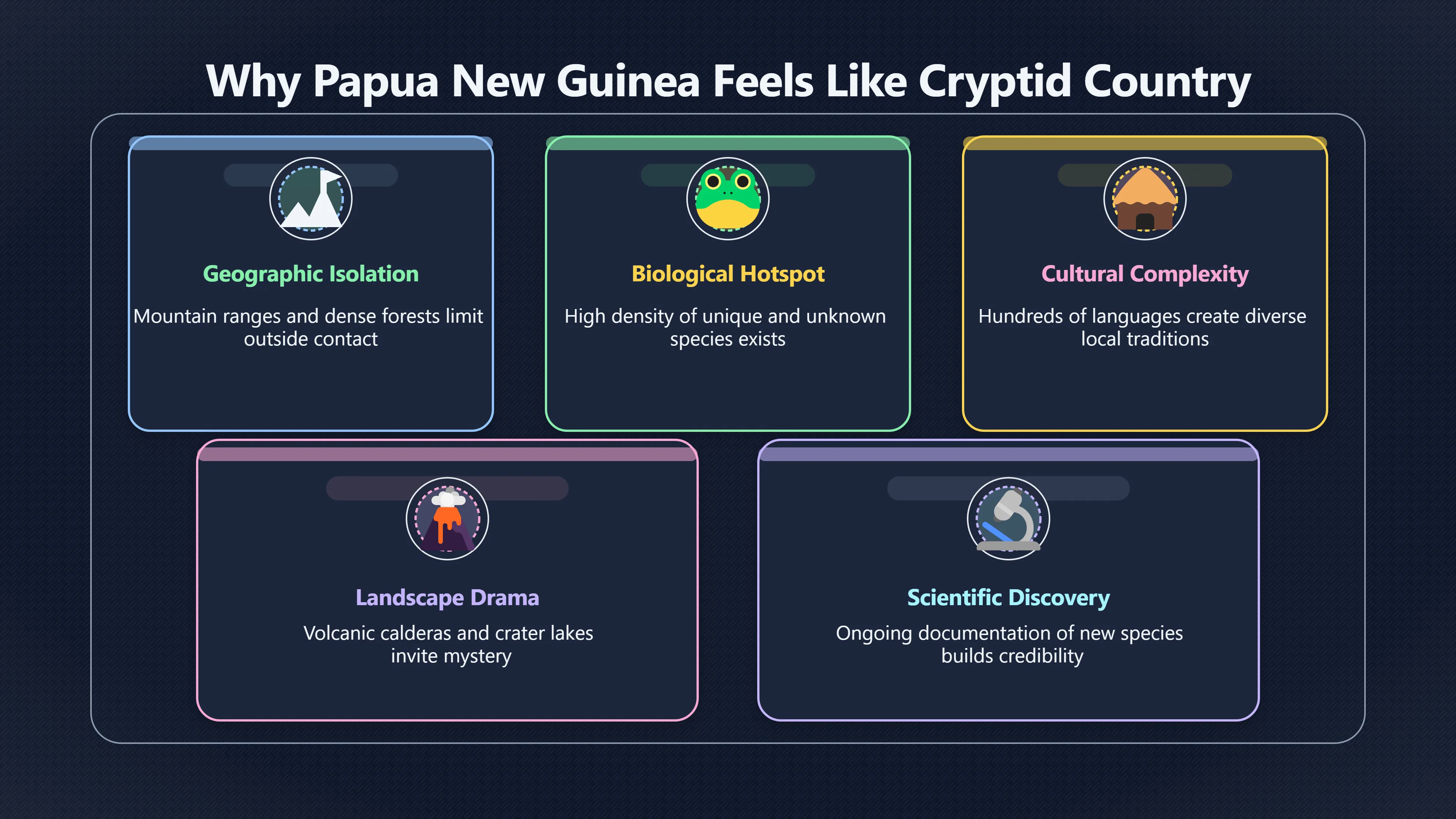
The country possesses many of the ingredients that encourage mystery-animal traditions.
Large parts of Papua New Guinea remain difficult to reach. Mountain ranges divide communities, river systems cut through enormous forests and many islands have historically had limited outside contact. For outsiders, these places can appear mysterious simply because they are unfamiliar.
At the same time, New Guinea is one of the world’s great biodiversity hotspots. Conservation organisations and researchers regularly highlight the island’s exceptional number of unique species and its continuing role as a frontier for biological discovery.[panda.org]wwf.panda.orgwwf newsMore than 1000 new species found in New Guinea | WWF27 Jun 2011 — A remarkable 1060 new species have been discovered the island…
This creates an important psychological effect. When people hear that scientists are still finding unknown frogs, insects, fish or mammals, it becomes easier to imagine that much larger creatures might also have escaped detection. Stories about the ropen, lake monsters or hidden forest creatures gain an extra layer of credibility because they are attached to a place where genuine discoveries really do happen.
However, there is a crucial distinction between an overlooked small species and a large undiscovered animal. The first is common in biological history. The second is much harder to support.

Remoteness, Biodiversity and Real Discoveries
One reason Papua New Guinea generates so many monster stories is that reality occasionally resembles adventure fiction.
Scientists have repeatedly documented species that were previously unknown to science across New Guinea. New species continue to emerge from rainforest surveys, mountain expeditions and marine research programmes.[panda.org]wwf.panda.orgwwf newsMore than 1000 new species found in New Guinea | WWF27 Jun 2011 — A remarkable 1060 new species have been discovered the island…
Recent rediscoveries have reinforced this image. Researchers working in the wider New Guinea region have confirmed animals that were thought extinct or known only from fragmentary evidence, including rare marsupials found in remote forests.[theguardian.com]theguardian.comThese “Lazarus taxa” include the pygmy long-fingered possum (Dactylonax kambuayai) and a newly classified species of ring-tailed glider (…
For the public, discoveries like these blur the boundary between science and legend. If a rare possum or shark can remain unnoticed for decades, some people ask why a larger mystery creature could not do the same.
The answer lies in scale.
Small animals can survive in specialised habitats, occur at low densities and leave limited evidence. Large animals require extensive food resources, breeding populations and ecological space. They interact with their environment in ways that are difficult to hide. The bigger the proposed creature becomes, the harder its long-term concealment becomes.
This tension explains much of Papua New Guinea’s cryptid culture. The country’s biodiversity makes mystery stories feel possible, even when the specific claims are far less plausible than the real discoveries that inspired them.
A Landscape That Encourages Monster Geography
Monster stories often cluster around dramatic landscapes, and Papua New Guinea has no shortage of them.
Researchers have identified roughly 5,383 freshwater lakes across the country, ranging from tiny floodplain pools to substantial bodies of water. Many lie in remote regions associated with local traditions and occasional monster reports.[Cambridge University Press & Assessment]cambridge.orgOpen source on cambridge.org.
Volcanic calderas, crater lakes, mangrove swamps and isolated islands also provide natural settings for unusual sightings. A glimpse of a crocodile, large fish, floating log, wave pattern or unfamiliar bird can quickly become something more mysterious when observed in a place already associated with local stories.
This does not mean witnesses are inventing what they saw. Rather, people interpret unexpected observations through the cultural and environmental context available to them. In a country famous for unexplored terrain, unusual sightings are more likely to be remembered as potential mysteries.
Local Spirits, Languages and Changing Meanings
Another reason Papua New Guinea breeds monster stories is cultural complexity.
The country contains hundreds of languages and many distinct local traditions. A creature story recorded in one community may have little connection to stories told elsewhere. Yet outside writers have often grouped diverse traditions together under broad labels such as “cryptids” or “mystery beasts.”
This can create misunderstandings.
Many traditional accounts are not intended as zoological descriptions of undiscovered animals. Some refer to spirits, ancestral beings, warnings about dangerous places or stories that carry social and cultural meanings. When these accounts are translated into modern monster language, their original context can be lost.
The famous ropen tradition illustrates this process. Modern cryptozoological interpretations often frame it as evidence for a surviving pterosaur. But local reports, historical retellings and later investigations do not always describe the same thing. Elements from folklore, unusual lights, large flying animals and modern media narratives have become intertwined over time.
In a country with such linguistic and cultural diversity, it is easy for separate traditions to merge into a single monster story once they reach newspapers, documentaries or cryptozoology books.
Why Large Hidden Animals Would Leave Traces
The strongest sceptical argument against many Papua New Guinea monster claims comes from ecology rather than disbelief.
Large animals cannot exist in isolation. A breeding population requires food, habitat and enough individuals to maintain genetic diversity. Such creatures would leave traces that researchers, hunters and local residents could potentially find.
These traces would include:[theguardian.com]theguardian.comThese “Lazarus taxa” include the pygmy long-fingered possum (Dactylonax kambuayai) and a newly classified species of ring-tailed glider (…
- Bones and carcasses.
- Tracks and trails.
- Droppings.
- Feeding damage.
- Nesting or breeding sites.
- Repeated and consistent observations.
Papua New Guinea certainly contains remote areas, but it is not biologically empty. Local communities, researchers, hunters, conservation workers and resource-development projects operate across much of the country. Major unknown animals would likely leave more evidence than the fragmentary reports usually associated with cryptid claims.
This is particularly important because Papua New Guinea lacks the kind of large native terrestrial mammal diversity seen in parts of Africa or Asia. The country’s fauna is extraordinarily rich, but much of that richness comes from birds, reptiles, amphibians, fish and smaller mammals rather than giant land animals.[pnglng.com]pnglng.comBiodiversity in Papua New GuineaBiodiversity in Papua New Guinea
As a result, the discovery of a new frog, bat or rodent is far more plausible than the existence of a hidden population of giant apes, dinosaurs or enormous unknown predators.
The Real Secret Behind the Stories
Papua New Guinea does not produce monster stories because it is a forgotten prehistoric world. It produces them because it sits at the intersection of three powerful forces.
First, it is genuinely one of the most biologically fascinating places on Earth, where new species and surprising rediscoveries still occur.[panda.org]wwf.panda.orgwwf newsMore than 1000 new species found in New Guinea | WWF27 Jun 2011 — A remarkable 1060 new species have been discovered the island…
Second, its geography encourages mystery. Remote forests, isolated islands and thousands of lakes naturally invite speculation about what might exist beyond familiar routes and settlements.[Cambridge University Press & Assessment]cambridge.orgOpen source on cambridge.org.
Third, its immense cultural diversity provides a rich collection of local traditions that can be reshaped, misunderstood or reinterpreted as monster narratives by outsiders.
Together, those factors make Papua New Guinea feel like cryptid country. The mystery is real, but it is usually the mystery of biodiversity, folklore and human storytelling rather than evidence for giant hidden beasts. The country’s greatest wonders are not necessarily the creatures people imagine may exist, but the extraordinary wildlife and traditions that unquestionably do.
Amazon book picks
Further Reading
Books and field guides related to Why Does Papua New Guinea Feel Like Cryptid Country?. Use these as the next step if you want deeper reading beyond the article.
Field Guide To Bigfoot, Yeti, & Other Mystery Primates Worldwide
Places Papua New Guinea stories within a global tradition.
New Guinea Tapeworms and Jewish Grandmothers
Demonstrates why New Guinea is associated with biological discovery.
eBay marketplace picks
Marketplace Samples
Live-tested eBay searches with available results related to this page.


Endnotes
1.
Source: wwf.panda.org
Title: wwf news
Link:https://wwf.panda.org/wwf_news/?200786%2FMore-than-1000-new-species-found-in-New-Guinea=
Source snippet
More than 1000 new species found in New Guinea | WWF27 Jun 2011 — A remarkable 1060 new species have been discovered the island...
2.
Source: solutions-site.org
Link:https://www.solutions-site.org/node/516
Source snippet
Over 1000 Species Newly Discovered In New Guinea27 Jun 2011 — Final Frontier: Newly Discovered species of New Guinea (1998 – 2008), a WWF...
3.
Source: cambridge.org
Link:https://www.cambridge.org/core/journals/journal-of-tropical-ecology/article/freshwater-lakes-of-papua-new-guinea-an-inventory-and-limnological-review/1A3DF15EAF9A42D192CC290FB9F8B51B
4.
Source: pnglng.com
Title: Biodiversity in Papua New Guinea
Link:https://www.pnglng.com/media/PNG-LNG-Media/Files/Environment/Biodiversity%20strategy/1284_67_Ch01_Part2.pdf
5.
Source: pnglng.com
Link:https://www.pnglng.com/media/PNG-LNG-Media/Files/Environment/Biodiversity%20strategy/1284_67_BS_Rev_2_final.pdf
6.
Source: cambridge.org
Title: freshwater lakes of papua new guinea an inventory and limnological review
Link:https://www.cambridge.org/core/services/aop-cambridge-core/content/view/1A3DF15EAF9A42D192CC290FB9F8B51B/S0266467400001073a.pdf/freshwater_lakes_of_papua_new_guinea_an_inventory_and_limnological_review.pdf
7.
Source: dicf.unepgrid.ch
Link:https://dicf.unepgrid.ch/papua-new-guinea/biodiversity
Source snippet
Interactive Country FichesBiodiversity / Papua New GuineaWhile occupying only 1% of the world's land mass, PNG hosts almost 7% of the wor...
8.
Source: couriermail.com.au
Link:https://www.couriermail.com.au/news/queensland/new-walking-shark-species-discovered-and-named-after-surprised-australian-academic/news-story/3fd8268d0c8bc516cb8463d9c5e3c99b
Source snippet
Christine Dudgeon from the University of the Sunshine Coast (UniSC), who captured the first specimen. This nocturnal, metre-long species...
9.
Source: theguardian.com
Link:https://www.theguardian.com/environment/2026/mar/05/marsupials-discovered-new-guinea
Source snippet
These “Lazarus taxa” include the pygmy long-fingered possum (Dactylonax kambuayai) and a newly classified species of ring-tailed glider (...
10.
Source: livescience.com
Link:https://www.livescience.com/animals/land-mammals/scientists-find-2-marsupial-species-thought-to-have-gone-extinct-6-000-years-ago-living-in-the-forests-of-new-guinea
Source snippet
This confirmation follows 27 years of investigation since initial clues surfaced in 1999. These "Lazarus taxa" were known only from ancie...
11.
Source: theguardian.com
Title: new guinea new species wwf
Link:https://www.theguardian.com/environment/2011/jun/26/new-guinea-new-species-wwf
Additional References
12.
Source: thetimes.com
Link:https://www.thetimes.com/world/asia/article/the-jungle-indiana-jones-and-his-larazus-revival-of-lost-marsupials-vnzgkfk0d
Source snippet
Flannery’s multi-year quest involved collaborating with local tribes who protected the glider due to its cultural significance. His team...
13.
Source: cbd.int
Title: Convention on Biological Diversity CBD Strategy and Action Plan
Link:https://www.cbd.int/doc/world/pg/pg-nbsap-v2-en.pdf
Source snippet
Convention on Biological DiversityCBD Strategy and Action Plan - Papua New Guinea (...Genetic diversity is the variety of information th...
14.
Source: asianscientist.com
Title: 1000 species discovered in new guinea
Link:https://www.asianscientist.com/2011/06/features/1000-species-discovered-in-new-guinea/
Source snippet
Asian Scientist MagazineNew Guinea Photo Gallery: 1000 New Species Discovered29 Jun 2011 — 29, 2011) – Scientists have found more than 1...
15.
Source: youtube.com
Title: New Species of Cus Cus
Link:http://www.youtube.com/watch?v=3LogVmP7HpA
Source snippet
The Enigma of the Ropen: Could a Living Pterosaur Still Exist in Papua New Guinea?...
16.
Source: youtube.com
Link:http://www.youtube.com/watch?v=MH33ks5IA-w
Source snippet
What's Hidden Under the Jungles of New Guinea?...
17.
Source: youtube.com
Title: Artrellia: Papua New Guinea’s Legendary Giant Dragon
Link:http://www.youtube.com/watch?v=rat6DMOtUko
Source snippet
New Species of CusCus - Lost Land of the Volcano Highlight Episode 3 - BBC...
18.
Source: youtube.com
Title: New Guinea Dinosaurs? | Prehistoric Cryptids In Papua New Guinea
Link:http://www.youtube.com/watch?v=PhhS4KxbnCM
Source snippet
Artrellia: Papua New Guinea’s Legendary Giant Dragon...
19.
Source: youtube.com
Title: What’s Hidden Under the Jungles of New Guinea?
Link:http://www.youtube.com/watch?v=r_RnzEDln8w
Source snippet
New Guinea Dinosaurs? | Prehistoric Cryptids In Papua New Guinea...
20.
Source: facebook.com
Link:https://www.facebook.com/binatangresearch/posts/-new-species-discoveries-by-the-new-guinea-binatang-research-centersince-its-fou/1278122071008786/
21.
Source: fao.org
Link:https://www.fao.org/4/AC080E/AC080e00.htm
Topic Tree