Within Moldova Monsters
Could a Monster Hide in Moldova's Rivers?
Moldova's rivers and reservoirs can distort an animal's apparent size, but no named water monster has produced a consistent sighting record.
On this page
- Why the Dniester and Prut look promising
- Large fish and misleading water sightings
- What a credible recurring case would require
Page outline Jump by section
Introduction
Could a monster hide in Moldova’s rivers? At first glance, the idea seems plausible. The Dniester and Prut are large, sometimes murky waterways bordered by steep banks, wetlands, reservoirs and deep channels. They look exactly like the sort of places where stories about unknown aquatic creatures might thrive. Yet when the available evidence is examined, Moldova’s rivers do not produce anything resembling a consistent “lake monster” tradition. There is no recognised Dniester beast, no famous Prut serpent, and no long-running sequence of sightings describing the same unknown animal.
What does exist is a combination of impressive river scenery, occasional reports of unusually large animals in the water, and genuine fish species capable of appearing startlingly large under the right conditions. The result is a landscape that encourages monster speculation without producing a convincing monster case.
Why the Dniester and Prut Look Promising
The Dniester is one of Eastern Europe’s major rivers, flowing through Ukraine and Moldova before reaching the Black Sea. Its basin includes reservoirs, deep stretches, reed-filled margins and extensive wildlife habitats. The Prut, which forms much of Moldova’s western border, also contains large reservoirs and slow-moving sections where visibility can be poor.[Дністер]dniester-commission.orgДністерThe Dniester basin is located in the territory of three countries – the Republic of Moldova, Poland, and Ukraine. The total length…
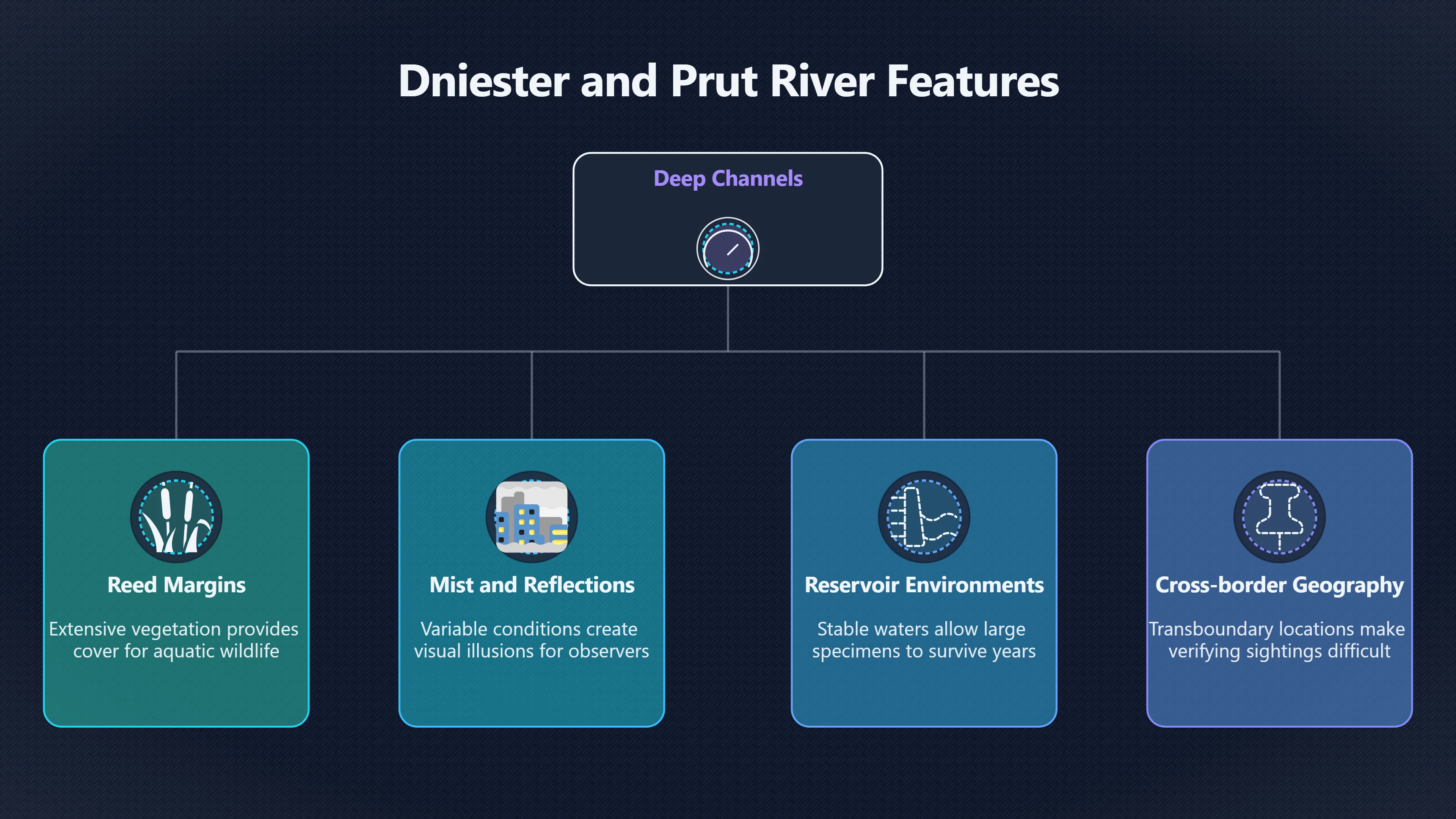
From a monster-story perspective, these rivers possess several ingredients that repeatedly appear in other countries’ legends:
- Large bodies of water where observers cannot easily judge distance or size.
- Variable water conditions, including mist, reflections and floating vegetation.
- Deep channels capable of concealing large fish.
- Cross-border geography that makes stories difficult to verify.
- Reservoir environments where unusually large specimens can survive for many years.
Scotland’s Loch Ness, Canada’s Ogopogo and other famous water-monster locations all benefit from similar visual conditions. The difference is that those places accumulated decades of repeated reports. Moldova’s rivers largely did not.
Searches of available folklore collections, wildlife reporting and modern media produce scattered references to unusual creatures in rivers, but not a stable tradition of recurring sightings tied to a named unknown animal. The story pattern that normally creates a recognised cryptid never fully developed.
Large Fish and Misleading Water Sightings
The most straightforward explanation for many hypothetical river-monster observations is that the Dniester and Prut contain genuinely large fish.
The leading candidate is the wels catfish (Silurus glanis), the largest freshwater fish native to much of Europe. Confirmed specimens can exceed 2.5 metres in length and weigh well over 100 kilograms. Scientific and fisheries sources describe it as Europe’s largest freshwater fish, with verified individuals approaching three metres.[wikipedia.org]WikipediaWels catfishWels catfish
The species is associated with large rivers and reservoirs, exactly the habitats found in Moldova. Modern fishing guides specifically identify the Dniester River, Dubăsari Reservoir and other Moldovan waters as catfish locations.[FishingWorldGuide.com]fishingworldguide.comfishing in moldovaThe Dniester River and Dubăsari Reservoir for catfish, the Prut River and Costești-Stânca…Read more…
A huge catfish seen briefly near the surface can create several illusions:
- A long body may appear serpent-like.
- Multiple fish swimming together can resemble one enormous creature.
- A large fish surfacing repeatedly may look as though it has humps.
- Waves generated by a submerged fish can distort estimates of size.
- Observers viewing from elevated banks may misjudge distance dramatically.
The wels catfish has a particularly monster-friendly appearance. Its broad head, whiskers and dark colouring can look unfamiliar to people who rarely encounter very large freshwater fish. Reports from elsewhere in Europe have repeatedly linked giant catfish to local monster rumours long before a closer examination identified the species.[Wikipedia]WikipediaWels catfishWels catfish
Other ordinary explanations are also available. Large carp, pike, floating logs, swimming mammals, waterfowl seen under unusual conditions and wave effects can all produce fleeting impressions of something much larger than it really is.

The Missing Ingredient: Repeated Testimony
The strongest argument against a Moldovan river monster is not that unusual things have never been seen. It is that the reports do not accumulate into a recognisable pattern.
A credible cryptid case normally develops through repetition. Witnesses in different years describe similar shapes, behaviours and locations. Local newspapers begin covering the reports. Investigators collect photographs, measurements or environmental evidence. Eventually a body of claims emerges that can be compared and challenged.
No equivalent archive appears to exist for either the Dniester or the Prut.
There are no widely cited photographs that have resisted explanation. There are no famous witness clusters centred on a particular bend, reservoir or river reach. There is no well-known creature name recognised across Moldova. Instead, references tend to be isolated anecdotes rather than parts of a continuing record.
This absence matters because large rivers are heavily used environments. The Dniester in particular is a major source of water, transport, recreation and fishing activity. Millions of observations occur around the river over time. If a large unknown aquatic animal were regularly present, one would expect repeated encounters rather than a handful of scattered stories.[REGARD SUR L'EST]regard-est.comthe dniester river a transboundary lifeline for ukraine and moldovaREGARD SUR L'ESTThe Dniester River: a transboundary lifeline for Ukraine and…9 Jun 2025 — The Dniester River runs through Ukraine and…
Why River Monsters Are Harder to Verify Than They Sound
Water is unusually good at creating uncertainty.
Even experienced observers can struggle to estimate the size of an object when only part of it is visible. A fish breaking the surface exposes very little of its body. Waves can connect separate objects into a single perceived shape. Reflections can create the illusion of movement where none exists.
Reservoirs add another complication. Fish often grow larger in productive, relatively stable waters than they do in smaller streams. A genuinely impressive animal may therefore be entirely real while still being misidentified.
This helps explain why river-monster stories frequently remain unresolved. The witness may honestly report seeing something extraordinary, yet the available information never becomes detailed enough to distinguish between an unknown creature and a known species viewed under unusual circumstances.
What a Credible Recurring Case Would Require
For the Dniester or Prut to move from monster folklore into a serious zoological mystery, the evidence threshold would need to rise substantially.
A convincing recurring case would ideally include:
- Multiple independent witnesses reporting similar details over time.
- Clear photographs or video showing scale and movement.
- Consistent descriptions rather than constantly changing appearances.
- Physical traces such as biological samples or identifiable tracks.
- Repeated observations from the same location.
- Evidence that cannot be explained by known fish, mammals, birds or environmental effects.
At present, none of these elements appears in sufficient quantity.
That does not make every unusual sighting worthless. Large rivers remain dynamic places where surprising encounters happen. It simply means that Moldova’s river-monster stories currently belong closer to the category of occasional mystery reports than to the category of established cryptid traditions.

The Verdict on Moldova’s River Monsters
The Dniester and Prut possess all the atmosphere needed for a monster legend: broad waters, deep channels, hidden wildlife and dramatic scenery. They are the sort of rivers where an observer can genuinely glimpse something puzzling.
However, the available record points toward a simple conclusion. Moldova has excellent monster habitat but a weak monster case.
No named aquatic cryptid dominates local tradition, no consistent sighting archive has emerged, and no physical evidence supports the existence of an unknown river creature. The most plausible explanations remain ordinary but impressive animals—especially large fish such as the wels catfish—combined with the well-known ability of rivers to distort what people think they have seen.[wikipedia.org]WikipediaWels catfishWels catfish
In that sense, the Dniester and Prut are not Moldova’s version of Loch Ness. They are better understood as rivers whose real wildlife is already large enough to inspire the occasional monster story.
Amazon book picks
Further Reading
Books and field guides related to Could a Monster Hide in Moldova's Rivers?. Use these as the next step if you want deeper reading beyond the article.
The World of Lore: Monstrous Creatures
Explores water monsters and creature legends from many cultures.
Lake Monster Mysteries
Directly addresses how supposed lake and river monsters are interpreted.
Mysteries of the Unexplained
Contains classic monster and mystery case studies useful for comparison.
eBay marketplace picks
Marketplace Samples
Live-tested eBay searches with available results related to this page.

![Listing image for The Cute Monsters Doll Character Action Figure Collectible Toys [Random Colour]](/assets/images/marketplace-covers/29f5d3d446a0ddba82a6.jpg)

Endnotes
1.
Source: regard-est.com
Title: the dniester river a transboundary lifeline for ukraine and moldova
Link:https://regard-est.com/the-dniester-river-a-transboundary-lifeline-for-ukraine-and-moldova
Source snippet
REGARD SUR L'ESTThe Dniester River: a transboundary lifeline for Ukraine and...9 Jun 2025 — The Dniester River runs through Ukraine and...
2.
Source: Wikipedia
Title: Wels catfish
Link:https://en.wikipedia.org/wiki/Wels_catfish
3.
Source: mdpi.com
Link:https://www.mdpi.com/2410-3888/7/6/325
Source snippet
Movement and Activity Patterns of Non-Native Wels Catfish...by D Nyqvist · 2022 · Cited by 15 — The Wels catfish (Silurus glanis Lin...
4.
Source: fishingworldguide.com
Title: fishing in moldova
Link:https://www.fishingworldguide.com/en/blog/fishing-in-moldova
Source snippet
The Dniester River and Dubăsari Reservoir for catfish, the Prut River and Costești-Stânca...Read more...
5.
Source: dniester-commission.org
Link:https://dniester-commission.org/en/dniester-river-basin/region/
Source snippet
ДністерThe Dniester basin is located in the territory of three countries – the Republic of Moldova, Poland, and Ukraine. The total length...
6.
Source: lifepredator.eu
Title: wels catfish
Link:https://lifepredator.eu/wels-catfish/
Source snippet
· it is the largest freshwater fish species in Europe and in the introduced range, with...
7.
Source: facebook.com
Link:https://www.facebook.com/moldovaexpo2020/videos/-moldova-a-place-to-find-yourselfsheltered-by-two-rivers-the-prut-and-the-dniest/580073236652947/
8.
Source: animalia.bio
Title: Wels catfish
Link:https://animalia.bio/wels-catfish
Additional References
9.
Source: ribarica.eu
Title: In Croatia, they inhabit the entire Danube basin: the Sava,
Link:https://ribarica.eu/en/blog/veliki-somovi-zasto-ih-ne-treba-vaditi
Source snippet
Big Catfish: Why They Should Stay in the River | RibaricaWels catfish can grow to 2.7 metres and 130 kilograms, and live up to 70...
10.
Source: fishbrain.com
Link:https://fishbrain.com/countries/md-moldova
Source snippet
Fishing in Moldova ➡️️️️ Explore the best fishing spots...Fishing in Moldova is focused on freshwater fishing in rivers and reservoirs...
11.
Source: youtube.com
Title: Beluga Sturgeon
Link:https://www.youtube.com/watch?v=31VVopg-ITk
Source snippet
Catfish, the Largest Specimens found in European rivers...
12.
Source: youtube.com
Title: Catching A 200lb Monster Catfish! | Chasing Monsters
Link:https://www.youtube.com/watch?v=_ep4OTnMAzo
Source snippet
Beluga Sturgeon - A Prehistoric Survivor's Battle for Existence...
13.
Source: travelfeed.com
Link:https://travelfeed.com/%40jurgan/fishing-on-the-banks-of-the-dniester-near-the-villages-of-troitsk-and-yaski
14.
Source: facebook.com
Link:https://www.facebook.com/tvpworldcom/posts/moldova-has-installed-new-protective-barriers-on-the-dniester-river-a-key-source/1568839461911374/
15.
Source: instagram.com
Link:https://www.instagram.com/p/DV8wK2agazm/
16.
Source: facebook.com
Link:https://www.facebook.com/CatFish.World.Official/posts/unbelievable-patterns-for-this-wels-european-catfish/1625330525819741/
17.
Source: eualive.net
Link:https://eualive.net/dniester-river-disaster-russian-strikes-in-ukraine-trigger-fuel-spill-prompting-moldovas-emergency-response/
18.
Source: youtube.com
Title: Wade Catches Shark-Sized Catfish | River Monsters
Link:https://www.youtube.com/watch?v=-RyU2zW6GZA
Source snippet
Jeremy Wade's Mighty Rivers - The Danube...
Topic Tree