Cryptid Reports from Guyana's Rivers and Rainforests
Guyana’s mystery-creature tradition is not built around one internationally famous “monster” in the way Scotland has Loch Ness or the Himalayas have the yeti.
Page outline Jump by section
Why Guyana is fertile ground for monster stories
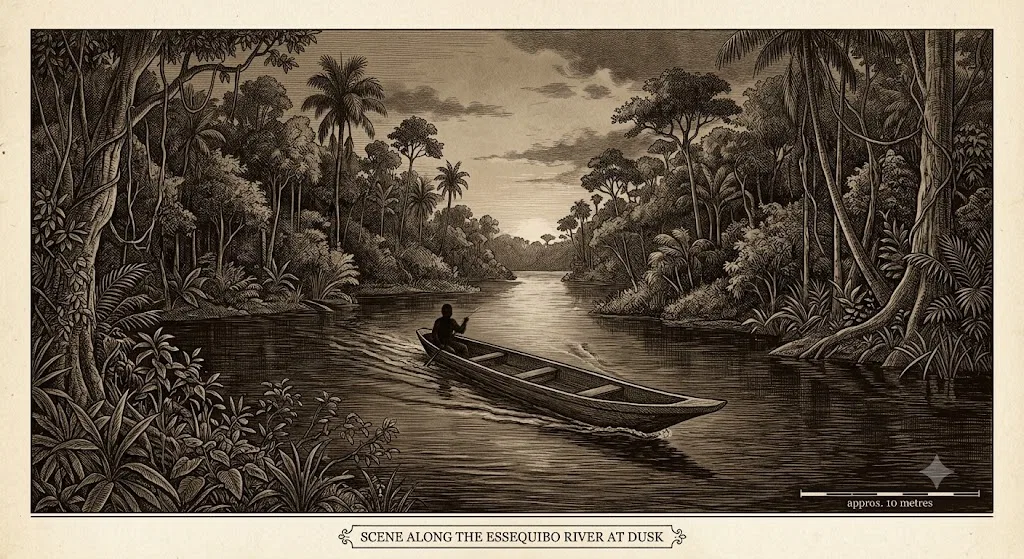
Guyana’s landscape helps explain why so many of its strange-creature traditions gather around water and forest. The country’s interior is dominated by rainforest, savannah, river systems and remote communities, while much of the population lives near the Atlantic coast. Guyana Tourism describes the country as having extensive grasslands, river basins and dense rainforest, with an estimated 87% of its forests intact; it also points to the Rupununi, Iwokrama, the Essequibo and other major basins as key wildlife regions.[Guyana Tourism]guyanatourism.comGuyana Tourism -Nature and WildlifeGuyana Tourism -Nature and Wildlife
That matters because Guyana is not a place where a “monster” has to be invented from nothing. The known fauna already includes animals that can look astonishing to visitors: jaguars, black caimans, giant river otters, arapaima, giant anteaters, harpy eagles, anacondas and river turtles. WWF Guianas lists jaguar, giant river otter, arapaima, black caiman and giant anteater among the special species of the wider Guianas, and notes that the region’s low population pressure and vast rainforest help wildlife flourish with relatively limited human interaction.[wwfguianas.org]wwfguianas.orgWildlife | WWFWildlife | WWF
For a reader interested in cryptids, this is the key point: Guyana’s “monster” stories sit in a country where genuine megafauna, dangerous water and limited visibility are everyday realities in many interior settings. A splash beside a canoe, a rolling arapaima, a caiman’s eyeshine, a jaguar moving through shadow or a giant otter surfacing at dusk can all feed the imagination without requiring a new species. The strange story and the natural explanation are not enemies here; they often grow from the same environment.[The Guardian]theguardian.comThe Guardian'We want to keep our forest': why Guyana's wilderness needs visitorsGuyana’s rainforest, part of the Guiana Shield, is a biodiversity hotspot home to unique flora and fauna, including giant river otters, a…
The Massacuraman: Guyana’s river ogre
The Massacuraman, also spelled Massacooramaan or Masacurraman, is the closest Guyana comes to a classic country-level cryptid. Popular descriptions present it as a huge, hairy, man-like creature living in the rivers of the interior, sometimes said to capsize boats and eat or drag away the people aboard. Caribbean folklore summaries commonly frame it as a kind of river jumbie or Amerindian-linked river spirit rather than a flesh-and-blood ape awaiting scientific discovery.[wordpress.com]caribbeanauthors.wordpress.comCaribbean Authors Massacooramaan and LagahooCaribbean Authors Massacooramaan and Lagahoo
The story’s geography is important. It is not usually a coastal beast, nor a city ghost. It belongs to the interior waterways, especially the sort of river travel associated with Indigenous communities, miners, boatmen and “pork knockers”, the local term often used for small-scale gold prospectors. In one widely repeated summary, the Massacooramaan is said to pull boats down in rapids and prey on people travelling through interior rivers.[HubPages]discover.hubpages.comJumbies of GuyanaJumbies of Guyana
As a cryptid claim, the Massacuraman is thinly evidenced. There are no reliable photographs, specimens, bodies, tracks or biological studies demonstrating a giant unknown river ape in Guyana. The story survives mainly through oral tradition, folklore writing, blog retellings, social-media folklore posts and local cultural memory. That weakens it as zoology but strengthens it as folklore: the creature expresses the danger of travelling after dark, crossing rough water, ignoring local knowledge and entering places where the river is not just scenery but a force with agency.
Several natural anchors may help explain why the tale feels plausible in setting. Black caimans can be large and intimidating; arapaima are massive air-breathing fish that roll at the surface; giant river otters are powerful, vocal and highly visible when encountered at close range; and submerged logs, currents and rapids can overturn boats without warning. None of these animals is “the” Massacuraman, but they make the idea of a boat-threatening river presence feel less abstract in Guyana than it would in a tamer landscape.[wwfguianas.org]wwfguianas.orgWildlife | WWFWildlife | WWF
Water mamas: mermaids with a Guyanese history
Guyana’s water mama tradition is better documented than many internet cryptid lists suggest. Anthropologist James Andrew Whitaker’s article “Water Mamas among the Makushi in Guyana”, published in the journal Folklore, examines Makushi accounts of water spirits known as water mamas, twingram or Tuenkaron. These beings are often described as mermaid-like, associated with rivers and lakes, and capable of enticing or abducting human beings.[Academia]academia.eduPDF) Water Mamas among the Makushi in GuyanaPDF) Water Mamas among the Makushi in Guyana
A striking feature of the Makushi material is that water mamas are not merely generic mermaids transplanted into South America. Whitaker reports that Makushi accounts often associate them with Europeans, whiteness, wealth, abduction, exotic palaces and historical encounters with outsiders. He connects this folklore to Makushi experiences of European contact, colonialism in Dutch and British Guiana, and ongoing relations with powerful outsiders.[Academia]academia.eduPDF) Water Mamas among the Makushi in GuyanaPDF) Water Mamas among the Makushi in Guyana
The reported locations also make the stories feel grounded in Guyana rather than floating in a vague mythic sea. Whitaker’s Makushi interlocutors associated water mamas with rivers including the Burro-Burro, Rewa, Takutu, Ireng and Essequibo, as well as with local lakes and even social spaces near the land-water boundary. In the stories, water mamas may sit near water brushing their hair, appear fair-skinned or light-haired, and transform between human-like and fish-tailed forms when water touches them.[Academia]academia.eduPDF) Water Mamas among the Makushi in GuyanaPDF) Water Mamas among the Makushi in Guyana
For cryptid readers, the water mama is best understood as folklore rather than a hidden aquatic animal. Yet it is not “just a mermaid story” either. It is a river-being tradition tied to specific Guyanese places, colonial memory, seduction, danger and unequal exchange. The creature’s power lies in the way it turns the river into a border: between land and water, village and outside world, ordinary life and a realm where wealth may come at a terrible cost.[Academia]academia.eduPDF) Water Mamas among the Makushi in GuyanaPDF) Water Mamas among the Makushi in Guyana
Kanaima: jaguar terror, sorcery and the problem of calling it a cryptid
The kanaima is often pulled into online monster lists because it is associated with transformation, jaguars and deadly forest pursuit. But it needs careful handling. In Guyanese and wider Guiana Shield contexts, kanaima is not simply a hairy beast or mystery animal. It is more often discussed as a feared form of assault sorcery, a violent spiritual or social force, and in some accounts a person empowered or possessed to kill.[Native Languages]native-languages.orgOpen source on native-languages.org.
Academic work treats kanaima as a serious ethnographic subject rather than a campfire monster. Neil L. Whitehead’s Dark Shamans: Kanaimà and the Poetics of Violent Death links kanaima to shamanism, violence, colonial pressures and Indigenous autonomy in the region. Duke University Press describes the book as drawing on testimonies from kanaima shamans, potential victims and victims’ families, and as exploring the historical emergence of kanaima under pressures from missionaries, rubber gatherers, miners and development agencies.[Duke University Press]dukeupress.eduDuke University Press Dark Shamans: Kanaimà and the Poetics of Violent DeathDuke University Press Dark Shamans: Kanaimà and the Poetics of Violent Death
Whitaker’s work on Makushi history adds another layer. His article on raiding, trading and kanaima argues that raiding, trading and sorcery were historically interrelated among the Makushi in Guyana, especially in the context of eighteenth- and nineteenth-century slaving, interethnic conflict and the shifting role of violence. That makes kanaima a tradition bound up with history, social fear and power, not merely a “were-jaguar” for a monster catalogue.[digitalcommons.trinity.edu]digitalcommons.trinity.eduRaiding, Trading, and Kanaima" by James Andrew Whitaker…
There is still a cryptid-adjacent reason to include kanaima on a Guyana monster page: popular retellings often emphasise shapeshifting, jaguar identity and terrifying pursuit through the forest. Stabroek News, discussing kanaima in Amerindian culture, notes its association with jaguars and with fear in collected stories.[Stabroek News]stabroeknews.comStabroek News The lore of Kanaima in Amerindian cultureStabroek News The lore of Kanaima in Amerindian culture
The evidence-aware conclusion is that kanaima belongs beside cryptids, but not inside the same box as an alleged lake monster. It is a human-spirit-jaguar complex, a language of feared violence and hidden agency. Treating it as a simple “creature sighting” strips away the cultural meaning that makes it important.
Old Higue and other jumbies: Guyana’s Caribbean monster inheritance
Guyana’s folklore is not only Indigenous or interior-focused. It also shares a wider Caribbean vocabulary of jumbies, spirits, witches and night-roaming beings shaped by African, Indian, European, Indigenous and Creole traditions. The Old Higue, also linked regionally to soucouyant-type folklore, is one of the best-known examples: a figure often described as an old woman who sheds her skin, becomes a ball of fire and feeds on babies or sleeping victims.[Wikipedia]WikipediaCulture of GuyanaCulture of Guyana
The Old Higue is not a cryptid in the biological sense. No one is seriously proposing an unknown animal species that removes its skin and flies as fire. Its relevance to a Guyana monster page is different: it shows how Guyanese creature lore includes domestic and village fears as well as river and forest dangers. Where the Massacuraman belongs to deep water and kanaima to the forested social world of sorcery and threat, the Old Higue enters the house at night.
This contrast matters because “cryptids by country” can accidentally flatten different kinds of belief into one category. Guyana’s monster map has several layers: river ogres, mermaid-like water spirits, jaguar-linked sorcery, Caribbean jumbies and real animals large enough to become legendary in poor light. The most useful approach is not to pretend all of them are hidden animals, but to ask what kind of fear or boundary each figure patrols.
Where the stories cluster
Guyana’s creature traditions cluster less around one single “haunted lake” than around recurring landscape types. The first is the river corridor: Essequibo, Rewa, Burro-Burro, Takutu, Ireng and other waterways appear in water mama accounts, while the Massacuraman belongs broadly to interior rivers and rapids. These are places where travel, trade, fishing, drowning and isolation meet.[Academia]academia.eduPDF) Water Mamas among the Makushi in GuyanaPDF) Water Mamas among the Makushi in Guyana
The second cluster is the forest and savannah interior, especially the Rupununi, Pakaraima and Makushi-related contexts. Guyana Tourism identifies the Rupununi grasslands, Iwokrama Rainforest, Kanuku Mountains, Pakaraimas and Konashen area as major wildlife regions; these are also the kinds of places where stories of jaguars, water beings, hidden communities and dangerous night travel feel culturally and environmentally at home.[Guyana Tourism]guyanatourism.comGuyana Tourism -Nature and WildlifeGuyana Tourism -Nature and Wildlife
The third cluster is the coastal and village world of jumbies. Old Higue stories, like many Caribbean night-spirit traditions, are less about unexplored wilderness and more about vulnerability inside settled life: infants, bedrooms, thresholds, rice traps, neighbours and suspicion. In that sense Guyana’s folklore spans the whole country, from the nursery to the rapid.
What could witnesses be seeing?
Some Guyanese monster reports are probably not “sightings” in the modern cryptozoological sense at all. They are stories transmitted as warnings, moral lessons, cosmological explanations or memories of danger. But where a claim does involve something seen in water or forest, several grounded explanations are worth considering.
Known large animals: Jaguars, caimans, giant river otters, arapaima, anacondas and giant anteaters can all appear startling, especially from a boat, in twilight, in turbid water or through foliage. Guyana’s wildlife tourism material openly promotes the chance to see many of these animals in places such as Iwokrama, Rewa and the Rupununi.[Guyana Tourism]guyanatourism.comGuyana Tourism -Nature and WildlifeGuyana Tourism -Nature and Wildlife
River conditions: A capsized boat does not require a monster. Rapids, hidden snags, darkness, alcohol, fatigue, overloaded craft and sudden weather can turn a journey dangerous. A river spirit story may preserve practical caution long after the original accident is forgotten.
Predator imagination: In a jaguar country, it is unsurprising that shapeshifting and jaguar-linked fear recur. The jaguar is both a real apex predator and a powerful symbolic animal. When a tradition such as kanaima fuses human violence with jaguar traits, it reflects both ecological reality and social anxiety.[Duke University Press]dukeupress.eduDuke University Press Dark Shamans: Kanaimà and the Poetics of Violent DeathDuke University Press Dark Shamans: Kanaimà and the Poetics of Violent Death
Colonial and outsider memory: Water mama stories show that some “creatures” may encode historical relationships rather than animal encounters. Whitaker’s Makushi research argues that themes of abduction, wealth, exotic palaces and fair-skinned water beings reflect contact with Europeans and other outsiders.[Academia]academia.eduPDF) Water Mamas among the Makushi in GuyanaPDF) Water Mamas among the Makushi in Guyana
Guyana in popular monster culture
Guyana has not been heavily commercialised as a monster-tourism destination, which is part of its charm. Its creature lore circulates through local storytelling, school and cultural material, newspaper features, blogs, YouTube folklore explainers, social media posts and diaspora memory rather than through a single global franchise. Even when Guyana appears in wildlife television, the emphasis is usually on real giants rather than paranormal beasts.
The River Monsters episode “Lair of Giants”, set on the Essequibo, is a good example of how Guyana’s real ecology can be framed in monster language without needing a supernatural claim. The episode summary describes Jeremy Wade travelling Guyana’s largest river in search of “monsters of the past” and encountering the idea of a river system filled with mysterious giants. The animals involved are part of the real “giants of Guyana” appeal: arapaima, large catfish, caimans and other formidable river life.[river-monsters.fandom.com]river-monsters.fandom.comLair of Giants | River Monsters WikiLair of Giants | River Monsters Wiki
Ecotourism has also given Guyana a different sort of monster afterlife: the country is marketed as a place to see living giants. The Guardian’s travel reporting from Rewa describes giant river otters, black caimans and arapaima in a community-run conservation context, while Guyana Tourism highlights jaguars, river otters, arapaima, caimans and harpy eagles as part of the country’s nature appeal.[The Guardian]theguardian.comThe Guardian'We want to keep our forest': why Guyana's wilderness needs visitorsGuyana’s rainforest, part of the Guiana Shield, is a biodiversity hotspot home to unique flora and fauna, including giant river otters, a…
That may be the most honest tourism angle. Guyana does not need to sell a confirmed unknown beast. Its rivers and forests already contain animals large enough, rare enough and dramatic enough to explain why monster stories took root.
How to read Guyana’s cryptids without flattening them
The best way to approach Guyana’s mystery-creature tradition is to separate four categories that often get mixed together.
First are folkloric beings such as the water mama and Old Higue. Their importance lies in story, warning, symbolism and cultural memory, not biological evidence. Second are cryptid-like local monsters such as the Massacuraman, which is described in animal-like terms but survives mainly through folklore and popular retelling. Third are spiritual-social figures such as kanaima, where reducing the tradition to “a were-jaguar” misses the deeper association with violence, sorcery, history and fear. Fourth are misidentified or mythologised real animals, including arapaima, caimans, jaguars, giant otters and anacondas.[academia.edu]academia.eduPDF) Water Mamas among the Makushi in GuyanaPDF) Water Mamas among the Makushi in Guyana
This distinction does not make the stories less compelling. It makes them more legible. A hairy river ogre tells us something about dangerous waterways. A mermaid-like water mama tells us something about seduction, abduction and colonial encounter. Kanaima tells us something about terror, social rupture and the jaguar-haunted imagination of the forest. The Old Higue tells us something about night, infancy, suspicion and Caribbean domestic fear.
For cryptid readers, the verdict is clear: Guyana has no well-supported case for a confirmed unknown monster species, but it has one of the richer creature landscapes in the region. Its legends are strongest when read with both curiosity and restraint. The monsters of Guyana are not just beasts waiting to be found; they are ways of remembering that rivers, forests, strangers and neighbours can all be dangerous after dark.
Amazon book picks
Further Reading
Books and field guides related to What Lurks in Guyana's Rivers and Rainforests?. Use these as the next step if you want deeper reading beyond the article.
Dark Shamans
Directly examines kanaima beliefs, violence and spiritual power in the Guiana region.
The Lost World
Evokes the mystery, wildlife and unexplored landscapes associated with Guyana's interior.
American Monsters
Provides broader context for how regional monster traditions develop and persist.
eBay marketplace picks
Marketplace Samples
Live-tested eBay searches with available results related to this page.




Endnotes
1.
Source: academia.edu
Title: (PDF) Water Mamas among the Makushi in Guyana
Link:https://www.academia.edu/126162120/Water_Mamas_among_the_Makushi_in_Guyana
2.
Source: digitalcommons.trinity.edu
Link:https://digitalcommons.trinity.edu/tipiti/vol15/iss2/4/
Source snippet
"Raiding, Trading, and Kanaima" by James Andrew Whitaker...
3.
Source: wwfguianas.org
Title: Wildlife | WWF
Link:https://www.wwfguianas.org/our_work22/wildlife/
4.
Source: rosalienebacchus.com
Link:https://www.rosalienebacchus.com/masacurraman-the-legendary-river-monster-by-rosaliene-bacchus.html
5.
Source: discover.hubpages.com
Title: Jumbies of Guyana
Link:https://discover.hubpages.com/education/Jumbies-of-Guyana
6.
Source: native-languages.org
Link:https://www.native-languages.org/kanaima.htm
7.
Source: Wikipedia
Title: Culture of Guyana
Link:https://en.wikipedia.org/wiki/Culture_of_Guyana
8.
Source: Wikipedia
Link:https://en.wikipedia.org/wiki/Soucouyant
9.
Source: river-monsters.fandom.com
Title: Lair of Giants | River Monsters Wiki
Link:https://river-monsters.fandom.com/wiki/Lair_of_Giants
10.
Source: Wikipedia
Link:https://en.wikipedia.org/wiki/Guyana
11.
Source: Wikipedia
Title: British people
Link:https://en.wikipedia.org/wiki/British_people
12.
Source: Wikipedia
Title: United Kingdom
Link:https://en.wikipedia.org/wiki/United_Kingdom
13.
Source: Wikipedia
Link:https://en.wikipedia.org/wiki/Myth
14.
Source: Wikipedia
Title: List of countries by forest area
Link:https://en.wikipedia.org/wiki/List_of_countries_by_forest_area
15.
Source: digitalcommons.trinity.edu
Link:https://digitalcommons.trinity.edu/cgi/viewcontent.cgi?article=1076&context=tipiti
16.
Source: cryptidarchives.fandom.com
Title: List of sea serpent sightings in the Pacific Ocean (1848–1891)
Link:https://cryptidarchives.fandom.com/wiki/List_of_sea_serpent_sightings_in_the_Pacific_Ocean_%281848%E2%80%931891%29
17.
Source: paranormal-strange.fandom.com
Link:https://paranormal-strange.fandom.com/wiki/Massacooramaan
18.
Source: cookie-pantheon.fandom.com
Link:https://cookie-pantheon.fandom.com/wiki/Kanaima
19.
Source: cryptidarchives.fandom.com
Link:https://cryptidarchives.fandom.com/wiki/Chirirume
20.
Source: rosalienebacchus.com
Link:https://www.rosalienebacchus.com/creating-the-setting-for-under-the-tamarind-tree1.html
21.
Source: youtube.com
Link:https://www.youtube.com/watch?v=sDZShhibwI8
22.
Source: youtube.com
Title: Issa Guyanese Ting
Link:https://www.youtube.com/watch?v=gAaRemt5uVI
23.
Source: youtube.com
Link:https://www.youtube.com/watch?v=eJZRUjH85sw
24.
Source: youtube.com
Link:https://www.youtube.com/watch?v=kmXbAVUCjbg
25.
Source: youtube.com
Link:https://www.youtube.com/shorts/IPlX9gSncME
26.
Source: youtube.com
Title: Issa Guyanese Ting
Link:https://www.youtube.com/watch?v=kZdtgF0afW4
27.
Source: youtube.com
Title: River Monsters Full Episode
Link:https://www.youtube.com/watch?v=ySV-EU8qo_Y
28.
Source: youtube.com
Title: Issa Guyanese Ting
Link:https://www.youtube.com/watch?v=B9eBnYsGutA
29.
Source: youtube.com
Link:https://www.youtube.com/watch?v=hsnZmHPxkKk
30.
Source: youtube.com
Link:https://www.youtube.com/watch?v=SedeF1lvqLk
31.
Source: conservation.org
Title: one small country one giant leap for nature
Link:https://www.conservation.org/news/one-small-country-one-giant-leap-for-nature
32.
Source: youtube.com
Title: Everything Has Sharp Teeth Down Here | Chasing Monsters
Link:https://www.youtube.com/watch?v=qVL7aZNCfGo
Source snippet
Amazon Rainforest – The Most Dangerous Jungle on Earth - Guyana...
33.
Source: youtube.com
Title: Amazon Rainforest – The Most Dangerous Jungle on Earth
Link:https://www.youtube.com/watch?v=7hA9L1l35H4
Source snippet
From Coast to Jungle: The Wild World of Guyana...
34.
Source: youtube.com
Title: From Coast to Jungle: The Wild World of Guyana
Link:https://www.youtube.com/watch?v=kx-EBdiXqTg
35.
Source: guyanatourism.com
Title: Guyana Tourism -Nature and Wildlife
Link:https://guyanatourism.com/nature-and-wildlife/
36.
Source: theguardian.com
Title: The Guardian’We want to keep our forest’: why Guyana’s wilderness needs visitors
Link:https://www.theguardian.com/travel/2019/oct/27/guyana-jungle-rainforest-community-run-wildlife-tour-adventure
Source snippet
Guyana’s rainforest, part of the Guiana Shield, is a biodiversity hotspot home to unique flora and fauna, including giant river otters, a...
37.
Source: caribbeanauthors.wordpress.com
Title: Caribbean Authors Massacooramaan and Lagahoo
Link:https://caribbeanauthors.wordpress.com/2023/10/22/massacooramaan-and-lagahoo/
38.
Source: dukeupress.edu
Title: Duke University Press Dark Shamans: Kanaimà and the Poetics of Violent Death
Link:https://www.dukeupress.edu/Dark-Shamans
39.
Source: stabroeknews.com
Title: Stabroek News The lore of Kanaima in Amerindian culture
Link:https://www.stabroeknews.com/2021/09/19/sunday/arts-on-sunday/the-lore-of-kanaima-in-amerindian-culture/
40.
Source: arcanebeastsandcritters.wordpress.com
Link:https://arcanebeastsandcritters.wordpress.com/2018/06/03/massacooramaan/
41.
Source: amintakilawan.wordpress.com
Title: jumbee time
Link:https://amintakilawan.wordpress.com/2018/10/26/jumbee-time/
42.
Source: sitareist.wordpress.com
Link:https://sitareist.wordpress.com/2013/02/19/an-archaic-form-of-biopower-of-the-shamanism-in-guyana-dark-shamans-kanaima-and-the-poetics-of-violent-death-by-neil-l-whitehead/
43.
Source: read.dukeupress.edu
Title: Ritual Violence and Magical Death in Amazonia
Link:https://read.dukeupress.edu/books/book/761/chapter/135446/Ritual-Violence-and-Magical-Death-in-Amazonia
44.
Source: cbd.int
Link:https://www.cbd.int/countries/profile/?country=gy
45.
Source: guyanatourism.com
Link:https://guyanatourism.com/
46.
Source: guyanatourism.com
Link:https://guyanatourism.com/about-us-2/land-of-giants/
47.
Source: wilderness-explorers.com
Title: giants of guyana
Link:https://wilderness-explorers.com/giants-of-guyana/
48.
Source: GOV.UK
Link:https://www.gov.uk/foreign-travel-advice/guyana
49.
Source: thecommonwealth.org
Link:https://thecommonwealth.org/our-member-countries/guyana
Additional References
50.
Source: facebook.com
Link:https://www.facebook.com/ElectricCityAquarium/posts/myths-monstersin-guyana-there-are-stories-told-of-the-elusive-water-mama-it-was-/783750385519114/
51.
Source: kiplingsociety.co.uk
Link:https://www.kiplingsociety.co.uk/readers-guide/rg_matterfact_notes.htm
52.
Source: scispace.com
Link:https://scispace.com/pdf/a-return-to-dark-shamans-kanaima-the-cosmology-of-threat-1xd8jueklc.pdf
53.
Source: instagram.com
Link:https://www.instagram.com/british_airways/?hl=en
54.
Source: skyscanner.net
Link:https://www.skyscanner.net/airline/airline-british-airways-ba.html
55.
Source: tripadvisor.com
Link:https://www.tripadvisor.com/Airline_Review-d8729039-Reviews-or60-British-Airways
56.
Source: britishairways.com
Link:https://www.britishairways.com/travel/home/public/en_gb/
57.
Source: goodreads.com
Link:https://www.goodreads.com/en/book/show/1095715.Dark_Shamans
58.
Source: amazon.com
Link:https://www.amazon.com/Dark-Shamans-Kanaima-Poetics-Violent/dp/0822329883?tag=searcht-20
59.
Source: facebook.com
Link:https://www.facebook.com/GuyanaUndiscovered/posts/did-you-know-more-than-80-of-guyana-is-still-covered-by-forests-and-the-country-/10159257042690889/
Topic Tree
Follow this branch
Related pages 192
- Antigua Cryptids
- Maldives Monsters
- Malta Monsters
- Qatar Monsters
- Argentina Monsters
- +187 more in sidebar