Monster Traditions of Haiti
Haiti’s creature traditions are less a catalogue of “unknown animals” than a vivid body of folklore in which people, spirits, animals and landscape keep changing places.
Page outline Jump by section
The Lougawou: Haiti’s Shapeshifter, Not Quite a Werewolf
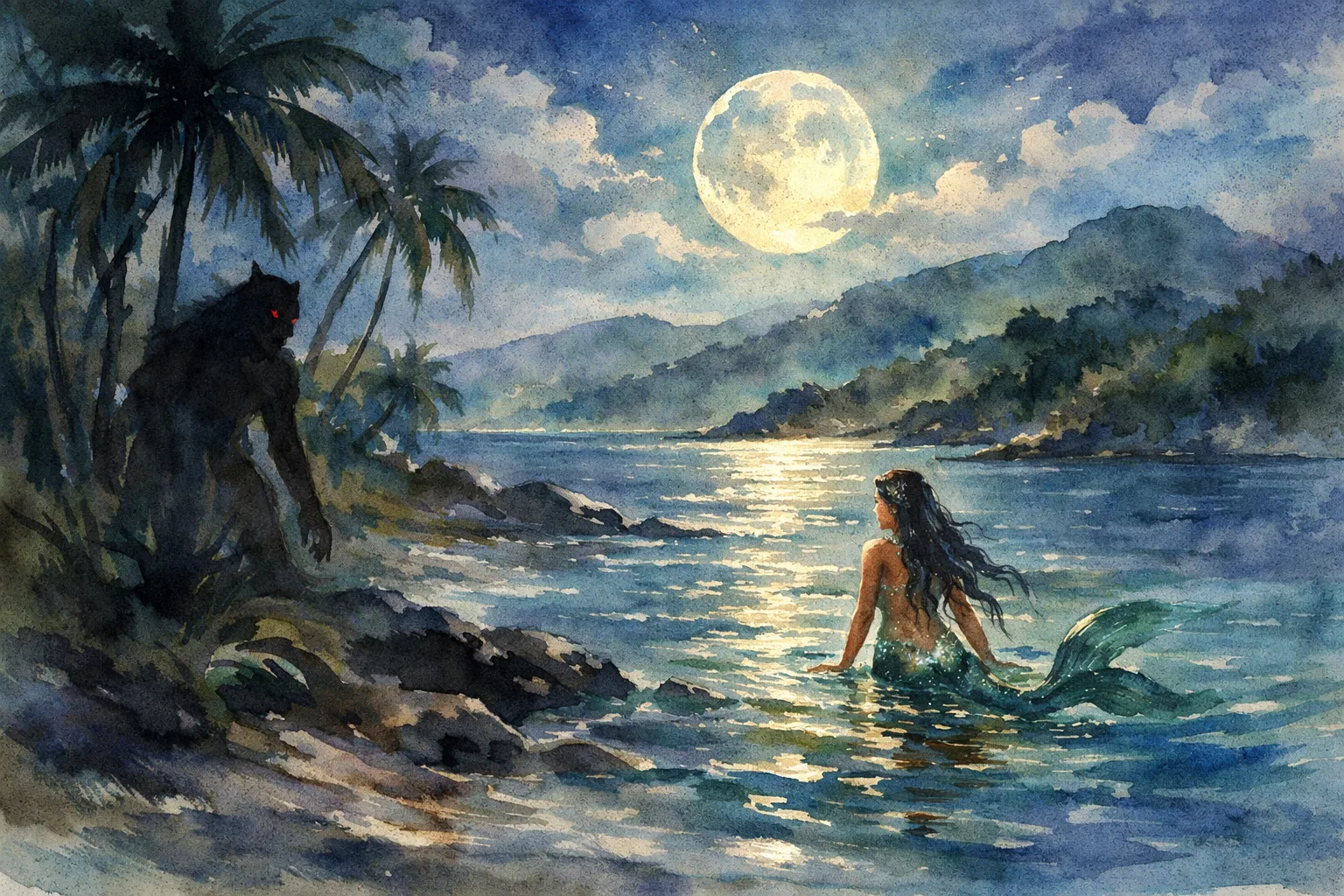
The creature most likely to appear on a Haiti cryptid page is the lougawou. The name comes from the French loup-garou, usually translated as “werewolf”, but Haitian accounts do not simply copy the European wolf-man. In Haitian use, the lougawou is more often a human shapeshifter: a person by day, a dangerous night-roamer by darkness, able to become an animal or a flying thing. A tourism-facing Haitian folklore summary describes it as a figure who may appear ordinary by day and transform at night, while George Eaton Simpson’s 1942 article, “Loup Garou and Loa Tales from Northern Haiti”, remains a key scholarly anchor for northern Haitian versions of the tradition.[Visit Haiti]visithaiti.comVisit Haiti From Mermaids to Lougawou: Uncover Haitian Folklore · Visit HaitiVisit Haiti From Mermaids to Lougawou: Uncover Haitian Folklore · Visit Haiti
That difference matters. Haiti has no native wolves, and the legend is not really about a wolf ecology. It is about fear of hidden power: the neighbour, stranger or socially marginal person who may not be what they seem. In one modern account of Haitian folklore, every neighbourhood is said to have its lougawou, often imagined as an unsuspected older woman by day. The same source records protective customs such as planting cedar trees or using protective herbal baths for children, which shows how the story operates as household folklore rather than a zoological claim.[Visit Haiti]visithaiti.comVisit Haiti From Mermaids to Lougawou: Uncover Haitian Folklore · Visit HaitiVisit Haiti From Mermaids to Lougawou: Uncover Haitian Folklore · Visit Haiti
Cryptid readers sometimes look for an animal behind the legend: a dog, cat, bird, snake or night animal misidentified in poor light. That may explain individual scares, but it does not explain the whole tradition. The lougawou is a social monster. Its horror comes from transformation, secrecy and vulnerability, especially the fear that children may be threatened at night. The “animal” form is flexible because the story is not tied to one species.
When Folklore Becomes a Flap
The most chilling modern lougawou report did not involve a mysterious animal in a forest. It emerged after the 12 January 2010 earthquake, when Haiti was devastated and many people were sleeping in camps or on the streets. Reuters, carried by ABC News, reported that fears of child-eating loup-garous had spread in displaced-person camps, and that people accused of being loups-garous had reportedly been attacked or lynched. The same report quoted Haiti’s then secretary of state for finance, Sylvain Lafalaisse, saying that people used loups-garous to “give a name to their fears”, while the real danger was child snatching, not spirits.[ABC News]abc.net.auABC News'Wolf-men' lynched in Haiti's ruinsABC News'Wolf-men' lynched in Haiti's ruins
This is one of the clearest examples of how a Haitian monster belief can move from story to crisis. The setting was not an ancient ruin or a remote mountain valley; it was post-disaster Port-au-Prince, where families were exposed, children had been separated from parents, and aid groups warned about trafficking risks. In that context, the lougawou became a frightening explanation for a real social danger.[ABC News]abc.net.auABC News'Wolf-men' lynched in Haiti's ruinsABC News'Wolf-men' lynched in Haiti's ruins
For a cryptid-style reading, the lesson is important: a “flap” does not always mean repeated sightings of an unknown creature. Sometimes it means a repeated accusation pattern. The testimony is still culturally significant, but the evidence points towards panic, rumour, child-protection fears and violence against suspected people rather than an undiscovered animal.

Water Spirits, Mermaids and the Sea
Haiti’s coastline and island setting naturally feed water-being traditions. The best-known figure is Lasirenn, often rendered in English as a Haitian mermaid or siren. In Vodou art and explanation, Lasirenn is not merely a pretty sea monster. She is a water spirit, often connected with the sea and with Agwe, the male sea spirit. The Figge Art Museum’s description of a Haitian sculpture of sirens explains that the Vodou siren is a water spirit and consort of Agwe, while also noting links with West African Mami Wata imagery and European ship-figure traditions.[Figge Art Museum]figgeartmuseum.orgFigge Art Museum
Modern Haitian folklore writing describes the mermaid as powerful, alluring and dangerous: a being associated with treasures, songs and the risk of being drawn into the water. Such stories sit at the edge of several categories at once. They are creature lore, religious imagery, sea folklore and moral warning. A reader looking for “Haiti’s mermaid cryptid” should therefore be careful: Lasirenn is not a reported biological species like a manatee mistaken for a half-human creature. She is a sacred and legendary water figure whose meaning is inseparable from Haitian spiritual culture.[Visit Haiti]visithaiti.comVisit Haiti From Mermaids to Lougawou: Uncover Haitian Folklore · Visit HaitiVisit Haiti From Mermaids to Lougawou: Uncover Haitian Folklore · Visit Haiti
There is also a serpent-rainbow tradition. Haitian folklore summaries describe the rainbow as a vast serpent drinking from the sea, linked in Vodou tradition with Ayida and Dambala. This is not a lake-monster report in the Loch Ness sense, but it does show how animal-shaped imagery can explain sky, rain, sea and creation in memorable visual form.[Visit Haiti]visithaiti.comVisit Haiti From Mermaids to Lougawou: Uncover Haitian Folklore · Visit HaitiVisit Haiti From Mermaids to Lougawou: Uncover Haitian Folklore · Visit Haiti
Zombies Belong Here, But Not as Mystery Animals
The Haitian zombie is one of the most globally influential monster figures ever associated with a single country, but it should be handled carefully on a cryptid page. In Haitian tradition, the zombie is not a pack-hunting corpse like the modern film monster. It is bound up with fears of enslavement, loss of will, social punishment, sorcery and the boundary between life and death. A Haitian folklore summary contrasts Hollywood zombies with Haitian ideas in which the terror is less flesh-eating and more the possibility that a sorcerer might seize a person’s spirit or agency.[Visit Haiti]visithaiti.comVisit Haiti From Mermaids to Lougawou: Uncover Haitian Folklore · Visit HaitiVisit Haiti From Mermaids to Lougawou: Uncover Haitian Folklore · Visit Haiti
The attempted “natural explanation” of zombification became famous through ethnobotanist Wade Davis, who argued that some cases might involve poisoning, including tetrodotoxin from puffer fish. Later scientific discussion has treated the claim as controversial rather than settled. A 2011 review revisited Davis’s work and noted his argument that zombies in Haiti were “produced” rather than merely folkloric, while also placing the topic within wider debate about evidence, pharmacology and interpretation.[PMC]pmc.ncbi.nlm.nih.govPMCRevisiting the Ethnobiology of the Zombie PoisonPMCRevisiting the Ethnobiology of the Zombie Poison
For this project’s creature-history frame, the zombie is best treated as an adjacent monster tradition rather than a cryptid. It has a huge afterlife in cinema and pop culture, but it is not an anomalous animal claim. Its importance is that it shows how Haitian folklore has repeatedly been transformed by outsiders into horror entertainment, often losing the historical and cultural meanings that made the original figure so disturbing.
The Real “Strange Animal” of Haiti: The Solenodon
If Haiti has a real animal that sounds as if it escaped from a cryptozoology handbook, it is the Hispaniolan solenodon. This nocturnal, burrowing mammal is endemic to Hispaniola, the island shared by Haiti and the Dominican Republic. The IUCN Small Mammal Specialist Group describes it as occurring in both countries, with a recognised Haitian form from the Massif de la Hotte area. It is active at night, shelters by day in burrows, hollow logs or crevices, feeds mainly on soil invertebrates, and is one of the few mammals with toxic saliva delivered through a groove in an incisor.[small-mammals.org]small-mammals.orgHispaniolan Solenodon – Small Mammals SGHispaniolan Solenodon – Small Mammals SG
That is wonderfully strange, but it is not a cryptid. It is a known species, scientifically described and conservation-studied. Its relevance is explanatory: Haiti’s forests do contain rare, nocturnal, unfamiliar animals that can surprise people, especially where habitat is fragmented and sightings are brief. The solenodon’s reduced range, the pressure from deforestation, charcoal production, agriculture and introduced predators, and its secretive habits all make it the kind of creature that could be rumoured about without needing to invent a monster.[small-mammals.org]small-mammals.orgHispaniolan Solenodon – Small Mammals SGHispaniolan Solenodon – Small Mammals SG
The solenodon also helps set limits. Haiti does not have the native large carnivore fauna that would support a plausible hidden wolf, leopard or ape tradition. Reports of animal transformation in lougawou stories belong to folklore and social fear more than zoology. When real wildlife enters the discussion, the most credible “mystery” is usually rarity, nocturnal behaviour or misidentification, not an unknown large beast.
Why Haiti Has Few Classic Lake-Monster or Bigfoot-Style Claims
Many country cryptid pages revolve around lakes, mountains or deep forests where witnesses claim to see a large unknown animal. Haiti’s evidence does not really cluster that way. Searches for Haitian lake monsters, sea serpents, ape-like creatures or phantom cats produce little that stands up as a country-specific sighting tradition. The stronger material clusters around oral folklore, Vodou-linked beings, shapeshifters, zombies and water spirits.
Geography helps explain this. Haiti occupies the western part of Hispaniola in the Caribbean, sharing the island with the Dominican Republic. It is mountainous, coastal and ecologically rich, but its best-documented unusual mammals are small or medium-sized island endemics such as the solenodon and hutia, not hidden megafauna.[Embassy of Haiti]haiti.orgOpen source on haiti.org.
This does not make Haiti less interesting. It makes it different from the usual “monster in the lake” template. The Haitian pattern is less about isolated wilderness sightings and more about creatures that live in the social landscape: the crossroads, the yard, the shoreline, the camp, the neighbourhood, the night path. The monsters are memorable because they are close to home.

Folklore, Religion and Misreading
A recurring problem in writing about Haitian monsters is the temptation to flatten everything into “Voodoo horror”. That is misleading and often unfair. Haitian Vodou is a living religion with a supreme God, spirits known as lwa, ritual service, possession, song, offerings and a long history shaped by West and Central African traditions, Catholicism, slavery and revolution. The Associated Press has reported that Vodou remains culturally powerful in Haiti, describing Bondye, the lwa and the religion’s role in giving people protection, community and meaning during hardship.[AP News]apnews.comOpen source on apnews.com.
That context changes how creature stories should be read. A water spirit, serpent figure or night being may look like a “monster” in an outsider’s monster list, but within Haitian culture it may belong to religious practice, moral storytelling, family warning, children’s tale, local memory or social commentary. Some figures are feared; others are revered; many are ambivalent.[Wikipedia]WikipediaHaitian VodouHaitian Vodou
The same caution applies to language. Calling the lougawou a “Haitian werewolf” is useful as a quick comparison, but it can also mislead readers into imagining a wolf-bodied creature under a full moon. Calling Lasirenn a “mermaid cryptid” may attract interest, but it can strip away the water-spirit setting that gives the figure its meaning. Good cryptid history keeps the strangeness while resisting the urge to force every tradition into a Western monster category.
Best Explanations for Haitian Creature Claims
The strongest explanations vary by creature type.
For the lougawou, the best explanation is folklore plus social fear. Individual incidents may involve misidentified dogs, cats, birds, snakes, shadows or human intruders, but the tradition itself is about shapeshifting, suspicion and vulnerability. The 2010 post-earthquake panic shows how quickly the figure could become a way to talk about child danger, insecurity and disorder.[ABC News]abc.net.auABC News'Wolf-men' lynched in Haiti's ruinsABC News'Wolf-men' lynched in Haiti's ruins
For mermaids and water beings, the best explanation is religious and maritime folklore rather than animal misidentification. Manatees and other marine animals have often been proposed as background explanations for mermaid stories elsewhere, but the Haitian Lasirenn tradition is more directly legible as a Vodou water-spirit figure with African and European image streams behind it.[Figge Art Museum]figgeartmuseum.orgFigge Art Museum
For zombies, the best explanation is cultural history with contested ethnobiology at the margins. Poisoning theories are part of the discussion, but they do not turn the zombie into a confirmed biological monster. The core fear is social death: losing freedom, identity and will.[PMC]pmc.ncbi.nlm.nih.govPMCRevisiting the Ethnobiology of the Zombie PoisonPMCRevisiting the Ethnobiology of the Zombie Poison
For hidden animals, the best explanation is usually absence of strong evidence. Haiti has rare and remarkable wildlife, but its well-supported mystery-animal material is thin compared with its folklore. The real animals most likely to generate surprise are nocturnal, elusive or poorly known to non-specialists, especially the solenodon; they do not support claims for a large unknown predator or ape.[small-mammals.org]small-mammals.orgHispaniolan Solenodon – Small Mammals SGHispaniolan Solenodon – Small Mammals SG
How Haiti’s cryptid traditions changed in retelling
Haitian creature traditions have not stayed frozen. The lougawou moved from oral tale and local fear into journalism during moments of crisis. The zombie moved from Haitian social and spiritual meanings into US occupation-era fascination, Hollywood horror and global pop culture. Lasirenn and other water spirits continue to appear in Haitian art, tourism writing and Vodou-influenced visual culture.[abc.net.au]abc.net.auABC News'Wolf-men' lynched in Haiti's ruinsABC News'Wolf-men' lynched in Haiti's ruins
That afterlife can be double-edged. On one hand, it keeps Haitian folklore visible. On the other, it can turn complex traditions into generic monsters. The zombie is the clearest case: the world knows the word, but often forgets Haiti. The lougawou faces a similar simplification when it is reduced to “werewolf”, and Lasirenn when she is reduced to “mermaid”. The more accurate reading is stranger and richer: Haitian creature lore is built around transformation, water, night, spirit power and the fear that ordinary life may suddenly reveal another layer.
The Bottom Line
Haiti’s cryptid profile is not dominated by a single lake monster, sea serpent or hairy wildman. Its strongest monster traditions are folkloric: the lougawou shapeshifter, the mermaid-like Lasirenn, serpent-rainbow imagery, night giants and the globally famous zombie. The best-supported evidence is not biological evidence for undiscovered animals, but documented folklore, scholarly collection, art, religious context and occasional news reports showing how belief can intensify during social stress.
For readers of strange-creature history, that makes Haiti valuable precisely because it challenges the usual cryptid checklist. The country’s monsters are not mainly “out there” in an unexplored wilderness. They are in the yard after dark, the sea’s edge, the crossroads, the camp, the story circle and the uneasy space between a neighbour and a beast.
Amazon book picks
Further Reading
Books and field guides related to What Monsters Does Haiti Really Have?. Use these as the next step if you want deeper reading beyond the article.
The Serpent and the Rainbow
Explores Haitian beliefs, Vodou traditions and supernatural narratives.
The Book of Imaginary Beings
Offers comparative perspectives on legendary creatures and folklore.
eBay marketplace picks
Marketplace Samples
Live-tested eBay searches with available results related to this page.

Endnotes
1.
Source: digitalcommons.oberlin.edu
Title: faculty schol
Link:https://digitalcommons.oberlin.edu/faculty_schol/305/
Source snippet
"Loup Garou and Loa Tales from Northern Haiti" by George Eaton Simpson...
2.
Source: small-mammals.org
Title: Hispaniolan Solenodon – Small Mammals SG
Link:https://small-mammals.org/portfolio/hispaniolan-solenodon/
3.
Source: figgeartmuseum.org
Title: Figge Art Museum
Link:https://figgeartmuseum.org/art/collections/item/four-sirens-670019/1110
4.
Source: Wikipedia
Title: Haitian Vodou
Link:https://en.wikipedia.org/wiki/Haitian_Vodou
5.
Source: pmc.ncbi.nlm.nih.gov
Title: PMCRevisiting the Ethnobiology of the Zombie Poison
Link:https://pmc.ncbi.nlm.nih.gov/articles/PMC3184504/
6.
Source: haiti.org
Link:https://www.haiti.org/haiti-at-a-glance/
7.
Source: Wikipedia
Link:https://en.wikipedia.org/wiki/Haiti
8.
Source: Wikipedia
Link:https://en.wikipedia.org/wiki/Loogaroo
9.
Source: Wikipedia
Link:https://en.wikipedia.org/wiki/Soucouyant
10.
Source: Wikipedia
Title: List of cryptids
Link:https://en.wikipedia.org/wiki/List_of_cryptids
11.
Source: Wikipedia
Link:https://en.wikipedia.org/wiki/Haitians
12.
Source: Wikipedia
Title: Haitian mythology
Link:https://en.wikipedia.org/wiki/Haitian_mythology
13.
Source: Wikipedia
Title: Hispaniolan solenodon
Link:https://en.wikipedia.org/wiki/Hispaniolan_solenodon
14.
Source: Wikipedia
Title: Ayida Wedo
Link:https://en.wikipedia.org/wiki/Ayida_Wedo
15.
Source: Wikipedia
Link:https://en.wikipedia.org/wiki/Official
16.
Source: word.tips
Link:https://word.tips/spelling/official-vs-oficial/
17.
Source: visithaiti.com
Title: Visit Haiti From Mermaids to Lougawou: Uncover Haitian Folklore · Visit Haiti
Link:https://visithaiti.com/haiti-up-close/haitian-mermaids-lougawou-folklore/
18.
Source: abc.net.au
Title: ABC News’Wolf-men’ lynched in Haiti’s ruins
Link:https://www.abc.net.au/news/2010-01-28/wolf-men-lynched-in-haitis-ruins/311962
19.
Source: apnews.com
Link:https://apnews.com/article/2ddd4922f6fdd071525e92879ede2f33
20.
Source: cryptidz.fandom.com
Title: Lake Monsters
Link:https://cryptidz.fandom.com/wiki/Lake_Monsters
21.
Source: openfactbook.org
Link:https://openfactbook.org/countries/haiti/
22.
Source: pmc.ncbi.nlm.nih.gov
Link:https://pmc.ncbi.nlm.nih.gov/articles/PMC6394114/
23.
Source: anthroencyclopedia.com
Title: haitian vodou
Link:https://www.anthroencyclopedia.com/entry/haitian-vodou
24.
Source: natureandsupernaturalnature.wordpress.com
Title: loup garou
Link:https://natureandsupernaturalnature.wordpress.com/tag/loup-garou/
25.
Source: GOV.UK
Link:https://www.gov.uk/foreign-travel-advice/haiti
26.
Source: ebsco.com
Link:https://www.ebsco.com/research-starters/geography-and-cartography/haiti
27.
Source: worldbank.org
Link:https://www.worldbank.org/ext/en/country/haiti
28.
Source: geofactbook.com
Link:https://geofactbook.com/countries/haiti
29.
Source: science.howstuffworks.com
Link:https://science.howstuffworks.com/science-vs-myth/strange-creatures/lougawou.htm
30.
Source: visithaiti.com
Link:https://visithaiti.com/
31.
Source: apnews.com
Link:https://apnews.com/hub/haiti
32.
Source: kids.nationalgeographic.com
Link:https://kids.nationalgeographic.com/geography/countries/article/haiti
Additional References
33.
Source: youtube.com
Title: Bêtes Noires: Sorcery as History in the Haitian-Dominican Borderlands
Link:https://www.youtube.com/watch?v=gO5qhPBEIyw
Source snippet
The Night Terror of Haiti: Lougarou Unveiled...
34.
Source: youtube.com
Title: Class Notes: Afoutayi
Link:https://www.youtube.com/watch?v=cbSHbeeakuw
Source snippet
Bêtes Noires: Sorcery as History in the Haitian-Dominican Borderlands...
35.
Source: youtube.com
Title: The Night Terror of Haiti: Lougarou Unveiled
Link:https://www.youtube.com/watch?v=OZIjg-ALcpw
Source snippet
Unraveling The Mystery Of Haiti's Zombie Legends | Our History...
36.
Source: researchgate.net
Link:https://www.researchgate.net/publication/328682359_The_Danger_of_the_Extended_Hand_A_Critique_of_Humanitarian_Aid_in_Makenzy_Orcel%27s_L%27Ombre_Animale
37.
Source: facebook.com
Link:https://www.facebook.com/groups/420774772372246/posts/587449649038090/
38.
Source: facebook.com
Link:https://www.facebook.com/100067822464063/posts/a-glossary-of-haitian-vodou-termsagwelwa-haitian-spirit-of-the-ocean-of-ships-an/993152982955441/
39.
Source: reddit.com
Link:https://www.reddit.com/r/haiti/comments/1j38qu9/q_does_anyone_know_the_history_between_haiti_and/
40.
Source: reddit.com
Link:https://www.reddit.com/r/haiti/comments/1kup1u5/does_lougawou_specifically_mean_werewolf_in/
41.
Source: instagram.com
Link:https://www.instagram.com/p/DR4aKCvERWQ/
42.
Source: naderartcollections.com
Link:https://www.naderartcollections.com/post/14299-exploring-haitian-history-through-mythology-and-folklore
Topic Tree
Follow this branch
Related pages 192
- Antigua Cryptids
- Maldives Monsters
- Malta Monsters
- Qatar Monsters
- Argentina Monsters
- +187 more in sidebar