Cryptid Lore from Philippine Monster Lore
The Philippines has no single national “cryptid” comparable to Scotland’s Loch Ness Monster.
Page outline Jump by section
Introduction
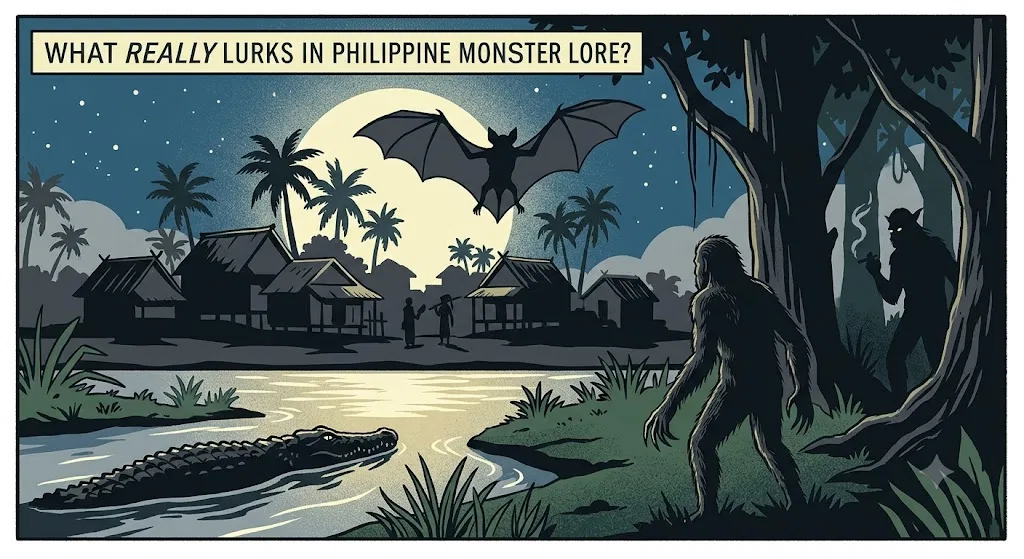
The most famous figure is the aswang, not one fixed species but a flexible category covering witches, corpse-eaters, animal-transformers and blood- or organ-feeding night creatures. Alongside it are beings such as the flying manananggal, the forest-dwelling tikbalang and kapre, and the ape-like Amomongo reported in Negros Occidental. Most belong principally to folklore rather than zoology. Yet the country’s dense forests, deep seas, enormous bats, unfamiliar nocturnal animals and genuinely gigantic crocodiles give its monster stories an unusually convincing natural backdrop. The result is a tradition in which old beliefs, frightening encounters, newspaper reporting and popular entertainment repeatedly reshape one another.
Folklore, cryptids and reported animals
Calling every Philippine legendary creature a cryptid can be misleading. In cryptozoology, a cryptid is normally presented as an undiscovered or unverified animal. Many Philippine beings are explicitly supernatural: they change shape, fly without biological means, detach parts of their bodies, curse people or act as spirits of particular places. These are better understood as folklore figures, even when witnesses describe encounters as real.
A useful distinction is:
- Folklore beings have established roles in inherited stories and belief systems. The aswang, tikbalang and kapre belong mainly here.
- Encounter traditions arise when people interpret noises, injuries, shadows or unusual animals through familiar folklore.
- Cryptid-style claims describe apparently physical creatures that might, at least in principle, be captured or photographed. The Amomongo is the clearest Philippine example.
- Known animals treated as monsters include giant crocodiles, oarfish, large snakes, bats and unfamiliar deep-sea species.
- Media creatures acquire standard appearances through films, comics, television reports and online retellings, even when older local accounts were much less consistent.
The boundaries are porous. Anthropological writing on the aswang describes it as a continuing “belief or near-belief” rather than merely a character in old tales. Accounts also differ sharply between provinces, reflecting the Philippines’ many languages, islands and local traditions. Researchers therefore warn against treating the aswang as one neatly defined monster with a universal appearance or behaviour.[ateneo.edu]archium.ateneo.eduCamarines Sur and Albay provinces in Bicol as a particular context of witchcraft unique to the…Read more…
Why the aswang dominates Philippine monster lore
The aswang is the country’s best-known monster because the name can absorb several different fears. Depending on the region and storyteller, an aswang may resemble a witch, vampire, ghoul, corpse-eater, human who becomes an animal, or predator that attacks pregnant women. Some traditions distinguish these beings carefully; popular media often group them together.
Written references extend back to the early Spanish colonial period, although those records must be read critically. Missionaries and colonial writers filtered Indigenous beliefs through European ideas about demons, witchcraft and paganism. By the late nineteenth century, observers were already noting that the term had become a general label for several otherwise distinct beings. Modern classifications similarly divide the tradition into categories such as vampires, organ-feeders, animal-transformers, ogres and harmful sorcerers.[Wikipedia]WikipediaOpen source on wikipedia.org.
The legend remained powerful because it places danger inside ordinary village life. The monster may look human during the day and live among its potential victims. Rather than attacking from a remote lake or unexplored mountain, it threatens households, pregnancies, funerals, travellers and social trust. Accusations can therefore attach themselves to neighbours, outsiders, healers or socially marginal people. That makes the tradition culturally important but also potentially harmful: a monster story can become a way of stigmatising a real person.
Capiz and the making of a “monster province”
The province of Capiz became particularly associated with aswang stories, although that reputation should not be mistaken for evidence of unusual creatures there. Repetition in jokes, films, television programmes and travel stories gradually turned a regional stereotype into something resembling a national brand.
Roxas City briefly attempted to reclaim that image through an Aswang Festival launched in the 2000s. Organisers promoted local food, crafts and tourism while trying to weaken the idea that Capiz was literally a haven for monsters. The strategy was controversial. Catholic leaders objected that the event appeared to celebrate witchcraft, while supporters regarded it as playful folklore and economic promotion. The dispute shows how a frightening tradition can become both an unwanted stigma and a marketable cultural asset.[aswangproject.com]aswangproject.comTHE ASWANG PROJECTASWANG FESTIVAL in Roxas City, Capiz | What Happened?April 27, 2015 — 27 Apr 2015 — The Aswang Festival's goal was to promote Capiz as a tourist destination while shaking the negative "aswan…
The manananggal and the monster in the sky
The manananggal is often treated as a type of aswang, though local classifications vary. Its familiar modern form is a woman whose upper body separates from the lower half at night, grows wings and flies in search of victims. Stories commonly describe an elongated tongue or feeding tube used to attack sleeping people, particularly pregnant women.
As a biological animal, this creature is impossible. Its importance lies instead in the way folklore gives physical form to anxieties about pregnancy, illness, nighttime vulnerability and the hidden identity of seemingly respectable neighbours. Cultural scholarship has also examined the monster’s reversal of expected bodily and maternal roles: the female body, ordinarily associated with childbirth and care, becomes divided and predatory.[eScholarship]escholarship.orge Scholarship Queer Aswang Transmedia: Folklore as Campe Scholarship Queer Aswang Transmedia: Folklore as Camp
Some sensory details may be reinforced by real nocturnal wildlife. The Philippines supports very large fruit bats, including flying foxes whose broad wings can look startling in poor light. Night birds, insects and mammals also produce unfamiliar calls around roofs, trees and plantations. None explains a body that splits in two, but they can supply the sound, movement and silhouette around which an inherited story takes shape.
This is a recurring pattern in monster reports. A witness does not necessarily invent an experience; rather, a genuine but ambiguous sight or noise is interpreted through the most culturally available explanation.
Forest beings: tikbalang and kapre
The tikbalang is usually portrayed as a tall, thin, horse-headed humanoid associated with mountains, forests and lonely roads. It is said to confuse travellers, cause them to lose their way or lead them repeatedly through the same landscape. The kapre is a much larger, darker and hairier tree-dwelling figure, often imagined smoking while seated in an enormous tree.
Neither is supported by physical evidence as an unknown animal. Their settings, however, are significant. Forest paths can become disorientating in darkness or heavy rain, especially where landmarks are obscured. Exhaustion, fear, changing weather and the tendency to walk in circles can make an ordinary episode of getting lost feel deliberate. A tale about a path-controlling creature turns environmental danger into an agent with motives.
The modern horse-headed appearance of the tikbalang also presents a historical puzzle because horses were introduced to the archipelago during the colonial period. Earlier traditions may have altered as new animals and images entered local life. This does not make the being a modern invention; folklore routinely changes its visual vocabulary while preserving an older function, such as misleading travellers or guarding wild places.
Tree spirits and giants likewise express a practical relationship with the landscape. Large old trees are visible landmarks, wildlife habitats and potentially dangerous places during storms. Stories about resident beings may encourage caution, respect or ritual behaviour around them. The National Museum of the Philippines similarly describes nature-associated spirits as guardians of forests, mountains and other natural features, illustrating how legendary beings can encode relationships between communities and place.[nationalmuseum.gov.ph]nationalmuseum.gov.phOpen source on nationalmuseum.gov.ph.
The Amomongo attacks in Negros
The Amomongo is the strongest Philippine candidate for a cryptid in the narrower, animal-like sense. It is described in parts of Negros as a hairy, human-sized, ape-like creature with long claws or nails. Unlike the manananggal, it is not normally said to divide its body, cast spells or become invisible. It behaves more like a dangerous wild animal.
The story gained national attention after incidents in Barangay Sag-ang, La Castellana, Negros Occidental, in June 2008. Two men, Elias Galvez and Salvador Aguilar, reported separate attacks by a hairy creature. Residents also blamed it for injuries to livestock and for chickens or goats reportedly found with their internal organs eaten. The local police chief confirmed that villagers had made reports, while later retellings described scratches sustained by the men and a pale or whitish, roughly human-sized attacker.[wikipedia.org]WikipediaOpen source on wikipedia.org.
The case has several elements that make a cryptid story memorable: named witnesses, visible injuries, dead animals, a precise village and a short period of concentrated alarm. What it lacks is equally important. No clear photograph, body, hair sample, footprint cast or independently examined biological trace established the presence of an unknown primate. Later accounts mostly repeat the original reports rather than adding new evidence.
A surviving ape population would also create a major zoological problem. The Philippines has native tarsiers and long-tailed macaques, but no recognised native gorillas, orangutans or other large non-human apes. A breeding population of human-sized apes would be expected to leave droppings, bones, feeding signs, DNA and repeated observations. An escaped captive primate is conceivable in an individual incident, but no such animal was identified.
More ordinary candidates include a macaque seen badly, a large dog, a person, injuries caused during panic, or attacks on livestock by known predators or scavengers. None can be proven from the available reporting. The fairest verdict is therefore not “unknown ape confirmed”, but an unresolved local animal scare amplified by an existing folkloric name.
Real animals that look like monsters
Philippine wildlife regularly produces objects and encounters that need little embellishment to seem fantastic.

Giant crocodiles
Saltwater crocodiles are real, dangerous and capable of extraordinary size. The most famous Philippine example was Lolong, captured near Bunawan in Agusan del Sur in 2011. He measured 6.17 metres and weighed more than a tonne, becoming the largest crocodile then held in captivity. After his death in 2013, his preserved remains became a major display at the National Museum of Natural History.[wikipedia.org]WikipediaOpen source on wikipedia.org.
Lolong matters to cryptid history because he demonstrates that some “giant reptile” reports need no unknown species. In remote wetlands, observers may see only eyes, a wake, part of a back or an enormous head. Estimates made from boats or riverbanks can easily grow in retelling, but the animal underneath the story may still be genuinely huge.
The capture also transformed fear into tourism. Bunawan developed an attraction around Lolong, while the crocodile later became a museum specimen and national natural-history icon. This is the clearest Philippine example of a supposed monster-sized animal passing from rumour and pursuit into measurement, display and public memory.
Oarfish and sea-serpent impressions
Oarfish are long, ribbon-shaped deep-sea fish that sometimes appear near the surface or wash ashore. Their elongated bodies, red fins and undulating movement are plausible sources for some sea-serpent imagery. They are known animals, but their rarity means that many people first encounter them as startling carcasses or viral photographs.
In the Philippines and elsewhere around the Pacific, oarfish appearances are sometimes linked online to earthquakes. Six were reported before a destructive 2017 earthquake in the southern Philippines, a coincidence frequently repeated as evidence of prediction. Scientific analysis has not established such a relationship. A study of deep-sea fish appearances and earthquakes found the supposed pattern consistent with an illusory correlation: memorable coincidences are retained while non-matches are forgotten.[abc7news.com]abc7news.comABC7 San Francisco Divers discover giant oarfish off coast of Taiwan, seen asABC7 San Francisco Divers discover giant oarfish off coast of Taiwan, seen as
Other possible “sea monsters” include whale sharks, whales, large rays, crocodiles entering coastal water, floating logs and groups of animals surfacing in a line. Tropical decomposition can also turn familiar carcasses into apparently unclassifiable masses when skin, hair and internal tissues break down unevenly.
Monster flaps and the growth of a sighting
A monster flap is a burst of reports concentrated in one area and period. The Amomongo alarm is one example, but the same pattern can occur whenever a frightening report gives residents a new explanation for ambiguous events.
The sequence often works like this:
- A person sees or experiences something alarming.
- The report circulates through neighbours, radio, television or social media.
- People begin watching for the creature.
- Ordinary sounds, damaged livestock or distant animals are interpreted within the new story.
- Descriptions become more consistent because witnesses learn what the creature is “supposed” to look like.
- Interest fades when no decisive evidence appears or another story replaces it.
This does not require deliberate lying. Expectation changes attention and memory. A witness who heard a roof scrape before the story spread may remember it later as part of the same creature’s activity. Journalists also favour memorable details, so the most vivid version can become the standard account even when early testimony was uncertain.
Modern online circulation accelerates the process. Old images are reposted without dates; animals photographed in other countries are relabelled as Philippine discoveries; computer-generated creatures are separated from their original context. Claims supported only by cropped clips, unattributed screenshots or repeated captions should therefore be treated more cautiously than reports with identifiable witnesses, locations and original records.

When folklore became psychological warfare
One of the darkest episodes in Philippine monster history concerns the Huk rebellion of the early 1950s. Accounts associated with American military adviser and intelligence operative Edward Lansdale describe a psychological operation that exploited fear of the aswang.
According to Lansdale’s later account, rumours were spread that an aswang inhabited an area used by Huk guerrillas. A captured fighter was allegedly killed, his body punctured and drained of blood, then left where his companions would find it. The corpse was intended to make the monster story appear real and frighten the unit away. The episode has been widely repeated in histories of covert action and psychological warfare, although many popular versions simplify the political context or treat Lansdale’s memoir-like narrative as if every detail were independently documented. A declassified biographical discussion from the CIA archive and later historical summaries confirm the central association between Lansdale, the Huk campaign and the deliberate use of local supernatural belief.[Wikipedia]WikipediaEdward LansdaleEdward Lansdale
The incident is important because it shows that monster belief was not merely entertainment. Authorities understood that familiar folklore could influence movement, morale and perceptions of danger. In this case, the “evidence” for the monster was reportedly manufactured through violence.
From village fear to comics and television
Philippine monsters have moved far beyond oral storytelling. They have appeared in horror films, children’s books, comics, advertising, festivals and television investigations. These adaptations preserve the creatures but also standardise them. A being that once varied from village to village acquires a recognisable face, set of powers and origin story.
A prominent recent example is Trese, based on the comics by Budjette Tan and Kajo Baldisimo and released internationally as an animated Netflix series in 2021. Its urban supernatural setting includes aswang clans and other beings drawn from Philippine traditions. The series presents folklore not as a relic of remote villages but as part of a modern metropolis shaped by crime, politics and family loyalties.[Netflix]netflix.comOpen source on netflix.com.
This pop-cultural afterlife has two effects. It introduces international audiences to Philippine traditions, but it can also blur regional differences. Viewers may assume that every creature has one authoritative form when the older record is full of contradictions. The most useful approach is to enjoy the modern version while recognising it as an adaptation rather than a definitive catalogue of national belief.
What the evidence supports
No Philippine monster tradition currently provides strong mainstream evidence for an undiscovered giant vertebrate. The most famous creatures are supernatural folklore figures, while the best-known animal-like case, the Amomongo, rests on testimony and reported injuries without diagnostic physical material.
That does not make the subject empty. Philippine monster lore preserves several different kinds of history at once:
- local ways of describing dangerous forests, roads, pregnancies and nighttime sounds;
- changing relationships with wildlife and wild places;
- colonial attempts to classify Indigenous beliefs as demonology;
- regional stereotypes, particularly the association of Capiz with the aswang;
- newspaper and television processes that turn isolated incidents into creature flaps;
- tourism and entertainment that convert fear into cultural identity;
- and deliberate manipulation, as in the reported use of aswang belief during counter-insurgency.
The most convincing “monsters” are sometimes the known animals. Lolong proved that a reptile large enough to sound exaggerated could be caught and measured. Oarfish show how a real deep-sea species can resemble a traditional sea serpent. Bats, macaques, birds and nocturnal mammals can provide the sensory spark for encounters interpreted through older stories.
Philippine mystery creatures are therefore best understood neither as confirmed zoological discoveries nor as meaningless superstition. They form a living meeting point between landscape, memory, fear, wildlife and storytelling. The strange claim may fail as evidence for a new species while remaining valuable evidence about how people make sense of danger—and how a country’s monsters change when they enter newspapers, museums, festivals and global popular culture.
Amazon book picks
Further Reading
Books and field guides related to What Really Lurks in Philippine Monster Lore?. Use these as the next step if you want deeper reading beyond the article.
The Aswang Complex in Philippine Folklore
Focused study of the Philippines' most famous monster tradition.
Creatures of Philippine Lower Mythology
Directly covers aswangs, kapre, tikbalang, and related beings.
Field Guide To Bigfoot, Yeti, & Other Mystery Primates Worldwide
Supports readers interested in mystery-animal reports.
eBay marketplace picks
Marketplace Samples
Live-tested eBay searches with available results related to this page.
Endnotes
1.
Source: archium.ateneo.edu
Link:https://archium.ateneo.edu/cgi/viewcontent.cgi?article=1209&context=socialtransformations
Source snippet
Camarines Sur and Albay provinces in Bicol as a particular context of witchcraft unique to the...Read more...
2.
Source: journal.usep.edu.ph
Link:https://journal.usep.edu.ph/index.php/Southeastern_Philippines_Journal/article/download/143/69/1144
Source snippet
A case study of Philippine creature urban legendsby J Casibual · 2022 · Cited by 5 — The relevance of creatures in urban legends is refle...
3.
Source: Wikipedia
Link:https://en.wikipedia.org/wiki/Aswang
4.
Source: philstar.com
Title: capiz also tourist haven
Link:https://www.philstar.com/opinion/2008/10/30/411047/capiz-also-tourist-haven
Source snippet
Capiz also a tourist haven30 Oct 2008 — Launched in 2003, the annual festival has three main objectives: one, to reverse the negative ima...
5.
Source: escholarship.org
Title: e Scholarship Queer Aswang Transmedia: Folklore as Camp
Link:https://escholarship.org/content/qt3mj1k076/qt3mj1k076.pdf
6.
Source: nationalmuseum.gov.ph
Link:https://www.nationalmuseum.gov.ph/category/uncategorized/page/43/
7.
Source: Wikipedia
Link:https://en.wikipedia.org/wiki/Tikbalang
8.
Source: Wikipedia
Link:https://en.wikipedia.org/wiki/Amomongo
9.
Source: Wikipedia
Link:https://en.wikipedia.org/wiki/Lolong
10.
Source: newsinfo.inquirer.net
Title: lolong back as star at natl museum of natural history
Link:https://newsinfo.inquirer.net/992214/lolong-back-as-star-at-natl-museum-of-natural-history
11.
Source: factcheck.afp.com
Link:https://factcheck.afp.com/doc.afp.com.37DH6NR
12.
Source: Wikipedia
Title: Edward Lansdale
Link:https://en.wikipedia.org/wiki/Edward_Lansdale
13.
Source: cia.gov
Link:https://www.cia.gov/readingroom/docs/CIA-RDP84-00499R000200080001-6.pdf
14.
Source: netflix.com
Link:https://www.netflix.com/title/81012541
15.
Source: Wikipedia
Link:https://en.wikipedia.org/wiki/Trese_%28TV_series%29
16.
Source: nationalmuseum.gov.ph
Link:https://www.nationalmuseum.gov.ph/the-blue-and-whites-of-kanduli-shoal-shipwreck/
17.
Source: nationalmuseum.gov.ph
Link:https://www.nationalmuseum.gov.ph/author/nationalmuseumgmail-com/page/55/
18.
Source: nationalmuseum.gov.ph
Link:https://www.nationalmuseum.gov.ph/our-museums/national-museum-of-natural-history/
19.
Source: nationalmuseum.gov.ph
Link:https://www.nationalmuseum.gov.ph/page/60/?m=wap
20.
Source: library.nationalmuseum.gov.ph
Link:https://library.nationalmuseum.gov.ph/digital-collection/digi/TF01/2015/TF01T0000041.pdf
21.
Source: library.nationalmuseum.gov.ph
Link:https://library.nationalmuseum.gov.ph/digital-collection/digi/TF01/2016/TF01T0000065.pdf
22.
Source: library.nationalmuseum.gov.ph
Link:https://library.nationalmuseum.gov.ph/digital-collection/digi/IG01/2014/IG01T0000015/IG01T0000015.pdf
23.
Source: Wikipedia
Title: List of Philippine mythological creatures
Link:https://en.wikipedia.org/wiki/List_of_Philippine_mythological_creatures
24.
Source: Wikipedia
Title: List of primates
Link:https://en.wikipedia.org/wiki/List_of_primates
25.
Source: military.com
Title: cold war operation used vampire folklore to intimidate philippine insurgents
Link:https://www.military.com/cold-war-operation-used-vampire-folklore-to-intimidate-philippine-insurgents
26.
Source: asj.upd.edu.ph
Link:https://www.asj.upd.edu.ph/mediabox/archive/ASJ-05-01-1967/jocano-filipino-catholicism-case-study-religious-change.pdf
27.
Source: aswangproject.com
Title: THE ASWANG PROJECTASWANG FESTIVAL in Roxas City, Capiz | What Happened?
Link:https://www.aswangproject.com/aswang-festival/
Source snippet
April 27, 2015 — 27 Apr 2015 — The Aswang Festival's goal was to promote Capiz as a tourist destination while shaking the negative "aswan...
Published: April 27, 2015
28.
Source: gmanetwork.com
Link:https://www.gmanetwork.com/news/topstories/nation/19116/church-wants-to-stop-aswang-festival-in-capiz/story/
Source snippet
GMA NetworkChurch wants to stop 'Aswang Festival' in Capiz28 Oct 2006 — The Archdiocese of Capiz wants a stop to the annual "Aswang Festi...
29.
Source: sunstar.com.ph
Title: is amomongo the bigfoot version of the philippines
Link:https://www.sunstar.com.ph/cebu/feature/is-amomongo-the-bigfoot-version-of-the-philippines
30.
Source: aswangproject.com
Link:https://www.aswangproject.com/amomongo/
31.
Source: abc7news.com
Title: ABC7 San Francisco Divers discover giant oarfish off coast of Taiwan, seen as
Link:https://abc7news.com/post/oarfish-creature-sea-animal-fish/13524337/
32.
Source: fiction-taxonomy.fandom.com
Link:https://fiction-taxonomy.fandom.com/wiki/Amomongo
33.
Source: aswangproject.com
Title: philippine cryptids cryptozoology
Link:https://www.aswangproject.com/philippine-cryptids-cryptozoology/
34.
Source: aswangproject.com
Title: creatures mythical beings philippine folklore mythology
Link:https://www.aswangproject.com/creatures-mythical-beings-philippine-folklore-mythology/
35.
Source: aswangproject.com
Title: aswang lore transferring the black chick
Link:https://www.aswangproject.com/aswang-lore-transferring-the-black-chick/
36.
Source: aswangproject.com
Title: etymology aswang
Link:https://www.aswangproject.com/etymology-aswang/
37.
Source: scribd.com
Title: THE ASWANG PROJ
Link:https://www.scribd.com/document/479354990/THE-ASWANG-PROJ
38.
Source: tilife.org
Title: Sea Serpent
Link:https://tilife.org/BackIssues/Archive/tabid/393/articleType/ArticleView/articleId/2254/Sea-Serpent.html
39.
Source: scholarworks.bgsu.edu
Link:https://scholarworks.bgsu.edu/cgi/viewcontent.cgi?article=2067&context=honorsprojects
40.
Source: phspirits.com
Link:https://phspirits.com/trese/
41.
Source: read.thebenildean.org
Title: netflixs trese entering the mythical side of manila
Link:https://www.read.thebenildean.org/2021/06/netflixs-trese-entering-the-mythical-side-of-manila
Additional References
42.
Source: kyotoreview.org
Link:https://kyotoreview.org/issue-12/in-search-of-aswang-a-ghost-story-monster-and-sorcerer-in-philippine-society/
Source snippet
Kyoto Review of Southeast AsiaIn Search of Aswang: A Ghost Story, Monster and Sorcerer...by K AZUMA · Cited by 3 — Aswang is a supernatu...
43.
Source: youtube.com
Title: The Amomongo: Philippines’ Mysterious Wild Ape – Fact or Folklore?
Link:https://www.youtube.com/watch?v=GIPd0N7HdSo
Source snippet
Aswangs of the CIA, Philippines | Folklore & History | Documentary...
44.
Source: youtube.com
Title: The Aswang: The Most Feared Monster in the Philippines
Link:https://www.youtube.com/watch?v=Co8IwR0QUMs
Source snippet
Mythological Monsters & Cryptids from the Philippines...
45.
Source: youtube.com
Title: THE ASWANG PHENOMENON Documentary Part 1 of 5
Link:https://www.youtube.com/watch?v=nbmDHXMBMtM
Source snippet
The Amomongo: Philippines' Mysterious Wild Ape – Fact or Folklore?...
46.
Source: youtube.com
Title: Mythological Monsters & Cryptids from the Philippines
Link:https://www.youtube.com/watch?v=LbpI92TdxFs
Source snippet
THE ASWANG PHENOMENON Documentary Part 1 of 5...
47.
Source: researchgate.net
Link:https://www.researchgate.net/publication/322765591_Sightings_of_the_Oceanic_oarfish_Regalicus_spp_Teleostei_Lampridiformes_are_primarily_found_in_the_region_of_tectonic_plate_boundaries
48.
Source: researchgate.net
Link:https://www.researchgate.net/publication/397433052_Frank_Xavier_Lynch_SJ_Ang_mga_Aswang_A_Bicol_Belief_in_Philippine_Society_and_the_Individual_Selected_Essays_of_Frank_Lynch_edited_by_Aram_A_Yengoyan_and_Perla_Q_Makil_184-206_Quezon_City_Institute_of
49.
Source: facebook.com
Link:https://www.facebook.com/DUHHfans/posts/a-monster-from-filipino-folkloreaswang-mythology-philippines/1070223867795730/
50.
Source: scribd.com
Link:https://www.scribd.com/document/415477796/Historiographic-Study-on-the-Aswang-from
51.
Source: medium.com
Link:https://medium.com/%40scaremesam/beware-the-tik-tik-the-aswang-and-other-monsters-of-the-philippines-720595cd3690
Topic Tree
Follow this branch
Related pages 192
- Antigua Cryptids
- Maldives Monsters
- Malta Monsters
- Qatar Monsters
- Argentina Monsters
- +187 more in sidebar