Within Monaco Monsters
Can Monaco Protect Its Real Sea Giants?
Monaco's modern monster story is about protecting real marine giants from ship strikes, noise, pollution, bycatch and climate change.
On this page
- Why the Pelagos Sanctuary was created
- The marine mammals living around Monaco
- Threats from ships, fishing and climate change
Page outline Jump by section
Introduction
Monaco’s most important modern “sea monster” story is not about an unknown creature lurking offshore. It is about something far more tangible: whether one of the busiest stretches of the Mediterranean can continue to support some of Europe’s largest marine animals. Just beyond Monaco’s coastline lies the Pelagos Sanctuary, a vast protected area created jointly by Monaco, France and Italy to safeguard whales, dolphins and their habitat. Covering roughly 87,500 square kilometres of the north-western Mediterranean, it was established because scientists recognised that this region supports an unusually rich concentration of marine mammals, including fin whales, sperm whales and several dolphin species.[accobams.org]accobams.orgUPDATED OVERVIEW OF THE NOISE HOTSPOTS IN THE…November 14, 2022 — 29 Nov 2022 — The Pelagos Sanctuary for Mediterranean Marine…
For a country often associated with yachts, harbours and luxury tourism, Monaco also sits beside one of the Mediterranean’s most significant wildlife refuges. The challenge today is that these giants are increasingly threatened not by hunters or mythical sea serpents, but by ship strikes, underwater noise, pollution, fishing pressures and climate change.[pelagos-sanctuary.org]pelagos-sanctuary.orgPelagos SanctuaryThreats8 May 2025 — The Pelagos Sanctuary and contiguous areas are known to be hot spots for ship collisions with fin wh…
Why the Pelagos Sanctuary Was Created
The waters between south-eastern France, Monaco, Corsica and north-western Italy form a productive marine ecosystem where deep underwater canyons and nutrient-rich conditions attract large marine mammals. Research conducted during the late twentieth century revealed unexpectedly high densities of cetaceans—whales, dolphins and porpoise relatives—in this part of the Mediterranean. Those findings helped drive calls for a dedicated international conservation area.[Tethys Research Institute]tethys.orgTethys Research InstituteConservationThe Pelagos Sanctuary. Tethys was the first to propose the creation of a transboundary area for the…
The result was the Pelagos Sanctuary for Mediterranean Marine Mammals, established through a tripartite agreement between France, Italy and Monaco in 1999 and later recognised as a specially protected area of Mediterranean importance. Unlike many marine reserves, it includes both territorial waters and areas of the high seas, reflecting the reality that whales and dolphins do not recognise national boundaries.[accobams.org]accobams.orgUPDATED OVERVIEW OF THE NOISE HOTSPOTS IN THE…November 14, 2022 — 29 Nov 2022 — The Pelagos Sanctuary for Mediterranean Marine…
This makes the sanctuary unusual in conservation history. It was one of the first large transboundary protected areas in the Mediterranean devoted specifically to marine mammals. Rather than protecting a single species, its purpose is to preserve an entire ecosystem used for feeding, migration, breeding and social behaviour.[initiativepelagos.org]initiativepelagos.orgCovering 87,500 km2 between France…
For Monaco, the sanctuary also reflects a long-standing national connection to marine science. The principality’s oceanographic institutions helped foster awareness that the region’s most remarkable animals were not legends but living species requiring active protection.
Which Giants Live Around Monaco?
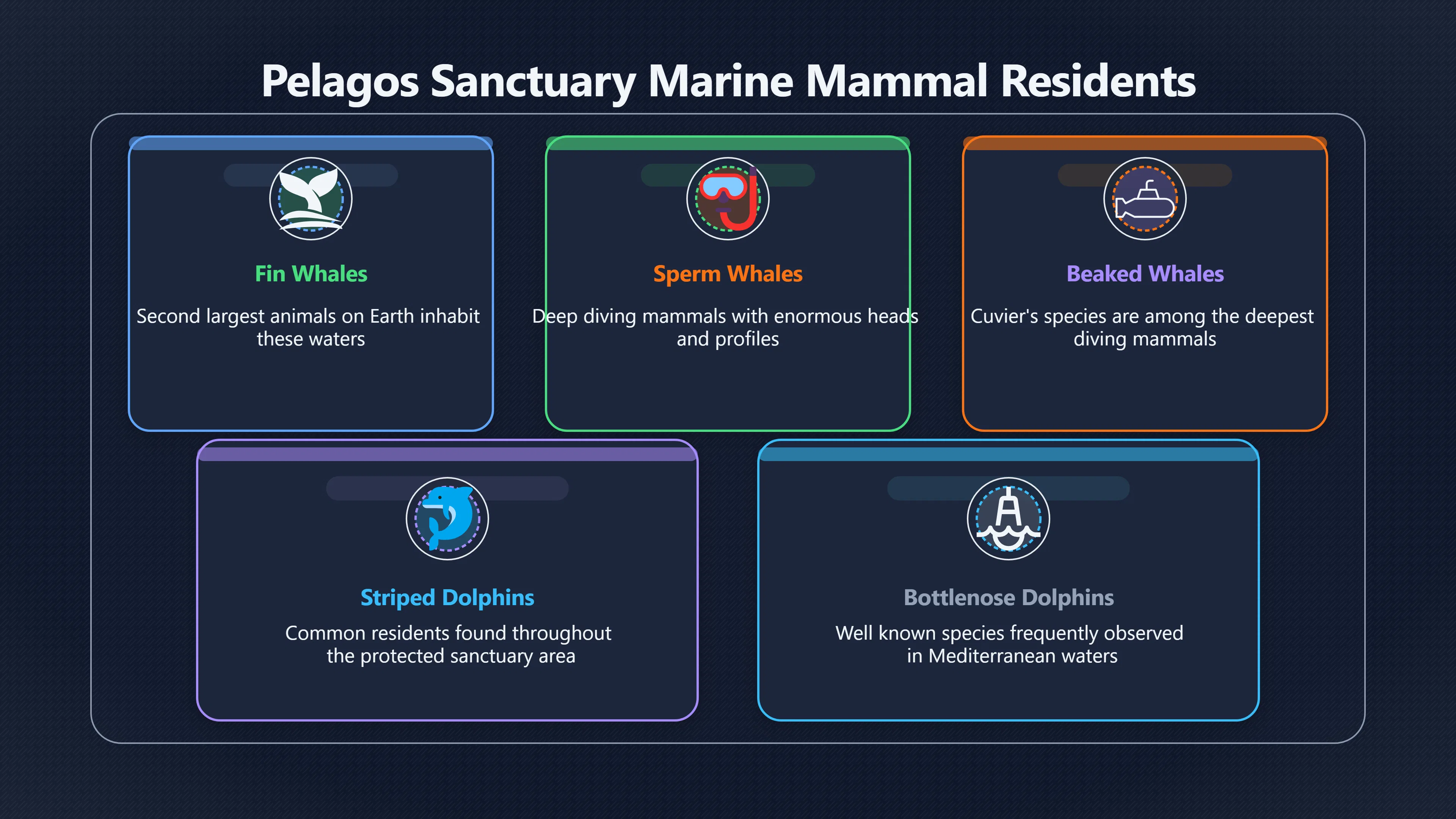
The Pelagos Sanctuary regularly hosts eight commonly observed species of whales and dolphins, although a greater number of cetacean species have been recorded across the wider area. The best-known residents include:[pelagos-sanctuary.org]pelagos-sanctuary.orgOpen source on pelagos-sanctuary.org.
- Fin whales, the second-largest animals on Earth after blue whales.
- Sperm whales, famous for their enormous heads and deep-diving abilities.
- Cuvier’s beaked whales, among the deepest-diving mammals known.
- Long-finned pilot whales.[pelagos-sanctuary.org]pelagos-sanctuary.orgSource details in endnotes.
- Striped dolphins.
- Bottlenose dolphins.
- Common dolphins.
- Risso’s dolphins.[pelagos-sanctuary.org]pelagos-sanctuary.orgOpen source on pelagos-sanctuary.org.
The fin whale is particularly important. The north-western Mediterranean serves as a critical feeding area for a distinct Mediterranean population, making the sanctuary one of the species’ most significant habitats in Europe.[IWC CRM and InforMEA]crm.iwc.intCRM and Infor MEAFranceCRM and Infor MEAFrance
These animals help explain why older generations of sailors sometimes reported “sea monsters”. A surfacing fin whale can appear as a long dark shape breaking the water repeatedly. A sperm whale’s broad back and unusual profile can look unfamiliar from a distance. Before modern marine biology became widespread, fleeting encounters with such animals often fuelled speculation about giant unknown creatures.
Today, however, researchers know that the region’s true marvels are not mysterious beasts but real cetaceans whose behaviour is still being studied. Citizen-science programmes, whale-watching surveys and long-term monitoring projects continue to reveal new information about their movements and ecology.[Tethys Research Institute]whalesanddolphins.tethys.orgOpen source on tethys.org.
Why Are Monaco’s Sea Giants Disappearing?
The sanctuary was created because protection was needed, but creating a protected area does not automatically remove threats.
Ship Strikes
One of the most serious dangers comes from collisions with vessels. The north-western Mediterranean contains major commercial shipping routes, ferry traffic and recreational boating activity. Fin whales and sperm whales are particularly vulnerable because of their size and surface behaviour. Researchers identify the Pelagos region as a hotspot for whale-ship collisions, and conservation groups have repeatedly warned that these incidents can undermine recovery of vulnerable populations.[pelagos-sanctuary.org]pelagos-sanctuary.orgPelagos SanctuaryThreats8 May 2025 — The Pelagos Sanctuary and contiguous areas are known to be hot spots for ship collisions with fin wh…
The problem is especially striking because the sanctuary exists in waters heavily used by people. A whale may be protected by international agreements, yet still face daily risks from passing ships.
Fishing and Bycatch
Fishing activity creates additional pressure. Cetaceans can become entangled in fishing gear, while some fishing practices reduce prey availability. Conservation agreements covering Mediterranean whales and dolphins identify accidental capture, entanglement and broader fishing impacts as significant threats across the region.[CMS]cms.intACCOBAMSThus, cetaceans undergo the impacts of pollution (chemical, noise and marine debris), of navigation (risk of vessel collisions…
Historically, illegal driftnets were also recognised as a serious danger for large whales within the sanctuary.[Pelagos Sanctuary]pelagos-sanctuary.orgPelagos SanctuaryThreats8 May 2025 — The Pelagos Sanctuary and contiguous areas are known to be hot spots for ship collisions with fin wh…
Noise and Pollution
The Mediterranean is one of the world’s busiest enclosed seas. For animals that rely heavily on sound, underwater noise can be a major problem.
Whales and dolphins use clicks, whistles and calls to communicate, navigate and locate food. Increased shipping traffic, industrial activity and some marine surveys can interfere with these behaviours. Studies of Mediterranean conservation planning identify underwater noise as a growing concern for cetacean populations.[accobams.org]accobams.orgUPDATED OVERVIEW OF THE NOISE HOTSPOTS IN THE…November 14, 2022 — 29 Nov 2022 — The Pelagos Sanctuary for Mediterranean Marine…
Chemical pollution is another challenge. Research has documented toxicological stress in cetaceans living within the Pelagos Sanctuary, demonstrating that even protected marine mammals remain exposed to contaminants moving through the marine food chain.[ScienceDirect]sciencedirect.comOpen source on sciencedirect.com.
How Climate Change Complicates Protection
Climate change adds a more complex and less visible threat.
The sanctuary was designed around a highly productive ecosystem rich in plankton and other marine life. Changes in sea temperature, ocean circulation and prey distribution can alter where whales find food and how they use the area. Conservationists increasingly recognise that protected boundaries alone cannot guarantee protection if the ecological conditions that attracted the animals begin to shift.[Pelagos Initiative]initiativepelagos.orgCovering 87,500 km2 between France…
This creates a difficult question for Monaco and its partners. A sanctuary can reduce direct human pressures, but it cannot by itself stop warming seas. Long-term conservation increasingly depends on adapting management strategies as marine ecosystems change.

Can the Sanctuary Succeed?
The Pelagos Sanctuary represents an unusual conservation experiment. Rather than protecting a remote wilderness, it attempts to safeguard large marine mammals in a region surrounded by ports, shipping lanes, tourism and densely populated coastlines.[Tethys Research Institute]tethys.orgTethys Research InstituteCSR Study AreaThe Pelagos Sanctuary for Mediterranean Marine Mammals is a transboundary marine protected area co…
Its achievements are real. The sanctuary has created a framework for international cooperation, scientific monitoring, public education and marine-mammal conservation across national borders. Whale-watching programmes, citizen-science initiatives and research campaigns have generated valuable knowledge about species that were once poorly understood in Mediterranean waters.[frontiersin.org]frontiersin.orgOpen source on frontiersin.org.
Yet the story remains unfinished. Reports of declining fin whale abundance in parts of the sanctuary, continuing ship-strike concerns and the mounting pressures of climate change show that protection is an ongoing process rather than a solved problem.[marinemammalhabitat.org]marinemammalhabitat.orgOpen source on marinemammalhabitat.org.
For readers interested in Monaco’s relationship with sea monsters and marine mysteries, the most remarkable creatures offshore are not legendary at all. They are the fin whales, sperm whales and dolphins that still inhabit the waters beyond the principality—and whose survival now depends on whether one of the Mediterranean’s most ambitious conservation projects can keep pace with the pressures of the modern sea.[Pelagos Sanctuary]pelagos-sanctuary.orgOpen source on pelagos-sanctuary.org.
Amazon book picks
Further Reading
Books and field guides related to Can Monaco Protect Its Real Sea Giants?. Use these as the next step if you want deeper reading beyond the article.
The Cultural Lives of Whales and Dolphins
Directly relates to whales and dolphins protected near Monaco.
eBay marketplace picks
Marketplace Samples
Live-tested eBay searches with available results related to this page.
Endnotes
1.
Source: accobams.org
Link:https://accobams.org/wp-content/uploads/2022/11/MOP8.Inf43_Noise-Hotspots-V2.pdf
Source snippet
UPDATED OVERVIEW OF THE NOISE HOTSPOTS IN THE...November 14, 2022 — 29 Nov 2022 — The Pelagos Sanctuary for Mediterranean Marine...
Published: November 14, 2022
2.
Source: tethys.org
Link:https://www.tethys.org/cetacean-sanctuary-research/csr-research/csr-study-area/
Source snippet
Tethys Research InstituteCSR Study AreaThe Pelagos Sanctuary for Mediterranean Marine Mammals is a transboundary marine protected area co...
3.
Source: pelagos-sanctuary.org
Link:https://pelagos-sanctuary.org/threats/
Source snippet
Pelagos SanctuaryThreats8 May 2025 — The Pelagos Sanctuary and contiguous areas are known to be hot spots for ship collisions with fin wh...
Published: May 2025
4.
Source: cms.int
Link:https://www.cms.int/legalinstrument/accobams
Source snippet
ACCOBAMSThus, cetaceans undergo the impacts of pollution (chemical, noise and marine debris), of navigation (risk of vessel collisions...
5.
Source: wwwcdn.imo.org
Link:https://wwwcdn.imo.org/localresources/en/KnowledgeCentre/IndexofIMOResolutions/MEPCDocuments/MEPC.380%2880%29.pdf
Source snippet
RESOLUTION MEPC.380(80) (adopted on 7 July 2023)...7 Jul 2023 — To minimize the risk of ship strikes with cetaceans and ship-generate...
Published: July 2023
6.
Source: tethys.org
Link:https://www.tethys.org/activities/conservation/
Source snippet
Tethys Research InstituteConservationThe Pelagos Sanctuary. Tethys was the first to propose the creation of a transboundary area for the...
7.
Source: researchgate.net
Title: 227726158 The Pelagos Sanctuary for Mediterranean Marine Mammals
Link:https://www.researchgate.net/publication/227726158_The_Pelagos_Sanctuary_for_Mediterranean_Marine_Mammals
8.
Source: whalesanddolphins.tethys.org
Link:https://whalesanddolphins.tethys.org/pelagos-sanctuary-blue-carbon-sink/
9.
Source: pelagos-sanctuary.org
Link:https://pelagos-sanctuary.org/
10.
Source: whalesanddolphins.tethys.org
Link:https://whalesanddolphins.tethys.org/join-us/cetacean-sanctuary-research/csr-research/
11.
Source: pelagos-sanctuary.org
Link:https://pelagos-sanctuary.org/species/
12.
Source: crm.iwc.int
Title: CRM and Infor MEAFrance
Link:https://crm.iwc.int/data/france-conservation-database
13.
Source: whalesanddolphins.tethys.org
Link:https://whalesanddolphins.tethys.org/
14.
Source: rac-spa.org
Title: wg502 05 draft updated ap cetaceans
Link:https://www.rac-spa.org/meetings/nfp15/nfp_docs/wg502_05_draft_updated_ap_cetaceans.pdf
15.
Source: sciencedirect.com
Link:https://www.sciencedirect.com/science/article/abs/pii/S0025326X13000696
16.
Source: researchgate.net
Link:https://www.researchgate.net/publication/288074375_Fin_whale_seasonal_trends_in_the_Pelagos_Sanctuary_Mediterranean_Sea
17.
Source: journal.iwc.int
Link:https://journal.iwc.int/index.php/jcrm/article/download/352/388/4367
18.
Source: youtube.com
Title: PELAGOS SANCTUARY
Link:https://www.youtube.com/watch?v=YvnPUxq4nfU
19.
Source: youtube.com
Title: PELAGOS Sanctuary
Link:https://www.youtube.com/watch?v=bfpRi-zMEKo
Source snippet
The Pelagos Sanctuary for Mediterranean Marine Mammal, aims and goals [1/4]...
20.
Source: initiativepelagos.org
Link:https://www.initiativepelagos.org/en/index
Source snippet
Covering 87,500 km2 between France...
21.
Source: frontiersin.org
Link:https://www.frontiersin.org/journals/marine-science/articles/10.3389/fmars.2020.596848/full
22.
Source: marinemammalhabitat.org
Link:https://www.marinemammalhabitat.org/wp-content/uploads/imma-factsheets/Mediterranean/North-Western-Mediterranean-Sea-Slope-and-Canyon-System-Mediterranean.pdf
23.
Source: wwfmmi.org
Link:https://www.wwfmmi.org/what_we_do/wildlife/the_pelagos_sanctuary/
24.
Source: worldrise.org
Title: pelagos sanctuary
Link:https://worldrise.org/en/pelagos-sanctuary/
25.
Source: wewhale.co
Title: the pelagos sanctuary
Link:https://wewhale.co/2022/10/06/the-pelagos-sanctuary/
Additional References
26.
Source: youtube.com
Title: The Pelagos Sanctuary for Mediterranean Marine Mammal, aims and goals [1/4]
Link:https://www.youtube.com/watch?v=4G1DXUk02Ys
Source snippet
Sanctuaire Pelagos: Territoires partagés, biodiversité à protéger...
27.
Source: youtube.com
Title: Sanctuaire Pelagos: Territoires partagés, biodiversité à protéger
Link:https://www.youtube.com/watch?v=GVsywoCu6Qo
Source snippet
SAvE Whales: Protecting Sperm Whales in the Kythira Strait (EN)...
28.
Source: vliz.be
Link:https://www.vliz.be/imisdocs/publications/235770.pdf
Source snippet
Vlaams Instituut voor de ZeeThe Pelagos Sanctuary for Mediterranean marine mammalsby G NOTARBARTOLO-DI-SCIARA · 2007 · Cited by 308 — The...
29.
Source: amnh.org
Link:https://www.amnh.org/content/download/141364/2285404/file/the-pelagos-sanctuary-for-mediterranean-marine-mammals.pdf
30.
Source: cbd.int
Link:https://www.cbd.int/doc/meetings/mar/ebsaws-2014-03/other/ebsaws-2014-03-submission-monaco-en.pdf
31.
Source: facebook.com
Link:https://www.facebook.com/FondationPrinceAlbertIIdeMonaco/posts/how-well-do-we-really-know-the-sea-just-beyond-our-coastlinespanning-87500-km%C2%B2-b/1453675656801564/
32.
Source: cotedazurfrance.com
Link:https://cotedazurfrance.com/discover/eco-tourism/harmony-and-exceptional-biodiversity-in-the-pelagos-sanctuary/
33.
Source: instagram.com
Link:https://www.instagram.com/p/DZu7CIKDggE/
34.
Source: pelagosdiscovery.it
Link:https://www.pelagosdiscovery.it/en/cetaceans-of-the-mediterranean
35.
Source: comune.viareggio.lu.it
Link:https://www.comune.viareggio.lu.it/dam/jcr%3A429b2e39-9a33-4931-8866-5c5613ed4e12
Topic Tree