Austria's Monsters Between Folklore and Evidence
Austria’s mystery-creature tradition is less about one national “monster” than a landscape of Alpine dragons, well-dated city legends, winter beast-masks, and occasional lake or wildlife claims.
Page outline Jump by section
Austria’s monster map starts in the Alps
Austria’s geography matters because its best creature traditions cluster around mountains, lakes, forests, ravines, and old urban wells rather than open wilderness in the modern Bigfoot sense. The Alps supply caves, avalanches, sudden weather, animal encounters and isolated paths; cities such as Klagenfurt and Vienna then turn those fears into fixed stories with statues, plaques, house names and tourist routes. That makes Austria’s cryptid history feel unusually concrete: even when the creature is impossible, the place often has an address.[austria.info]austria.infoOpen source on austria.info.
The reader looking for “Austrian cryptids” should separate four kinds of material. First are folkloric monsters such as the Lindwurm, basilisk and Tatzelwurm, whose stories predate modern cryptozoology. Second are masked ritual beings such as Krampus and Perchten figures, which look monstrous but belong to winter custom rather than animal reports. Third are lake and river mysteries, usually light on evidence but helped by Austria’s deep lakes and large native fish. Fourth are modern wildlife claims, where returning predators or escaped animals can make ordinary sightings feel uncanny.[austria.info]austria.infoOpen source on austria.info.
The Klagenfurt Lindwurm: Austria’s most famous monster with a fossil behind it
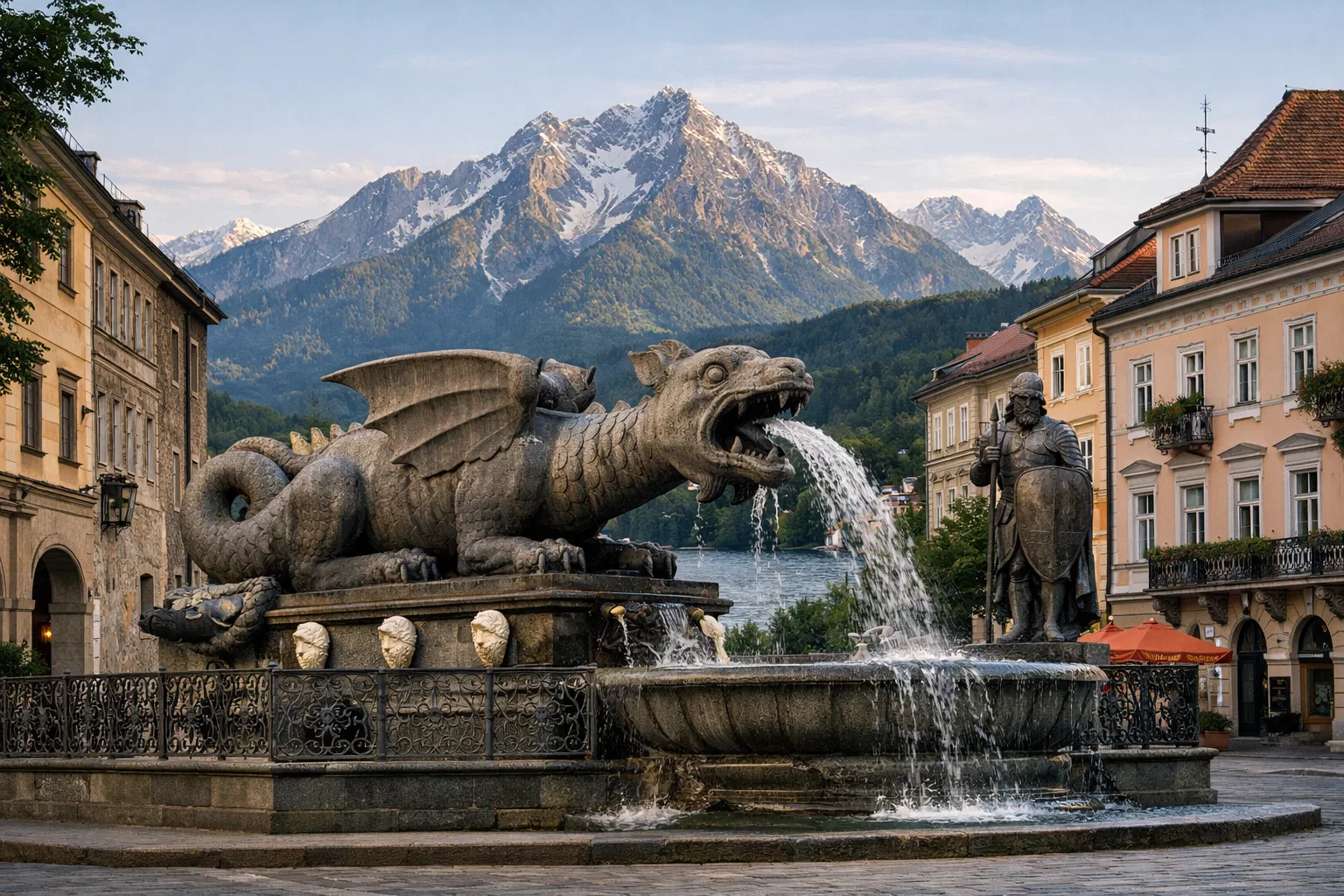
The Klagenfurt Lindwurm is Austria’s clearest bridge between legend, civic identity and natural history. In the story, a dragon haunted the swampy land around what became Klagenfurt, threatening travellers and livestock until it was defeated by a baited bull and a chain. The city’s famous Lindwurm Fountain, first built in the late 16th century, turned that story into a public emblem. Austria’s official cultural presentation describes the fountain as commissioned after a woolly rhinoceros skull was interpreted as proof of the dragon, with the monument carved in 1583 from local stone.[Austria in USA]austria.orgOpen source on austria.org.
The important point is not that the skull proves a dragon. It shows how a real, puzzling fossil could become monster evidence before modern palaeontology gave people a better explanation. The Rhino Resource Center describes the Klagenfurt monument as erected after the discovery of a rhinoceros skull near the town, then believed to belong to a drake or dragon; another Austrian university-hosted account says the Ice Age cranium was found in a gravel pit near Klagenfurt in 1335 and interpreted as a dragon or Lindwurm.[Rhino Resource Center]rhinoresourcecenter.comthe klagenfurt lindwurmthe klagenfurt lindwurm
That makes the Lindwurm more interesting than a simple “false monster” story. It is a case study in how evidence changes meaning. A skull that once authenticated a dragon later became evidence for extinct megafauna, while the dragon stayed alive as a symbol of Klagenfurt. For cryptid history, this is a useful caution: an object can be genuine while the creature story attached to it is wrong.[Atlas Obscura]atlasobscura.comAtlas Obscura Lindwurmbrunnen in KlagenfurtAtlas Obscura Lindwurmbrunnen in Klagenfurt
The Tatzelwurm: the cat-faced Alpine crawler
The Tatzelwurm is the Austrian cryptid most likely to feel like a classic mystery animal. It is usually described as a short, lizard- or serpent-like Alpine creature, sometimes with two front legs, sometimes with four or more, and in many retellings with a cat-like head. The tradition crosses borders through the Alpine world, but Austrian place-names and regional variants appear in Tyrol, Styria, Salzburg and the Salzkammergut, which fits the creature’s mountain-pass character.[Wikipedia]WikipediaOpen source on wikipedia.org.
The appeal of the Tatzelwurm is that it sits halfway between dragon and zoology. It is not a city monument like the Klagenfurt Lindwurm, but a creature of slopes, rocks, tunnels and damp weather. Older Alpine discussions treated such reports as possible sightings of unusual reptiles, giant lizards, snakes, otters or confused glimpses of known animals. A later summary of early scholarship notes that naturalist Karl Wilhelm von Dalla Torre argued in 1887 that Alpine dragon reports could be identified as lizards or snakes, while also recognising that the popular idea of the Tatzelwurm lingered like a “phantom” after belief in giant dragons had faded.[Wikipedia]WikipediaOpen source on wikipedia.org.
For modern readers, the evidence is weak: the creature survives mainly through collected anecdotes, folklore books and cryptid retellings, not through specimens, repeatable photographs or biological traces. Its value is cultural rather than zoological. The Tatzelwurm preserves how Alpine communities imagined danger close to the ground: a venomous, sudden, hard-to-see animal that belonged in rock holes and rough pasture, exactly where a startled traveller might misread a snake, salamander, marten, otter or rolling shadow.[Wikipedia]WikipediaOpen source on wikipedia.org.
Vienna’s basilisk: a monster with an address
Vienna’s basilisk legend is one of Austria’s best urban monster stories because it is tied to Schönlaterngasse 7 rather than a vague “somewhere in the woods”. In the standard version, a baker’s maid goes to draw water from a well in 1212 and discovers a foul-smelling creature. A brave apprentice is lowered down, sees a beast shaped like a rooster with a scaled tail, clumsy feet, glowing eyes and a little crown, and the authorities identify it as a basilisk.[SAGEN]sagen.atDer Basilisk in der SchönlaterngasseDer Basilisk in der Schönlaterngasse
The basilisk belongs to a wider European bestiary tradition: a deadly serpent-king or rooster-serpent hybrid whose gaze or breath can kill. Vienna localised that imported creature by giving it a precise well, a house, a date and later an inscription. A SAGEN.at documentation page on historical Viennese legendary figures notes that the supposed basilisk could still be seen at the Basilisk House on Schönlaterngasse 7 and preserves the old house inscription linking the event to 1212 and a later renovation in 1577.[SAGEN]sagen.atOpen source on sagen.at.
There is also a sceptical physical angle. Othenio Abel’s 1923 discussion of prehistoric animals in fairy tale, legend and superstition identified the surviving “basilisk” figure from Schönlaterngasse 7 as a sandstone concretion from Vienna’s ground layers, not a preserved monster. That does not kill the story; it explains why this legend has had such a long afterlife. Like the Klagenfurt skull, the basilisk shows how odd natural objects can become anchors for monster belief.[SAGEN]sagen.atTafel 5Tafel 5
Lake monsters: Traunsee’s “Lungy” is thin but revealing
Austria does not have a lake-monster tradition as internationally famous as Loch Ness, but Traunsee in Upper Austria sometimes appears in modern folklore and travel writing as the home of a creature called “Lungy”. The setting helps the comparison: Traunsee is Austria’s deepest lake according to Austria’s national tourism site, which gives a depth of 204 metres, and its steep mountain backdrop makes it an ideal stage for deep-water rumours.[Austria.info]austria.infotraunsee almtaltraunsee almtal
The problem is evidence. “Lungy” is mentioned in scattered travel and folklore-style summaries, often as a water-horse or lake creature linked with a mermaid, but the live-source trail is much thinner than for the Klagenfurt Lindwurm or Vienna basilisk. Some online summaries describe Traunsee as Austria’s answer to Loch Ness, yet the claim generally lacks dated witness files, newspaper runs, named investigators or physical evidence. It is better treated as a localised lake legend with modern cryptid packaging, not as a strong unresolved animal case.[Surviving Europe]survivingeurope.comSurviving Europe Salzburg Day Trips: 10 Austrian Lakes Worth a VisitSurviving Europe Salzburg Day Trips: 10 Austrian Lakes Worth a Visit
A more ordinary “monster” in Austrian waters is the wels catfish. The Danube is home to this enormous native catfish, which the International Commission for the Protection of the Danube River describes as reaching “titanic proportions”; Austrian hydropower company VERBUND has also reported sizeable wels catfish using fish-pass monitoring at Greifenstein. A huge fish seen briefly at dusk, surfacing in a river or lake, is a much better explanation for many European freshwater monster impressions than an unknown surviving reptile.[ICPDR]icpdr.orgOpen source on icpdr.org.
Krampus and Perchten: monster costumes, not mystery animals
Krampus is often pulled into cryptid lists because he looks like a horned beast, but in Austria he belongs to winter ritual, moral theatre and regional custom rather than zoological mystery. Austria’s tourism site describes Krampus traditions as still alive in rural areas, especially around 5 December, the eve of St Nicholas Day, with groups wearing carved masks, goat and ram horns, furs and bells. Salzburg’s tourism office similarly presents Krampus and Perchten parades as centuries-old folk customs in which wild masked figures scare away dark winter spirits.[Austria.info]austria.infoOpen source on austria.info.
That distinction matters. A Krampus run can look like a monster flap to an outsider: night streets, bells, horns, animal hides, shouting crowds and children being frightened. But nobody needs to propose an unknown creature. The “evidence” is deliberately performative. Tyrol’s tourism site separates the roles neatly: Perchten drive away evil winter spirits with bells, while Krampus punishes naughty children.[Tyrol]tyrol.comOpen source on tyrol.com.
For an Austria cryptid page, Krampus and Perchten are still worth including because they show how strongly animal masks shape the country’s monster imagination. Horns, fur, bells, hooves, shaggy bodies and wild faces recur in Alpine visual culture. They help explain why Austrian beast folklore is so often embodied in public festivals rather than confined to private eyewitness reports.[Austria.info]austria.infoOpen source on austria.info.

Real wildlife behind strange sightings
Modern Austria is not empty of large animals. Bears, wolves and lynx are all part of current conservation and management discussions, and the Austrian Centre for Bear, Wolf and Lynx states that these large predators are increasingly returning to Austria. The European Commission’s large-carnivore overview adds a useful nuance: brown bears may be present in Austria, but no reproduction has been recorded there in the monitored material it summarises.[Vetmeduni]vetmeduni.ac.atOpen source on vetmeduni.ac.at.
This matters for mystery-beast claims because a genuine lynx glimpse can look uncanny. Lynx are elusive, catlike and associated with forest cover; Kalkalpen National Park monitors lynx using camera traps and telemetry, which shows how difficult these animals can be to document even when they are real. A fleeting large-cat sighting in Austria is therefore not automatically a “phantom panther”; it may be a misjudged lynx, dog, fox, deer, shadow, domestic cat at odd scale, or in rare cases an escaped exotic animal.[Kalkalpen National Park]en.kalkalpen.atNational Park LynxNational Park Lynx
Austria’s returning predators also change folklore by making old fears feel newly plausible. A farmer who hears about wolves taking livestock, a hiker who sees eyeshine near a forest road, or a tourist who photographs a dark shape by water may reach for monster language before wildlife knowledge catches up. The better sceptical approach is not to mock the witness, but to ask what known animals were present, what distance and light were involved, and whether any track, hair, scat, carcass pattern or camera-trap evidence followed.[Vetmeduni]vetmeduni.ac.atOpen source on vetmeduni.ac.at.
What the Austrian evidence really supports
Austria’s monster tradition is strong; its cryptid evidence is mostly weak. The best-documented items are not living mystery animals but durable legends with physical anchors: the Klagenfurt Lindwurm and its fossil background, the Vienna basilisk and its house tradition, and the ongoing public performance of Krampus and Perchten. The Tatzelwurm is the closest to a classic Alpine cryptid, but it remains an anecdotal creature without accepted biological proof.[austria.org]austria.orgOpen source on austria.org.
That does not make the subject less interesting. Austria is a particularly good country for seeing how monster stories form. A strange skull becomes a dragon. A mineral concretion becomes a basilisk. Deep water attracts a lake creature. Masked winter customs turn animal fear into theatre. Returning lynx, wolves and bears remind people that the landscape still contains real, hard-to-see predators. The honest conclusion is that Austria’s cryptids are best understood as a layered tradition of folklore, misidentification, civic storytelling and occasional wildlife confusion rather than as a catalogue of likely undiscovered animals.[rhinoresourcecenter.com]rhinoresourcecenter.comthe klagenfurt lindwurmthe klagenfurt lindwurm
Amazon book picks
Further Reading
Books and field guides related to Austria's Monsters Between Folklore and Evidence. Use these as the next step if you want deeper reading beyond the article.
The Element Encyclopedia of Magical Creatures
Includes many European legendary creatures relevant to Austria.
The Encyclopedia of Things That Never Were
Covers dragons, basilisks and related folklore.
eBay marketplace picks
Marketplace Samples
Live-tested eBay searches with available results related to this page.


Endnotes
1.
Source: austria.org
Link:https://www.austria.org/wahrzeichen/klagenfurt
2.
Source: sagen.at
Title: Der Basilisk in der Schönlaterngasse
Link:https://www.sagen.at/texte/sagen/oesterreich/wien/vonaltenhaeusern/basilisk.html
3.
Source: austria.info
Title: traunsee almtal
Link:https://www.austria.info/en-gb/locations/traunsee-almtal/
4.
Source: austria.info
Link:https://www.austria.info/en-gb/inspiration/raucous-traditions/
5.
Source: salzburg.info
Link:https://www.salzburg.info/en/salzburg/advent/krampus-percht
6.
Source: sagen.at
Link:https://www.sagen.at/doku/woderwolf/sagenfiguren.html
7.
Source: tyrol.com
Link:https://www.tyrol.com/activities/events/krampus-processions
8.
Source: icpdr.org
Link:https://www.icpdr.org/publications/catfish-carp-and-caviar-fisheries-danube-and-mississippi-rivers
9.
Source: Wikipedia
Link:https://en.wikipedia.org/wiki/Lindworm
10.
Source: Wikipedia
Title: Woolly rhinoceros
Link:https://en.wikipedia.org/wiki/Woolly_rhinoceros
11.
Source: Wikipedia
Link:https://en.wikipedia.org/wiki/Tatzelwurm
12.
Source: sagen.at
Title: DAS BASILISKENHAUS
Link:https://www.sagen.at/texte/sagen/oesterreich/wien/1_bezirk/basiliskenhaus.html
13.
Source: Wikipedia
Link:https://en.wikipedia.org/wiki/Basilisk
14.
Source: sagen.at
Title: Tafel 5
Link:https://www.sagen.at/doku/vorweltliche_Tiere/Tafel_5.html
15.
Source: sagen.at
Link:https://www.sagen.at/doku/vorweltliche_Tiere/Basiliskensage.html
16.
Source: verbund.com
Title: rekord wels greifenstein
Link:https://www.verbund.com/en/group/news-press/press-releases/2018/6/19/rekord-wels-greifenstein
17.
Source: en.kalkalpen.at
Title: National Park Lynx
Link:https://en.kalkalpen.at/luchs
18.
Source: Wikipedia
Title: Phantom cat
Link:https://en.wikipedia.org/wiki/Phantom_cat
19.
Source: Wikipedia
Title: Loch Ness Monster
Link:https://en.wikipedia.org/wiki/Loch_Ness_Monster
20.
Source: Wikipedia
Title: List of cryptids
Link:https://en.wikipedia.org/wiki/List_of_cryptids
21.
Source: Wikipedia
Link:https://en.wikipedia.org/wiki/Krampus
22.
Source: Wikipedia
Link:https://en.wikipedia.org/wiki/Chupacabra
23.
Source: Wikipedia
Link:https://en.wikipedia.org/wiki/Official
24.
Source: Wikipedia
Link:https://en.wikipedia.org/wiki/Austria
25.
Source: Wikipedia
Title: Wels catfish
Link:https://en.wikipedia.org/wiki/Wels_catfish
26.
Source: Wikipedia
Link:https://simple.wikipedia.org/wiki/Traunsee
27.
Source: Wikipedia
Link:https://en.wikipedia.org/wiki/Traunsee
28.
Source: Wikipedia
Title: Lennart Karl
Link:https://en.wikipedia.org/wiki/Lennart_Karl
29.
Source: Wikipedia
Link:https://ig.wikipedia.org/wiki/Tatzelwurm
30.
Source: Wikipedia
Title: Karl Lagerfeld
Link:https://en.wikipedia.org/wiki/Karl_Lagerfeld
31.
Source: sagen.at
Link:https://www.sagen.at/texte/sagen/oesterreich/tirol/telfs/worterklaerungen.html
32.
Source: sagen.at
Link:https://www.sagen.at/texte/sagen/oesterreich/wien/sagen_legenden_gugitz/basilisk.html
33.
Source: sagen.at
Link:https://www.sagen.at/doku/hda/basilisk.html
34.
Source: sagen.at
Title: SAGE N.at
Link:https://www.sagen.at/texte/sagen/oesterreich/wien/1_bezirk/sagen_1_bezirk.html
35.
Source: sagen.at
Link:https://www.sagen.at/texte/sagen/oesterreich/wien/vonaltenhaeusern/vonaltenhaeusern.htm
36.
Source: sagen.at
Link:https://www.sagen.at/texte/sagen/oesterreich/wien/sagen_legenden_gugitz/sagen_legenden_gugitz.htm
37.
Source: austria.info
Link:https://www.austria.info/en-gb/
38.
Source: austrian.best
Link:https://austrian.best/tag/traunsee/
39.
Source: vetmeduni.ac.at
Link:https://www.vetmeduni.ac.at/en/research-institute-of-wildlife-ecology/services/oesterreichzentrum-austria-centre-bear-wolf-and-lynx
40.
Source: environment.ec.europa.eu
Title: Environment Large carnivore populations across Europe
Link:https://environment.ec.europa.eu/topics/nature-and-biodiversity/habitats-directive/large-carnivores/large-carnivore-populations-across-europe_en
41.
Source: rhinoresourcecenter.com
Title: the klagenfurt lindwurm
Link:https://rhinoresourcecenter.com/library/images/the-klagenfurt-lindwurm/
42.
Source: atlasobscura.com
Title: Atlas Obscura Lindwurmbrunnen in Klagenfurt
Link:https://www.atlasobscura.com/places/lindwurmbrunnen
43.
Source: survivingeurope.com
Title: Surviving Europe Salzburg Day Trips: 10 Austrian Lakes Worth a Visit
Link:https://survivingeurope.com/salzburg-day-trips-austrian-lakes/
44.
Source: cryptidz.fandom.com
Link:https://cryptidz.fandom.com/wiki/Tatzelwurm
45.
Source: battlebrothers.fandom.com
Link:https://battlebrothers.fandom.com/wiki/Lindwurm
46.
Source: fireemblem.fandom.com
Link:https://fireemblem.fandom.com/wiki/Lindwurm
47.
Source: xenoblade.fandom.com
Link:https://xenoblade.fandom.com/wiki/Lindwurm
48.
Source: cryptidarchives.fandom.com
Link:https://cryptidarchives.fandom.com/wiki/Tatzelwurm
49.
Source: dictionary.cambridge.org
Link:https://dictionary.cambridge.org/dictionary/english/official
50.
Source: youtube.com
Link:https://www.youtube.com/watch?v=kOLUcYUbKl8
51.
Source: astonishinglegends.com
Link:https://astonishinglegends.com/astonishing-legends/2018/9/24/tatzelwurm
52.
Source: catfishconservationgroup.co.uk
Link:https://www.catfishconservationgroup.co.uk/welscatfish/
53.
Source: tripadvisor.com
Link:https://www.tripadvisor.com/Attraction_Review-g190436-d2193897-Reviews-Lindwurmbrunnen-Klagenfurt_Carinthia_Austrian_Alps.html
54.
Source: GOV.UK
Link:https://www.gov.uk/foreign-travel-advice/austria
55.
Source: lakeriver.at
Link:https://www.lakeriver.at/Traunsee.html
56.
Source: eileenmuellerauthor.com
Title: The Tatzelwurm
Link:https://www.eileenmuellerauthor.com/writing/the-tatzelwurm-swiss-alpine-dragon/
57.
Source: ebsco.com
Link:https://www.ebsco.com/research-starters/social-sciences-and-humanities/krampus
58.
Source: animalia.bio
Title: Wels catfish
Link:https://animalia.bio/wels-catfish
Additional References
59.
Source: youtube.com
Title: Demons in the service of Santa Claus! What are the Austrian Krampus?
Link:https://www.youtube.com/watch?v=hubv2fVZkuU
Source snippet
Krampus: Exploring the Legend of the Christmas Demon...
60.
Source: youtube.com
Title: Klagenfurt Dragon: Austria’s Monster Beneath the City
Link:https://www.youtube.com/watch?v=1wxnCVftung
Source snippet
Krampus: The Christmas Demon & Santa's Shadow | Alpine Folklore History...
61.
Source: muenzeoesterreich.com
Link:https://www.muenzeoesterreich.com/en/collect/series/mythical-creatures
62.
Source: reddit.com
Link:https://www.reddit.com/r/Fishing/comments/45b8gc/74_foot_200_pound_catfish_that_had_blocked_an/
63.
Source: instagram.com
Link:https://www.instagram.com/reel/DZPtLRbtuXu/
64.
Source: facebook.com
Link:https://www.facebook.com/PoliceHour/posts/a-eurasian-lynx-has-escaped-from-a-wildlife-park-in-wales-over-the-weekend-the-f/968047646666915/
65.
Source: facebook.com
Link:https://www.facebook.com/7NewsAustralia/posts/a-giant-black-cat-like-creature-has-been-spotted-roaming-rural-australia-and-has/2106934812650034/
66.
Source: cascada.travel
Link:https://www.cascada.travel/blog/all-you-need-to-know-about-puma-spotting-in-patagonia
67.
Source: reddit.com
Link:https://www.reddit.com/r/mythology/comments/181hpdq/are_there_any_mythological_creatures_in_austrian/
68.
Source: ricksteves.com
Link:https://www.ricksteves.com/europe/austria
Topic Tree
Follow this branch
Related pages 192
- Antigua Cryptids
- Maldives Monsters
- Malta Monsters
- Qatar Monsters
- Argentina Monsters
- +187 more in sidebar