Cryptids of Ghana's Forests and Lakes
Ghana is not a country with a single famous “national cryptid” in the Loch Ness Monster mould.
Page outline Jump by section
Ghana’s monster map is mostly forest, lake and sacred-animal country
The strongest Ghanaian creature traditions cluster around places where everyday life meets a powerful landscape: dense forest, sacred water, hunting ground, village edge, shrine grove, or protected wildlife area. That matters because the stories rarely behave like simple “unknown animal” reports. They are usually about boundaries: the safe village against the dangerous bush, the human world against the spirit world, or ordinary animals becoming signs of ancestral and spiritual presence.
In southern Ghana, especially in Akan and Asante contexts, the forest is the key setting. R. S. Rattray’s Religion and Art in Ashanti is catalogued by eHRAF as a detailed ethnographic source on Ashanti religious beliefs, practices, spirits, arts, oaths and taboos, based on fieldwork in Ashanti, Ghana, in the 1920s. That source tradition helps explain why Ghana’s best-known monsters are not usually lake beasts or sea serpents, but bush beings and forest powers.[eHRAF World Cultures]ehrafworldcultures.yale.edue HRAF World Cultures Religion And Art In Ashantie HRAF World Cultures Religion And Art In Ashanti
Water has its own monster-like charge. Lake Bosomtwe, Ghana’s only natural lake and a UNESCO biosphere reserve, is tied to Ashanti oral tradition about a hunter from Asaman whose quarry vanished into the lake; the same UNESCO page notes that farming, tourism and fishing remain major local activities around the lake. The story is not a lake-monster report in the classic cryptozoological sense, but it gives the lake a supernatural origin and keeps it within Ghana’s wider map of creature-linked sacred places.[UNESCO]unesco.orgLake BosomtweLake Bosomtwe
Northern Ghana adds a different pattern through sacred crocodile traditions. At Paga in the Upper East Region, the crocodiles are real animals, not unknown beasts, but the folklore around them makes them feel “cryptid-adjacent”: visitors encounter living reptiles that local tradition treats as sacred, ancestral or spiritually protected. This is a useful reminder that Ghana’s mystery-animal traditions often concern the meaning of animals as much as their biological identity.[Atlas Obscura]atlasobscura.comAtlas Obscura Sacred Crocodile Ponds of PagaAtlas Obscura Sacred Crocodile Ponds of Paga
The sasabonsam: Ghana’s clearest monster figure
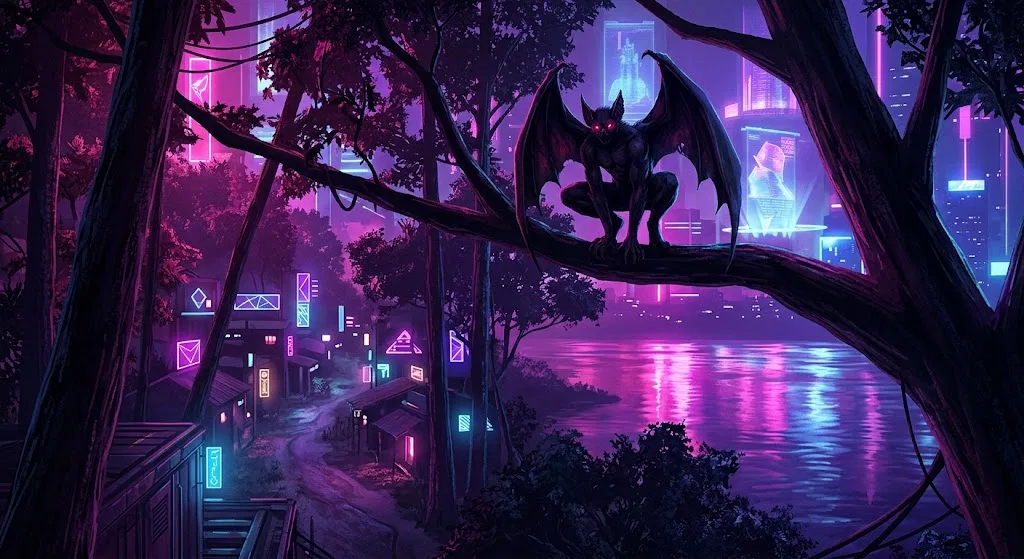
The sasabonsam is the creature most likely to appear when Ghana is discussed in cryptid and monster-folklore circles. In the British Museum’s description of a 1935 Ghana-made figure, the sasabonsam is called a superhuman figure rooted in traditional Ghanaian beliefs, said to live in the bush and tallest trees, often depicted as red and hairy with bat-like wings, a long beard, horns, an ape-like body and snake legs, and believed to be dangerous to humans and allied with witches.[British Museum]britishmuseum.orgBritish Museumfigure | British MuseumBritish Museumfigure | British Museum
That description shows why the sasabonsam travels so easily into modern cryptid culture. It has several “monster report” ingredients at once: a partly animal body, a forest habitat, nocturnal danger, tree-dwelling behaviour, and an ambush pattern. Yet the museum record also makes clear that it is a cultural and spiritual figure, not evidence for an undiscovered primate, bat or reptile. The creature belongs first to folklore and religious imagination.
The carved afterlife of the sasabonsam is especially important. The British Museum notes that its figure was recorded as made in Kumasi in September 1935, and that Osei Bonsu is believed to have first carved a sasabonsam image in 1925 for a linguist staff. A related British Museum figure, also carved in Ghana in 1935 by Osei Bonsu, is described as a human-headed quadruped with wings; the museum notes that a similar Pitt Rivers Museum figure was described as an animal form of sasabonsam said to live in the ground.[British Museum]britishmuseum.orgBritish Museumfigure | British MuseumBritish Museumfigure | British Museum
That detail matters because it shows the legend changing across media. The sasabonsam is not just a whispered forest terror. It becomes a carved object, a museum specimen of belief, a modern article topic, a decorative and symbolic image, and eventually an entry in global monster culture. Its “evidence” is not a body or a photograph; it is a trail of oral tradition, ethnographic writing, carvings, collector records and later retellings.
What witnesses would have thought they were seeing
A modern reader may ask whether any Ghanaian monster could be a misidentified animal. For the sasabonsam, the answer is probably “not in any simple one-animal way”. Its features combine too many symbolic elements: bat wings, horns, ape-like body, snake legs, red hair and tree-dwelling menace. That looks less like a distorted field sighting and more like a composite monster built from the fears and signs of the forest.
Still, Ghana’s real wildlife gives some clues to how strange encounters can grow. Mole National Park reports more than 90 mammal species, including elephants, buffalo, antelope, primates, leopard and historically listed lion, along with hundreds of birds, reptiles, amphibians and butterflies. Panthera has also reported camera-trap work with partners in Mole to assess threatened leopard populations. A brief or frightened glimpse of a leopard, primate, large bat, civet, pangolin or snake at dusk can become much stranger in retelling, especially where the forest already carries spiritual meaning.[Moore National Park]molenationalpark.orgMoore National Park Mole National ParkMoore National Park Mole National Park
The Lake Bosomtwe biosphere reserve offers another example of the real and the legendary overlapping. UNESCO lists species in the reserve area including tree pangolin, western green mamba, marsh mongoose, white-crested hornbill and lesser spot-nosed monkey. None of these animals is a lake monster, but each belongs to a landscape where unusual sightings, sudden movement, night sounds and local taboos can feed memorable stories.[UNESCO]unesco.orgLake BosomtweLake Bosomtwe
For sceptical readers, this is the most useful distinction: Ghanaian creature stories are not best explained by asking, “Which unknown animal is this?” The better question is, “What real landscape, animal behaviour, social boundary or spiritual rule is the story organising?” In the sasabonsam’s case, the answer points strongly to the forest as a dangerous moral and spiritual space.
The mmoatia and the small beings of the bush
Alongside the sasabonsam, Ghanaian folklore includes small forest beings often discussed in English as dwarf-like or fairy-like figures. They are commonly known in modern retellings as mmoatia, and they sit closer to spirit folklore than to cryptozoology. They are not usually presented as an unknown biological species; they are beings of the bush, trickery, disappearance and contact with powers beyond ordinary human control.
Their importance for a Ghana cryptid page is not that they provide a strong “case file”. Rather, they help explain the folklore environment in which monsters like the sasabonsam make sense. In a world of forest spirits, taboos and beings that may mislead or punish people, the monster is not an isolated oddity. It is part of a wider map of unseen agency.
Rattray’s work is again useful here because the eHRAF catalogue places his Ashanti study squarely within religious beliefs, spirits, taboos, rites and art. Even without treating every later internet description as equally reliable, the older ethnographic frame supports the broader point: Ghanaian monster lore grows from religious and social worlds in which forests, animals and spirits are deeply connected.[eHRAF World Cultures]ehrafworldcultures.yale.edue HRAF World Cultures Religion And Art In Ashantie HRAF World Cultures Religion And Art In Ashanti
Lake Bosomtwe: sacred water, not a Nessie clone
Lake Bosomtwe is sometimes tempting to treat as Ghana’s answer to a lake-monster site because it is visually dramatic, sacred, circular and famous. But the evidence points in a different direction. Its strongest traditional story is not about a hidden beast surfacing from the water; it is about a hunter, an antelope, a lake of spiritual significance and a landscape where water, food, death and community identity meet. UNESCO records the Ashanti oral tradition that a hunter discovered the lake around 360 years ago while chasing an antelope that vanished into it, after which the lake was found to contain edible fish.[UNESCO]unesco.orgLake BosomtweLake Bosomtwe
Scientifically, Lake Bosomtwe is also remarkable without needing a monster. Research on the Bosumtwi impact event identifies it as a roughly 10.5 km-wide, about 1.07-million-year-old impact structure in Ghana. That makes the lake a place where geology and legend naturally reinforce each other: the landscape looks extraordinary because it is extraordinary.[arXiv]arxiv.orgOpen source on arxiv.org.
For cryptid readers, the key takeaway is that Lake Bosomtwe is a sacred-lake tradition rather than a strong lake-creature tradition. It belongs on Ghana’s mystery-creature map because animals and spirits are central to its origin story, but it should not be inflated into a Ghanaian Loch Ness story without better evidence.
Sacred crocodiles and real animals with legendary status
The crocodiles of Paga show another Ghanaian pattern: real animals becoming surrounded by extraordinary claims. Travel and folklore sources describe the Paga crocodile ponds as sacred places where crocodiles are unusually tolerated or revered, with local traditions linking the animals to protection, ancestry and the souls of the community.[Atlas Obscura]atlasobscura.comAtlas Obscura Sacred Crocodile Ponds of PagaAtlas Obscura Sacred Crocodile Ponds of Paga
This is not cryptozoology in the strict sense. No unknown crocodile species is required. The mystery lies in the relationship between people and animals: why dangerous reptiles are protected, fed, approached by visitors and interpreted through sacred history. For a country-level monster project, Paga is valuable because it shows how Ghanaian creature traditions can be public-facing, touristic and deeply local at the same time.
There is also a caution here. Tourist versions of sacred-animal stories can become simplified: “friendly crocodiles” is an easy phrase, but crocodiles remain powerful wild animals. The folklore is meaningful, yet the biological explanation is straightforward: these are living crocodiles embedded in a local sacred and tourist economy, not hidden monsters.
Why Ghana has fewer famous newspaper cryptids than some countries
Some countries’ cryptid pages are built around dated newspaper scares: a beast on the moor, a sea serpent near a harbour, a phantom cat on a road. Ghana’s public-facing record is different. The strongest accessible material is folklore, ethnography, museum objects, sacred geography and wildlife context, rather than a chain of modern eyewitness flaps with names, dates and police reports.
That does not make the tradition weaker. It makes it a different kind of evidence. The sasabonsam has a stronger cultural record than many one-off monster sightings elsewhere: it appears in older Asante belief systems, in carved works, and in institutional museum catalogues. What it lacks is the sort of modern case-file evidence that cryptozoologists prefer: tracks, photographs, repeated independent reports and biological samples.[British Museum]britishmuseum.orgBritish Museumfigure | British MuseumBritish Museumfigure | British Museum
The same is true of Lake Bosomtwe and Paga. Their creature stories are anchored in place and practice, but not in the claim that science has missed a giant unknown animal. Ghana’s “mystery beasts” are therefore best approached as folklore-first traditions with occasional overlap into wildlife, tourism and modern monster culture.
Plausible explanations without flattening the stories
A sceptical reading of Ghanaian creature lore does not have to strip the stories of interest. It can separate three layers that often get blurred together.
Folklore and spiritual teaching. The sasabonsam’s forest setting, danger to wanderers and association with witches fit a world where stories teach caution about the bush, social boundaries and unseen forces. The British Museum’s account explicitly places the figure in traditional Ghanaian belief while also noting its partial relationship to Christian devil imagery, suggesting a layered tradition rather than a simple animal report.[British Museum]britishmuseum.orgBritish Museumfigure | British MuseumBritish Museumfigure | British Museum
Misidentified wildlife. Ghana has real leopards, primates, large reptiles, snakes, pangolins, bats and nocturnal mammals, many of which can appear strange in poor light or dense vegetation. Mole National Park’s species list and Panthera’s leopard camera-trap work show that impressive animals still inhabit Ghanaian landscapes, even when they are rare, shy or difficult to observe.[Moore National Park]molenationalpark.orgMoore National Park Mole National ParkMoore National Park Mole National Park
Modern reclassification as “cryptids”. Some Ghanaian beings are now discussed in global cryptid lists because they look monster-like to outsiders. That can be fun, but it risks changing the story. A sasabonsam is not just “a flying humanoid”; it is a Ghanaian and Asante-linked forest figure with a long cultural setting, a carved visual history and a role in ideas about the dangerous bush.[British Museum]britishmuseum.orgBritish Museumfigure | British MuseumBritish Museumfigure | British Museum
How later accounts reshaped Ghana’s cryptid traditions
The sasabonsam’s modern history shows how Ghanaian monster folklore moves from oral setting to object, archive and internet. First, it belongs to a local world of forest danger and spiritual beings. Then artists such as Osei Bonsu give it carved form, including the 1935 Ghana-made British Museum figure and related works. Then museums, scholars and art historians describe those objects, creating a record that later writers can cite.[British Museum]britishmuseum.orgBritish Museumfigure | British MuseumBritish Museumfigure | British Museum
In the twenty-first century, the creature enters wider monster culture. GhanaWeb has reported on the British Museum sasabonsam figure, while art-historical writing on Osei Bonsu’s sasabonsam has discussed the creature’s older Ghanaian folklore context and its later carved representation. Popular folklore sites then repeat and remix the image: a winged, hairy, tree-dwelling forest monster from Ghana.[ghanaweb.com]ghanaweb.comSee the first carved image of Sasabonsam located in the British Museum 1922890See the first carved image of Sasabonsam located in the British Museum 1922890
That afterlife is not a hoax, but it is a transformation. The more the sasabonsam circulates globally, the easier it becomes to treat it as a creature entry detached from Ghanaian religious history, Asante art and local landscape. A good Ghana cryptid page should do the opposite: keep the monster tied to the forests, carvings, stories and cultural meanings that made it powerful in the first place.
What Ghana contributes to cryptid history
Ghana’s creature traditions challenge the idea that a cryptid must be a disputed animal awaiting scientific confirmation. In Ghana, the most durable “monsters” are not supported by zoological evidence, but they are strongly supported as cultural facts: people told the stories, carved the beings, attached them to places, protected animals through belief, and turned certain landscapes into zones of awe.
The sasabonsam is the central figure because it has the richest monster profile and the clearest documentary afterlife. Lake Bosomtwe matters because it shows how animal-origin legend, sacred water and dramatic geology can produce a mystery landscape without a lake monster. Paga’s crocodiles matter because they show how real animals can acquire legendary status through sacred protection and tourism. Ghana’s wildlife matters because leopards, primates, snakes, pangolins and nocturnal forest animals provide the ecological texture behind many frightening or ambiguous encounters.[britishmuseum.org]britishmuseum.orgBritish Museumfigure | British MuseumBritish Museumfigure | British Museum
The result is a country-level monster tradition that is less about proving a hidden species and more about reading a landscape correctly. Ghana’s strange creatures live where many monster traditions begin: at the edge of the path, in the high branches, beside sacred water, and in the uneasy space between what people see, what they fear, and what a community remembers.
Amazon book picks
Further Reading
Books and field guides related to What Monsters Haunt Ghana's Forests and Lakes?. Use these as the next step if you want deeper reading beyond the article.
Mythology:Timeless Tales of Gods and Heroes
Helps readers compare Ghanaian monster traditions with wider mythic storytelling.
Religion and Art in Ashanti
Important source for understanding creatures and beliefs in Ghanaian folklore.
eBay marketplace picks
Marketplace Samples
Live-tested eBay searches with available results related to this page.
Endnotes
1.
Source: unesco.org
Title: Lake Bosomtwe
Link:https://www.unesco.org/en/mab/lake-bosomtwe
2.
Source: panthera.org
Title: Amazing Animals in Ghana | Panthera
Link:https://panthera.org/blog-post/amazing-animals-ghana
3.
Source: arxiv.org
Link:https://arxiv.org/abs/1305.3631
4.
Source: ghanaweb.com
Title: See the first carved image of Sasabonsam located in the British Museum 1922890
Link:https://www.ghanaweb.com/GhanaHomePage/NewsArchive/See-the-first-carved-image-of-Sasabonsam-located-in-the-British-Museum-1922890
5.
Source: archive.org
Link:https://archive.org/stream/CreepyStories/EncyclopediaOfVampireMythology_djvu.txt
6.
Source: archive.org
Link:https://archive.org/details/akanashantifolkt0000ratt
7.
Source: ghanaweb.com
Title: See the first carved image of Sasabonsam located in the British Museum 1922890
Link:https://www.ghanaweb.com/GhanaHomePage/NewsArchive/See-the-first-carved-image-of-Sasabonsam-located-in-the-British-Museum-1922890?gallery=1
8.
Source: ghanaweb.com
Link:https://www.ghanaweb.com/GhanaHomePage/NewsArchive/LIVESTREAMED-Otumfuo-delivers-lecture-on-Asante-Culture-and-Heritage-Past-and-Present-in-the-UK-1941373
9.
Source: ghanaweb.com
Title: Yaw Owusu receives honorary award from Otumfuo 2036182
Link:https://www.ghanaweb.com/GhanaHomePage/NewsArchive/Yaw-Owusu-receives-honorary-award-from-Otumfuo-2036182
10.
Source: britishmuseum.org
Title: British Museumfigure | British Museum
Link:https://www.britishmuseum.org/collection/object/E_Af1935
11.
Source: ehrafworldcultures.yale.edu
Title: e HRAF World Cultures Religion And Art In Ashanti
Link:https://ehrafworldcultures.yale.edu/cultures/fe12/documents/002
12.
Source: atlasobscura.com
Title: Atlas Obscura Sacred Crocodile Ponds of Paga
Link:https://www.atlasobscura.com/places/sacred-crocodile-ponds-of-paga
13.
Source: britishmuseum.org
Title: British Museumfigure | British Museum
Link:https://www.britishmuseum.org/collection/object/E_Af1947
14.
Source: molenationalpark.org
Title: Moore National Park Mole National Park
Link:https://molenationalpark.org/
15.
Source: artsanddivinityfacultyjournal.wp.st-andrews.ac.uk
Title: Uncovering an Archival Cage Challenges Posed by Osei Bonsus Sasabonsam
Link:https://artsanddivinityfacultyjournal.wp.st-andrews.ac.uk/files/2024/01/Uncovering-an-Archival-Cage-Challenges-Posed-by-Osei-Bonsus-Sasabonsam.pdf
16.
Source: Wikipedia
Link:https://en.wikipedia.org/wiki/Ghana
17.
Source: Wikipedia
Link:https://en.wikipedia.org/wiki/Sasabonsam
18.
Source: national-parks.org
Link:https://national-parks.org/ghana/mole/
19.
Source: cryptidarchives.fandom.com
Link:https://cryptidarchives.fandom.com/wiki/Sasabonsam
20.
Source: visitghana.com
Title: lake bosomtwe
Link:https://visitghana.com/lake-bosomtwe/
21.
Source: worldbank.org
Link:https://www.worldbank.org/ext/en/country/ghana
22.
Source: thecommonwealth.org
Link:https://thecommonwealth.org/our-member-countries/ghana
23.
Source: atlasobscura.com
Title: monster mythology sasabonsam
Link:https://www.atlasobscura.com/articles/monster-mythology-sasabonsam
24.
Source: kids.nationalgeographic.com
Link:https://kids.nationalgeographic.com/geography/countries/article/ghana
25.
Source: powerful-media.com
Title: osei bonsu
Link:https://powerful-media.com/powerlist/powerlistees/osei-bonsu/
Additional References
26.
Source: youtube.com
Link:https://www.youtube.com/watch?v=rc_i48bAbQk
Source snippet
The Untold Story & History of the Fight Between the two African gods SasaBonsam and Sasraku...
27.
Source: youtube.com
Title: SASABONSAM — The Blood Debt | African Horror story
Link:https://www.youtube.com/watch?v=9mTxHy1mJwU
Source snippet
Unbelievable! Man Found in Ghana Defeats Vampire (Sasabonsam) and Escapes Witch Attacks and Arrest...
28.
Source: youtube.com
Link:https://www.youtube.com/watch?v=lB019zLUjjE
Source snippet
Ghana's Sacred Lake: Science vs Myth...
29.
Source: reddit.com
Link:https://www.reddit.com/r/Cryptozoology/comments/md3lzd/21st_century_sea_serpents/
30.
Source: researchgate.net
Link:https://www.researchgate.net/publication/284167771_Status_of_Primate_Populations_in_Protected_Areas_Targeted_by_Community_Forest_Biodiversity_Project_Ghana
31.
Source: researchgate.net
Link:https://www.researchgate.net/publication/334808651_STAKEHOLDER_VIEWS_ON_SUSTAINABLE_COMMUNITY-BASED_ECOTOURISM_A_CASE_OF_THE_PAGA_CROCODILE_PONDS_IN_GHANA
32.
Source: researchgate.net
Link:https://www.researchgate.net/publication/380722533_Exploring_Materials_for_Constructing_Fancy_Dress_Masquerade_Costumes_in_Winneba_Ghana
33.
Source: history.co.uk
Link:https://www.history.co.uk/articles/strange-sea-serpent-sightings-from-history
34.
Source: ghanaembassy.at
Link:https://ghanaembassy.at/about-ghana/
35.
Source: facebook.com
Link:https://www.facebook.com/groups/275114380263865/posts/405299890578646/
Topic Tree
Follow this branch
Related pages 192
- Antigua Cryptids
- Maldives Monsters
- Malta Monsters
- Qatar Monsters
- Argentina Monsters
- +187 more in sidebar