What Keeps Britain's Monster Legends Alive?
The United Kingdom’s mystery-creature tradition is not one single story but a lively mixture of old folklore, modern eyewitness claims, newspaper excitement, deliberate hoaxes and ordinary animals seen in difficult conditions. Scotland has the world-famous Loch Ness Monster and several quieter loch beasts.
Page outline Jump by section
Introduction
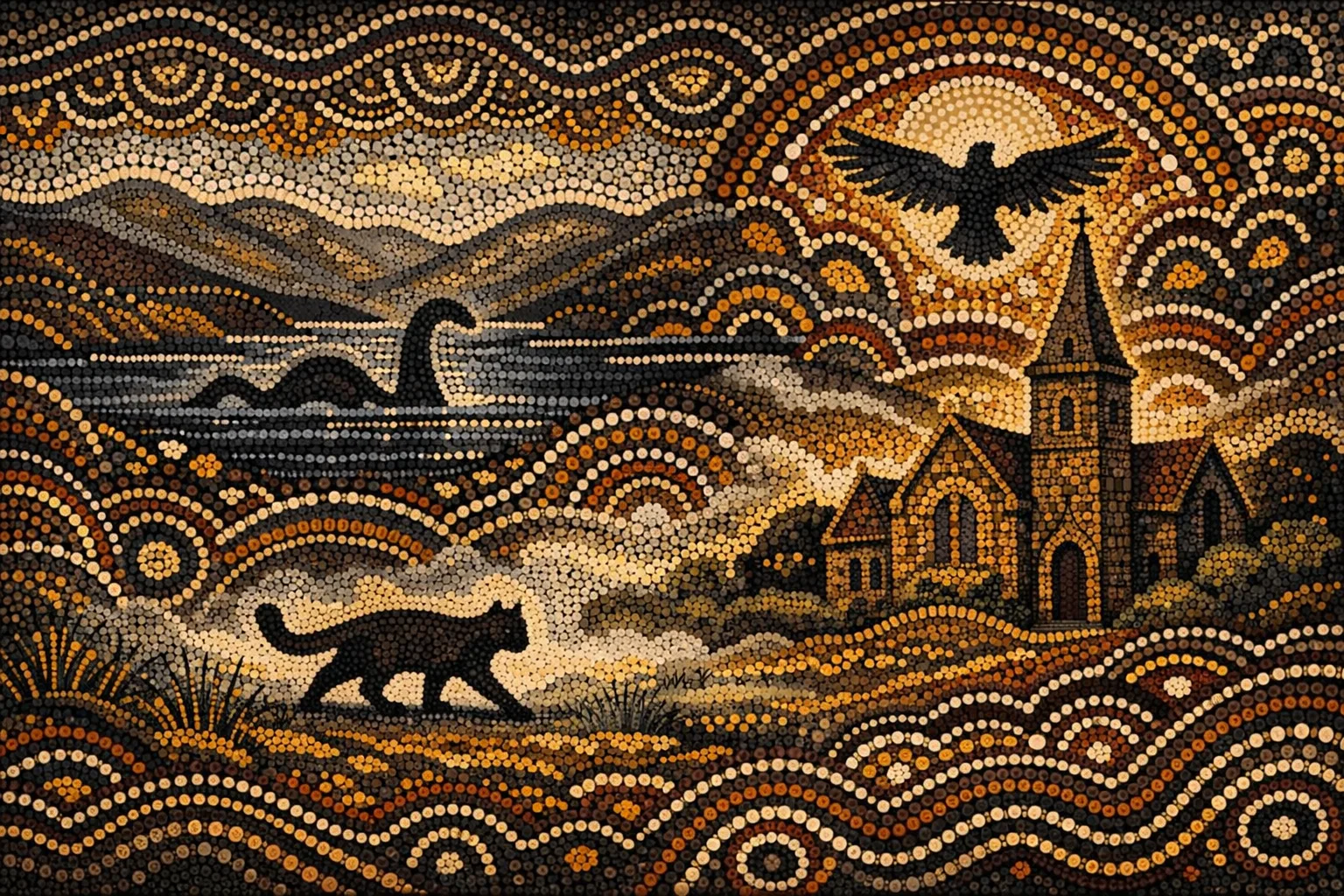
None of the country’s celebrated cryptids has been established as an unknown animal by strong mainstream evidence. Yet the stories matter because they reveal how landscapes acquire personalities. A dark loch suggests something submerged; a lonely moor becomes ideal big-cat country; an owl glimpsed beside a church tower can become a bird-man. The most interesting question is therefore not simply whether the creatures are real, but how sightings, folklore, photographs, journalism and local pride combine to keep them alive.
Why Loch Ness became Britain’s monster capital
The Loch Ness Monster, usually called Nessie, dominates British cryptid culture because it combines an unusually dramatic setting with a perfectly timed modern media story. Loch Ness is long, deep, dark with peat-stained water and difficult to observe below the surface. Boat wakes, swimming animals and floating debris can appear briefly and vanish before a witness has time to judge their size or distance.
Although later retellings connect Nessie with much older Scottish water-beast traditions, the recognisable modern monster story began in 1933. That April, the Inverness Courier reported Aldie Mackay’s description of a large, whale-like creature disturbing the loch. Further reports followed, including George Spicer’s claim that he and his wife saw a long-necked animal cross the road towards the water. The resulting publicity helped fix the image of Nessie as a bulky, prehistoric-looking creature rather than the less anatomically specific water spirits of earlier folklore.[Wikipedia]WikipediaLoch Ness MonsterLoch Ness Monster
The most influential piece of supposed evidence appeared in 1934. The so-called “Surgeon’s Photograph” showed what looked like a small head and long neck rising from the water. For decades it shaped almost every popular image of Nessie. The photograph was eventually exposed as a staged model mounted on a toy submarine, reportedly created as part of a revenge hoax connected with big-game hunter Marmaduke Wetherell. Wetherell had previously promoted “monster footprints” that Natural History Museum examination identified as having been made with a dried hippopotamus foot, probably an umbrella stand.[Wikipedia]WikipediaLoch Ness MonsterLoch Ness Monster
Later searches were technologically more serious. Investigators used sonar, underwater cameras, surface watches and photographic analysis. These projects sometimes recorded unexplained contacts or ambiguous shapes, but none produced a specimen, repeatable observation or clear image demonstrating a large unknown vertebrate. Loch Ness Project researcher Adrian Shine has argued that many classic observations are better understood as wakes, birds, otters, seals, floating logs or visual effects created by the loch’s surface conditions. The project’s own historical review notes that stricter photographic standards exposed how easily apparent monsters could be faked or mistaken.[lochnessproject.org]lochnessproject.orgLoch Ness and Morar Project Report 1983Gould (The Loch Ness Monster and others 1934), Mrs Constance Whyte (More…
A major environmental DNA survey offered a different kind of test. Environmental DNA, or eDNA, consists of genetic material that animals leave in water through skin, waste and other biological traces. Researchers sampled shoreline, surface, mid-water and deep-water locations in Loch Ness. They found no genetic evidence supporting plesiosaurs, sharks, catfish or sturgeon, but detected abundant eel DNA throughout the loch. The project could not determine the size of individual eels, so lead researcher Neil Gemmell allowed that an unusually large eel might explain some reports. That was a possibility rather than evidence for a giant specimen, and the study did not uncover DNA from an unknown monster.[otago.ac.nz]otago.ac.nzfirst edna study of loch ness points to something fishyUniversity of OtagoFirst eDNA Study Of Loch Ness Points To Something Fishy5 Sept 2019 — Eels are very plentiful in Loch Ness, with eel DN…
The strongest overall interpretation is therefore cumulative rather than spectacular. Different sightings probably have different causes: unusual wakes, known animals, floating material, exaggerated size estimates, expectation and occasional fraud. A single creature is attractive because it explains every report at once, but the evidence fits a long series of unrelated incidents more comfortably.

Scotland’s other loch monsters
Nessie is not Scotland’s only claimed freshwater beast. Highland folklore contains many stories of dangerous water creatures, especially water horses associated with lochs, rivers and crossings. Modern lake-monster reports borrowed from this older atmosphere while changing its creatures into something closer to zoological puzzles.
The best-known alternative is Morag, said to inhabit Loch Morar in the western Highlands. Reports collected from the late nineteenth and twentieth centuries describe humps, long bodies and disturbances on the water. The most dramatic account came in 1969, when Duncan McDonell and William Simpson said their boat struck a large creature that then approached them. They claimed to have used an oar and rifle to drive it away. The story is memorable, but it survives chiefly as testimony: no physical remains or decisive photograph followed.[Wikipedia]WikipediaMorag (lake monsterMorag (lake monster
Loch Morar is a convincing monster setting for much the same reason as Loch Ness. It is exceptionally deep, enclosed by steep Highland scenery and difficult to watch continuously. The Loch Ness and Morar Project compared reports from both waters and found that supposedly significant surface events were rare, brief and difficult to record. That makes the lochs fertile ground for sincere uncertainty, but also means the central claim remains resistant to proper testing.[lochnessproject.org]lochnessproject.orgLoch Ness and Morar Project Report 1983Gould (The Loch Ness Monster and others 1934), Mrs Constance Whyte (More…
These Scottish stories should not be treated as identical to the older water-horse tradition. A folkloric water beast might act as an omen, lure travellers or embody the dangers of deep water. A twentieth-century loch monster is usually discussed as though it were a hidden species waiting for sonar or DNA confirmation. The two traditions overlap, but one belongs primarily to storytelling and belief, while the other borrows the language of zoology.
Britain’s phantom big cats
Reports of large cats are the United Kingdom’s most persistent land-based animal mystery. Witnesses describe black panthers, pumas, lynx-like animals and unusually large tawny cats. Regional names include the Surrey Puma, the Beast of Exmoor, the Beast of Bodmin Moor, the Fen Tiger and various Highland or Cotswold cats.
The modern pattern became nationally visible in Surrey during the 1960s. Between September 1964 and August 1966, Surrey Police reviewed 362 reported sightings of the supposed Surrey Puma. Newspapers followed searches, alleged tracks and livestock attacks, turning scattered observations into a sustained “monster flap” in which each new report made the next one seem more plausible.[surrey-pcc.gov.uk]surrey-pcc.gov.ukThe Surrey pumaThe Surrey puma
Even at the time, zoologists offered mundane explanations. Maurice Burton argued that the Surrey reports could collectively involve feral cats, dogs, foxes and errors of scale. A large animal seen for seconds across a field has few reliable size markers; a domestic cat on a ridge can look enormous when the observer assumes it is farther away. Burton also questioned alleged puma prints because impressions in sand are easily distorted and difficult to identify confidently.[The Guardian]theguardian.comarchive puma a case of the galloping bloodhound 1966However, not everyone agrees with Burton. Mr. Oliver Moxon, a hotelier and Liberal politician who organized puma-hunting expeditions, ins…
The Beast of Bodmin Moor became the most famous later case. Reports described a black, panther-like predator and linked it with dead livestock. A government investigation in 1995 found no verifiable evidence that an exotic large cat was living on the moor, while noting that the available material could not establish the claimed predator. The case nonetheless remained popular because the official inquiry itself made the beast appear important enough to warrant government attention.[The Cornish Bird]cornishbirdblog.comThe Cornish Bird The Truth behind the Beast of Bodmin Moor!The Cornish Bird The Truth behind the Beast of Bodmin Moor!
One common theory holds that owners released big cats after the Dangerous Wild Animals Act 1976 introduced licensing requirements. The Act does indeed require a licence to keep listed dangerous wild animals, including most non-domestic cats. There have also been isolated cases of escaped or released exotic felines in Britain, including a puma captured in Scotland in 1980. What has not been demonstrated is the existence of a hidden, self-sustaining national breeding population descended from mass releases.[Legislation.gov.uk]legislation.gov.ukOpen source on legislation.gov.uk.
The distinction is important. An individual exotic cat escaping in Britain is biologically possible and has happened. A long-established population of leopards or pumas surviving across several regions would be a much larger claim. Such animals would be expected to leave repeated clusters of kills, unambiguous trail-camera photographs, bodies, droppings, genetic material and breeding evidence. Natural England told the Guardian in 2024 that no credible evidence of wild-living big cats had been presented to it dating back to the 1990s. Specialists examining alleged livestock kills have also disputed whether the damage matches large-cat feeding behaviour.[The Guardian]theguardian.comOpen source on theguardian.com.
Reports continue, including police logs and freedom-of-information disclosures. Devon and Cornwall Police recorded allegations involving panthers, pumas, lynx and even lions between 2021 and 2025, while the Welsh Government released information in 2026 concerning alleged sightings reported from 2020 to 2025. These records demonstrate that people are reporting large cats; they do not by themselves verify the animals described.[LBC]lbc.co.ukdevon cornwall big cat sightings police 2025 5Hjd6dp 2devon cornwall big cat sightings police 2025 5Hjd6dp 2
The fairest assessment is that British big-cat folklore may contain several realities at once: occasional escaped animals, large domestic or hybrid cats, dogs, deer seen badly, unreliable size estimates, fabricated evidence and some observations that remain unresolved because the information is too limited.
Water monsters before and beyond Nessie
Wales’s Afanc shows how deeply rooted British water-monster traditions can be. The creature is associated with several locations in different versions, including the River Conwy and lakes in north Wales. It is variously imagined as a huge aquatic beast, something like a beaver or crocodile, or a supernatural creature capable of causing floods when angered.[Historic UK]historic-uk.comOpen source on historic-uk.com.
Unlike Nessie, the Afanc is primarily a legendary figure rather than the subject of a continuous modern search programme. Its stories concern dangerous water, heroic attempts to capture or remove the creature and the consequences of disturbing it. Nineteenth-century collections such as Elias Owen’s Welsh Folk-lore helped preserve regional traditions at a time when oral accounts were being gathered into print.[Library Wales]library.walesOpen source on library.wales.
Northern Ireland’s Lough Neagh has creation legends, stories of giants and local water lore, but it has not produced a single modern cryptid brand comparable with Nessie. This difference is revealing. A large lake and ancient tradition do not automatically create a famous monster. Sustained newspaper coverage, memorable photographs, tourist infrastructure and repeated retelling are just as important as the physical landscape.[loughneaghtours.com]loughneaghtours.comOpen source on loughneaghtours.com.
Britain’s coast has also generated sea-serpent and stranded-carcass stories. The supposed Canvey Island Monster, reported after a strange body washed ashore in Essex in the 1950s, was described in ways that made it sound almost amphibious. Later interpretations identify the remains as a badly decomposed anglerfish or related fish. The case is a good example of a “globster” mystery: decay removes familiar features, exaggerates others and turns an ordinary marine animal into an apparently unknown one.[beyondthepoint.co.uk]beyondthepoint.co.ukThe Canvey Island MonsterThe Canvey Island Monster
When monsters are deliberately manufactured
Some British cryptids did not merely accumulate doubtful evidence; showmanship appears to have been central to their creation. Cornwall’s Morgawr, a supposed long-necked sea monster of Falmouth Bay, emerged in the mid-1970s around artist and magician Tony “Doc” Shiels.
Reports and photographs depicted an animal resembling a classic sea serpent, while Shiels promoted monster-raising performances and cultivated an ambiguous public persona somewhere between investigator, entertainer and admitted trickster. Later scholarship has treated Morgawr as a “folkloresque” creation: a modern invention made to look and behave like inherited folklore.[Wikipedia]WikipediaMorgawr (folkloreMorgawr (folklore
Shiels was also closely involved with Cornwall’s Owlman story. In 1976, he publicised a claim that two girls had seen a large, winged humanoid near the tower of St Mawnan and St Stephen’s Church. Further reports described pointed ears, glowing eyes and claw-like feet. Nearly all the early information passed through Shiels, which makes independent verification difficult. Large owls seen at dusk, especially near church towers where barn owls may nest, offer a straightforward explanation for at least the visual ingredients. Critics have additionally argued that the witness chain was too closely connected with Shiels to treat the episode as a robust series of independent encounters.[Wikipedia]WikipediaOpen source on wikipedia.org.
A hoax does not necessarily end a legend. In some cases it improves it. Morgawr and Owlman became attached to real Cornish places, entered books and local popular culture, and gave visitors a story to carry through woods and along cliff paths. Once a creature becomes part of a landscape’s identity, later tellers need not believe the original claim literally.

Why strange sightings feel convincing
Most witnesses who report monsters are not necessarily lying. Human perception works quickly and constructively, especially when an object is distant, partly hidden or seen only briefly.
Several recurring problems shape British cryptid reports:
- Distance and scale: Without a reliable reference point, a nearby small animal and a distant large animal can create similar silhouettes.
- Partial views: A deer’s head, a line of swimming birds or several separate waves may be mentally joined into one long creature.
- Expectation: Once a place is known for a monster, ambiguous sights are more likely to be interpreted through that story.
- Memory: Retelling tends to make uncertain details more coherent. A vague dark shape may gradually acquire a neck, fins or a feline tail.
- Media feedback: Publicity produces more observers, more reports and more named beasts. The Surrey Puma episode shows how rapidly sightings can multiply once a case becomes prominent.
- Decomposition: Marine carcasses lose hair, skin, fins and facial features, leaving forms that look unfamiliar even to experienced observers.
This does not mean every unexplained report has been solved. It means that “unexplained” is a description of the available information, not a biological classification. A blurry image that cannot be identified does not become evidence of a new species simply because no one can say exactly what it shows.
Folklore, witness claim or animal evidence?
British monster stories become easier to understand when their different forms are kept separate.
Folklore consists of stories passed through communities and adapted over time. The Afanc and phantom black dogs belong mainly in this category. Their meaning may involve danger, death, boundaries or local identity rather than zoological description.
Witness claims are reports by people who believe they saw something unusual. Loch Ness sightings and many big-cat encounters fall here. They deserve accurate recording, but testimony alone rarely identifies a species.
Media inventions and hoaxes include fabricated photographs, staged tracks and stories deliberately promoted for entertainment. The Surgeon’s Photograph and the theatrical world surrounding Morgawr are central examples.
Plausible animal explanations involve known wildlife behaving unexpectedly or appearing distorted by distance, water, darkness or decomposition. Eels, otters, seals, deer, dogs, owls, domestic cats, swimming birds and large fish recur because they can supply the visible features from which monster descriptions are assembled.
Strong zoological evidence would require something much better: a body, diagnostic DNA, clear repeatable imagery, reliably collected tracks or biological material with a documented chain of custody. No celebrated UK cryptid currently meets that standard.
Monsters as local identity and tourism
Whatever their biological status, cryptids can have measurable cultural lives. Nessie appears on signs, souvenirs, visitor centres, cruises and family attractions throughout the Loch Ness area. VisitScotland openly presents the unanswered monster question as part of the destination’s appeal, while local tourism organisations use the wider landscape, history and legend together rather than treating Nessie as an isolated curiosity.[VisitScotland]visitscotland.comVisit Scotland The Loch Ness MonsterVisit Scotland The Loch Ness Monster
The commercial relationship is not proof that the legend was invented solely for tourism. The modern story attracted visitors because it was already compelling, and local businesses understandably built around that interest. Tourism then helped maintain the creature’s visibility, creating a cycle in which each anniversary, search or photograph brings fresh attention.
Smaller legends operate on the same principle at a local scale. Bodmin Moor’s beast adds menace to an already atmospheric landscape. Owlman gives a Cornish church and woodland an extra narrative layer. The Afanc links particular Welsh waters with a much older storytelling tradition. A creature does not need to be zoologically real to affect where people travel, what they photograph and how they remember a place.
What the British cryptid tradition really shows
The United Kingdom has produced no confirmed plesiosaur in a Highland loch, no demonstrated breeding population of black leopards and no authenticated winged humanoid. Its monster record is instead a rich archive of uncertain observations, transformed wildlife, inherited folklore and highly effective storytelling.
Loch Ness shows how a brief 1930s news cycle can grow into a global legend when it gains an unforgettable image and an ideal landscape. Phantom-cat reports show how plausible biological possibilities can become mixed with weak photographs, police logs and recurring errors of scale. The Afanc and black-dog traditions show that not every monster was originally meant to be treated as an undiscovered animal. Morgawr and the Owlman demonstrate that invention and performance can themselves become folklore.
The most evidence-aware position is neither automatic belief nor ridicule. Some witnesses undoubtedly saw real animals or real disturbances they could not identify. A few exotic animals have genuinely escaped captivity. Many reports are too incomplete to solve. But extraordinary biological claims require evidence stronger than sincere testimony, ambiguous film or a famous place-name. Britain’s cryptids remain most convincing as cultural creatures: inhabitants of lochs, moors, headlines and memory, always visible enough to be retold and never clear enough to be caught.
Amazon book picks
Further Reading
Books and field guides related to What Keeps Britain's Monster Legends Alive?. Use these as the next step if you want deeper reading beyond the article.
Mystery Animals of Britain and Ireland
Matches the page's broad survey of UK monster traditions.
eBay marketplace picks
Marketplace Samples
Live-tested eBay searches with available results related to this page.
Endnotes
1.
Source: Wikipedia
Title: Loch Ness Monster
Link:https://en.wikipedia.org/wiki/Loch_Ness_Monster
2.
Source: lochnessproject.org
Link:https://www.lochnessproject.org/ARCHIVE%20ROOM/papershtml/LOCH_NESS_Morar_report_1983.htm
Source snippet
Loch Ness and Morar Project Report 1983Gould (The Loch Ness Monster and others 1934), Mrs Constance Whyte (More...
3.
Source: lochnessproject.org
Title: loch ness archive timeline
Link:https://www.lochnessproject.org/ARCHIVE%20ROOM/loch_ness_archive_timeline.htm
Source snippet
Loch Ness Project Adrian Shine(1974) In Search of Lake Monsters. London: Garnstone. However, the seal theory was to prove too mundane fo...
4.
Source: lochnessproject.org
Link:https://www.lochnessproject.org/FIELDWORKGROUNDTRUTH/eDNA%20LOCH%20NESS/eDNA%20LOCHNESS_index.html
Source snippet
eDNA IndexThe eDNA survey involved shore-line, surface, mid and deepwater sampling at Loch Ness and three [other lochs]({{ 'other-lochs/' | relative_url }}). The water samples...
5.
Source: Wikipedia
Title: Morag (lake monster)
Link:https://en.wikipedia.org/wiki/Morag_%28lake_monster%29
6.
Source: surrey-pcc.gov.uk
Title: The Surrey puma
Link:https://www.surrey-pcc.gov.uk/175th-anniversary-of-surrey-police/the-surrey-puma/
7.
Source: legislation.gov.uk
Link:https://www.legislation.gov.uk/ukpga/1976/38
8.
Source: gov.wales
Link:https://www.gov.wales/atisn26951
9.
Source: historic-uk.com
Link:https://www.historic-uk.com/HistoryUK/HistoryofWales/The-Legend-of-the-River-Conwy-Afanc/
10.
Source: library.wales
Link:https://www.library.wales/discover-learn/digital-exhibitions/books/history-books/welsh-folk-lore-a-collection-of-the-folk-tales-and-legends-of-north-wales
11.
Source: loughneaghtours.com
Link:https://loughneaghtours.com/myths-and-legends-of-lough-neagh/
12.
Source: beyondthepoint.co.uk
Title: The Canvey Island Monster
Link:https://beyondthepoint.co.uk/the-canvey-island-monster/
13.
Source: Wikipedia
Link:https://en.wikipedia.org/wiki/Canvey_Island_Carcass
14.
Source: Wikipedia
Title: Morgawr (folklore)
Link:https://en.wikipedia.org/wiki/Morgawr_%28folklore%29
15.
Source: Wikipedia
Link:https://en.wikipedia.org/wiki/Owlman
16.
Source: visitscotland.com
Title: Visit Scotland The Loch Ness Monster
Link:https://www.visitscotland.com/places-to-go/loch-ness/things-to-do/nessie
17.
Source: visitscotland.org
Title: Visit Scotland Case study | Loch Ness Hub & Travel
Link:https://www.visitscotland.org/news/visitor-economy-case-studies/loch-ness-hub-and-travel
18.
Source: Wikipedia
Link:https://en.wikipedia.org/wiki/Cryptozoology
19.
Source: Wikipedia
Title: Department for Environment, Food and Rural Affairs
Link:https://en.wikipedia.org/wiki/Department_for_Environment%2C_Food_and_Rural_Affairs
20.
Source: Wikipedia
Title: British big cats
Link:https://en.wikipedia.org/wiki/British_big_cats
21.
Source: Wikipedia
Title: List of cryptids
Link:https://en.wikipedia.org/wiki/List_of_cryptids
22.
Source: Wikipedia
Title: Black dog (folklore)
Link:https://en.wikipedia.org/wiki/Black_dog_%28folklore%29
23.
Source: brighton-hove.gov.uk
Link:https://www.brighton-hove.gov.uk/sites/default/files/migrated/article/inline/downloads/licence_applications/licence_-_exotic%2C_dangerous_or_wild_animals/DANGEROUSWILDANIMALSACT1976.pdf
24.
Source: defrafarming.blog.gov.uk
Link:https://defrafarming.blog.gov.uk/
25.
Source: library.wales
Link:https://www.library.wales/discover-learn/education/learning-resources
26.
Source: westminster.gov.uk
Title: list of dangerous wild animals
Link:https://www.westminster.gov.uk/sites/default/files/media/documents/list_of_dangerous_wild_animals.pdf
27.
Source: gov.scot
Title: foi 202000064829
Link:https://www.gov.scot/publications/foi-202000064829/
28.
Source: otago.ac.nz
Title: first edna study of loch ness points to something fishy
Link:https://www.otago.ac.nz/news/newsroom/first-edna-study-of-loch-ness-points-to-something-fishy
Source snippet
University of OtagoFirst eDNA Study Of Loch Ness Points To Something Fishy5 Sept 2019 — Eels are very plentiful in Loch Ness, with eel DN...
29.
Source: theguardian.com
Title: loch ness monster could be a giant eel say scientists
Link:https://www.theguardian.com/science/2019/sep/05/loch-ness-monster-could-be-a-giant-eel-say-scientists
Source snippet
The GuardianLoch Ness monster could be a giant eel, say scientists5 Sept 2019 — Loch Ness monster could be a giant eel, say scientists ·...
30.
Source: theguardian.com
Title: archive puma a case of the galloping bloodhound 1966
Link:https://www.theguardian.com/theguardian/2010/nov/05/archive-puma-a-case-of-the-galloping-bloodhound-1966
Source snippet
However, not everyone agrees with Burton. Mr. Oliver Moxon, a hotelier and Liberal politician who organized puma-hunting expeditions, ins...
31.
Source: cornishbirdblog.com
Title: The Cornish Bird The Truth behind the Beast of Bodmin Moor!
Link:https://cornishbirdblog.com/the-truth-behind-the-beast-of-bodmin-moor/
32.
Source: cornwall.co.uk
Title: the beast of bodmin moor
Link:https://www.cornwall.co.uk/legends/the-beast-of-bodmin-moor/
33.
Source: theguardian.com
Link:https://www.theguardian.com/world/2024/feb/22/it-was-a-big-cat-claimed-cumbrian-leopard-sighting-fails-to-convince-experts
34.
Source: lbc.co.uk
Title: devon cornwall big cat sightings police 2025 5Hjd6dp 2
Link:https://www.lbc.co.uk/article/devon-cornwall-big-cat-sightings-police-2025-5Hjd6dp_2/
35.
Source: visitnorthwales.co.uk
Link:https://visitnorthwales.co.uk/folklore/
36.
Source: cornishbirdblog.com
Link:https://cornishbirdblog.com/the-owlman-of-mawnan-smith/
37.
Source: theguardian.com
Title: britains big cats are pumas running wild or is it our imagination
Link:https://www.theguardian.com/global/2019/apr/14/britains-big-cats-are-pumas-running-wild-or-is-it-our-imagination
38.
Source: theguardian.com
Title: country diary puma petersfield 1964
Link:https://www.theguardian.com/environment/2014/oct/26/country-diary-puma-petersfield-1964
39.
Source: cryptidz.fandom.com
Title: Canvey Island Monster
Link:https://cryptidz.fandom.com/wiki/Canvey_Island_Monster
40.
Source: mythus.fandom.com
Link:https://mythus.fandom.com/wiki/Owlman
41.
Source: itsmth.fandom.com
Link:https://itsmth.fandom.com/wiki/Morgawr
42.
Source: cryptidz.fandom.com
Title: Beast of Bodmin Moor
Link:https://cryptidz.fandom.com/wiki/Beast_of_Bodmin_Moor
43.
Source: cryptidz.fandom.com
Link:https://cryptidz.fandom.com/wiki/Morgawr
44.
Source: non-aliencreatures.fandom.com
Title: Surrey Puma
Link:https://non-aliencreatures.fandom.com/wiki/Surrey_Puma
45.
Source: cryptidz.fandom.com
Link:https://cryptidz.fandom.com/wiki/Morag
46.
Source: youtube.com
Link:https://www.youtube.com/watch?v=vtWIzY13440
47.
Source: bigcatsgb.co.uk
Title: dangerous wild animals act 1976
Link:https://www.bigcatsgb.co.uk/why-non-native-big-cats-may-roam-the-uk/dangerous-wild-animals-act-1976/
48.
Source: mdcls.blogspot.com
Title: loch ness
Link:https://mdcls.blogspot.com/2012/12/loch-ness.html
49.
Source: lochnesssightings.com
Title: loch morar
Link:https://www.lochnesssightings.com/loch-morar
Additional References
50.
Source: newyorker.com
Link:https://www.newyorker.com/magazine/2000/11/27/loch-ness-monster-in-the-monitor
Source snippet
Since then, Rines has continued searching for the creature using advanced equipment like high-definition sonar and underwater cameras. De...
51.
Source: donttakepictures.com
Title: the loch ness monster turns 83 the story of the surgeons photograph
Link:https://www.donttakepictures.com/dtp-blog/2017/4/19/the-loch-ness-monster-turns-83-the-story-of-the-surgeons-photograph
Source snippet
Don't Take PicturesThe Loch Ness Monster Turns 83: The Story of...19 Apr 2017 — After Spurling revealed the photograph as a hoax, he exp...
52.
Source: youtube.com
Title: The Mystery Of The Loch Ness Monster | A Legend Uncovered
Link:https://www.youtube.com/watch?v=9mrvMinlBSY
Source snippet
The Legend Of The Loch Ness Monster | Channel 4...
53.
Source: history.co.uk
Link:https://www.history.co.uk/articles/fiends-fairies-creepy-cryptids-from-british-folklore
54.
Source: visitinvernesslochness.com
Link:https://www.visitinvernesslochness.com/about-viln
55.
Source: britishbigcats.org
Link:https://www.britishbigcats.org/about.php
56.
Source: facebook.com
Link:https://www.facebook.com/drewmillwardart/posts/all-the-way-from-mawnan-in-cornwall-its-creep-no-10-the-owlman/411805383633722/
57.
Source: nature.scot
Link:https://www.nature.scot/sites/default/files/2019-07/Publication%202010%20-%20SNH%20Commissioned%20Report%20398%20-%20Assessing%20the%20economic%20impacts%20of%20nature%20based%20tourism%20in%20Scotland.pdf
58.
Source: indigogroup.co.uk
Link:https://www.indigogroup.co.uk/edge/bdogfl.htm
59.
Source: mybigcatsightings.co.uk
Link:https://www.mybigcatsightings.co.uk/big-cats-and-public-safety.html
Topic Tree
Follow this branch
Related pages 192
- Antigua Cryptids
- Maldives Monsters
- Malta Monsters
- Qatar Monsters
- Argentina Monsters
- +187 more in sidebar