Where Slovenia's Monsters Meet the Real Landscape
Slovenia does not have a single modern cryptid celebrity comparable with Scotland’s Loch Ness Monster.
Page outline Jump by section
Introduction
For readers seeking modern sightings, photographs or organised hunts, the evidence is thin. Slovenia’s best-attested cases belong mainly to folklore, literature, ethnographic research and tourism rather than continuing cryptozoological investigation. That does not make them uninteresting. On the contrary, Slovenia offers an unusually clear example of how genuine animals, dramatic geology and inherited storytelling can combine to create monsters that feel perfectly at home in their surroundings.
Why Slovenia became a land of dragons
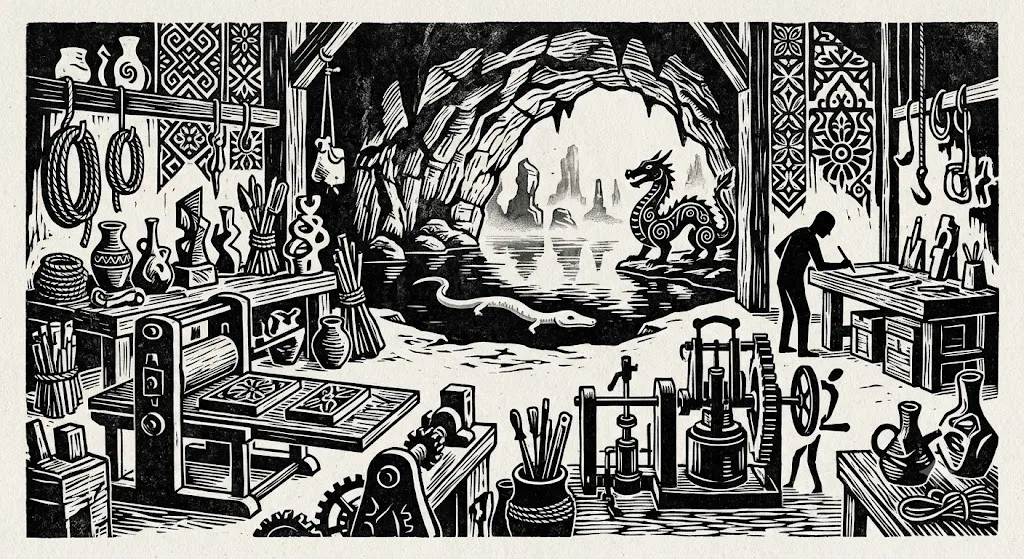
Much of south-western Slovenia is karst country: limestone terrain shaped by caves, underground rivers, disappearing streams and springs whose behaviour can appear unpredictable from the surface. Water may vanish below ground, reappear elsewhere or surge after prolonged rain. Lake Cerknica, one of Europe’s largest intermittent lakes, periodically drains through the porous landscape and later returns, transforming fields into open water. Such places naturally encouraged stories about hidden beings controlling the world below.[Notranjski park - SL]notranjski-park.siNotranjski parkSLLake Cerknica - Notranjski park - ENThe intermittent Lake Cerknica is home to three species of 'carnivorous' plants – intermediate blad…
In traditional accounts, a dragon was not necessarily a distant flying reptile guarding a castle. It might lie beneath a mountain, cave, village or underground lake. Its movements could explain floods, landslides, earthquakes or changes in the flow of a spring. Slovenian oral traditions collected around places such as Rodik and Zaplana include underground dragons associated with water and particular features of the terrain. The creature often functions as a folk explanation for geological forces that people could observe but not directly see.[zrc-sazu.si]sms.zrc-sazu.siFull text (pdfThere, where the dragon lies, is a spring. When too much water gathers for the dragon, he pours it away. This goes on…Read more…
This is an important distinction when approaching Slovenian “cryptids”. These dragons were generally not reported in the modern style of a brief roadside encounter followed by a newspaper investigation. They belonged to a landscape system. A spring pulsed because something shifted beneath it; a flood came because an underground beast released water; an oddly shaped animal found after rain was interpreted as evidence that the hidden dragon had offspring.
The olm: the real animal behind the baby dragon
The olm is Slovenia’s most convincing bridge between folklore and zoology. It is a pale, elongated salamander adapted to permanent life in underground water. Its eyes are greatly reduced, its skin lacks the pigmentation typical of surface animals, and feathery external gills project from its head. To anyone unfamiliar with cave biology, an olm appearing after a flood could easily look like something unfinished, unnatural or newly hatched.[I feel Slovenia]slovenia.infoI feel SloveniaMeet "baby dragons" in Postojna CaveHuman fish offspring hatched at the Postojna Cave. Learn about the life of dragon babi…
The association with dragons was recorded by the Carniolan scholar Janez Vajkard Valvasor in his 1689 work on the region. While investigating a spring near Vrhnika, he was told that a dragon inhabited the cave beneath it. Local reasoning held that pale creatures washed out after heavy rainfall were the dragon’s young, proving that a much larger parent lived in the subterranean system. Valvasor reported the claim but approached it with the curiosity and doubt of an early naturalist.[The New Yorker]newyorker.comThe New Yorker What's Behind Slovenia's Love Affair with a Salamander?Found in the ancient Postojna Cave, olms, often called "baby dragons," have fascinated observers with their unique appearance and life cy…
The explanation is now zoological rather than cryptozoological. Floodwater can displace cave animals and carry them towards springs or the surface. The “young dragons” were olms, while the unseen adult dragon was an inference built from their appearance and the mysterious hydraulics of the karst. The story is therefore neither a straightforward hoax nor evidence of an unknown giant reptile. It is a traditional interpretation of a real and exceptionally unfamiliar species.
The olm remains remarkable without supernatural embellishment. It is the largest vertebrate permanently adapted to European cave waters, can endure very long periods without feeding and reproduces slowly. Breeding events are rare enough to attract international attention. At Postojna Cave, 22 young survived from eggs laid in 2016, while 30 survived from a clutch produced in 2022, according to the cave’s published figures.[I feel Slovenia]slovenia.infoI feel SloveniaMeet "baby dragons" in Postojna CaveHuman fish offspring hatched at the Postojna Cave. Learn about the life of dragon babi…
Those hatchings gave the old legend a powerful modern afterlife. News reports, tourism material and conservation campaigns regularly call olms “baby dragons”. The phrase is memorable, visually apt and rooted in documented local belief. Unlike many commercial monster mascots, it did not have to be invented from nothing.
There is also a serious environmental message beneath the playful branding. The olm is classified as vulnerable, and its dependence on clean subterranean water makes it sensitive to pollution and disruption of karst aquifers. Protecting the “dragon” therefore means protecting underground freshwater systems used by wildlife and people alike.[iucnredlist.org]nc.iucnredlist.orgERL Pulse Amphibians 2025ERL Pulse Amphibians 2025

Ljubljana’s dragon: legend, symbol and city mascot
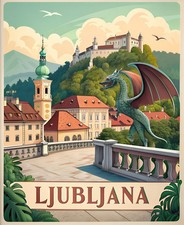
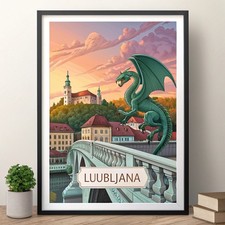
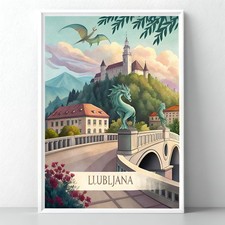
Ljubljana’s dragon is the most visible monster in Slovenia. Dragons appear on the city’s coat of arms, souvenirs and public imagery, while the four large copper creatures on Dragon Bridge have become among its best-known landmarks. Yet the city dragon is not based on a well-documented modern sighting. It is a cultural symbol assembled from several overlapping traditions.[The New Yorker]newyorker.comThe New Yorker What's Behind Slovenia's Love Affair with a Salamander?Found in the ancient Postojna Cave, olms, often called "baby dragons," have fascinated observers with their unique appearance and life cy…
One popular story links Ljubljana to Jason and the Argonauts. After obtaining the Golden Fleece, Jason supposedly travelled north and reached the marshy country around the Ljubljanica, where he fought a dragon. This is a later geographical attachment to classical myth rather than evidence of a historical encounter. It gave Ljubljana an heroic monster-slaying origin that suited a city already surrounded by wetlands, rivers and dragon traditions.[The New Yorker]newyorker.comThe New Yorker What's Behind Slovenia's Love Affair with a Salamander?Found in the ancient Postojna Cave, olms, often called "baby dragons," have fascinated observers with their unique appearance and life cy…
Christian imagery added another layer. Saint George, the conventional dragon-slayer, is associated with the chapel at Ljubljana Castle. More broadly, Slovenian dragons often appear as dangerous forces subdued by saints, heroes or magical specialists. Over time, however, Ljubljana’s dragon ceased to function primarily as an enemy. It became a guardian-like emblem: fierce enough to be impressive, but friendly enough for children’s books, festivals and tourism.
The modern city mascot is therefore best understood as the afterlife of folklore rather than a cryptid claim. No reliable body of footprints, photographs, carcasses or recurring eyewitness descriptions supports a biological dragon in Ljubljana. What survives is something culturally stronger: a monster that has been adopted as part of the city’s identity.
Underground dragons beyond Postojna
The baby-dragon story is not an isolated curiosity. Slovenian tradition contains numerous accounts of serpent-like or dragon-like beings dwelling beneath particular hills, settlements and bodies of water. One common form is the underground dragon sometimes rendered in English as a lindworm: a large reptilian creature whose cramped resting place contains water or treasure and whose movements disturb the surface.[zrc-sazu.si]sms.zrc-sazu.siFull text (pdfThere, where the dragon lies, is a spring. When too much water gathers for the dragon, he pours it away. This goes on…Read more…
At Zaplana, folklore described a dragon beneath the ground near a spring. Water accumulated around the creature until it discharged the excess, explaining fluctuations in the spring’s flow. Traditions documented around Rodik likewise attached dragons and other beings to named points in the landscape. Such stories gave communities a memorable map of dangerous or unusual places: sinkholes, caves, springs, ruins and routes where the ground itself seemed unstable.[sms.zrc-sazu.si]sms.zrc-sazu.siFull text (pdfThere, where the dragon lies, is a spring. When too much water gathers for the dragon, he pours it away. This goes on…Read more…
These accounts are easily distorted when removed from their setting. A modern retelling may present an underground dragon as though villagers repeatedly saw a giant reptile. In many source traditions, however, the dragon was inferred from effects—rising water, strange sounds, trembling ground or an animal washed from a cave—rather than observed directly.
Natural explanations vary by location. Karst drainage accounts for sudden changes in water level; erosion and rock movement produce noises underground; landslides and minor tremors can make hills seem animate. The value of the stories lies not in proving an undiscovered species but in showing how communities personified complicated environmental processes.
Zlatorog: Slovenia’s golden-horned mountain beast
Zlatorog, the legendary white chamois with golden horns, is Slovenia’s best-known mountain creature. It belongs to the Julian Alps, especially the country around Mount Triglav and the Trenta Valley. Unlike the underground dragon, Zlatorog is not principally a hidden monster blamed for natural disasters. He is a magical wild animal, guardian and embodiment of an untouchable Alpine realm.[tnp.si]tnp.siOpen source on tnp.si.
In the familiar story, Zlatorog leads a herd tended by supernatural women in a mountain paradise. His golden horns provide access to treasure. A young hunter, driven by jealousy and greed, shoots him, but miraculous flowers spring from the animal’s blood. After eating one, Zlatorog revives and charges. The hunter, dazzled by the horns, falls to his death, and the restored animal destroys the once-beautiful garden.[tnp.si]tnp.siOpen source on tnp.si.
The tale became nationally influential after being written down and reshaped in the nineteenth century. It later inspired literature, art, film, commercial branding and Alpine tourism. Slovenia’s first full-length Slovene-language film, made in 1931, was titled In the Kingdom of Zlatorog, demonstrating how quickly the animal moved from regional legend to national cultural emblem.[Wikipedia]WikipediaOpen source on wikipedia.org.
From a cryptozoological perspective, Zlatorog is not a plausible undiscovered species. The creature is plainly based on recognisable Alpine ungulates, most commonly interpreted as a chamois, with supernatural attributes added: golden horns, resurrection and command of magical treasure. A distant pale animal on snow or limestone may have helped sustain the image, but no credible evidence suggests that golden-horned white chamois form a separate population.
The story’s lasting appeal comes from its moral geography. Zlatorog represents wild country that punishes possession. The hunter can enter the mountains, but he cannot own their living symbol without destroying both himself and the paradise he desires.
Water beings and the danger beneath calm surfaces
Slovenian rivers and lakes also belong to a wider Central European tradition of water beings. One of the most famous Slovenian examples entered literature through France Prešeren’s nineteenth-century ballad The Water Man. The poem drew on an older Ljubljana story recorded by Valvasor, in which a young woman dancing in the city is carried away by a mysterious man associated with the Ljubljanica.[Wikipedia]WikipediaOpen source on wikipedia.org.
Such beings are not cryptids in a narrow zoological sense. They may appear human, shape-shifting or explicitly supernatural. Their relevance to mystery-creature history lies in the role they play: they give agency to deep pools, floods, drowning and treacherous currents. A calm-looking river can conceal a dangerous force, so the story presents that force as an intelligent being able to lure people into the water.
Slovenia’s disappearing lakes and underground rivers provide particularly fertile surroundings for this kind of folklore. At Lake Cerknica, water can cover a broad wetland and then drain away, revealing meadows and channels. The lake supports fish, amphibians, large birds and mammals from surrounding forests, creating many opportunities for half-seen animals, unfamiliar calls and moving shapes among reeds.[Notranjski park - SL]notranjski-park.siNotranjski parkSLLake Cerknica - Notranjski park - ENThe intermittent Lake Cerknica is home to three species of 'carnivorous' plants – intermediate blad…
Even so, Slovenia has not developed a widely documented Cerknica or Bled lake-monster tradition comparable with Nessie. Lake Bled has numerous origin legends, including a story in which divine punishment causes water to surround a church, but the lake’s folklore is not centred on a persistent unknown animal supported by recurring modern sightings.[Bled]bled.siLake Bled and its legendsLake Bled and its legends
Why modern monster reports are scarce
A striking feature of Slovenia’s creature lore is the absence of a large, well-documented twentieth- or twenty-first-century monster flap. There is no famous sequence of newspaper reports describing an ape-like creature, sea serpent, phantom cat or lake beast, followed by searches and disputed photographs. The available record is dominated instead by traditional narratives, ethnographic material, literary adaptation and the reinterpretation of known animals.
That may partly reflect Slovenia’s real wildlife. Its forests contain brown bears, wolves and Eurasian lynx, all of which are elusive enough to generate alarming or uncertain encounters. Lynx are seen only exceptionally, wolves generally avoid people, and bears may be encountered more often but still spend much of their lives concealed by woodland. A fleeting view at dusk can make an ordinary large carnivore appear larger, darker or stranger than it is.[Portal GOV.SI]gov.siOpen source on gov.si.
Animal damage can also produce rumours before experts identify the cause. Slovenian environmental records show that bears and wolves account for substantial losses involving protected wildlife, particularly attacks on livestock. Where tracks are unclear or witnesses arrive after the event, a known predator can temporarily become an unidentified beast in local conversation.[kazalci.arso.gov.si]kazalci.arso.gov.siOpen source on arso.gov.si.
The landscape adds further ambiguity. Forest cover restricts visibility, mountain scale disrupts distance estimates, reeds hide swimming birds and mammals, and caves distort sound. At Lake Cerknica alone, more than 300 bird species have been recorded. Large cormorants, grebes, herons and white-tailed eagles can create unfamiliar silhouettes, splashes or calls, especially for visitors who do not know the wetland’s wildlife.[Notranjski park - SL]notranjski-park.siNotranjski parkNotranjski park
None of this means every unusual observation is dishonestly reported. Misidentification usually begins with a sincere experience: a person sees something briefly under poor conditions and reaches for the closest available story. In Slovenia, those stories already contain dragons, water beings, magical mountain animals and predators lurking just beyond clear sight.
Tourism without a cryptid hoax
Slovenian tourism has enthusiastically embraced legendary creatures, but usually without presenting them as scientifically unconfirmed animals awaiting discovery. Postojna Cave openly connects the olm with the baby-dragon tradition while also explaining the animal’s biology and conservation. Visitors are invited to enjoy the legend and meet the real creature behind it.[slovenia.info]slovenia.infoI feel SloveniaMeet "baby dragons" in Postojna CaveHuman fish offspring hatched at the Postojna Cave. Learn about the life of dragon babi…
Ljubljana uses its dragon as a civic emblem rather than claiming that a reptilian monster occupies the river. Triglav National Park presents Zlatorog as a myth tied to Alpine heritage, landscape ethics and storytelling. Ptuj and surrounding areas preserve the masked Kurent tradition, whose shaggy, horned figures drive away harmful forces and welcome spring; these are ritual characters performed by people, not mystery animals reported in the wild.[Triglavski narodni park]tnp.siOpen source on tnp.si.
This separation is helpful. It allows monster traditions to support museums, trails, festivals and souvenirs without requiring fabricated eyewitness testimony. The olm remains an especially successful example because folklore attracts attention to a genuinely unusual and threatened species. The visitor arrives for a baby dragon and leaves having encountered cave ecology.
What counts as evidence in Slovenia’s creature stories?
Slovenia’s cases fall into several distinct categories, and confusing them produces poor cryptid history.
- Known animal interpreted through folklore: the olm mistaken for, or described as, a dragon’s offspring.
- Landscape legend: underground dragons used to explain springs, floods, trembling ground or caves.
- Supernatural animal tale: Zlatorog, whose magical powers and moral role place him firmly in legend.
- Water-spirit tradition: beings associated with drowning, seduction and dangerous currents rather than zoological sightings.
- Civic and tourist symbolism: Ljubljana’s dragon and modern “baby dragon” branding.
- Possible modern misidentification: fleeting encounters with bears, wolves, lynx, wildcats, large birds or swimming animals.
The first category offers physical evidence, but it supports the existence of a known salamander, not an adult dragon. The others are valuable evidence for belief, storytelling and cultural memory. They are not biological proof.
A convincing modern unknown-animal case would require more than an inherited legend or a blurry shape. Useful evidence would include repeated independent observations with consistent descriptions, recoverable biological material, clear imagery, tracks examined by qualified specialists and a habitat capable of supporting a breeding population. Slovenia’s famous creature traditions do not meet that standard.
The lasting Slovenian pattern
Slovenia’s mystery beasts are most persuasive when treated not as failed zoological discoveries but as creatures shaped by place. The olm looks legendary because evolution made it almost perfectly suited to darkness. Underground dragons make sense in a country where rivers disappear into rock. Zlatorog belongs on inaccessible ridges among real chamois, while water beings embody the dangers of rivers and intermittent lakes.
The country’s creature history therefore tells a subtler story than a catalogue of sightings. It shows how people use animals to interpret landscapes that conceal their workings. Science eventually explained the pale creature washed from the cave, but it did not erase the dragon. Instead, the explanation gave the legend a new role—as a memorable introduction to one of Europe’s strangest real animals and to the fragile underground world on which it depends.
Amazon book picks
Further Reading
Books and field guides related to Where Slovenia's Monsters Meet the Real Landscape. Use these as the next step if you want deeper reading beyond the article.
The Lore of the Land
Useful for understanding how landscapes generate monster stories.
The Element Encyclopedia of Magical Creatures
Covers dragons, water beings and legendary creatures relevant to Slovenia.
The Book of Imaginary Beings
Provides context for legendary creatures and monster traditions.
Fairy and Folk Tales of the Slavic Peoples
Relevant to the Slavic cultural background of Slovenian legends.
eBay marketplace picks
Marketplace Samples
Live-tested eBay searches with available results related to this page.
Endnotes
1.
Source: slovenia.info
Link:https://www.slovenia.info/en/stories/meet-baby-dragons-in-postojna-cave
Source snippet
I feel SloveniaMeet "baby dragons" in Postojna CaveHuman fish offspring hatched at the Postojna Cave. Learn about the life of dragon babi...
2.
Source: notranjski-park.si
Title: Notranjski park
Link:https://notranjski-park.si/en/discover/natural-landmarks/lake-cerknica
Source snippet
SLLake Cerknica - Notranjski park - ENThe intermittent Lake Cerknica is home to three species of 'carnivorous' plants – intermediate blad...
3.
Source: notranjski-park.si
Title: Notranjski park
Link:https://notranjski-park.si/en/projects/life-cerknisko-jezero
Source snippet
SLLIFE Cerkniško jezeroThe Lake Cerknica, which dries up periodically, is the largest intermittent lake in Europe. nesting of endangered...
4.
Source: notranjski-park.si
Title: Notranjski park
Link:https://notranjski-park.si/en/latest/news/life-trsca-a-new-monograph-on-lake-cerknica-has-been-published
Source snippet
SLA new monograph on Lake Cerknica has been publishedLake Cerknica is one of the largest intermittent lakes in Europe and is listed as a...
5.
Source: sms.zrc-sazu.si
Title: Full text (pdf)
Link:https://sms.zrc-sazu.si/pdf/Kropej_2012_Supp_06.pdf
Source snippet
There, where the dragon lies, is a spring. When too much water gathers for the dragon, he pours it away. This goes on...Read more...
6.
Source: journals.openedition.org
Link:https://journals.openedition.org/gaia/2710?lang=en
7.
Source: slovenia.info
Title: 21334 a record breaking achievement of postojna cave s baby dragons
Link:https://www.slovenia.info/en/press-centre/news-of-the-tourism-press-agency/21334-a-record-breaking-achievement-of-postojna-cave-s-baby-dragons
8.
Source: nc.iucnredlist.org
Title: ERL Pulse Amphibians 2025
Link:https://nc.iucnredlist.org/redlist/content/attachment_files/ERL_Pulse_Amphibians_2025.pdf
9.
Source: slovenia.info
Link:https://www.slovenia.info/en/stories/explore-the-world-of-slovenian-myths-and-legends
10.
Source: Wikipedia
Link:https://en.wikipedia.org/wiki/Goldhorn
11.
Source: Wikipedia
Link:https://en.wikipedia.org/wiki/Vodyanoy
12.
Source: notranjski-park.si
Title: Notranjski park
Link:https://notranjski-park.si/en/discover/natural-landmarks/lake-cerknica/other-animals
13.
Source: notranjski-park.si
Title: Notranjski park
Link:https://notranjski-park.si/en/plan-your-trip/activities/bird-watching
14.
Source: bled.si
Title: Lake Bled and its legends
Link:https://www.bled.si/en/inspiration/blog/2022070115555442/lake-bled-and-its-legends/
15.
Source: gov.si
Link:https://www.gov.si/en/topics/large-carnivores/
16.
Source: gov.si
Link:https://www.gov.si/assets/vladne-sluzbe/UKOM/Promocija-Slovenije/Promocijske-publikacije/Info-booklet-2025-english.pdf
17.
Source: kazalci.arso.gov.si
Link:https://kazalci.arso.gov.si/en/content/compensation-damage-caused-protected-animal-species
18.
Source: kazalci.arso.gov.si
Title: compensation damage caused protected animal species 0
Link:https://kazalci.arso.gov.si/en/content/compensation-damage-caused-protected-animal-species-0
19.
Source: kazalci.arso.gov.si
Link:https://kazalci.arso.gov.si/index.php/en/content/compensation-damage-caused-protected-animal-species
20.
Source: notranjski-park.si
Title: Notranjski park
Link:https://notranjski-park.si/en/discover/natural-landmarks/lake-cerknica/birds
21.
Source: gov.si
Title: Sinfo september 2014
Link:https://www.gov.si/assets/vladne-sluzbe/UKOM/Sinfo/Sinfo-arhiv/Sinfo-september-2014.pdf
Published: september 2014
22.
Source: gov.si
Link:https://www.gov.si/assets/vladne-sluzbe/UKOM/Promocija-Slovenije/Sinfo/Sinfo-arhiv/Sinfo-7-8-2017.pdf
23.
Source: gov.si
Title: Sinfo oktober 2014
Link:https://www.gov.si/assets/vladne-sluzbe/UKOM/Sinfo/Sinfo-arhiv/Sinfo-oktober-2014.pdf
24.
Source: gov.si
Link:https://www.gov.si/assets/vladne-sluzbe/UKOM/Promocija-Slovenije/Sinfo/Sinfo-arhiv/Sinfo-3-4-2015.pdf
25.
Source: gov.si
Link:https://www.gov.si/assets/vladne-sluzbe/UKOM/Promocija-Slovenije/Sinfo/Sinfo-arhiv/Sinfo-7-8-2015.pdf
26.
Source: gov.si
Link:https://www.gov.si/assets/vladne-sluzbe/UKOM/Promocija-Slovenije/Sinfo/Sinfo-arhiv/Sinfo-11-12-2018.pdf
27.
Source: gov.si
Title: Sinfo 1 2025
Link:https://www.gov.si/assets/vladne-sluzbe/UKOM/Promocija-Slovenije/Sinfo/Sinfo-arhiv/Sinfo-1-2025.pdf
28.
Source: gov.si
Link:https://www.gov.si/assets/vladne-sluzbe/UKOM/Promocija-Slovenije/Sinfo/Sinfo-arhiv/Sinfo-5-6-2019.pdf
29.
Source: gov.si
Title: Sinfo 1 2014
Link:https://www.gov.si/assets/vladne-sluzbe/UKOM/Promocija-Slovenije/Sinfo/Sinfo-arhiv/Sinfo-1-2014.pdf
30.
Source: gov.si
Link:https://www.gov.si/assets/vladne-sluzbe/UKOM/Promocija-Slovenije/Sinfo/Sinfo-arhiv/Sinfo-3-4-2016.pdf
31.
Source: gov.si
Link:https://www.gov.si/en/state-authorities/ministries/ministry-of-the-environment-and-spatial-planning/about-the-ministry/directorate-for-nature/
32.
Source: gov.si
Link:https://www.gov.si/assets/ministrstva/MKGP/PODROCJA/GOZDARSTVO/NGP/OPNGP-2022_2026_EN.pdf
33.
Source: gov.si
Link:https://www.gov.si/assets/ministrstva/MOP/Publikacije/biological_landscape_diversity_in_slovenia.pdf
34.
Source: natura2000.gov.si
Link:https://natura2000.gov.si/fileadmin/user_upload/knjiznica/publikacije/Multifunctional_forest_management_in_natura_2000_sites_1.pdf
35.
Source: eionet.arso.gov.si
Title: si Environmental indicators in Slovenia
Link:https://eionet.arso.gov.si/sites/default/files/2024-03/Kazalciokoljavsloveniji_en.pdf
36.
Source: notranjski-park.si
Title: life trsca insight into the animal world of lake cerknica
Link:https://notranjski-park.si/en/latest/news/life-trsca-insight-into-the-animal-world-of-lake-cerknica
37.
Source: life.notranjski-park.si
Title: si Supporters
Link:https://life.notranjski-park.si/en/supporters/
38.
Source: notranjski-park.si
Link:https://notranjski-park.si/en/latest/events/life-trsca-research-day-wild-animals
39.
Source: notranjski-park.si
Link:https://notranjski-park.si/en/latest/news/life-trsca-water—our-wealth-and-responsibility
40.
Source: Wikipedia
Link:https://en.wikipedia.org/wiki/Storsj%C3%B6odjuret
41.
Source: Wikipedia
Title: Lake monster
Link:https://en.wikipedia.org/wiki/Lake_monster
42.
Source: Wikipedia
Title: Loch Ness Monster
Link:https://en.wikipedia.org/wiki/Loch_Ness_Monster
43.
Source: Wikipedia
Title: Slavic dragon
Link:https://en.wikipedia.org/wiki/Slavic_dragon
44.
Source: slovenia.info
Title: 5518 the last baby dragon from the batch is born
Link:https://www.slovenia.info/en/press-centre/news-of-the-tourism-press-agency/5518-the-last-baby-dragon-from-the-batch-is-born
45.
Source: slovenia.info
Title: 5556 iflscience loves slovenian baby dragons
Link:https://www.slovenia.info/en/press-centre/news-of-the-tourism-press-agency/5556-iflscience-loves-slovenian-baby-dragons
46.
Source: slovenia.info
Title: 5559 olm eggs the first two slovenian dragons emerge
Link:https://www.slovenia.info/en/press-centre/news-of-the-tourism-press-agency/5559-olm-eggs-the-first-two-slovenian-dragons-emerge
47.
Source: slovenia.info
Title: 5547 dragon quest in postojna cave
Link:https://www.slovenia.info/en/press-centre/news-of-the-tourism-press-agency/5547-dragon-quest-in-postojna-cave
48.
Source: slovenia.info
Link:https://www.slovenia.info/en/places-to-go/attractions/postojna-cave
49.
Source: slovenia.info
Title: 5600 the slovenian woman of the year is an olm
Link:https://www.slovenia.info/en/press-centre/news-of-the-tourism-press-agency/5600-the-slovenian-woman-of-the-year-is-an-olm
50.
Source: slovenia.info
Link:https://www.slovenia.info/en/things-to-do/discover-nature/caves
51.
Source: slovenia.info
Title: 5486 enjoy the summer festival zmaj ma mlade in postojna
Link:https://www.slovenia.info/en/press-centre/news-of-the-tourism-press-agency/5486-enjoy-the-summer-festival-zmaj-ma-mlade-in-postojna
52.
Source: newyorker.com
Title: The New Yorker What’s Behind Slovenia’s Love Affair with a Salamander?
Link:https://www.newyorker.com/tech/annals-of-technology/whats-behind-slovenias-love-affair-with-a-salamander
Source snippet
Found in the ancient Postojna Cave, olms, often called "baby dragons," have fascinated observers with their unique appearance and life cy...
53.
Source: postojnska-jama.eu
Link:https://www.postojnska-jama.eu/en/wonderland-stories/baby-dragons-secret-stories/
Source snippet
Postojna Cave ParkBaby Dragons' Secret StoriesThe earliest written accounts of the offspring of a terrible dragon living inside Postojna...
54.
Source: tnp.si
Link:https://www.tnp.si/en/park/nature-and-culture/myths-and-legends/
55.
Source: triglavskazakladnica.si
Link:https://www.triglavskazakladnica.si/en/content/content-details/198/
56.
Source: ihavenotv.com
Link:https://ihavenotv.com/category/nature
Additional References
57.
Source: youtube.com
Title: Searching for the Human Fish | Cave Exploring in Slovenia
Link:https://www.youtube.com/watch?v=YiWkczEMSoE
Source snippet
The Curse of the [Ljubljana Dragon]({{ 'ljubljana-dragon/' | relative_url }}) - A Horror Fairy Tale...
58.
Source: youtube.com
Title: Postojna Cave, Slovenia
Link:https://www.youtube.com/watch?v=RL2oGswnxOo
Source snippet
Searching for the Human Fish | Cave Exploring in Slovenia...
59.
Source: youtube.com
Title: Baby Dragons’ Morph Video – one year in 24 seconds
Link:https://www.youtube.com/watch?v=IJG0QpHVFCk
Source snippet
Postojna Cave, Slovenia - REAL Life Baby Dragons...
60.
Source: academia.edu
Link:https://www.academia.edu/96874775/Formation_of_the_Fairy_Tale_Matrix_of_a_Dragon_Slayer
61.
Source: facebook.com
Link:https://www.facebook.com/euronews/posts/a-black-panther-was-reportedly-spotted-in-the-bulgarian-village-of-dupnitsa-spar/1152302060278456/
62.
Source: researchgate.net
Link:https://www.researchgate.net/publication/335802682_A_spatial_open-population_capture–recapture_model
63.
Source: instagram.com
Link:https://www.instagram.com/reel/DU8sGz5k0ee/
64.
Source: zdjp.si
Link:https://zdjp.si/wp-content/uploads/2023/01/AH_30-2022-3.pdf
65.
Source: reddit.com
Link:https://www.reddit.com/r/Cryptozoology/comments/1fuolm9/an_explanation_of_the_north_american_black_panther/
66.
Source: instagram.com
Link:https://www.instagram.com/p/Dae8j3XAKev/
Topic Tree
Follow this branch
Related pages 192
- Antigua Cryptids
- Maldives Monsters
- Malta Monsters
- Qatar Monsters
- Argentina Monsters
- +187 more in sidebar