Monsters Remembered in Belarus
Belarus does not have a long, well-documented cryptid record in the same way that Scotland has Loch Ness or the United States has Bigfoot. Its strongest mystery-creature tradition is more folkloric than zoological: the Tsmok, a Belarusian dragon or serpent-dragon associated above all with Lepel Lake in Vitebsk Region.
Page outline Jump by section
The creature most associated with Belarus: the Lepel Tsmok
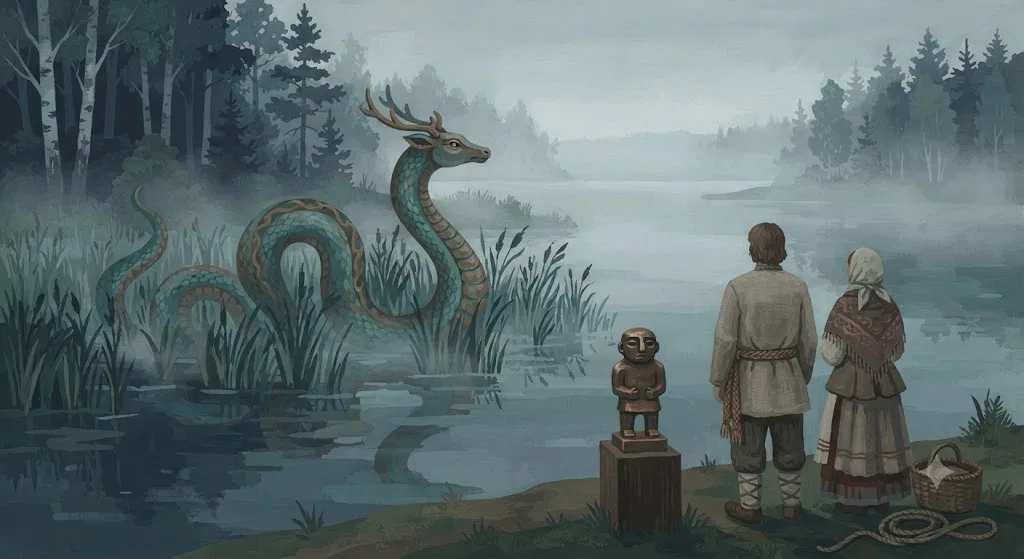
The Tsmok is the clear centrepiece of Belarusian monster lore. Official Belarusian tourism material describes it as a folklore figure found in many Belarusian tales and legends, outwardly imagined as a mixture of snake and dragon, with scales, wings, teeth and bright colouring. In older belief, such beings were said to live in caves and at the bottom of deep bodies of water, which makes the link with lakes and marshes especially important.[en.belarus.travel]en.belarus.travelOpen source on belarus.travel.
What makes the Belarusian Tsmok distinctive is its unusually friendly modern character. The official tourism account stresses that it is not usually presented as a bloodthirsty monster: folk belief often casts it as living in harmony with people and even helping with household tasks. This is a long way from the fire-breathing villain of many Western dragon stories. The Lepel version is closer to a guardian, household helper, water-spirit and local mascot rolled into one.[en.belarus.travel]en.belarus.travelOpen source on belarus.travel.
Lepel’s claim is now physical as well as folkloric. In 2013, a bronze sculpture of the Tsmok was installed on the shore of Lepel Lake, initiated by local artist and historian Vladimir Shushkevich. The tourism account says Shushkevich remembered stories from his grandmother about a monster in the lake that came ashore at weddings to receive food from the wedding table. That detail matters because it gives the legend a social role: the monster is not just lurking in the water, but interacting with village ritual, marriage, food and good fortune.[en.belarus.travel]en.belarus.travelOpen source on belarus.travel.
Why Lepel Lake became the dragon’s home
Lepel’s monster story works because the place already feels like suitable dragon country. Northern Belarus is rich in lakes, rivers, bogs and forested wetlands, and the wider Lepel District is connected with the Berezinsky Biosphere Reserve, a major protected landscape of bogs, rivers and wildlife. Belarus.by describes the reserve as covering 131,785 hectares across Lepel, Dokshitsy and Borisov districts, with 69 rivers, seven lakes, and extensive wetland systems.[Belarus]belarus.byBerezinsky Biosphere ReserveBerezinsky Biosphere Reserve
Those environments do not prove anything cryptid-like, but they explain why water monsters and marsh beings are culturally plausible there. A deep or misty lake, a reedy shoreline, beavers moving at dusk, otters, large fish, waterbirds, drifting logs and fog can all become story material. The same official reserve source notes 56 mammal species, 234 bird species, 34 fish species, and 16 to 17 amphibian and reptile species in the area, including large mammals such as bison, moose, bear, wolf and lynx. A landscape with that much real animal life gives folklore plenty to feed on.[Belarus]belarus.byBerezinsky Biosphere ReserveBerezinsky Biosphere Reserve
The Tsmok also fits broader Slavic dragon traditions. A scholarly article on treasure-bearing spirits and flying serpents in East Slavic and Finno-Ugric contexts notes that the Belarusian Tsmok has parallels across Slavic languages and mythologies, and that in Belarusian folklore it appears in magical and heroic fairy tales about serpent slayers as well as in material connected with St George. The same study links some Tsmok traditions with wealth-bringing or domestic spirits, which helps explain why the creature can be helpful rather than purely destructive.[ojs.zrc-sazu.si]ojs.zrc-sazu.siOpen source on zrc-sazu.si.

Folklore creature, literary monster, or cryptid?
The Lepel Tsmok is often discussed like a lake monster, but the evidence base is not the same as a modern sighting file. Its strongest sources are folklore, literature, local memory, sculpture and tourism promotion. That does not make it unimportant; it simply means the question should be “how did this creature become Belarus’s dragon?” rather than “is there a large unknown animal in the lake?”
A key modern influence is Belarusian writer Vladimir Korotkevich. Belarus.by says the most detailed description of the Tsmok was given in Korotkevich’s historical novel Christ Landed in Grodno, where the last Belarusian Tsmok is linked to one of the Lepel lakes. Belarus.travel gives the literary description in vivid terms: a water dragon with a thick neck, wide fins, a seal-like body, and a head resembling both a deer and a snake. This is exactly the kind of image that moves a creature from oral tradition into a more fixed public form.[Belarus]belarus.byPress releases, Belarus | Belarus.byPress releases, Belarus | Belarus.by…
That literary detail also explains why the modern statue does not look like a generic fantasy dragon. The 2013 branding plan said the sculpture would follow Korotkevich’s image of a seal-bodied, snake-or-deer-headed creature, and the later tourism account says sculptor Lev Aganov studied sources before creating the friendly Lepel figure. In other words, the creature’s current appearance is not the result of a zoological description from witnesses; it is a curated cultural image built from folklore, literature and local identity.[Belarus]belarus.byPress releases, Belarus | Belarus.byPress releases, Belarus | Belarus.by…
The Tsmok as tourist brand
The Tsmok’s modern afterlife is unusually well documented. In 2013, BelTA reported that the mythical Tsmok would become a symbol of Lepel District through a rural tourism project supported as part of an EU programme on water, nature and sustainable rural tourism in Russia and Belarus. The same report explicitly says local authorities chose the creature as a tourist brand because of its mythological associations with Lepel.[Belarus]belarus.byPress releases, Belarus | Belarus.byPress releases, Belarus | Belarus.by…
That branding succeeded because the Tsmok is flexible. It can be a lake monster for visitors who enjoy strange stories, a dragon for children, a folklore figure for cultural festivals, and a symbol of local landscape for regional tourism. Belarus.by’s event listings describe the Tsmok as one of the most mysterious creatures of Belarusian mythology and a well-known symbol of Lepel District, with festivals and cultural events built around Slavic mythology, quests, workshops and theatrical performances.[Belarus]belarus.bybelarus events calendar august 2019 i 103120belarus events calendar august 2019 i 103120
This is a good example of how a cryptid-style tradition changes over time. The creature begins as a lake and marsh being, is reshaped by literature, becomes a sculpture, then becomes a festival and destination hook. The result is not a hoax in the simple sense. It is a public folklore brand: playful, locally meaningful, and openly mythic.
The Belarusian chupacabra scare
Belarus’s most modern mystery-beast flap is the so-called chupacabra. Unlike the Tsmok, this is not an old Belarusian creature. It is an imported media monster attached to rural animal deaths. Euroradio’s 2019 overview says the “Mexican mythical creature” entered Belarusian information space from around 2011, with reports from different districts of a mysterious animal killing chickens, rabbits and sometimes dogs. The same article says officials tended to deny a monster explanation and point instead to foxes, polecats, lynx or raccoon dogs.[Навіны Беларусі | euroradio.fm]euroradio.fmOpen source on euroradio.fm.
This pattern is familiar far beyond Belarus. Chupacabra stories usually begin with dead livestock or poultry, then grow through rumours of puncture marks, missing blood, strange footprints or an ugly animal glimpsed at night. In Belarus, the creature became less a single animal than a label for frightening rural predation events. Euroradio’s framing is especially useful because it treats the Belarusian chupacabra as a “new monster” of folk demonology rather than as an established native legend.[Навіны Беларусі | euroradio.fm]euroradio.fmOpen source on euroradio.fm.
Specific Belarusian reports show the usual mix of fear, damage and uncertainty. Euroradio reported in 2012 that Starobin residents blamed a chupacabra for attacks on hens, hares, cats and pigs; a follow-up story said the rumours spread widely through the settlement before being treated as solved. Other regional reports describe rabbit hutches torn open and animals killed, which is exactly the kind of scene that can feel unnatural to owners even when ordinary predators are plausible.[Навіны Беларусі | euroradio.fm]euroradio.fmchupacabra attacks starobin photo 120251chupacabra attacks starobin photo 120251
What could explain the reports?
For the Tsmok, the best explanation is cultural rather than zoological: a water-dragon tradition rooted in Belarusian and wider Slavic folklore, strengthened by Lepel’s lake landscape, then fixed in public memory through Korotkevich, sculpture and tourism. There is no strong mainstream evidence for a large unknown animal in Lepel Lake, and the sources most often cited are folklore, literature and cultural promotion rather than biological investigation.[belarus.travel]en.belarus.travelOpen source on belarus.travel.
For the chupacabra, ordinary predators are the most likely starting point. Belarus has foxes, raccoon dogs, wolves, lynx and other carnivores in its wider fauna; the Berezinsky reserve’s official species list shows how rich the country’s mammal community is, including several animals capable of frightening people or killing domestic animals under the right circumstances. Rural attacks on rabbits and poultry can be messy, and predators do not always eat neatly or consume every animal they kill.[Belarus]belarus.byBerezinsky Biosphere ReserveBerezinsky Biosphere Reserve
Misidentification can also be made worse by real wildlife surprises. In 2017, Euroradio reported that a forest wildcat, considered extinct in Belarus for about 90 years, had been recorded by a camera trap in the Chernobyl Exclusion Zone; the report noted visible marks such as a massive tail with black rings. That case was not a cryptid claim, but it is a useful reminder that rare or returning animals can look startling when seen briefly, especially at night or on poor-quality footage.[Навіны Беларусі | euroradio.fm]euroradio.fmOpen source on euroradio.fm.
Belarus in the wider cryptid map
Belarus is best understood as a country where monster lore is strongly tied to water, marshes and rural edges. It does not currently offer a large body of repeat modern lake-monster sightings, ape-man reports or phantom-cat files with robust documentation. Instead, it has one highly developed national-style dragon tradition and one modern imported predator scare.
That makes Belarus interesting in a quieter way. The Tsmok shows how a legendary creature can become warmer, more local and more civic over time. The chupacabra shows how global monster language can settle onto ordinary rural anxieties about livestock loss. Between them, they reveal two different routes into cryptid culture: one from deep folklore into tourism, the other from sensational media into village rumour.
What readers should take away
Belarus’s headline creature is the Lepel Tsmok: a dragon-like water being associated with Lepel Lake, Belarusian folklore, Korotkevich’s literary imagination, and a modern bronze sculpture that turned the legend into a regional symbol. It is better treated as a living folklore creature than as an animal claim.[en.belarus.travel]en.belarus.travelOpen source on belarus.travel.
The Belarusian chupacabra, by contrast, is a recent media-era monster attached to reports of killed poultry and rabbits. Its likely explanations lie in predator activity, misidentification, rumour spread and the borrowing of a dramatic name from international popular culture.[Навіны Беларусі | euroradio.fm]euroradio.fmOpen source on euroradio.fm.
The country’s forests, wetlands and lakes matter because they give both kinds of story a believable setting. Belarus has real wolves, lynx, bears, bison, beavers, fish, reptiles and wetland birds; it does not need confirmed unknown animals to have a rich monster tradition. Its cryptid history is really a story about how people interpret wild landscapes when folklore, fear, literature and tourism all meet at the water’s edge.[Belarus]belarus.byBerezinsky Biosphere ReserveBerezinsky Biosphere Reserve
Amazon book picks
Further Reading
Books and field guides related to What Monsters Does Belarus Really Remember?. Use these as the next step if you want deeper reading beyond the article.
Russian Fairy Tales (Illustrated by Ivan Bilibin)
Contains the folklore landscape from which Belarusian dragon traditions emerged.
Slavic Folklore
Directly explains creatures, beliefs and folklore motifs relevant to Belarus.
The World of Lore: Monstrous Creatures
Supports readers interested in folklore monsters rather than zoological cryptids.
eBay marketplace picks
Marketplace Samples
Live-tested eBay searches with available results related to this page.
Endnotes
1.
Source: en.belarus.travel
Link:https://en.belarus.travel/news/lepelsky-tsmok
2.
Source: belarus.by
Title: Press releases, Belarus | Belarus.by
Link:https://www.belarus.by/en/press-center/press-release/mythical-tsmok-to-become-tourist-brand-for-lepel-district_i_0000005467.html
Source snippet
Press releases, Belarus | Belarus.by...
3.
Source: euroradio.fm
Link:https://euroradio.fm/ru/fenomen-chupakabry-kak-meksikanskiy-monstr-prizhilsya-v-belarusi-karta
4.
Source: belarus.by
Title: Berezinsky Biosphere Reserve
Link:https://www.belarus.by/en/about-belarus/natural-history/berezinsky-biosphere-reserve
5.
Source: ojs.zrc-sazu.si
Link:https://ojs.zrc-sazu.si/sms/article/download/11174/10397/32468
6.
Source: belarus.by
Title: belarus events calendar august 2019 i 103120
Link:https://www.belarus.by/en/press-center/press-release/belarus-events-calendar-august-2019_i_103120.html
Published: august 2019
7.
Source: belarus.by
Title: belarus events calendar august 2021 i 133790
Link:https://www.belarus.by/en/press-center/press-release/belarus-events-calendar-august-2021_i_133790.html
Published: august 2021
8.
Source: belarus.by
Title: belarus events calendar august 2024 i 176144
Link:https://www.belarus.by/en/press-center/press-release/belarus-events-calendar-august-2024_i_176144.html
Published: august 2024
9.
Source: euroradio.fm
Title: chupacabra attacks starobin photo 120251
Link:https://euroradio.fm/en/report/chupacabra-attacks-starobin-photo-120251
10.
Source: euroradio.fm
Title: starobin chupacabra mystery solved 120531
Link:https://euroradio.fm/en/report/starobin-chupacabra-mystery-solved-120531
11.
Source: euroradio.fm
Link:https://euroradio.fm/en/considered-extinct-90-years-forest-wildcat-spotted-chernobyl-area
12.
Source: belarus.by
Link:https://www.belarus.by/en/travel/belarus-life/sightseeing/tourist-attraction-vitebsk
13.
Source: belarus.by
Title: belarus events calendar august 2016 i 44730
Link:https://www.belarus.by/en/press-center/press-release/belarus-events-calendar-august-2016_i_44730.html
Published: august 2016
14.
Source: ru.belarus.travel
Title: travelЛепельский цмок
Link:https://ru.belarus.travel/news/lepelsky-tsmok
15.
Source: en.belarus.travel
Title: travel Berezinsky Biosphere Reserve
Link:https://en.belarus.travel/landmarks/berezinsky-biosphere-reserve
16.
Source: euroradio.fm
Title: chupacabra corpse stolen dokshytsy
Link:https://euroradio.fm/en/chupacabra-corpse-stolen-dokshytsy
17.
Source: berezinsky.by
Link:https://berezinsky.by/en/category/news/
18.
Source: folklore.ee
Title: Notes on Belarusian Mythology Studies Anastasiya Gulak
Link:https://folklore.ee/sator/wp-content/uploads/2026/03/08.pdf
19.
Source: youtube.com
Title: The Lepel Tsmok: A Symbol of the City
Link:https://www.youtube.com/watch?v=ni72xfimM-g
Source snippet
Belarusian mythological monsters...
20.
Source: youtube.com
Title: Belarusian mythological monsters
Link:https://www.youtube.com/watch?v=hQDHnnrW6JM
Source snippet
Europe’s Belarus Mythical Creatures...
21.
Source: youtube.com
Title: Crazy Creatures: Kikimora
Link:https://www.youtube.com/watch?v=GmL1guawDMQ
Source snippet
Belarus Lepel Tsmok folklore Лепель. Религиозный и светский Алексей Козлов...
22.
Source: cryptidz.fandom.com
Link:https://cryptidz.fandom.com/wiki/Tsmok
23.
Source: Wikipedia
Title: Slavic dragon
Link:https://en.wikipedia.org/wiki/Slavic_dragon
24.
Source: Wikipedia
Link:https://en.wikipedia.org/wiki/Chupacabra
25.
Source: mammalwatching.com
Link:https://www.mammalwatching.com/gd_place/belarus/
26.
Source: hrcak.srce.hr
Link:https://hrcak.srce.hr/file/502326
27.
Source: biodb.com
Link:https://biodb.com/region/belarus/
28.
Source: kehilalinks.jewishgen.org
Link:https://kehilalinks.jewishgen.org/lepel/lepel.html
29.
Source: cbd.int
Link:https://www.cbd.int/countries/profile/?country=by
30.
Source: minsktours.by
Title: Berezinsky Biosphere Reserve
Link:https://www.minsktours.by/belarus_nature_tours/berezinsky_biosphere_reserve.html
31.
Source: reform.news
Link:https://reform.news/en/belarusians-march-with-a-tsmok-for-the-first-time-at-berlin-s-carnival-of-cultures-photo-reportage/
32.
Source: fishi-pedia.com
Link:https://www.fishi-pedia.com/reptiles/countries/bielorussie
33.
Source: lcc-vsglobal.com
Title: Berezinsky biosphere reserve
Link:https://lcc-vsglobal.com/berezinsky-biosphere-reserve/
Additional References
34.
Source: birdwatchinghq.com
Link:https://birdwatchinghq.com/snakes-of-belarus/
35.
Source: researchgate.net
Link:https://www.researchgate.net/publication/352889239_Beliefs_About_Flying_Serpents_In_Belarusian_Estonian_And_Russian_Estonian_Traditions
36.
Source: facebook.com
Link:https://www.facebook.com/groups/137414080218517/posts/1112168179409764/
37.
Source: instagram.com
Link:https://www.instagram.com/reel/DTH25OrCZo1/?hl=en
38.
Source: academia.edu
Link:https://www.academia.edu/49499356/Beliefs_About_Flying_Serpents_In_Belarusian_Estonian_And_Russian_Estonian_Traditions
39.
Source: instagram.com
Link:https://www.instagram.com/p/C8QaM4DytkD/
40.
Source: hiwaifu.com
Link:https://www.hiwaifu.com/en/robot/20678639
41.
Source: reddit.com
Link:https://www.reddit.com/r/europe/comments/79q3ru/considered_extinct_for_90_years_forest_wildcat/
42.
Source: facebook.com
Link:https://www.facebook.com/rankerweirdhistory/posts/has-a-creature-called-the-brosno-dragon-been-lurking-in-a-russian-lake-since-the/1185804453761875/
43.
Source: reddit.com
Link:https://www.reddit.com/r/AskHistorians/comments/oayw81/how_did_chupacabras_get_to_belarus/
Topic Tree
Follow this branch
Related pages 192
- Antigua Cryptids
- Maldives Monsters
- Malta Monsters
- Qatar Monsters
- Argentina Monsters
- +187 more in sidebar