Within Italy Cryptids
Why Did Italy's Marshes Grow Dragons?
Tarantasio and Thyrus turn old marsh fear, disease and land improvement into dragon stories with lasting civic meaning.
On this page
- Tarantasio and lost Lake Gerundo
- Thyrus and the civic dragon of Terni
- Bad air, drainage and symbolic defeat
Page outline Jump by section
Introduction
Some of Italy’s most memorable dragons were not really monsters of unexplored wilderness. They were stories that helped people make sense of unhealthy marshes, stagnant water and landscapes that seemed actively hostile to human life. In regions where wetlands bred disease, released foul-smelling gases and hindered settlement, communities often imagined a dragon lurking behind the danger. The creature gave a face to invisible threats. When the marsh was drained or the land reclaimed, the dragon could be said to have been defeated.
Two famous examples illustrate this pattern particularly well: Tarantasio of the vanished Lake Gerundo in Lombardy and Thyrus of Terni in Umbria. Neither survives because of modern sightings. Instead, both endure because they transformed environmental problems into dramatic stories of heroes, monsters and civic triumph. Their legends reveal how Italians once understood dangerous wetlands long before modern medicine and environmental science offered other explanations.[Wikipedia]WikipediaLago GerundoLago Gerundo
Tarantasio and the Lost Lake Gerundo
The strongest example of a marsh dragon as environmental memory is Tarantasio, the legendary monster of Lake Gerundo. According to tradition, this dragon inhabited a vast wetland area that once occupied parts of modern Lombardy between Milan, Lodi, Cremona and Bergamo. The lake itself gradually disappeared through natural changes and drainage works, leaving behind fertile agricultural land.[Wikipedia]WikipediaGerundo LakeGerundo Lake
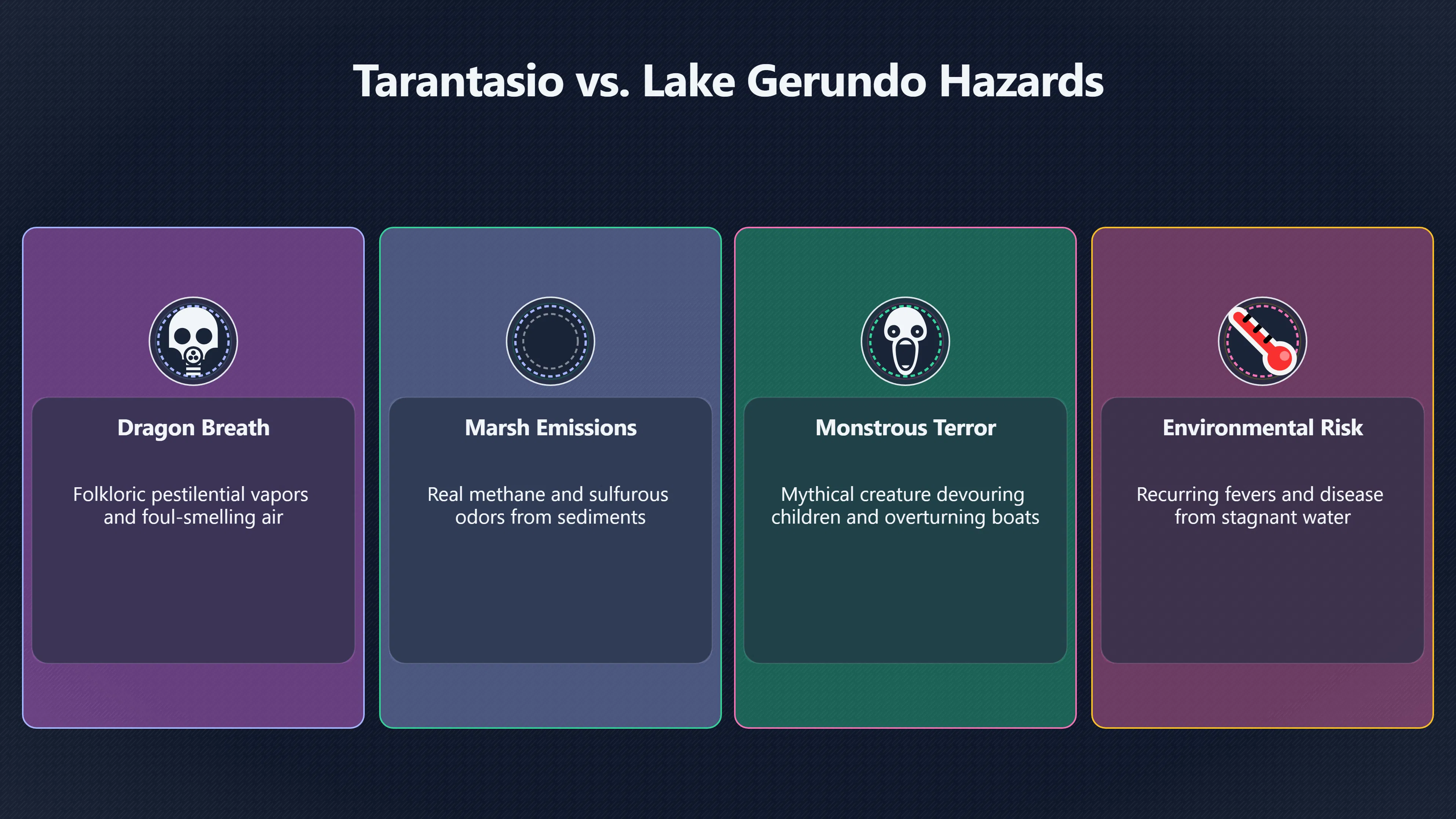
In the legend, Tarantasio terrorised local communities. It devoured children, overturned boats and poisoned the surrounding air with its foul breath. The detail that matters most is not the dragon’s appearance but its breath. Again and again, versions of the story describe pestilential vapours spreading from the lake and making people ill.[Wikipedia]WikipediaOpen source on wikipedia.org.
Modern interpretations suggest that the legend preserved memories of real environmental hazards:
- The marshes around Gerundo produced unpleasant sulphurous odours and methane emissions from muddy sediments.
- Wetlands were associated with recurring fevers and disease.
- Dangerous water, unstable ground and periodic flooding threatened local settlements.
- People lacked scientific explanations for many of these hazards and instead explained them through a monstrous creature.[wikipedia.org]WikipediaLago GerundoLago Gerundo
The connection between marshes and illness was especially powerful in pre-modern Europe. Long before mosquitoes were identified as carriers of malaria, people often believed disease came from poisonous air rising from swamps. The very term “malaria” originated from the idea of “bad air”. Marshes therefore seemed like places where invisible death emerged from the landscape itself.[amjmedsci.com]amjmedsci.comMalaria, a Journey in Time: In Search of the Lost Myths and…by R Neghina · 2010 · Cited by 97 — This essay assesses the history of mal…
Seen through that lens, Tarantasio’s deadly breath looks less like a zoological description and more like a folkloric explanation for disease-ridden wetlands.
The Dragon Dies When the Marsh Disappears
One of the most revealing features of the Tarantasio story is that the monster’s defeat is closely linked to the reclamation of the land.
Different versions credit heroes, saints or rulers with killing the dragon. Some traditions associate the victory with Saint Christopher, others with Frederick Barbarossa, while another famous version connects the feat to the origins of the Visconti dynasty. Yet all of these stories point toward the same symbolic outcome: the dangerous wetland is conquered and transformed into productive land.[Wikipedia]WikipediaLago GerundoLago Gerundo
The dragon and the swamp effectively become the same thing. Once drainage projects, canals and land improvements reduce the threat, folklore remembers the achievement as the slaying of a monster. The story turns environmental engineering into heroic myth.[Wikipedia]WikipediaLago GerundoLago Gerundo
Thyrus and the Civic Dragon of Terni
The dragon Thyrus occupies a slightly different place in Italian tradition. Unlike Tarantasio, it is less closely tied to a vanished lake and more deeply woven into the civic identity of Terni in Umbria. Nevertheless, the environmental themes remain strikingly similar.[Hotel Fonte Cesia]fontecesia.itthe dragon of terniHotel Fonte CesiaThe legend of the dragon of Terni2 Sept 2019 — This legend is set in the very distant past and tells the story of a drag…
According to the legend, a dragon lived near Terni and terrorised the population. Its most dangerous weapon was not claws or teeth but a poisonous, pestilent breath capable of suffocating people. The creature haunted the countryside around the city until a young knight from the Cittadini family finally slew it.[Hotel Fonte Cesia]fontecesia.itthe dragon of terniHotel Fonte CesiaThe legend of the dragon of Terni2 Sept 2019 — This legend is set in the very distant past and tells the story of a drag…
The emphasis on foul air once again recalls older fears surrounding unhealthy landscapes. Medieval people often interpreted bad smells as direct evidence of disease. A monster whose breath killed from a distance fit naturally into that worldview.[Hotel Fonte Cesia]fontecesia.itthe dragon of terniHotel Fonte CesiaThe legend of the dragon of Terni2 Sept 2019 — This legend is set in the very distant past and tells the story of a drag…
Unlike many dragons that disappear after their defeat, Thyrus became part of the city’s identity. The creature survives on Terni’s heraldry and civic symbolism, turning a former menace into a local emblem. The dragon remains visible not because people believe it still exists, but because the story became part of how the city understood its own history.[Wikipedia]WikipediaEuropean dragonEuropean dragon

From Monster to Civic Symbol
This transformation is important. In many European dragon stories, the creature remains an enemy. In Terni, the dragon eventually becomes a symbol of the city itself.
That change reflects a broader pattern in folklore. Once a landscape is controlled and its dangers reduced, the monster no longer represents an immediate threat. Instead, it becomes a marker of local identity, something that distinguishes one town from another and links present-day residents to a legendary past.[Wikipedia]WikipediaEuropean dragonEuropean dragon

Bad Air, Drainage and Symbolic Defeat
The common thread linking Tarantasio and Thyrus is not cryptozoology but environmental memory.
Both dragons are associated with three recurring themes:
Dangerous water. Marshes, lakes and poorly drained land created practical risks ranging from flooding to difficult travel and disease.[Wikipedia]WikipediaLago GerundoLago Gerundo
Poisonous air. Legends repeatedly describe foul breath, pestilence and deadly vapours. These details mirror historical beliefs that illness arose from noxious air emitted by wetlands.[Wikipedia]WikipediaLago GerundoLago Gerundo
Human victory through improvement. The dragon is ultimately defeated when people reclaim the landscape, whether through drainage works, settlement, political authority or religious intervention. The story converts environmental change into a memorable narrative of heroism.[Wikipedia]WikipediaLago GerundoLago Gerundo
This helps explain why these legends endured long after belief in literal dragons faded. They continued to communicate something true about the places that produced them. The monsters preserved memories of landscapes that had once been unhealthy, difficult and feared.
Why These Dragons Matter More Than Sightings
Modern readers sometimes approach Italian dragon legends expecting evidence of unknown creatures. Tarantasio and Thyrus point in a different direction. Their value lies not in eyewitness reports but in what they reveal about how communities interpreted their environment.
The dragons provided a simple explanation for complex problems: mysterious fevers, foul-smelling marshes, dangerous waterways and the challenge of making difficult land habitable. They also offered satisfying endings. When the wetland was drained, the disease reduced or the settlement prospered, the community could say the dragon had been slain.
That is why these stories remain important in Italy’s monster tradition. They are less like lake-monster reports and more like folklore maps of environmental fear. Behind the scales, claws and poisonous breath sits a very real historical subject: the long struggle between people and the wetlands that shaped their lives.[wikipedia.org]WikipediaLago GerundoLago Gerundo
Amazon book picks
Further Reading
Books and field guides related to Why Did Italy's Marshes Grow Dragons?. Use these as the next step if you want deeper reading beyond the article.
The First Fossil Hunters
Shows how environmental evidence can inspire monster legends.
The Book of Imaginary Beings
Places local dragon stories within a wider bestiary tradition.
The Mythical Creatures Bible
Covers dragon archetypes useful for understanding Tarantasio and Thyrus.
eBay marketplace picks
Marketplace Samples
Live-tested eBay searches with available results related to this page.




Endnotes
1.
Source: Wikipedia
Title: Lago Gerundo
Link:https://it.wikipedia.org/wiki/Lago_Gerundo
2.
Source: Wikipedia
Title: Gerundo Lake
Link:https://en.wikipedia.org/wiki/Gerundo_Lake
3.
Source: Wikipedia
Link:https://it.wikipedia.org/wiki/Tarantasio
4.
Source: reddit.com
Link:https://www.reddit.com/r/DnD/comments/4nbemz/tarantasio_the_legendary_dragon_of_po_valley_italy/
Source snippet
Tarantasio, the legendary dragon of Po valley (Italy): r/DnDThe legend say that a dragon was terrifying people leaving near that lake/sw...
5.
Source: amjmedsci.com
Link:https://www.amjmedsci.com/article/S0002-9629%2815%2931429-4/fulltext
Source snippet
Malaria, a Journey in Time: In Search of the Lost Myths and...by R Neghina · 2010 · Cited by 97 — This essay assesses the history of mal...
6.
Source: Wikipedia
Title: European dragon
Link:https://en.wikipedia.org/wiki/European_dragon
7.
Source: fontecesia.it
Title: the dragon of terni
Link:https://www.fontecesia.it/en/stories-legends-umbria/the-dragon-of-terni/
Source snippet
Hotel Fonte CesiaThe legend of the dragon of Terni2 Sept 2019 — This legend is set in the very distant past and tells the story of a drag...
8.
Source: ultimatepopculture.fandom.com
Title: European dragon
Link:https://ultimatepopculture.fandom.com/wiki/European_dragon
Source snippet
One of the most famous wyverns of Italian folklore is Thyrus, a wyvern that besieged Terni in the Middle Ages.Read more...
Additional References
9.
Source: italiansrus.com
Link:https://www.italiansrus.com/articles/tarantasio.htm
Source snippet
Tarantasio DragonLegend tells us of a great dragon like creature named Tarantasio that roamed the Po Valley during the 12th and 13th cent...
10.
Source: instagram.com
Link:https://www.instagram.com/p/CusEJ2GobVM/
Source snippet
The dragon Tarantasio was the undisputed ruler of Lake...According to legend, the fantastic creature frequently emerged from the waters...
11.
Source: facebook.com
Link:https://www.facebook.com/groups/229761791287211/posts/1403422053921173/
Source snippet
Terni in the Middle Ages. One day, a young and brave...Read more...
12.
Source: dangerousminds.net
Title: Tarantasio: the infamous dragon of Milan
Link:https://dangerousminds.net/history/tarantasio-infamous-dragon-of-milan/
Source snippet
Dangerous Minds19 Apr 2026 — That legend was that the lake was guarded by a creature of enormous, terrifying power, a dragon by the name...
13.
Source: exploring-umbria.com
Link:https://www.exploring-umbria.com/en/terni-eng/
Source snippet
No one could approach his lair for miles around...Read more...
14.
Source: english-heritage.org.uk
Title: They take many different forms and have varying characteristics.Read more
Link:https://www.english-heritage.org.uk/visit/inspire-me/blog/articles/dragons-and-their-origins/
Source snippet
Dragons and their Origins10 Mar 2021 — Dragons feature in legend and folklore all across Britain, as well as Europe and Asia...
15.
Source: verochic.com
Title: The Legend of Dragon Tarantasio!
Link:https://www.verochic.com/en/the-legend-of-drake-tarantasio/
Source snippet
20 Apr 2020 — The Tarantasio dragon died, hit in the heart and sank in the waters of the lake. Victorious The Knight Uberto Visco...
16.
Source: substack.com
Title: Mythology: Gods and Monsters
Link:https://substack.com/%40godsandmonstersinfo/note/c-213626031
Source snippet
TarantasioTarantasio wasn't your typical gold-hoarding dragon. He lived in the "reed-choked sludge" of Lake Gerundo—a body of water that...
17.
Source: youtube.com
Link:https://www.youtube.com/shorts/gttMffhkzOI
Source snippet
ional Spooky Creatures | Thyrus the Dragon of Terni, Italy. 11...
18.
Source: limnetica.com
Link:https://www.limnetica.com/documentos/limnetica/limnetica-28-2-p-283.pdf
Source snippet
Historical importance of wetlands in malaria transmission in southwest of Spain. Malaria is a parasitic disease that is currently affecti...
Topic Tree