Where Cambodia's Monsters Meet Real Wildlife
Cambodia’s strongest “cryptid” tradition is not a modern monster-hunt built around one famous lake beast. It is a layered creature culture in which sacred serpents, giant river animals, elusive forest mammals and crocodile stories overlap.
Page outline Jump by section
Introduction
The useful way to read Cambodian monster lore is therefore not to ask, “Which beast is secretly real?” A better question is, “Which stories are mythic, which are memory of real animals, and which sit in the uneasy middle?” Cambodia has all three. Its temples preserve supernatural serpent imagery; its rivers still hold rare animals large enough to start rumours; and its forests contain one of the world’s great “maybe gone, maybe not” mammal mysteries.[metmuseum.org]metmuseum.orgThe Metropolitan Museum of Art Buddha Sheltered by a NagaThe Metropolitan Museum of Art Buddha Sheltered by a Naga
Why Cambodia’s monster map begins with serpents
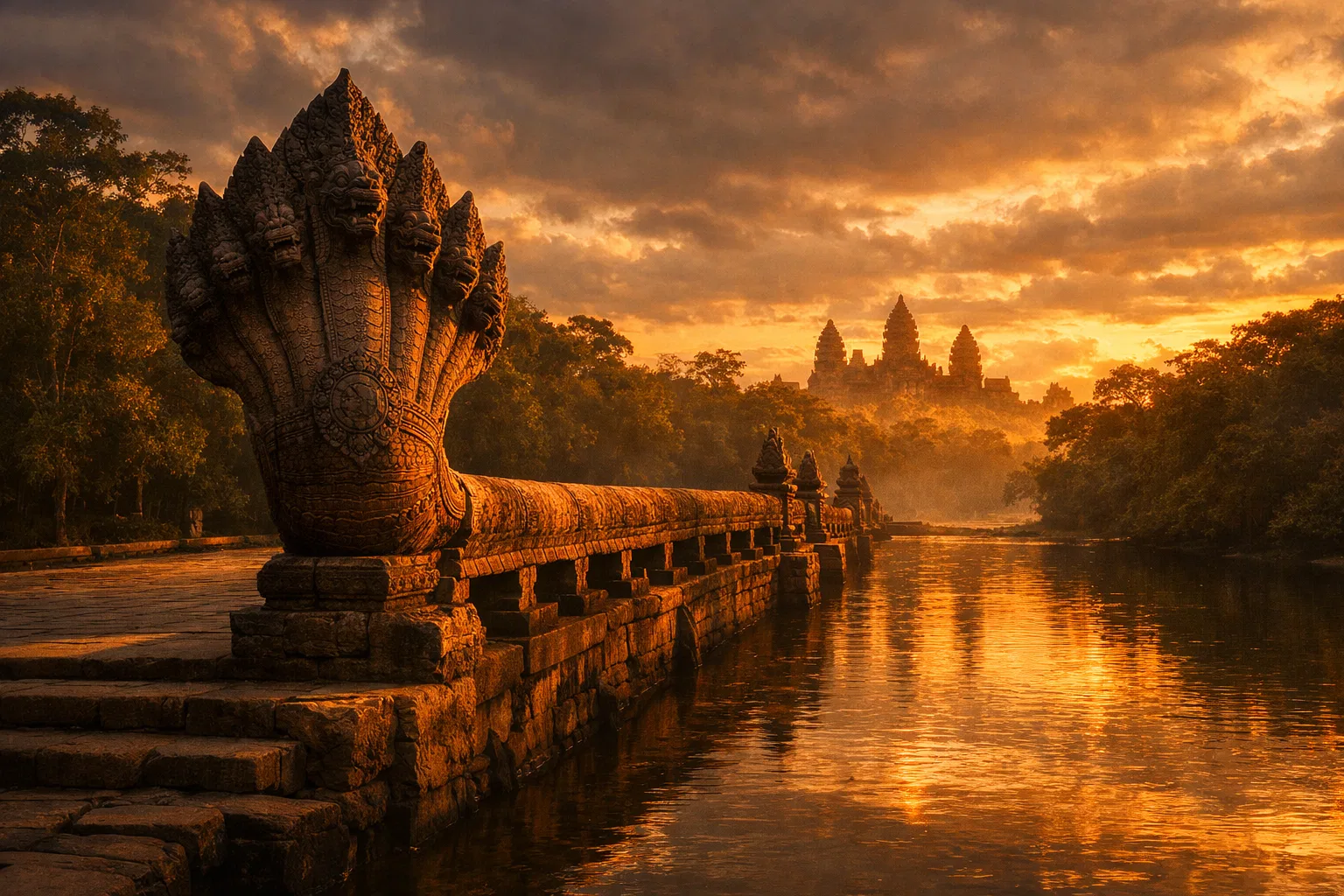
The naga is the creature most deeply bound to Cambodia’s national imagination. In Khmer origin tradition, the marriage of Preah Thong and Neang Neak links an incoming prince with a serpent princess, while the naga king creates land by withdrawing the waters. One academic discussion of the myth notes that there are many versions, but that they commonly express the founding of civilisation; in the cited nineteenth-century account, the naga princess embodies life, earth and water, while the prince embodies a complementary solar and spiritual principle.[PhilArchive]philarchive.orgPhil Archive85p-文字版Phil Archive85p-文字版
That matters for a cryptid-focused reader because the Cambodian naga is not simply “a big snake report”. It is a national, religious and architectural figure. A naga can be an ancestor, a water-being, a guardian, a bridge between worlds, or a sign of royal and sacred order. In that sense, Cambodian serpent lore belongs partly to the same broad family as dragon and water-serpent traditions elsewhere, but it is also specifically Khmer in how it is tied to land, identity, temple approaches and water management.[PhilArchive]philarchive.orgPhil Archive85p-文字版Phil Archive85p-文字版
Angkor made the serpent visible in stone. The causeways and bridges of Angkorian Cambodia repeatedly use naga balustrades, and one classic account of Southeast Asian kingship describes the city gates as lined with gods and demons holding a vast seven-headed serpent, turning the whole city into an image of the cosmic churning of the ocean. The Smithsonian’s National Museum of Asian Art also describes naga-decorated bridges as a hallmark of Angkor-era art, while the Metropolitan Museum notes the popularity in Cambodia of the Buddha protected by the serpent king Muchilinda during the reign of Jayavarman VII.[angkordatabase.asia]angkordatabase.asiaAngkor Database Conceptions of State and Kingship in Southeast AsiaAngkor Database Conceptions of State and Kingship in Southeast Asia
For sceptical readers, this means the naga should not be treated like a newspaper sighting of an unknown animal. It is better understood as a sacred serpent tradition that drew power from real snakes, monsoon water, floodplain life and Indic-Buddhist imagery, then became one of Cambodia’s most durable cultural symbols.
Are there Cambodian lake monsters?
Cambodia does not have a single well-documented “Loch Ness” equivalent with a long run of dated sightings, named eyewitnesses and a local tourist industry built around one beast. The country’s water-monster material is looser and older: naga stories, crocodile fear, river spirits and the genuine shock value of huge Mekong fish. That makes Cambodia less of a classic lake-monster country and more of a serpent-and-river-giant country.
The Tonle Sap is the obvious place where a lake-monster tradition could grow. It is one of the world’s most productive freshwater fisheries, according to UNESCO, and its ecology is dramatic enough to feel mythic without adding monsters: seasonal flooding, migrating fish, floating communities and a river system tied to the Mekong.[UNESCO]unesco.orgEarth Network mission in Tonle Sap Biosphere Reserve, in CambodiaEarth Network mission in Tonle Sap Biosphere Reserve, in Cambodia
Real animals do much of the work that cryptids do elsewhere. The Mekong giant catfish can reach around 3 metres and 300 kilograms, and in December 2024 six critically endangered individuals were caught and released in Cambodia within a few days, an event researchers called unprecedented. The fish were caught in the Tonle Sap and Mekong system and were probably migrating from floodplain habitats near Tonle Sap Lake towards spawning areas farther north.[AP News]apnews.comOpen source on apnews.com.
Cambodia also entered global “river monster” headlines in 2022 when a giant freshwater stingray caught in the Mekong was reported as the world’s largest recorded freshwater fish, about 4 metres long and 300 kilograms. This was not a cryptid; it was a known endangered species. But it shows why large, dark, rarely seen aquatic animals can easily generate extraordinary stories along the Mekong.[Mongabay News]news.mongabay.comgiant stingray caught in cambodia is worlds largest freshwater fishgiant stingray caught in cambodia is worlds largest freshwater fish
The kouprey: Cambodia’s real mystery mammal
The kouprey is the closest Cambodia comes to a classic modern cryptozoological case: a large land animal known to science, culturally important, poorly observed, and possibly extinct while still leaving room for disputed reports. It is a wild cattle species associated with Cambodia and neighbouring parts of mainland Southeast Asia. WWF Cambodia describes it as Cambodia’s national mammal and says its name means “forest ox”.[WWF Cambodia]wwf.org.khOpen source on wwf.org.kh.
Unlike the naga, the kouprey is not a supernatural being. It was scientifically described in 1937, and much of what is known about it comes from expeditions in Cambodia in the 1950s and early 1960s. The problem is that confirmed evidence then dries up. Dialogue Earth reports that claimed sightings continued into the 1980s, but that the last confirmed sighting was in 1969 in northern Cambodia. WWF Cambodia gives a slightly different emphasis, saying the species was “last seen in 1988” while also noting that the last published records date from Charles Wharton’s 1963–64 work.[Dialogue Earth]dialogue.earthEarth The kouprey: on the trail of Cambodia’s elusive wild cattleEarth The kouprey: on the trail of Cambodia’s elusive wild cattle
That disagreement is exactly why the kouprey belongs on a Cambodian mystery-animal page. It is not an invented monster, yet its current status is uncertain enough to invite expeditions, rumours and “last survivor” hopes. The Asian Wild Cattle Specialist Group says there have been no confirmed sightings since 1983 and that the species may already be extinct; other summaries place the last confirmed record earlier. The cautious reading is that Cambodia’s forest ox is a real animal with no modern confirmed population, not a proven surviving cryptid.[asianwildcattle.org]asianwildcattle.orgOpen source on asianwildcattle.org.
The kouprey also shows how war, hunting and habitat loss turn zoology into legend. It appears in Cambodian symbolism, stamps, logos and sporting nicknames, yet most living Cambodians will never have seen one. That is the melancholy twist: the creature’s afterlife may now be stronger in culture than in the forest.[Dialogue Earth]dialogue.earthEarth The kouprey: On the trail of Cambodia's elusive wild cattleEarth The kouprey: On the trail of Cambodia's elusive wild cattle

Crocodiles, giant snakes and the misidentification problem
Many Cambodian monster stories are best understood against the country’s real wildlife. Large reptiles are not imaginary here. Siamese crocodiles, once widespread in Southeast Asia, were thought by the late twentieth century to be nearly or entirely gone from the wild, but a 2000 survey found a surviving population in Cambodia’s Cardamom Mountains. Associated Press reported in 2024 that roughly 400 wild Siamese crocodiles were then believed to live in Cambodia, as part of an estimated 1,000 across the species’ range.[AP News]apnews.comOpen source on apnews.com.
That conservation story matters because crocodiles often occupy the same imaginative space as monsters: hidden water, sudden danger, ancient appearance and uncertain abundance. Fauna & Flora’s Cambodian crocodile project focuses especially on the Cardamom Mountains, aiming to increase the wild population through carefully managed releases of purebred animals. AP’s reporting also notes the complication of crocodile farms, where hybridisation with larger, more aggressive species makes release decisions risky.[Fauna & Flora]fauna-flora.orgFauna & Flora Conserving Siamese crocodiles in Cambodia | Fauna & FloraFauna & Flora Conserving Siamese crocodiles in Cambodia | Fauna & Flora
Snakes are another obvious source of exaggeration. Cambodia has large pythons and cobras, and the visual language of multi-headed nagas can make ordinary snake encounters feel symbolically charged. A king cobra or python glimpsed at night, near water, or through vegetation does not need to be unknown to be frightening. In folklore, it can become a sign; in social media, it can become a “monster”; in reality, it may simply be an impressive animal in a country where snakes still form part of the lived landscape.[Cambodianess]cambodianess.comface to face with cambodias common snake speciesface to face with cambodias common snake species
The same logic applies to “phantom cat” style reports. Cambodia historically had large cats, but tigers are now considered functionally extinct in the country; AP reported that Cambodia’s last observed tiger was in 2007 and that authorities have pursued reintroduction plans involving India. Clouded leopards and other elusive carnivores can still feed rumour, but modern claims need careful separation between old memory, hopeful misidentification and confirmed wildlife evidence.[AP News]apnews.comOpen source on apnews.com.
Why the Mekong keeps making believable monsters
The Mekong is one reason Cambodian creature lore stays compelling. A river that can still produce 300-kilogram fish does not require much embellishment to feel uncanny. The Mekong giant catfish is critically endangered, rarely seen by ordinary people, migratory, and still poorly understood in parts of its life cycle. Researchers have spent years tagging and releasing fish in Cambodia to learn where they move and how migration corridors might be protected.[AP News]apnews.comOpen source on apnews.com.
This is where folklore and conservation meet. A “river monster” headline may attract attention, but the scientific story is usually about decline. The Mekong giant catfish population has fallen sharply because of overfishing, dams blocking migration routes and wider river disruption. The AP report on the 2024 Cambodia catches framed the event as hopeful precisely because the animal is so rare; finding six giants in a few days did not prove abundance, but it suggested the species was not immediately beyond saving.[AP News]apnews.comOpen source on apnews.com.
For a cryptid reader, the lesson is useful: Cambodia’s waters contain animals that are strange enough without being unknown. The best “monster” accounts here often become more interesting when treated as ecology rather than as proof of a hidden species. A fisherman’s huge shadow in the river might be a sacred sign in one telling, a rare conservation encounter in another, and a misremembered fish tale in a third.

Folklore, faith and animal memory
Cambodian creature traditions do not divide cleanly into “real animal” and “made-up monster”. The naga is not a zoological claim, but it is shaped by an environment of rivers, rain, snakes, flood cycles and agriculture. The kouprey is a zoological species, but its disappearance has given it a ghostly status. The Mekong giant catfish and giant freshwater stingray are confirmed animals, but their scale and rarity make them feel legendary. Crocodiles are real predators, but their sudden appearances and conservation drama give them a mythic edge.
This mixture is typical of strong monster traditions. People do not invent creatures in a vacuum; they build them out of landscape, danger, memory, religion and half-seen animals. In Cambodia, the landscape repeatedly points back to water: the Tonle Sap, the Mekong, Angkor’s moats, temple causeways and the serpent princess who helps reveal the land itself.[philarchive.org]philarchive.orgPhil Archive85p-文字版Phil Archive85p-文字版
The most evidence-aware reading is therefore layered. Cambodia’s naga belongs to sacred and national mythology, not cryptozoological proof. The kouprey belongs to conservation mystery: a real animal possibly lost, with claimed sightings but no secure modern confirmation. The river giants belong to zoology, though they explain why monster stories around Cambodian waters can feel plausible. Together, they make Cambodia one of mainland Southeast Asia’s richest countries for serpent lore, mystery mammals and real-life aquatic giants.
What would count as good evidence now?
For sacred creatures such as the naga, “evidence” is the wrong test. The important records are myths, rituals, sculpture, temple architecture and living cultural practice. A seven-headed serpent at Angkor is not evidence of a seven-headed animal; it is evidence of a powerful symbolic system that has lasted for centuries.[National Museum of Asian Art]asia.si.eduNational Museum of Asian Art Naga Bridge: Spean Ta OngNational Museum of Asian Art Naga Bridge: Spean Ta Ong
For the kouprey, the evidence standard is different. A credible modern case would need clear photographs or video, genetic material, horns or other remains with verified provenance, or repeated camera-trap records from suitable habitat. Claimed sightings alone are not enough, especially in forests where banteng, domestic cattle, gaur-like memories and poor viewing conditions can confuse identification. The long gap since confirmed records makes caution essential.[Dialogue Earth]dialogue.earthEarth The kouprey: on the trail of Cambodia’s elusive wild cattleEarth The kouprey: on the trail of Cambodia’s elusive wild cattle
For river monsters, the best evidence often already exists through fisheries science: tagging, measurements, DNA sampling, verified catches and release records. Cambodia’s giant fish are not hidden monsters waiting to be named; they are known endangered species whose survival depends on habitat, migration routes and local cooperation. The strange part is not that they might exist, but that animals this large can still move through a heavily used river system almost unseen.[AP News]apnews.comOpen source on apnews.com.
Amazon book picks
Further Reading
Books and field guides related to Where Cambodia's Monsters Meet Real Wildlife. Use these as the next step if you want deeper reading beyond the article.

The last unicorn
Explores elusive animals and conservation mysteries similar to Cambodia's lost-species stories.
eBay marketplace picks
Marketplace Samples
Live-tested eBay searches with available results related to this page.

Endnotes
1.
Source: philarchive.org
Title: Phil Archive85p-文字版
Link:https://philarchive.org/archive/GIOTMO-4
2.
Source: dialogue.earth
Title: Earth The kouprey: on the trail of Cambodia’s elusive wild cattle
Link:https://dialogue.earth/en/nature/kouprey-on-the-trail-of-cambodias-elusive-wild-cattle/
3.
Source: unesco.org
Title: Earth Network mission in Tonle Sap Biosphere Reserve, in Cambodia
Link:https://www.unesco.org/en/articles/earth-network-mission-tonle-sap-biosphere-reserve-cambodia
4.
Source: news.mongabay.com
Title: giant stingray caught in cambodia is worlds largest freshwater fish
Link:https://news.mongabay.com/2022/06/giant-stingray-caught-in-cambodia-is-worlds-largest-freshwater-fish/
5.
Source: asianwildcattle.org
Link:https://www.asianwildcattle.org/kouprey.html
6.
Source: dialogue.earth
Title: Earth The kouprey: On the trail of Cambodia’s elusive wild cattle
Link:https://dialogue.earth/en/nature/the-kouprey-on-the-trail-of-cambodias-elusive-wild-cattle/
7.
Source: cambodianess.com
Title: face to face with cambodias common snake species
Link:https://cambodianess.com/article/face-to-face-with-cambodias-common-snake-species
8.
Source: unesco.org
Link:https://www.unesco.org/en/articles/unesco-conducts-consultations-core-areas-tonle-sap-biosphere-reserve-strengthen-conservation-and
9.
Source: cambodianess.com
Link:https://cambodianess.com/article/cambodia-warns-social-media-creators-against-dangerous-snake-and-crocodile-videos
10.
Source: cambodianess.com
Title: preah thong and neang neak statues grace sihanoukville
Link:https://cambodianess.com/article/preah-thong-and-neang-neak-statues-grace-sihanoukville
11.
Source: news.mongabay.com
Title: siamese crocodile release into the wild marks conservation milestone in cambodia
Link:https://news.mongabay.com/2025/03/siamese-crocodile-release-into-the-wild-marks-conservation-milestone-in-cambodia/
12.
Source: conservation.org
Link:https://www.conservation.org/press/camera-trap-study-reveals-a-vital-sanctuary-for-wildlife-and-endangered-species-in-cambodia-s-central-cardamom-mountains
13.
Source: wwf.mg
Link:https://www.wwf.mg/en/?316410%2FWWF-convenes-Tiger-Expert-Committee-to-advance-Cambodias-tiger-reintroduction-plans=
14.
Source: apnews.com
Link:https://apnews.com/article/9d091c1abf612b2ff87a3c4b5ddc8ebf
15.
Source: metmuseum.org
Title: The Metropolitan Museum of Art Buddha Sheltered by a Naga
Link:https://www.metmuseum.org/art/collection/search/39100
16.
Source: wwf.org.kh
Link:https://www.wwf.org.kh/our_work/wildlife_at_risk_in_cambodia/mammals_at_risk_in_cambodia/kouprey/
17.
Source: metmuseum.org
Title: The Metropolitan Museum of Art Buddha Protected by a Seven-headed Naga
Link:https://www.metmuseum.org/art/collection/search/38451
18.
Source: angkordatabase.asia
Title: Angkor Database Conceptions of State and Kingship in Southeast Asia
Link:https://angkordatabase.asia/publications/conceptions-of-state-and-kingship-in-southeast-asia
19.
Source: asia.si.edu
Title: National Museum of Asian Art Naga Bridge: Spean Ta Ong
Link:https://asia.si.edu/explore-art-culture/collections/collections-areas/southeast-asian/sacred-sites-in-southeast-asia/naga-bridge-spean-ta-ong/
20.
Source: apnews.com
Link:https://apnews.com/article/24fba9b95b83c08e5773b83bde942fd1
21.
Source: fauna-flora.org
Title: Fauna & Flora Conserving Siamese crocodiles in Cambodia | Fauna & Flora
Link:https://www.fauna-flora.org/projects/conserving-siamese-crocodiles-cambodia/
22.
Source: apnews.com
Link:https://apnews.com/article/52a5a1f9d06a16383aad4143f29aee97
23.
Source: fauna-flora.org
Link:https://www.fauna-flora.org/explained/crisis-in-cambodia-new-threat-to-the-glorious-biodiversity-of-the-cardamom-mountains/
24.
Source: Wikipedia
Title: Preah Thong and Neang Neak
Link:https://en.wikipedia.org/wiki/Preah_Thong_and_Neang_Neak
25.
Source: Wikipedia
Title: Mekong giant catfish
Link:https://en.wikipedia.org/wiki/Mekong_giant_catfish
26.
Source: Wikipedia
Link:https://en.wikipedia.org/wiki/Kouprey
27.
Source: angkordatabase.asia
Link:https://angkordatabase.asia/books/the-world-of-khmer-mythology
28.
Source: cdn.angkordatabase.asia
Link:https://cdn.angkordatabase.asia/libs/docs/publications/serpents-in-angkor-apotheosis-of-a-decorative-motif/Serpents_in_Angkor.pdf
29.
Source: angkordatabase.asia
Title: the giant garuda of koh ker
Link:https://angkordatabase.asia/images/khmer-art-worldwide/the-giant-garuda-of-koh-ker
30.
Source: cdn.angkordatabase.asia
Link:https://cdn.angkordatabase.asia/libs/docs/Angkor-guide-glaize.pdf
31.
Source: angkordatabase.asia
Link:https://angkordatabase.asia/libs/docs/publications/glossary-for-angkor-lovers-and-researchers/adbglossary022022.pdf
32.
Source: cdn.angkordatabase.asia
Title: sharrock garuda vajrapani 2009
Link:https://cdn.angkordatabase.asia/libs/docs/publications/garu%E1%B8%8Da-vajrap%C4%81%E1%B9%87i-and-religious-change-in-jayavarman-viis-angkor/sharrock-garuda-vajrapani-2009.pdf
33.
Source: cdn.angkordatabase.asia
Link:https://cdn.angkordatabase.asia/libs/docs/unesco-special-issue-wh-cambodia-2013.pdf
34.
Source: cdn.angkordatabase.asia
Title: walker angkor empire
Link:https://cdn.angkordatabase.asia/libs/docs/walker-angkor-empire.pdf
35.
Source: cdn.angkordatabase.asia
Link:https://cdn.angkordatabase.asia/libs/docs/thomson-The_Antiquities_of_Cambodia-1867.pdf
36.
Source: angkordatabase.asia
Title: Four Faces of Siva
Link:https://angkordatabase.asia/books/four-faces-of-siva-the-detective-story-of-a-vanished-race
37.
Source: artensterben.de
Link:https://www.artensterben.de/en/kouprey/
38.
Source: wwf.panda.org
Link:https://wwf.panda.org/discover/our_focus/wildlife_practice/profiles/mammals/kouprey
39.
Source: blog.nature.org
Title: kouprey the ultimate mystery mammal
Link:https://blog.nature.org/2021/11/08/kouprey-the-ultimate-mystery-mammal/
40.
Source: books.google.com
Title: Preah Thong and Neang Neak
Link:https://books.google.com/books/about/Preah_Thong_and_Neang_Neak.html?id=9vnp0QEACAAJ
41.
Source: cryptidz.fandom.com
Link:https://cryptidz.fandom.com/wiki/Naga
42.
Source: sealionplus.iseas.edu.sg
Title: iseas.edu.sg D P75_04
Link:https://sealionplus.iseas.edu.sg/nodes/view/10074?type=all
43.
Source: asia.si.edu
Title: edanmdm:fsg S1995.119
Link:https://asia.si.edu/explore-art-culture/collections/search/edanmdm%3Afsg_S1995.119/
Additional References
44.
Source: youtube.com
Title: World’s largest freshwater fish caught in Cambodia
Link:https://www.youtube.com/watch?v=_Iw2tsmnkGY
Source snippet
Serpent Kings and Sky Bridges: The Naga in Cambodia's Myths, Temples, and Daily Life...
45.
Source: youtube.com
Title: KOUPREY FOOTAGE IN THE WILD
Link:https://www.youtube.com/watch?v=S8w2EPVpqNQ
Source snippet
Catching A COLOSSAL Mekong Catfish | CATFISH | River Monsters...
46.
Source: youtube.com
Title: Catching A COLOSSAL Mekong Catfish | CATFISH | River Monsters
Link:https://www.youtube.com/watch?v=14ak28bcVgo
Source snippet
World's largest freshwater fish caught in Cambodia...
47.
Source: youtube.com
Title: Legends of the Forest: Cambodia’s Mythical Creatures
Link:https://www.youtube.com/watch?v=Ee701zuBqIQ
Source snippet
KOUPREY FOOTAGE IN THE WILD - Extinct Wild Cattle (RARE)...
48.
Source: facebook.com
Link:https://www.facebook.com/groups/898899773959040/posts/1537852503397094/
49.
Source: facebook.com
Link:https://www.facebook.com/iucn.asia/videos/20-years-ago-the-siamese-crocodile-was-thought-to-be-extinct-today-theres-a-thri/943326721495628/
50.
Source: researchgate.net
Link:https://www.researchgate.net/publication/318489649_Movement_of_captive-reared_Siamese_crocodiles_Crocodylus_siamensis_released_in_the_Southern_Cardamom_National_Park_Cambodia
51.
Source: facebook.com
Link:https://www.facebook.com/nikkeiasia/posts/cambodias-giant-lake-shrinks-as-climate-change-mekong-dams-cut-fish-supplytonle-/982100383953227/
52.
Source: pinterest.com
Link:https://www.pinterest.com/ideas/cambodian-monsters/931866942431/
53.
Source: pinterest.com
Link:https://www.pinterest.com/ideas/cambodian-mythical-creatures/907605462897/
Topic Tree
Follow this branch
Related pages 192
- Antigua Cryptids
- Maldives Monsters
- Malta Monsters
- Qatar Monsters
- Argentina Monsters
- +187 more in sidebar