Within Syrian Monsters
Why Syrian Ghouls Hide Behind Familiar Faces
Syrian ghoul stories use disguise, hunger and lonely places to turn social fears into memorable monster tales.
On this page
- How the ghoul deceives travellers and families
- The woodcutter tale and its warning about trust
- How European horror reshaped the Arab ghoul
Page outline Jump by section
Introduction
In Syrian folklore, the ghoul is frightening not because it is obviously monstrous, but because it often looks ordinary. Unlike the modern Western image of a graveyard-dwelling corpse-eater, the ghoul of Syrian and wider Arab storytelling is usually a deceiver: a shape-changing being that hides behind familiar faces, appears on lonely roads, waits in ruined places, and tricks people into trusting it before revealing its true nature. The core of the legend is not brute force but deception. Stories about ghouls teach listeners to be cautious of appearances, especially when travelling, wandering far from home, or placing trust in strangers. Over time, these tales became some of the most memorable monster traditions associated with Syria and the wider Arabic-speaking world.[Wikipedia]WikipediaOpen source on wikipedia.org.
Why Syrian Ghouls Hide Behind Familiar Faces
The most distinctive feature of the ghoul in Syrian storytelling is its ability to disguise itself. Folklore descriptions commonly place the creature in deserts, valleys, ruins, caves and isolated roads where travellers are vulnerable. Rather than attacking openly, the ghoul misleads people, luring them away from safety and into danger. Medieval and later Arabic sources describe it as a being capable of changing form, often appearing as a woman, a relative, an old traveller or another harmless figure.[Wikipedia]WikipediaOpen source on wikipedia.org.
This ability serves an important narrative purpose. The ghoul embodies a fear that is far more universal than monsters hiding in the dark: the fear that something dangerous may be concealed beneath a familiar appearance. In many stories, the victim’s mistake is not failing to fight the creature but failing to recognise deception.
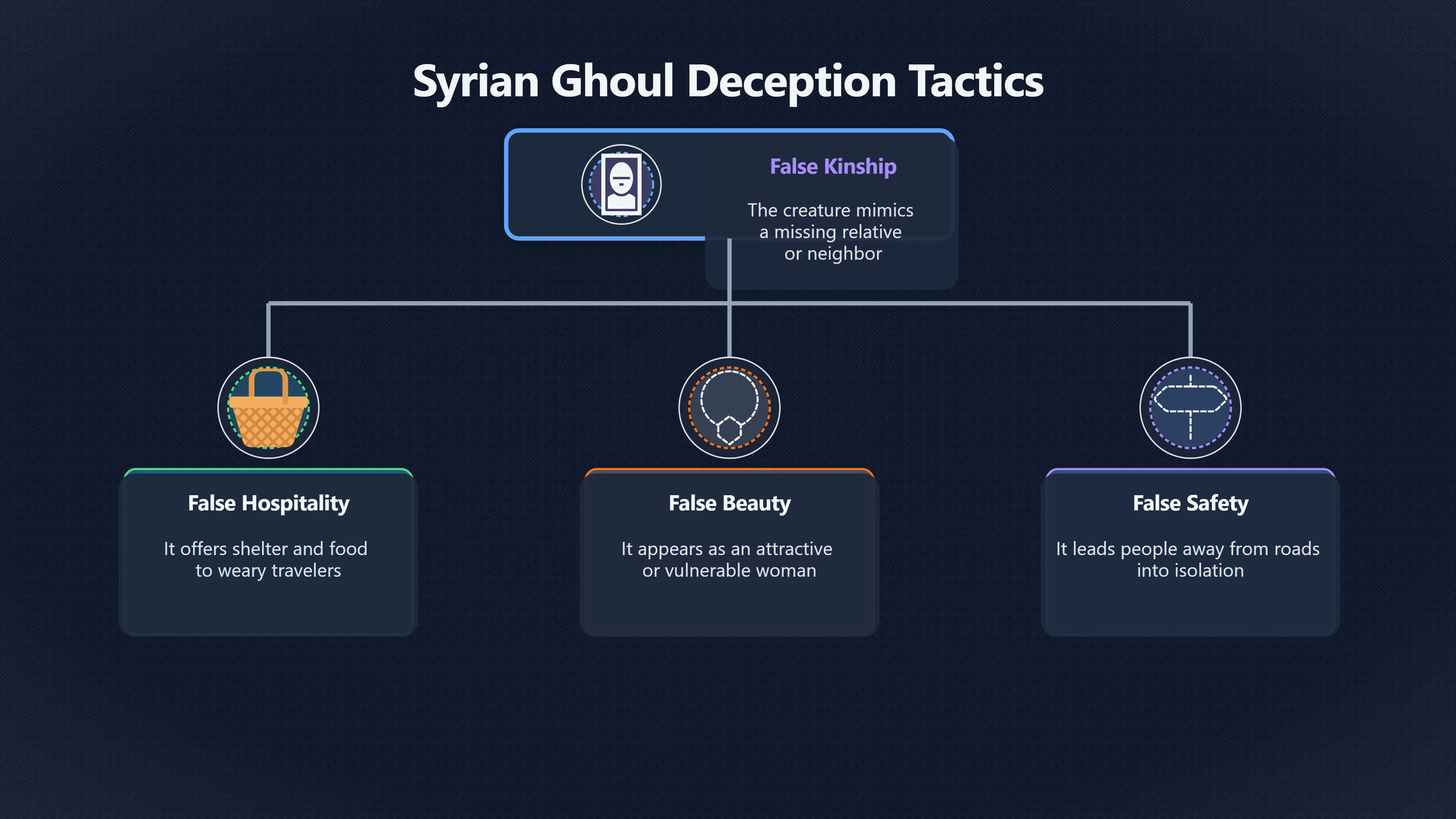
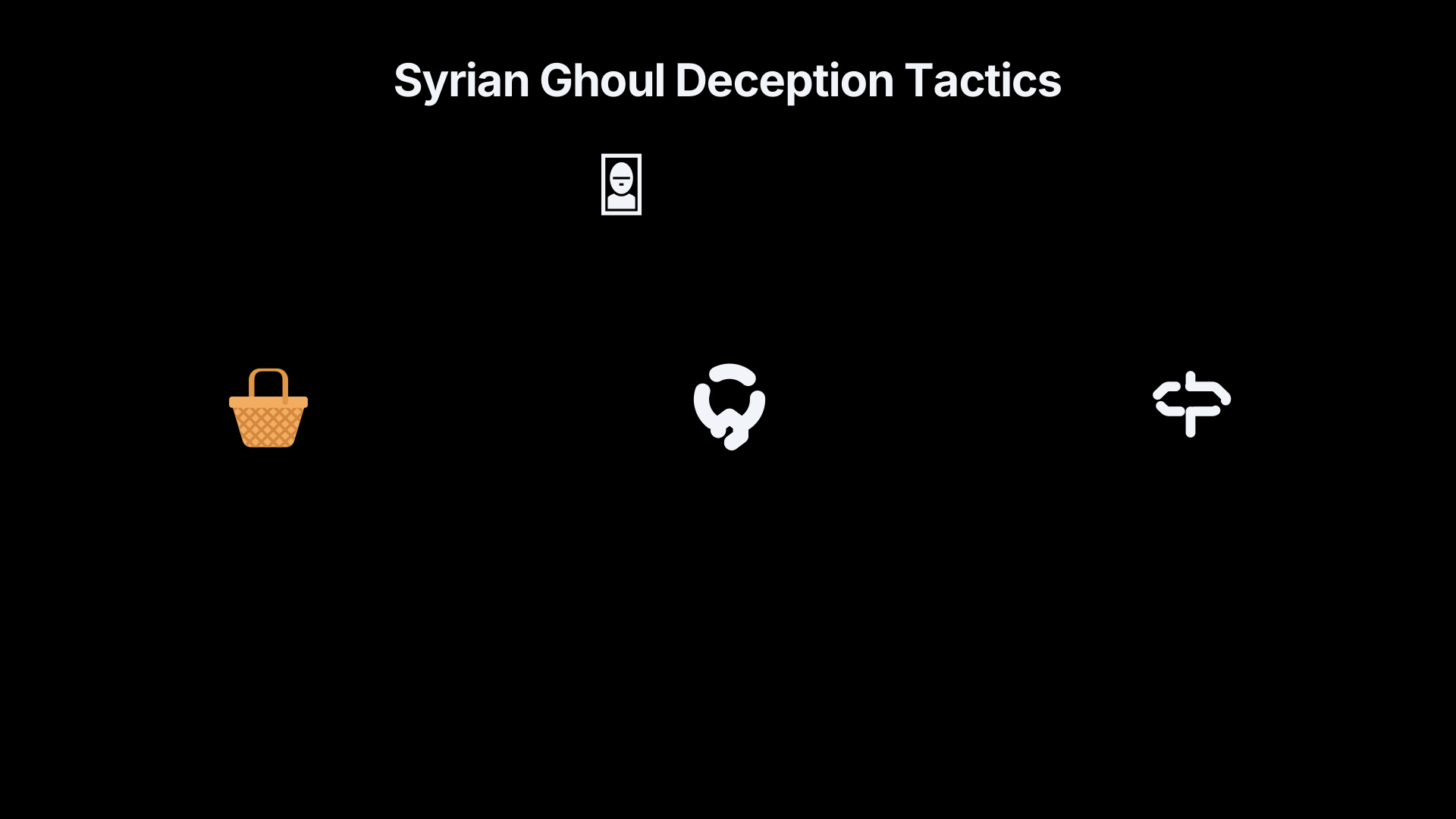
Several recurring themes appear in Syrian and neighbouring Arab traditions:
- False kinship: the ghoul pretends to be a missing relative, neighbour or friend.
- False hospitality: it offers shelter, food or guidance to travellers.
- False beauty: it appears attractive or vulnerable in order to gain sympathy.
- False safety: it leads people away from roads, villages or companions and into isolated places.[wikipedia.org]WikipediaOpen source on wikipedia.org.
The lesson is usually social rather than supernatural. Listeners are reminded that trust should be earned, not granted simply because someone appears familiar.
How the Ghoul Deceives Travellers and Families
Roads and wilderness areas are central to ghoul folklore. Traditional Syrian communities depended on travel routes crossing sparsely populated countryside. Stories warned of the risks associated with becoming separated from companions or wandering into unfamiliar territory.
Many accounts describe a lone traveller encountering a seemingly harmless woman who requests help or offers directions. Only later does the traveller notice something wrong: an animal-like foot, strange behaviour, impossible strength or an appetite that reveals a non-human nature. By the time the disguise fails, the victim may already be far from safety.[Wikipedia]WikipediaOpen source on wikipedia.org.
Family-centred tales use a similar mechanism. Instead of deceiving strangers, the ghoul infiltrates domestic life. It may appear as a relative returning home after a long absence or as a respected elder. In these stories, children or women often recognise clues that male family members overlook. Folklorists have noted that many Arabic ghoul tales emphasise the importance of listening to warnings from family members who detect the deception first.[Wikipedia]WikipediaOpen source on wikipedia.org.
This pattern transforms the ghoul from a simple monster into a storytelling device for discussing trust, judgement and social awareness.
The Woodcutter Tale and Its Warning About Trust
One of the most revealing examples connected to Syrian and wider Arab folklore is the group of stories sometimes known as The Woodcutter’s Wealthy Sister or The Woodcutter’s Weary Wife. In these tales, a ghoul disguises itself as a prosperous female relative and attempts to draw a woodcutter away from his family. The creature appears respectable and convincing, but its intentions are predatory. Family members eventually uncover the deception and expose the monster.[Wikipedia]WikipediaOpen source on wikipedia.org.
What makes this tale memorable is that the threat does not arrive as a beast emerging from a cave. It arrives wearing the face of someone trustworthy.
The story’s warning operates on several levels:
- Wealth and appearance can be misleading.
- Isolation makes deception easier.
- Family advice should not be ignored.
- Good judgement matters more than physical strength.
For audiences hearing the tale around hearths or in village gatherings, the ghoul’s disguise was the crucial element. The creature succeeds only because people believe what they want to see.
This differs sharply from many modern monster stories, where danger is obvious from the beginning. In ghoul narratives, the monster is dangerous precisely because it initially appears normal.

The Ghoul and the Fear of Wild Places
Although ghouls can enter homes in folklore, they remain strongly associated with marginal landscapes. Deserts, abandoned ruins, caves and neglected roads appear repeatedly in traditional descriptions. These settings occupy a symbolic boundary between the safe world of the community and the uncertain world beyond it.[Wikipedia]WikipediaOpen source on wikipedia.org.
For Syrian audiences, ruined settlements and isolated countryside were familiar realities rather than exotic fantasy settings. Stories attached supernatural dangers to places where travellers could genuinely become lost, robbed, injured or killed.
In that sense, the ghoul may be understood as a folkloric explanation for real-world hazards:
- A missing traveller becomes the victim of a ghoul.
- Strange sounds in ruins become evidence of supernatural inhabitants.
- Dangerous predators in remote areas acquire a monstrous identity.
- Unexplained disappearances are folded into an existing narrative framework.
Some traditions even link the ghoul with animal forms such as hyenas. This connection is especially interesting because hyenas have long occupied an uneasy place in Middle Eastern folklore. Their nocturnal habits, unusual appearance and scavenging behaviour made them natural candidates for supernatural interpretation.[wikipedia.org]WikipediaOpen source on wikipedia.org.
How European Horror Reshaped the Arab Ghoul
Modern readers often imagine a ghoul as a corpse-eating undead creature lurking in cemeteries. That image is largely the result of European adaptations rather than traditional Syrian folklore.
A major turning point came when stories from One Thousand and One Nights were translated into European languages. Translators and later writers emphasised the ghoul’s connection to graves and cannibalism while downplaying its role as a deceptive shape-shifter. Over time, Western horror fiction transformed the creature into a cemetery monster that resembled later fictional undead beings.[Wikipedia]WikipediaOpen source on wikipedia.org.
As horror literature, films and games spread internationally, this newer image became dominant. Many people today recognise the word “ghoul” but are unfamiliar with the older Syrian and Arab tradition in which deception is the creature’s defining trait.
The difference is significant:
Traditional Syrian and Arab ghoulModern Western ghoulShape-changing deceiverCorpse-eating monsterTargets travellers and familiesAssociated with graveyardsUses disguise and trickeryRelies on physical horrorAppears in folk warningsAppears in horror fictionSymbolises misplaced trustSymbolises death and decay
The older version is arguably more unsettling. A monster that can wear a familiar face creates a different kind of fear from one that is immediately recognisable.

The cultural afterlife of Ghouls
The enduring power of Syrian ghoul stories comes from their psychological realism. Most people will never encounter a supernatural creature in a desert ruin, but everyone understands the risk of being deceived.
The ghoul survives in folklore because it transforms everyday anxieties into a memorable narrative form. It warns against blind trust, reminds travellers to remain cautious, and turns unfamiliar landscapes into stages for moral lessons. Whether appearing as a wealthy relative, a stranded traveller or a helpful stranger, the creature’s true weapon is not its claws or teeth but its ability to convince people that danger looks harmless.[wikipedia.org]WikipediaOpen source on wikipedia.org.
Within Syria’s broader monster traditions, that emphasis on disguise and misdirection makes the ghoul unique. It is less a mystery animal than a folklore mechanism for exploring one of humanity’s oldest fears: that the face we trust may not be the face we think we know.
Amazon book picks
Further Reading
Books and field guides related to Why Syrian Ghouls Hide Behind Familiar Faces. Use these as the next step if you want deeper reading beyond the article.
The Arabian Nights
Features the supernatural world that shaped popular ideas about ghouls across the Arab world.
Arab Folklore
Provides cultural background for ghoul legends and storytelling traditions.
The Book of Imaginary Beings
Includes legendary creatures and shape-shifting beings from many traditions.
Legends of the Fire Spirits
Explores related beings and beliefs that overlap with ghoul traditions.
eBay marketplace picks
Marketplace Samples
Live-tested eBay searches with available results related to this page.


Endnotes
1.
Source: Wikipedia
Link:https://en.wikipedia.org/wiki/Ghoul
2.
Source: Wikipedia
Title: List of spiritual entities in Islam
Link:https://en.wikipedia.org/wiki/List_of_spiritual_entities_in_Islam
3.
Source: scribd.com
Link:https://www.scribd.com/document/823596142/Ghoul-Wikipedia
Source snippet
Etymology and Folklore of Ghouls | PDFIn Arabic folklore, ghouls often appear as cautionary figures, embodying societal warnings ab...
4.
Source: Wikipedia
Title: Superstition in Islamic tradition
Link:https://en.wikipedia.org/wiki/Superstition_in_Islamic_tradition
5.
Source: Wikipedia
Title: Ghouls in popular culture
Link:https://en.wikipedia.org/wiki/Ghouls_in_popular_culture
6.
Source: thehorrordome.com
Title: Due to its
Link:https://www.thehorrordome.com/blogs/news/the-ghoul-arabias-haunting-myth-of-the-shape-shifting-monster?srsltid=AfmBOoqZUtmO0DYEOep3pQClLAQlSslnNShfLyppZfzx0JbhrpefUOon
Source snippet
The Horror DomeThe Ghoul: Arabia's Haunting Myth of the Shape-Shifting...22 Sept 2023 — Frequently portrayed as a shape-shifter, the gho...
7.
Source: thehorrordome.com
Title: the ghoul arabias haunting myth of the shape shifting monster
Link:https://www.thehorrordome.com/blogs/news/the-ghoul-arabias-haunting-myth-of-the-shape-shifting-monster?srsltid=AfmBOopH_brugGeirKHHzJrswiMtuib2YGurZ73jIUvZH1-6u-OXrFMP
Additional References
8.
Source: ebsco.com
Link:https://www.ebsco.com/research-starters/literature-and-writing/ghoul-mythical-creature
Source snippet
In some later accounts, the ghoul was said to be able to change shape. One...Read more...
9.
Source: greydogtales.com
Title: Digging Deeper Than The Grave
Link:https://greydogtales.com/blog/digging-deeper-than-the-grave-the-ghul-part-two/
Source snippet
The Ghul Part Two22 May 2016 — In this tale, the ghul appears as an attractive young woman in the wasteland – so shapeshifting can be one...
Published: May 2016
10.
Source: reddit.com
Link:https://www.reddit.com/r/fo76/comments/1qlnz74/the_ghoul_disguise_is_the_only_reason_im_refusing/
Source snippet
The Ghoul Disguise is the only reason I'm refusing to turnThe disguise covers the face, sure, but it's the secret deodorizing treatment t...
11.
Source: mythus.fandom.com
Title: Myth and Folklore Ghoul
Link:https://mythus.fandom.com/wiki/Ghoul
Source snippet
It may appear in the form of a hyena or a hound, opening up graves and devouring corpses.Read more...
12.
Source: facebook.com
Link:https://www.facebook.com/BahraniHistory/posts/al-ghoul-devilish-arabian-monsterhow-a-supernatural-creature-preoccupied-the-liv/1177430391238131/
13.
Source: steamcommunity.com
Link:https://steamcommunity.com/app/1151340/discussions/0/591781130180576911/?l=brazilian
14.
Source: instagram.com
Link:https://www.instagram.com/reel/DSSDEOBEQui/?hl=en
15.
Source: facebook.com
Link:https://www.facebook.com/groups/PokemonGoSG/posts/2335325003380659/
16.
Source: facebook.com
Link:https://www.facebook.com/groups/nativecomicbooksociety/posts/9390670134319244/
17.
Source: youtube.com
Title: Arabic Folklore’s Most Terrifying Creature: The Ghoul
Link:https://www.youtube.com/watch?v=ZdljTiX4aNk
Source snippet
The Ghoul Was Never Meant to Be a Zombie...
Topic Tree