Within Kenya Cryptids
Was the Nandi Bear Ever One Animal?
The Nandi Bear became Kenya's classic mystery beast because real highland predators, oral warnings and colonial reports blurred together.
On this page
- Nandi country and early reports
- Chemosit, kerit and shifting local names
- Hyena, honey badger and folklore explanations
Page outline Jump by section
Introduction
The Nandi Bear is Kenya’s most famous mystery beast, but the deeper researchers look into the reports, the less it resembles a single undiscovered animal. Accounts from western Kenya describe a powerful, shaggy creature with high shoulders, a sloping back and a reputation for attacking livestock or even people. Yet different witnesses seem to have been describing very different animals, legends and fears under the same label. Over more than a century, the “Nandi Bear” became a catch-all name for strange predator sightings in the Kenyan highlands, particularly in Nandi country. The enduring mystery is not whether a bear lived in Kenya—there are no native bears in modern East Africa—but how folklore, real wildlife and colonial reporting combined to create one of Africa’s most persistent monster traditions.[Wikipedia]WikipediaNandi bearJanuary 11, 2026 — In East African folklore, the Nandi bear is a creature said to live in East Africa. It takes its name from the Nandi p…

Was the Nandi Bear Ever One Animal?
The strongest sceptical argument is that the Nandi Bear was never a single creature at all. Early reports varied dramatically. Some described an animal that looked vaguely bear-like, others a giant hyena, a massive baboon, or a dark, long-haired predator seen at night. Even the names attached to the creature shifted from district to district. By the mid-twentieth century, cryptozoological writers were already noting that multiple traditions and sightings had probably been merged into one famous monster.[wikipedia.org]WikipediaOn the Track of Unknown AnimalsOn the Track of Unknown Animals
The English name itself encouraged confusion. Colonial officials and settlers needed a familiar comparison for readers back home, and “bear” conveyed a heavy-bodied, intimidating animal. Yet witnesses were not describing an actual bear. Instead they were trying to describe an unfamiliar shape glimpsed in poor conditions, often at night or in thick vegetation.[Wikipedia]WikipediaNandi bearJanuary 11, 2026 — In East African folklore, the Nandi bear is a creature said to live in East Africa. It takes its name from the Nandi p…
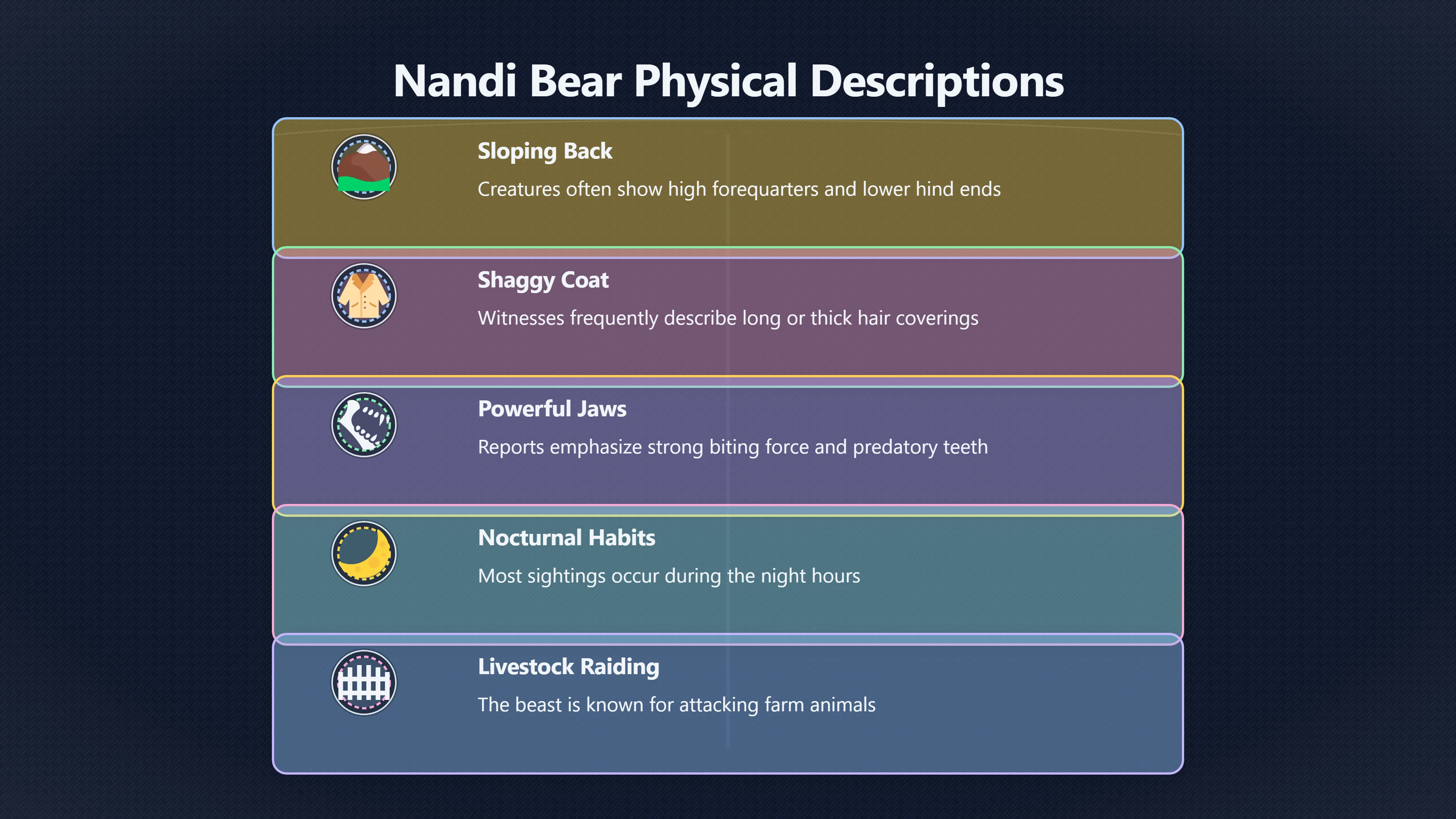
Many famous Nandi Bear descriptions share a few recurring features:[youtube.com]youtube.comThe Nandi Bear | The Fierce Beasts of Western KenyaNandi Bear is Real | Nandi Bear Cryptozoology…
- High forequarters and a lower hind end.
- Long or shaggy hair.
- Powerful jaws.
- Nocturnal habits.
- Livestock-raiding behaviour.
- A frightening reputation that exceeded the evidence for actual attacks.
Those characteristics fit several known African animals far better than they fit an unknown bear species.[Wikipedia]WikipediaNandi bearJanuary 11, 2026 — In East African folklore, the Nandi bear is a creature said to live in East Africa. It takes its name from the Nandi p…
Nandi Country and Early Reports
The legend became strongly associated with the Nandi region of western Kenya during the colonial period. Reports circulated among settlers, hunters and administrators in the early twentieth century, and discussions appeared in natural-history circles linked to the East Africa and Uganda Natural History Society. Charles William Hobley, one of the society’s founders, helped popularise reports of an unidentified beast from the region.[Wikipedia]WikipediaEast Africa Natural History SocietyEast Africa Natural History Society
What made the reports compelling was their setting. Nandi country contained forests, grasslands and agricultural areas where people regularly encountered dangerous wildlife. Predators could vanish into cover before being identified properly. Livestock losses demanded explanations, and unusual tracks or fleeting sightings were easily transformed into stories about a mysterious beast.[Wikipedia]WikipediaNandi bearJanuary 11, 2026 — In East African folklore, the Nandi bear is a creature said to live in East Africa. It takes its name from the Nandi p…
Newspaper coverage and retellings amplified the mystery. As stories travelled, details changed. A strange livestock killer could become a man-eater. A large hyena could become an unknown species. Repeated retelling gradually created a standard image of the Nandi Bear even though the original accounts were far from consistent.[Wikipedia]WikipediaOn the Track of Unknown AnimalsOn the Track of Unknown Animals
Chemosit, Kerit and Shifting Local Names
One reason the mystery remains difficult to untangle is that “Nandi Bear” is not a traditional local name. It is a colonial umbrella term applied to several creatures and traditions. Reports have been linked to names including Kerit, Chemosit, Koddoelo, Ngoloko and others.[wikipedia.org]WikipediaKalenjin folkloreKalenjin folklore
This creates a major problem for anyone trying to identify the creature. Some traditions refer to a dangerous animal. Others describe something closer to a supernatural being or bogey figure. In Kalenjin folklore, for example, the Chemosit is often portrayed as a frightening legendary creature rather than an ordinary animal. The Kerit, meanwhile, is more commonly associated with the mystery-beast tradition that became known internationally as the Nandi Bear.[Wikipedia]WikipediaKalenjin folkloreKalenjin folklore
As stories moved between communities and then into English-language publications, distinctions blurred. A folkloric monster, a cautionary tale for children and a report of an unidentified predator could all become evidence for the same supposed creature. This process explains why descriptions became increasingly contradictory over time.[Wikipedia]WikipediaKalenjin folkloreKalenjin folklore

Why Witnesses Thought They Saw Something Unknown
The most interesting sightings are not necessarily evidence of a hidden animal. They reveal how difficult wildlife identification can be under real-world conditions.
Many reports occurred:
- At night.
- During brief encounters.
- In dense vegetation.
- When observers were frightened.
- After livestock attacks or other stressful events.
Psychologists and wildlife researchers have long recognised that memory and perception become less reliable under such circumstances. A glimpse of a familiar animal can be transformed into something extraordinary, especially if local stories already provide a framework for interpreting what was seen.[Wikipedia]WikipediaKalenjin folkloreKalenjin folklore
The Nandi Bear legend also gained strength because western Kenya already contained genuinely dangerous animals. People were not inventing fear from nothing. They were living among predators capable of killing livestock and occasionally threatening humans. A mysterious explanation often seemed more satisfying than a mundane one.[Wikipedia]WikipediaNandi bearJanuary 11, 2026 — In East African folklore, the Nandi bear is a creature said to live in East Africa. It takes its name from the Nandi p…
Hyena, Honey Badger and Folklore Explanations
The spotted hyena is the leading sceptical explanation. Its anatomy matches many classic Nandi Bear descriptions: high shoulders, a sloping back, powerful jaws and a surprisingly intimidating appearance. Hyenas can appear much larger than expected when seen briefly or under poor lighting. An unusually large individual, a diseased animal with abnormal fur, or a sighting from an unusual angle could easily generate reports of a strange beast.[Wikipedia]WikipediaNandi bearJanuary 11, 2026 — In East African folklore, the Nandi bear is a creature said to live in East Africa. It takes its name from the Nandi p…
Another frequently proposed explanation is the honey badger. Although much smaller than most Nandi Bear descriptions, honey badgers are famously aggressive and unusually robust. Some researchers and writers have suggested that exceptionally large or unusually dark individuals could have contributed to reports of a bear-like animal. Bernard Heuvelmans, one of the best-known cryptozoological authors, considered black honey badgers a plausible source for some sightings.[ShukerNature]karlshuker.blogspot.comtarzan and nandi bearShukerNatureTARZAN AND THE NANDI BEAR25 Mar 2011 — “The 'true' Nandi bear, the cryptid whose descriptions most closely resemble a bear an…
Other suggestions include:
- Large baboons seen under unusual conditions.
- Misidentified hyenas with atypical colouring.
- Folklore creatures transformed into “animal” reports.
- Hoaxes and embellished newspaper stories.
- Multiple different animals grouped together under one name.[wikipedia.org]WikipediaOn the Track of Unknown AnimalsOn the Track of Unknown Animals
Notably, the explanations do not have to compete. Different sightings may have had different causes. A livestock-raiding hyena, a frightening folktale and a mistaken sighting of another animal could all contribute to the same legend.
The Giant Hyena Idea
Among more adventurous explanations, the most persistent is the giant-hyena theory. Some writers have speculated that reports reflected an unknown surviving species related to extinct giant hyenas such as Pachycrocuta brevirostris. The idea gained popularity because a giant hyena would explain the creature’s powerful build and carnivorous reputation.[Wikipedia]WikipediaKalenjin folkloreKalenjin folklore
However, there is no physical evidence supporting the survival of such an animal in modern Kenya. No verified specimens, bones, photographs or genetic samples have emerged despite decades of interest. As a result, mainstream zoology does not regard the giant-hyena hypothesis as likely. The theory survives largely because it provides an attractive explanation for reports that sound more dramatic than ordinary hyena encounters.[Wikipedia]WikipediaKalenjin folkloreKalenjin folklore
Why the Legend Endured
One striking feature of the Nandi Bear story is that convincing reports became far less common as wildlife surveys improved and knowledge of East African mammals expanded. If a large unknown predator had been living in the region, researchers would expect clearer evidence to accumulate over time. Instead, the legend increasingly survived in books, magazines and popular culture rather than in new, well-documented encounters.[Cryptid Archives]cryptidarchives.fandom.comCryptid Archives Nandi bearCryptid ArchivesNandi bear - Encyclopaedia of Cryptozoology - FandomThe Nandi bear or chemosit (Kalenjin: "devil") is a cryptid reported…
That does not make the story unimportant. The Nandi Bear remains a fascinating example of how local folklore, real predator encounters and colonial-era mystery writing can merge into a single enduring creature. The most persuasive explanation is not that one hidden beast escaped detection for a century, but that many different experiences were gradually combined into a monster larger than any one sighting. In that sense, the Nandi Bear is less a lost animal than a record of how people interpreted danger, wilderness and uncertainty in Kenya’s highlands.[Wikipedia]WikipediaOn the Track of Unknown AnimalsOn the Track of Unknown Animals
Amazon book picks
Further Reading
Books and field guides related to Was the Nandi Bear Ever One Animal?. Use these as the next step if you want deeper reading beyond the article.
Cryptozoology A To Z
Contains entries on famous mystery animals including African cases.
On the Track of Unknown Animals
The Nandi Bear is one of the best-known African mystery animals.
The Kingdon Field Guide to African Mammals
Covers hyenas, badgers and other likely explanations.
eBay marketplace picks
Marketplace Samples
Live-tested eBay searches with available results related to this page.


Endnotes
1.
Source: Wikipedia
Title: Nandi bear
Link:https://en.wikipedia.org/wiki/Nandi_bear
Source snippet
January 11, 2026 — In East African folklore, the Nandi bear is a creature said to live in East Africa. It takes its name from the Nandi p...
Published: January 11, 2026
2.
Source: Wikipedia
Title: Kalenjin folklore
Link:https://en.wikipedia.org/wiki/Kalenjin_folklore
3.
Source: Wikipedia
Title: On the Track of Unknown Animals
Link:https://en.wikipedia.org/wiki/On_the_Track_of_Unknown_Animals
4.
Source: Wikipedia
Title: East Africa Natural History Society
Link:https://en.wikipedia.org/wiki/East_Africa_Natural_History_Society
5.
Source: Wikipedia
Title: Nandi (Hinduism)
Link:https://en.wikipedia.org/wiki/Nandi_%28Hinduism%29
Source snippet
Nandi (Hinduism)Nandikeshvara or Nandideva, is the bull vahana (mount) of the Hindu god Shiva. He is also the guardian deity of Kailas...
6.
Source: youtube.com
Title: The FULL Story of the Nandi Bear
Link:https://www.youtube.com/watch?v=8w98_sall1A
Source snippet
The Nandi Bear | The Fierce Beasts of Western Kenya...
7.
Source: youtube.com
Title: The Nandi Bear | The Fierce Beasts of Western Kenya
Link:https://www.youtube.com/watch?v=oFkNhw3W8uI
Source snippet
Nandi Bear is Real | Nandi Bear Cryptozoology...
8.
Source: cryptidarchives.fandom.com
Title: Cryptid Archives Nandi bear
Link:https://cryptidarchives.fandom.com/wiki/Nandi_bear
Source snippet
Cryptid ArchivesNandi bear - Encyclopaedia of Cryptozoology - FandomThe Nandi bear or chemosit (Kalenjin: "devil") is a cryptid reported...
9.
Source: karlshuker.blogspot.com
Title: tarzan and nandi bear
Link:https://karlshuker.blogspot.com/2011/03/tarzan-and-nandi-bear.html
Source snippet
ShukerNatureTARZAN AND THE NANDI BEAR25 Mar 2011 — “The 'true' Nandi bear, the cryptid whose descriptions most closely resemble a bear an...
10.
Source: cryptidz.fandom.com
Title: Nandi Bear
Link:https://cryptidz.fandom.com/wiki/Nandi_Bear
Source snippet
Bear - Cryptid Wiki - FandomUsually described as a shaggy, slope-backed predator reminiscent of a hyena, it is widely regarded as a compo...
Additional References
11.
Source: instagram.com
Link:https://www.instagram.com/thisisnandi/?hl=en
Source snippet
Nandi (@thisisnandi) • Instagram photos and videosNandi 5,151 followers 4,241 following 🎤Singer📝Songwriter 💁🏾 ♀️Model Works with @steamdo...
12.
Source: ebsco.com
Link:https://www.ebsco.com/research-starters/language-and-linguistics/nandi-mythical-bull
Source snippet
Nandi (mythical bull) | Language and LinguisticsNandi is a significant figure in Hindu mythology, recognized primarily as the steed and d...
13.
Source: deviantart.com
Link:https://www.deviantart.com/arcanetales/art/Nandi-Bear-A-Hyena-Like-Creature-From-Kenya-1151560902
Source snippet
Nandi Bear: A Hyena Like Creature From KenyaThe Nandi bear or chemosit (Kalenjin: "Demon") is a cryptid reported from the highlands of we...
14.
Source: academia.edu
Link:https://www.academia.edu/164830414/THE_KERIIT_OF_THE_KALENJIN_An_Inquiry_into_the_Nandi_Bear_Phenomenon
Source snippet
THE KERIIT OF THE KALENJIN: An Inquiry into the Nandi...Background: This paper presents an inquiry into the Keriit (also Keteet, Chemosi...
15.
Source: vedaconnection.in
Title: the significance of nandi lord shiva s divine companion and symbol of devotion
Link:https://vedaconnection.in/blogs/blogs/the-significance-of-nandi-lord-shiva-s-divine-companion-and-symbol-of-devotion?srsltid=AfmBOoqAOXUkV1c4y2gt507ky9zsws4cc6nlvVPRmG12aXhLxbi87ASf
Source snippet
The Significance of Nandi: Lord Shiva's Divine Companion...Nov 21, 2567 BE — Known as the vahana (vehicle) and gatekeeper of Lord Shiva...
16.
Source: reddit.com
Link:https://www.reddit.com/r/Cryptozoology/comments/17egx03/the_nandi_bear_of_east_africa/
Source snippet
Also known as the Chemosit by the locals, the Nandi Bear was first reported back in...Read more...
17.
Source: reddit.com
Link:https://www.reddit.com/r/Cryptozoology/comments/jfa8gl/this_video_is_about_the_nandi_bear_an_alleged/
Source snippet
robust brown hyena (either a population or subspecies of Hyaena brunnea...
18.
Source: instagram.com
Link:https://www.instagram.com/p/DWOoIvPiPPm/?hl=en
Source snippet
en compared to a bear (obviously), a giant hyena, or a very big...
19.
Source: facebook.com
Link:https://www.facebook.com/johanegerkranspublic/posts/more-from-my-upcoming-book-cryptozoology-the-nandi-bear-is-a-bear-like-cryptid-f/1392992199295023/
Source snippet
d as a large, heavily built, shaggy animal with a sloped back...
20.
Source: reddit.com
Link:https://www.reddit.com/r/Cryptozoology/comments/1hpmibs/a_newspaper_drawing_of_the_nandi_bear_a_cryptid/
Source snippet
nas are found, suggesting that brown hyeanas would shrink as...
Topic Tree