Creature Lore of Yemen's Wildest Stories
Yemen does not have a single famous national cryptid comparable to Scotland’s Loch Ness Monster or North America’s Bigfoot.
Page outline Jump by section
Introduction
The strongest material clusters in two very different landscapes. On mainland Yemen, large but elusive animals such as the Arabian leopard, striped hyena and Yemen monitor can produce rumours, disputed sightings and exaggerated descriptions. On the remote Socotra archipelago, extreme biological isolation, reptile diversity, caves and distinctive oral traditions have supported tales of giant snakes, dragons and wilderness-dwelling beings. The evidence ranges from documented species and scholarly folklore research to unverified local tradition. There is no convincing proof of an unknown monster, but Yemen offers an unusually clear demonstration of how real wildlife, lost fauna and storytelling can overlap.
Why Yemen’s creature lore is difficult to classify
Most modern cryptid traditions are built through newspapers, photographs, television coverage and repeated sighting reports. Yemen’s material survives differently. Much of it comes from ancient travel writing, oral literature, linguistic research and accounts recorded by archaeologists or visiting naturalists. Years of conflict and limited field access have also restricted wildlife surveys, especially in remote mountain and border regions.
This means the boundaries between categories are unusually important. A giant serpent in a Socotran cave may be a mythological guardian rather than a claimed zoological species. A large cat reported in the mountains may be a surviving Arabian leopard, not a “phantom cat”. An unfamiliar monitor lizard may genuinely be an undescribed animal, as happened in the late twentieth century. Treating all these stories as equivalent cryptid sightings would flatten the evidence rather than clarify it.
The most useful approach is therefore to separate four strands:
- Folklore: traditional stories whose meaning may be social, religious or symbolic.
- Historical animal claims: old descriptions that cannot now be checked directly.
- Modern wildlife reports: observations that may involve rare known species.
- Zoological discoveries: animals once overlooked by science but subsequently collected and described.
Yemen has examples of all four, although the last category supplies its most remarkable creature story.

Socotra’s giant reptiles: memory, error or extinction?
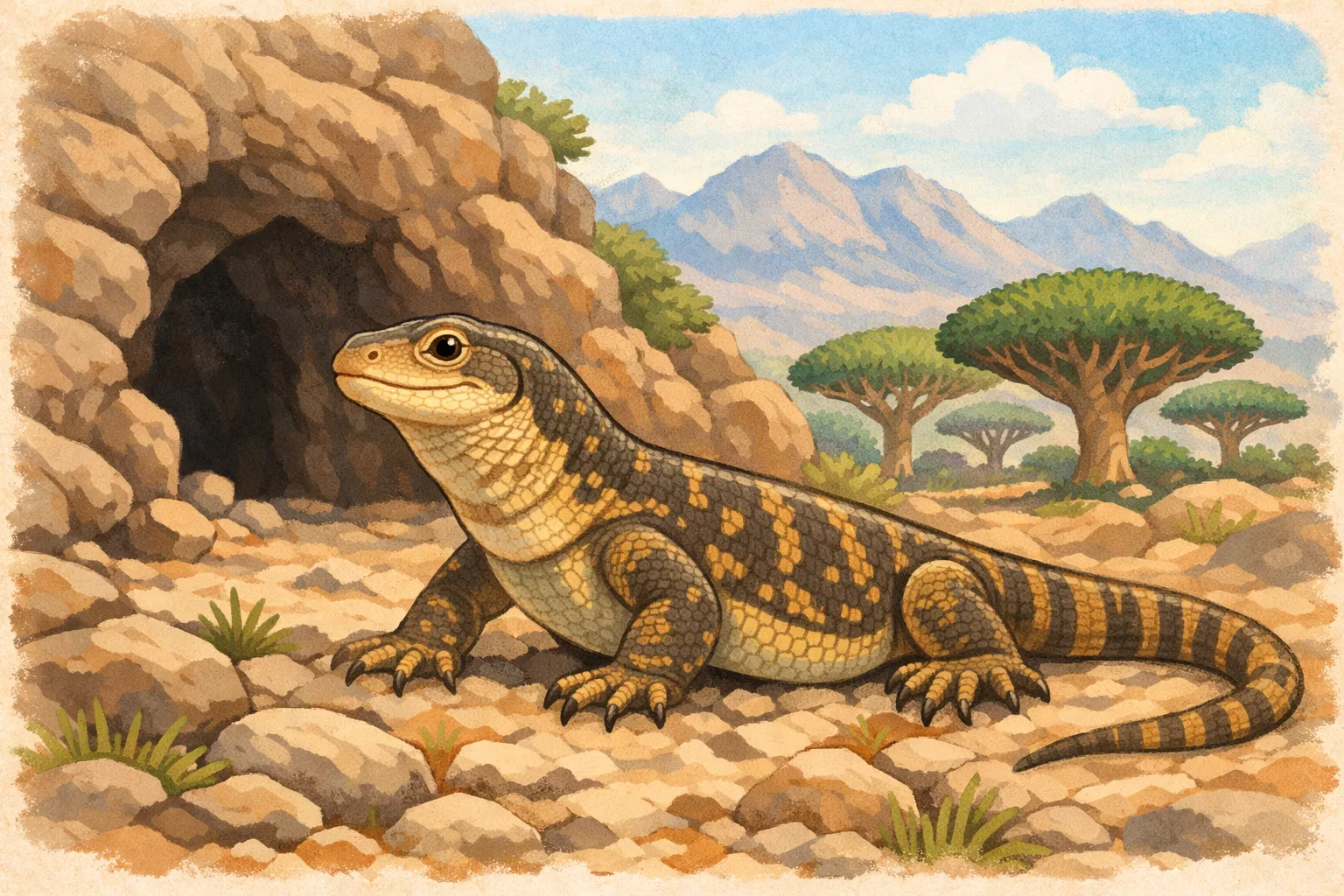
The oldest mystery-animal claim associated with Yemen concerns Socotra. The Periplus of the Erythraean Sea, a maritime guide generally dated to the first century AD, described the island—then known to Mediterranean traders as Dioscorida—as possessing crocodiles, numerous snakes and “great lizards”. It added that people ate the lizards and rendered their fat for use like oil. The same account described several kinds of tortoise, including a particularly large mountain form valued for its thick shell.[ToposText]topostext.orgPeriplus of the Erythraean Sea (Perip.M.Rubri)… Socotra], and is very large but desert and marshy, having rivers in it and cro…
No crocodile, land tortoise or truly giant terrestrial lizard is known from Socotra today. That discrepancy creates several possibilities. The writer may have repeated sailors’ tales, confused Socotra with another trading destination, used imprecise animal names, or described species that later disappeared. Human settlement, hunting, introduced animals and environmental change have caused island extinctions elsewhere, so vanished large reptiles are not impossible. At present, however, the necessary physical evidence—such as securely identified bones or shells—has not established that Socotra once supported the animals described in the Periplus.
The claim is especially tempting because Socotra really is exceptionally rich in reptiles. UNESCO records extremely high endemism among the archipelago’s reptile species, meaning that most occur nowhere else. Modern surveys describe a fauna dominated by geckos, skinks, snakes, lizards and a chameleon rather than crocodiles or giant tortoises. The extraordinary real biodiversity makes an ancient lost-reptile story feel plausible, but it does not by itself confirm the text.[unesco.org]whc.unesco.orgUNESCO World Heritage CentreSocotra ArchipelagoExtremely high levels of endemism occur in Socotra's reptiles (34 species, 90% endemism) a…
For cryptid enthusiasts, Socotra’s “great lizards” are therefore best treated as an unresolved historical zoological claim. They are not modern monsters reported by a continuing chain of witnesses. They are animals mentioned in an old commercial geography whose relationship to the island’s actual past fauna remains uncertain.
The serpents said to inhabit Socotra’s caves
Giant-snake traditions are better documented as living folklore. Researchers studying the cultures of Socotra and the neighbouring Mahra region have recorded a mythological serpent associated with caves, danger and the wild landscape. Archaeological fieldwork has also identified a large Socotran cavern locally linked with a hidden giant snake or dragon.[JSTOR]jstor.orgThis Socotran mythological serpent has an interesting parallel in Ethiopian traditions. In the samples of revolutionary…Read more…
Hoq Cave, one of Socotra’s best-known natural and archaeological sites, illustrates how such beliefs can affect real behaviour. Local people reportedly avoided penetrating far into it because of a feared giant snake. Exploration in the early 2000s revealed ancient inscriptions, religious objects and evidence that overseas visitors had entered the cave centuries earlier, but no enormous reptile. The creature’s cultural presence was nevertheless real: it helped define the cave as a dangerous, restricted place before organised exploration and tourism changed its reputation.[Condé Nast Traveler]cntraveler.comOpen source on cntraveler.com.
Snake stories are easy to misread through a purely zoological lens. Caves conceal sound, distance and movement; ordinary snakes can appear much larger during a brief encounter; and oral traditions often assign giant guardians to springs, caverns, treasure places or sacred sites. Socotra also has genuine endemic snakes, giving the stories a familiar animal foundation. Yet the scholarly evidence places the giant serpent chiefly within mythology and traditional culture, not within a modern series of measured tracks, carcasses or consistent eyewitness descriptions.
The result is a legend with a clear location but no convincing specimen. It belongs to Yemen’s mystery-creature history because people remembered and feared it as something inhabiting the landscape, even though its strongest value is folkloric rather than biological.
Socotra’s wild man
A less familiar tradition concerns a wild human-like being from Socotra. A study published in the Bulletin of the School of Oriental and African Studies examined a Socotran “wild man” narrative in comparison with related traditions. Such figures commonly occupy the border between humanity and wilderness: hairy, uncivilised, physically unusual or unable to behave according to ordinary social rules.[Cambridge University Press & Assessment]cambridge.orgOpen source on cambridge.org.
It would be misleading to turn this figure automatically into a Yemeni Bigfoot. The surviving material is a traditional text rather than a well-documented sequence of modern sightings. Wild-man stories across many cultures can express ideas about isolation, hunger, social exclusion, dangerous terrain or the contrast between settled life and the world beyond it. Their human-like monsters often reveal more about the community telling the story than about an undiscovered primate.
Socotra has no native population of apes or monkeys, and its only native terrestrial mammal fauna is extremely limited. That ecological fact weighs heavily against the survival of a large unknown primate. The wild man is therefore most responsibly understood as a folklore figure with possible parallels elsewhere, not as evidence of an unclassified hominin.
The Yemen monitor: a cryptozoological success story
Yemen’s most compelling “unknown animal” episode ended with scientific recognition rather than continued mystery. During the 1980s, German zoologist Wolfgang Böhme noticed an unfamiliar monitor lizard in television footage filmed in Yemen. Specimens were subsequently obtained, and the animal was formally described in 1989 as the Yemen monitor, Varanus yemenensis. Specialist accounts still refer to it informally as the monitor discovered through television.[Varanidae]varanidae.orgOpen source on varanidae.org.
The case is often repeated as a rare example of an animal effectively hiding in plain sight. Museum specimens had apparently existed before the formal description, but their origin or identity had not been correctly understood. The species was not a dragon or a giant survivor from prehistory; it was a large monitor lizard inhabiting parts of Yemen and south-western Saudi Arabia. Its scientific recognition nevertheless shows how incomplete zoological knowledge can remain even for a conspicuous vertebrate.[Wikipedia]WikipediaYemen monitorYemen monitor
Several factors help explain the oversight. Yemen contains steep mountains, seasonal watercourses and regions that have historically been difficult for outside researchers to survey. Monitor species can also resemble one another sufficiently for isolated observations or old specimens to be misidentified. The decisive evidence was not a story alone but a chain of testable material: recorded footage, collected specimens, anatomical comparison and a published taxonomic description.
For readers interested in cryptids, this is the country’s clearest lesson. Local or incidental evidence can point towards a real undescribed animal, but a claim becomes zoology only when specimens and diagnostic research allow others to verify it. The Yemen monitor crossed that line; the giant cave serpent has not.
Leopards, hyenas and “mystery beasts” on the mainland
Yemen’s mountains support, or historically supported, large mammals capable of generating monster-like reports. The most important is the Arabian leopard, a critically endangered big cat whose surviving distribution is uncertain and severely fragmented. Its preference for rugged terrain, low population density and mostly nocturnal behaviour makes direct observation exceptionally difficult.
Reports of a large cat attacking livestock or appearing briefly on a mountainside should not automatically be dismissed, but neither do they prove a hidden population. Camera traps, photographs that allow identification, genetic samples, tracks documented by specialists and confirmed kills provide much stronger evidence than second-hand descriptions. Conservation programmes in the Arabian Peninsula rely heavily on such methods because even trained researchers can spend long periods without detecting a leopard.[catsg.org]catsg.orgOpen source on catsg.org.
Striped hyenas provide another likely source of frightening night encounters. A hyena’s sloping back, heavy forequarters, vocalisations and scavenging behaviour can appear uncanny, particularly when the animal is seen in poor light. Across the wider Middle East and north-east Africa, hyenas have accumulated associations with graveyards, shapeshifting, spirits and beings that blur the distinction between animal and monster. Those regional comparisons help explain how a real predator can acquire a supernatural reputation, although they should not be treated as proof that every neighbouring tradition occurs unchanged in Yemen.
Yemeni literature also preserves the idea of an ambiguous hyena-like beast. The title of Zayd Mutee’ Dammaj’s story collection Tahish al-Huban refers to a creature described as a hyena–wolf hybrid. This is literary and linguistic evidence of a culturally recognisable composite beast, not a scientific claim that wolves and hyenas form a natural hybrid species.[Wikipedia]WikipediaTahish al-HubanTahish al-Huban
These animals demonstrate why Yemen’s “phantom beast” stories require caution. A rare leopard may be mistaken for an unknown cat; a hyena may become a supernatural scavenger; a dog, jackal or badly seen predator may be enlarged through repeated retelling. In each case, ecology offers plausible candidates without proving the details of any individual account.
Dragons without animals
Socotra’s most famous dragon is botanical. The dragon’s blood tree produces a dark red resin that has been traded, used medicinally and surrounded by stories explaining its blood-like colour. One widely circulated legend says that the first tree grew where a dragon and an elephant fought and their blood mingled. The tree’s strange umbrella-shaped crown and red sap have made it a powerful visual emblem of the island.[Le Monde Diplomatique]mondediplo.comLe Monde Diplomatique Legends of the dragon's blood treeLe Monde Diplomatique Legends of the dragon's blood tree
This matters to Yemen’s creature traditions because modern tourism often blends distinct forms of strangeness. Photographs of the trees are paired with language about alien landscapes, lost worlds and dragons, while old tales of serpents and enchantment reinforce the atmosphere. Socotra’s genuine biodiversity is dramatic enough that promotional writing can easily slide from “unusual” into “prehistoric” or “otherworldly”.
The dragon symbolism does not establish a former population of literal dragons. It shows how landscape, trade goods and animal imagery reinforce one another. A red resin invites a blood legend; a remote island invites stories of guarded caves and hidden creatures; unfamiliar reptiles make ancient descriptions of “great lizards” easier to imagine. Tourism has not invented these associations, but it has repackaged them for an international audience.
What the evidence supports
Yemen’s mystery-animal record is notable for its variety rather than for one dominant monster. The evidence supports several different conclusions:
- The Yemen monitor is real and was recognised by science after being noticed in documentary footage.
- Socotra has a documented tradition of giant serpents and wild beings, but the available evidence places them mainly within folklore.
- Ancient writers claimed that Socotra had crocodiles, great lizards and large tortoises, although the descriptions remain unverified by secure physical remains.
- Rare known predators can produce uncertain modern reports, especially where surveys are difficult and wildlife populations are severely depleted.
- Modern images and travel writing amplify Socotra’s monster-like atmosphere, sometimes mixing natural history with legend.
There is currently no strong mainstream evidence for a surviving giant reptile, unknown ape-like animal or enormous cave snake in Yemen. The absence of proof is not the same as proof that every story is meaningless. Folklore preserves how people understood caves, predators and dangerous ground; historical texts may contain distorted memories of real fauna; and the Yemen monitor demonstrates that scientific catalogues can be incomplete.
The country’s most revealing creature story is therefore not that a monster has been found. It is that Yemen contains several different ways for an animal to become mysterious: by disappearing, by remaining rare, by being misidentified, by entering oral tradition—or, occasionally, by appearing on television before science has given it a name.
Amazon book picks
Further Reading
Books and field guides related to What Creatures Haunt Yemen's Wildest Stories?. Use these as the next step if you want deeper reading beyond the article.
Field Guide To Bigfoot, Yeti, & Other Mystery Primates Worldwide
Provides global context for creature traditions and unexplained animal reports.
Abominable Science!
Explains how folklore, misidentification, and real animals create monster stories.
Arabia Felix
Offers historical context for Yemen and the traditions recorded by travelers.
eBay marketplace picks
Marketplace Samples
Live-tested eBay searches with available results related to this page.


Endnotes
1.
Source: topostext.org
Link:https://topostext.org/work/491
Source snippet
Periplus of the Erythraean Sea (Perip.M.Rubri)... Socotra], and is very large but desert and marshy, having rivers in it and cro...
2.
Source: whc.unesco.org
Link:https://whc.unesco.org/en/list/1263/
Source snippet
UNESCO World Heritage CentreSocotra ArchipelagoExtremely high levels of endemism occur in Socotra's reptiles (34 species, 90% endemism) a...
3.
Source: researchgate.net
Title: 342575943 Ecological preferences of the endemic reptile community of Socotra
Link:https://www.researchgate.net/publication/342575943_Ecological_preferences_of_the_endemic_reptile_community_of_Socotra
Source snippet
ResearchGate(PDF) Ecological preferences of the endemic reptile...6 Jul 2020 — The Socotra Archipelago is a unique hotspot of biodiversi...
4.
Source: jstor.org
Link:https://www.jstor.org/stable/41223705
Source snippet
This Socotran mythological serpent has an interesting parallel in Ethiopian traditions. In the samples of revolutionary...Read more...
5.
Source: researchgate.net
Title: Research Gate(PDF) A Recent Archaeological Survey on Soqotra
Link:https://www.researchgate.net/publication/230508837_A_Recent_Archaeological_Survey_on_Soqotra_Report_on_the_preliminary_expedition_season_January_5th-February_2nd_2001
Source snippet
Report...... mouth with a clearance of. approximately 10 m. This cave is famed. locally as the 'secret' cave of a giant snake. or dragon...
6.
Source: cambridge.org
Link:https://www.cambridge.org/core/journals/bulletin-of-the-school-of-oriental-and-african-studies/article/wild-man-from-the-island-of-soqotra-a-new-text-in-its-comparative-setting/B0DC86F38EADE2852A72269867261AC5
7.
Source: varanidae.org
Link:https://www.varanidae.org/4-4_Koch_et_al.pdf
8.
Source: varanidae.org
Link:https://varanidae.org/Vol_1_No_2.pdf
9.
Source: Wikipedia
Title: Yemen monitor
Link:https://en.wikipedia.org/wiki/Yemen_monitor
10.
Source: catsg.org
Link:https://www.catsg.org/arabianleopard
11.
Source: sciencedirect.com
Link:https://www.sciencedirect.com/science/article/abs/pii/S1617138122001066
12.
Source: Wikipedia
Title: Tahish al-Huban
Link:https://en.wikipedia.org/wiki/Tahish_al-Huban
13.
Source: Wikipedia
Link:https://en.wikipedia.org/wiki/Werehyena
14.
Source: Wikipedia
Title: Arabian horse
Link:https://en.wikipedia.org/wiki/Arabian_horse
15.
Source: Wikipedia
Title: Category:Middle Eastern legendary creatures
Link:https://en.wikipedia.org/wiki/Category%3AMiddle_Eastern_legendary_creatures
16.
Source: Wikipedia
Link:https://en.wikipedia.org/wiki/Jinn
17.
Source: Wikipedia
Title: Dracaena cinnabari
Link:https://en.wikipedia.org/wiki/Dracaena_cinnabari
18.
Source: Wikipedia
Title: Unusual articles
Link:https://en.wikipedia.org/wiki/Wikipedia%3AUnusual_articles
19.
Source: researchgate.net
Title: aranus yemenensis the new monitor spe fig2 236013683
Link:https://www.researchgate.net/figure/aranus-yemenensis-the-new-monitor-spe_fig2_236013683
20.
Source: researchgate.net
Link:https://www.researchgate.net/profile/Daniel_Bennett6/publication/277559302_A_little_book_of_monitor_lizards/links/5c33e9c8299bf12be3b673d3/A-little-book-of-monitor-lizards.pdf
21.
Source: researchgate.net
Link:https://www.researchgate.net/publication/215438991_Annotated_checklist_and_distribution_of_the_Socotran_Archipelago_Herpetofauna_Reptilia
22.
Source: jstor.org
Link:https://www.jstor.org/stable/195147
23.
Source: cambridge.org
Link:https://www.cambridge.org/core/journals/oryx/article/searching-for-spots-a-comprehensive-survey-for-the-arabian-leopard-panthera-pardus-nimr-in-saudi-arabia/B77C63D113EFC1DC33DA93A5799761EE
24.
Source: cntraveler.com
Link:https://www.cntraveler.com/stories/2010-10-05/in-the-land-of-the-dragon-s-blood-tree
25.
Source: mondediplo.com
Title: Le Monde Diplomatique Legends of the dragon’s blood tree
Link:https://mondediplo.com/2025/01/12socotra
26.
Source: theextinctions.com
Link:https://www.theextinctions.com/articles-1/islands-socotra
27.
Source: inthedarkair.wordpress.com
Link:https://inthedarkair.wordpress.com/tag/mythology/
28.
Source: inthedarkair.wordpress.com
Link:https://inthedarkair.wordpress.com/tag/yemen/
29.
Source: oeil-et-plume.net
Link:https://oeil-et-plume.net/2015/03/yemen-dragons-socotra/
Additional References
30.
Source: depts.washington.edu
Link:https://depts.washington.edu/silkroad/texts/periplus/periplus.html
Source snippet
UW DepartmentsThe Voyage around the Erythraean Sea... Socotra], and is very large but desert and marshy, having rivers in it and crocodil...
31.
Source: world-heritage-datasheets.unep-wcmc.org
Link:https://world-heritage-datasheets.unep-wcmc.org/datasheet/output/site/socotra-archipelago
Source snippet
World Heritage DatasheetsSOCOTRA ARCHIPELAGO - World Heritage DatasheetAmong the 34 reptiles the six snakes are endemic; 15 out of 18 gec...
32.
Source: youtube.com
Title: Arabia’s Last Great Cat: The Return of the Arabian Leopard
Link:https://www.youtube.com/watch?v=MTGuNXRPgIs
Source snippet
Explorers venture deep into Yemen's 'Well of Hell'...
33.
Source: youtube.com
Title: Explorers venture deep into Yemen’s ‘Well of Hell’
Link:https://www.youtube.com/watch?v=uB8frdqTrCw
Source snippet
The Locals Warn Anyone Who Goes Near This Hole in Yemen...
34.
Source: reddit.com
Link:https://www.reddit.com/r/Cryptozoology/comments/1usnq4y/periplus_of_the_erythraean_sea_mentions_a_giant/
35.
Source: academia.edu
Link:https://www.academia.edu/5593272/LBML_blackandwhiteversion
36.
Source: reddit.com
Link:https://www.reddit.com/r/Unexplained/comments/1rmxoc6/a_strange_creature_in_yemen/
37.
Source: academia.edu
Link:https://www.academia.edu/2475767/An_Iron_Age_II_snake_cult_in_the_Oman_peninsula_evidence_from_Bithnah_Emirate_of_Fujairah_
38.
Source: hangar1publishing.com
Link:https://hangar1publishing.com/blogs/cryptids/middle-eastern-cryptids?srsltid=AfmBOorfAaG3j4umIrDKUR2kNximwt2Q0tdhS31BhKu-tQBkDJoTls9W
39.
Source: facebook.com
Link:https://www.facebook.com/groups/671764208399118/posts/1298054435770089/
Topic Tree
Follow this branch
Related pages 192
- Antigua Cryptids
- Maldives Monsters
- Malta Monsters
- Qatar Monsters
- Argentina Monsters
- +187 more in sidebar