Monsters Remembered in Croatia
Croatia is not a classic “one famous monster” country in the way Scotland has Loch Ness or Nepal has the yeti.
Page outline Jump by section
Introduction
That does not make the material weak. It makes it more interesting. Croatian monster lore sits at the point where oral tradition, earthquakes, forests, caves, wolves, bears, monk seals, tourism and newspaper-friendly “strange animal” stories meet. The country’s cryptid map is best read as a set of local traditions: Istria for vampire-hunters and night beings, Zagreb and Međimurje for underground dragons, Bilogora for wild forest people, and the Adriatic for rare marine animals that can briefly look like sea monsters.
Croatia’s creature map is regional, not centralised
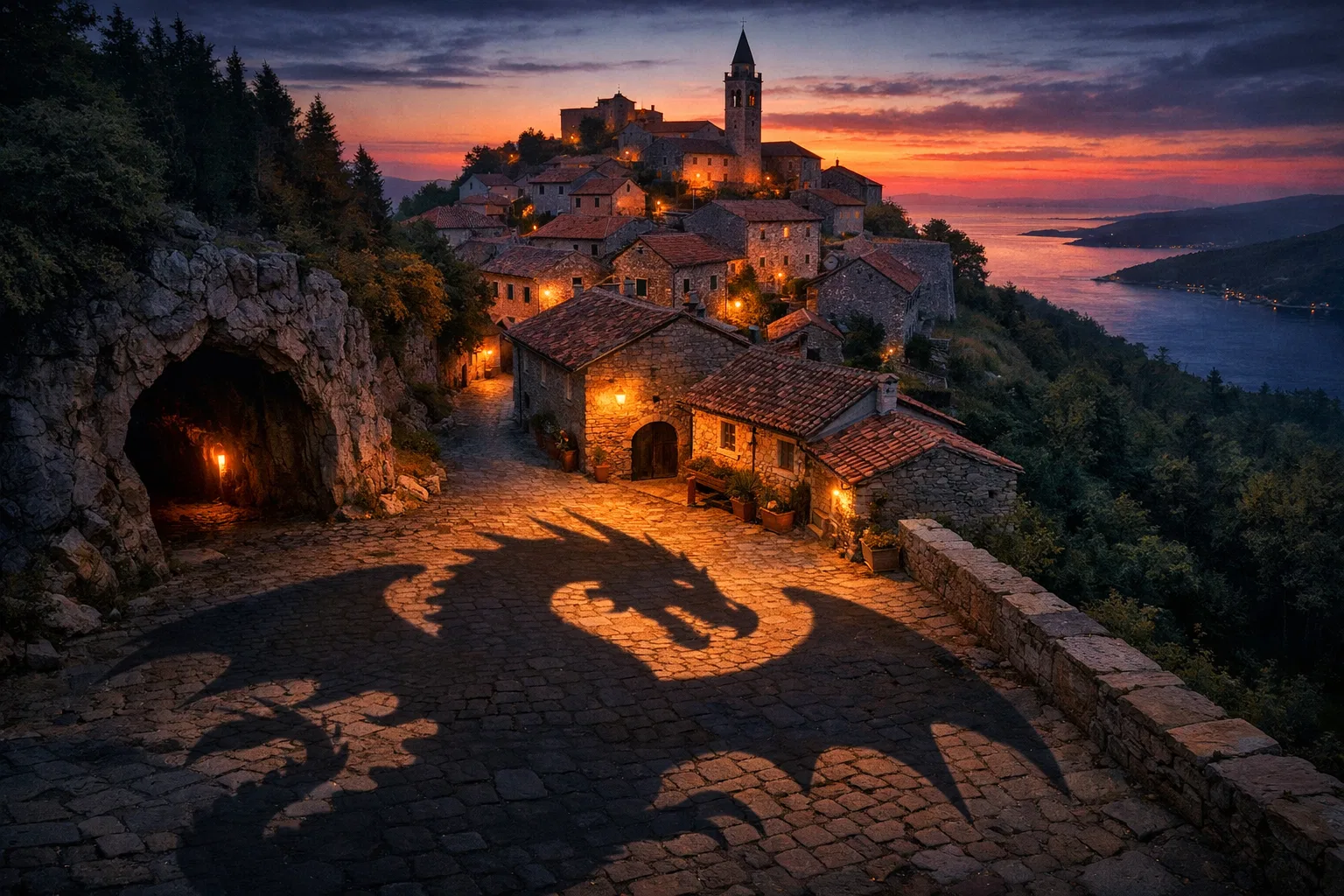
Croatia’s legendary animals and monster-like beings tend to belong to particular landscapes. Istria, especially inland villages such as Kringa and the wider peninsula, is strongly associated with vampire-like and witch-like traditions. Bilogora in north-western Croatia preserves stories of forest beings and wild women. Zagreb and Čakovec have dragon-under-the-city legends. The Adriatic coast adds a different layer: seals, sharks, large fish and old sea-lore rather than a single named sea serpent.
This matters because it stops the reader looking for one national “Croatian Bigfoot” or one famous lake monster. The Croatian pattern is closer to a folklore ecosystem. Different regions used different beings to explain danger, illness, storms, bad harvests, hidden water, wild woodland and social anxiety. Croatian scientific and heritage sources also show that these traditions were collected as oral literature and folk belief, not as confirmed animal reports. For example, a Croatian ethnological study of the krsnik describes it as a supernatural being in oral tradition, especially in Istria, the Croatian Littoral and Kvarner islands, with roles that include healer and protector.[Hrčak]hrcak.srce.hrHrčak Krsnik: from Tradition to Actual HealingHrčak Krsnik: from Tradition to Actual Healing
The strongest “cryptid-like” cases are therefore not strong because they prove unknown animals. They are strong because they have local depth, named places and repeated motifs. A Croatian monster page is most useful when it asks: is this a witness claim, a folk being, a tourist afterlife, a misidentified real animal, or a story that changed as it moved from village talk to media and pop culture?
The Istrian vampire is Croatia’s best-known monster tradition
The most internationally recognisable Croatian creature story is Jure Grando of Kringa in Istria, usually promoted as one of Europe’s earliest named vampire figures. Croatia’s official tourism site presents him as the “oldest European vampire” and frames the tale around the Istrian term for a vampire-like or warlock-like being.[Hrvatska Puna Života]croatia.hrHrvatska Puna Života Croatian VampireHrvatska Puna Života Croatian Vampire The story’s importance is not that it proves a vampire existed, but that it gives Croatia a unusually well-localised vampire tradition: a named man, a named village and a documented early-modern telling.
The usual source trail points back to Johann Weikhard von Valvasor’s 1689 work, in which he recorded the story as he heard it in or around Kringa. A later report on Kringa’s tourist revival notes that Valvasor’s account is the first document on Grando and that local tourism authorities revived the legend with a deliberately non-literal attitude: “No one is claiming that vampires or evil forces exist,” one local official said; the aim was to promote a documented legend.[Istrianet]istrianet.orgIstria on the InternetIstria on the Internet
That distinction is crucial. Grando belongs to the history of vampire belief, corpse anxiety and village storytelling, not to animal cryptozoology. Yet in a country-level monster guide he deserves central placement because he is one of Croatia’s clearest examples of a local supernatural being becoming a branded public legend. The movement is easy to trace:
- Village belief: a dead man is remembered as returning, troubling the living and requiring ritual action.
- Written record: Valvasor’s account gives the story historical visibility.
- Regional identity: Istria becomes associated with a darker supernatural bestiary.
- Tourism and pop culture: Kringa can market the legend without asking visitors to believe it literally.
Istria’s broader creature world gives Grando context. Croatian public broadcaster HRT describes Istria as a place where witches, warlocks, vampire-hunters, werewolves and other fantastic beings remain unusually present in storytelling and cultural branding. It quotes folklore scholar Evelina Rudan explaining that such beings warn of chaos entering the ordered world and preserve ancestral heritage.[Hrvatska radiotelevizija]glashrvatske.hrt.hrHrvatska radiotelevizija HRT: Istra – a place of fantastic creaturesHrvatska radiotelevizija HRT: Istra – a place of fantastic creatures This is exactly how many monster traditions work: the creature is less a hidden species than a social alarm bell.
Krsnik and the night battle against harmful beings
The krsnik is one of Croatia’s most distinctive monster-adjacent figures because it reverses the usual pattern. Instead of being the monster, the krsnik is often the person who fights or heals against harmful forces. In Croatian and Slovenian Istrian folklore, the krsnik appears as a protector, healer or supernatural opponent of witches and destructive beings. A 2003 study in Studia ethnologica Croatica describes the krsnik as a traditional supernatural phenomenon in parts of Croatia, especially Istria, the Croatian Littoral and the islands of Kvarner, and discusses the figure’s role as medicine man and healer.[Hrčak]hrcak.srce.hrHrčak Krsnik: from Tradition to Actual HealingHrčak Krsnik: from Tradition to Actual Healing
More recent work on Istrian narrative folklore notes that Maja Bošković-Stulli published 18 stories about the krsnik from Croatian Istria and that many of these stories connect the figure with protection against witchcraft and the safeguarding of harvests. It also describes 19th-century and later narratives in which the krsnik fights witches or appears as a healer and protector of people and animals.[Hrčak]hrcak.srce.hrOpen source on srce.hr.
For readers used to Bigfoot or lake monsters, the krsnik may feel like a poor fit. It is not normally a mystery animal. But it belongs in Croatia’s creature history because it shows how local monster traditions are built around conflict. The frightening figure is not always the one named in the title. Sometimes the memorable being is the defender: the village specialist who can recognise hidden harm, lift curses, protect cattle, and keep a hostile night world from breaking into ordinary life.
This also explains why Istrian folklore is so adaptable for modern fantasy and horror. It already has a cast: harmful witches or warlocks, vampire-like dead, werewolf transformations, protective krsniks, and communities trying to work out who is dangerous and who is secretly helping. HRT’s account stresses that these beings have become a regional brand while still belonging to handed-down oral tradition.[Hrvatska radiotelevizija]glashrvatske.hrt.hrHrvatska radiotelevizija HRT: Istra – a place of fantastic creaturesHrvatska radiotelevizija HRT: Istra – a place of fantastic creatures
Dragons under cities explain shaking ground and hidden water
Croatia’s dragon lore is less about winged reptiles seen in the sky and more about enormous underground beings tied to earth movement, water and old urban centres. Zagreb has a well-known legend of a sleeping dragon beneath the city. The Zagreb tourism site Love Zagreb links the story to the aftermath of the 1880 earthquake, when residents spread superstitious tales of a huge green dragon sleeping beneath the old town near the cathedral; when the dragon wakes, the ground shakes.[Lovezagreb]lovezagreb.hrmysterious world of zagreb legendsmysterious world of zagreb legends
Čakovec and Međimurje have a related dragon tradition centred on the pozoj, a dragon-like being said to lie beneath the town or castle. Modern tourism retellings place the creature beneath the Old Zrinski Castle in Čakovec and connect its movements with earthquakes, floods and storms.[Turisticke Price]turistickeprice.hrTuristicke Price The legend of the dragon that guards the spirit of MeđimurjeTuristicke Price The legend of the dragon that guards the spirit of Međimurje The motif also appears in wider Slavic dragon lore, where the Croatian pozoj is linked with subterranean presence and can sometimes be controlled or removed only by a special magic student or learned wanderer.[Wikipedia]WikipediaSlavic dragonSlavic dragon
These are not eyewitness animal reports in the modern sense. They are environmental legends. A dragon under a city gives shape to forces people can feel but cannot see: earthquakes, underground water, storms, marshes and the instability of old ground. That makes the pozoj more like a mythic explanation of landscape behaviour than a cryptid awaiting discovery.
Zagreb’s legend also shows how monster lore survives by attaching itself to public memory. The 1880 earthquake was real; the dragon explanation was not a geological account, but it gave the catastrophe a memorable body. When later visitors hear that a dragon sleeps under the city, they are hearing a folk way of turning seismic fear into a story.
Bilogora’s hairy forest beings are Croatia’s nearest “wild people” lore
If Croatia has anything close to a Bigfoot-like tradition, it is not a famous modern footage case but the older forest lore of Bilogora. Ethnologist Zvonko Lovrenčević’s 1970 study of mythological legends in Bilogora lists the vedi as giant human-like beings in torn clothing who live in forests and may be helpers and protectors or dangerous and malicious. The same abstract also records forest girls, water beings, witches, night beings and other figures from local folk belief.[Hrčak]hrcak.srce.hrHrčak MYTHOLOGISCHE SAGEN IN DER BILOGORAHrčak MYTHOLOGISCHE SAGEN IN DER BILOGORA
Later summaries of the ved tradition describe them as large, hairy, human-like forest beings, sometimes organised into tribes, sometimes attached to households, and remembered as helpers, rivals or threats. A local tourism page for Bjelovar-Bilogora also treats the region’s mythology as a cultural attraction, including forest girls described as small mythological beings with maiden-like faces living in the forests of Bilogora.[Bilogora Bjelovar Tourism]visitbjelovar.hrBilogora Bjelovar Tourism MitologijaBilogora Bjelovar Tourism Mitologija
This is where sceptical handling matters. Hairy forest people are tempting to recast as relic hominids, especially in online cryptid culture, but the source base is folklore collection, not zoological evidence. Croatia’s climate, long human settlement, managed forests and known mammal fauna do not support a hidden population of large apes. The more grounded reading is that the vedi and forest girls belong to a European family of wild-person and woodland-spirit traditions: beings that mark the forest as socially and morally different from the village.
They still matter for cryptid history because the shape is familiar. A reader will recognise the ingredients: hair-covered body, great strength, deep forest home, stories of encounters, helpful or hostile behaviour, and a fading tradition remembered by older people. The Croatian difference is that these beings are embedded in household and regional folklore rather than modern tracks, casts, photographs or expedition claims.
Croatia has more “monster habitats” than monster evidence
A country can be rich in monster settings even when it is poor in modern cryptid evidence. Croatia has several habitats that naturally generate strange-animal stories.
The Dinaric mountains and karst regions support real large carnivores. The European Commission’s large carnivore material places Croatia within the Dinaric-Balkan-Pindos region, where brown bears, wolves and Eurasian lynx occur, and notes that people in the region have lived with bears and wolves for many generations.[Environment]environment.ec.europa.euEnvironment Dinaric-Balkan-Pindos PlatformEnvironment Dinaric-Balkan-Pindos Platform Europe-wide data also show wolves, bears and lynx as major monitored species, with the lynx reinforcement in Slovenia helping prevent likely re-extinction in Slovenia and Croatia.[Environment]environment.ec.europa.euEnvironment Large carnivore populations across EuropeEnvironment Large carnivore populations across Europe
That matters because real predators feed legend. A night glimpse of a bear, a wolf pack heard in poor weather, a lynx crossing a track, or a jackal call at the edge of a village can all become larger in memory. None of these animals needs to be unknown to feel uncanny.
The Adriatic adds a different problem: scale. Large marine animals are rare enough near swimmers and boaters to feel extraordinary, but not impossible. Monk seals, for example, are part of Croatia’s natural and cultural history. A specialist article on legal protection states that the Mediterranean monk seal was the only seal species inhabiting the Adriatic, that sightings along the Croatian coast are rare and sometimes doubtful, and that biologists have debated whether reports represent wanderers from elsewhere or a tiny remaining local presence.[Monk Seal Guardian]monachus-guardian.orgMonk Seal Guardian PerspectivesMonk Seal Guardian Perspectives
Large sharks can also produce “sea monster” reactions without requiring a monster. In 2026, footage near Cres was assessed by experts as most likely a basking shark, the world’s second-largest fish species. The report described the animal as rare in the Adriatic but consistently present along the eastern Adriatic coast, especially around the Kvarner Gulf, and harmless to humans despite its size.[Croatia Week]croatiaweek.comOpen source on croatiaweek.com.
Croatia’s caves add a final layer: animals that look invented but are real. The olm, a pale cave salamander found in the Dinaric karst region including south-western Croatia, has long been associated with “baby dragon” folklore in neighbouring Slovenia and the wider karst world. AmphibiaWeb notes that the olm is listed as vulnerable because of its fragmented, limited distribution and declining population, while accounts of the animal’s mythology connect washed-up cave salamanders with dragon traditions.[AmphibiaWeb]amphibiaweb.orgOpen source on amphibiaweb.org.

Lake monsters are surprisingly weak in the Croatian record
For a country with dramatic lakes, rivers and karst waters, Croatia does not have a well-established public lake monster tradition comparable to Loch Ness, Lake Champlain or Sweden’s Storsjön. Searches for Croatian lake monsters tend to turn up thin online material, gaming or video references, or broader South Slavic water beings rather than a durable, well-documented sighting archive.
That absence is useful information. It suggests that Croatia’s water monsters are more likely to appear as folk beings, marsh noises, river demons or environmental warnings than as a single named animal allegedly living in a specific lake. The bukavac, a noisy water monster from South Slavic and Syrmian folklore, is sometimes connected with areas near eastern Croatia and Serbia, but the stronger references place it in a wider regional tradition rather than a securely Croatian national case.[Wikipedia]WikipediaOpen source on wikipedia.org.
The sceptical explanation for many Balkan water-creature stories is not one tidy answer. Marsh birds, foxes, jackals, frogs, night acoustics, drowned-tree shapes, livestock deaths, and children’s warning tales can all help a creature take form. In the case of the drekavac, South Slavic tradition often links the being with eerie cries or the restless dead; modern “sightings” elsewhere in the region have sometimes been explained as ordinary animal carcasses or misidentified attacks.[Wikipedia]WikipediaOpen source on wikipedia.org.
Croatia’s strongest water-related monster material therefore sits less in “there is a beast in this lake” and more in three overlapping zones: river and marsh folklore in the east, Adriatic encounters with rare real animals, and karst-cave dragon imagery connected with underground water.
The Adriatic “sea monster” is usually a real animal seen rarely
The Croatian coast is a perfect place for sea-monster talk: clear water, islands, deep channels, fishing culture and tourist cameras. Yet the most credible strange-sea cases are not unknown animals. They are rare or surprising encounters with known species.
The monk seal is a good example because it has both folklore texture and conservation reality. Its Croatian names have included forms glossed as “sea bear” or “sea man”, and its history includes conflict with fishermen who blamed it for damaging nets. Modern sightings are rare, debated and conservation-sensitive.[Monk Seal Guardian]monachus-guardian.orgMonk Seal Guardian PerspectivesMonk Seal Guardian Perspectives A seal surfacing near a cave or beach can easily feel like a creature from an older bestiary, especially in places where few people expect seals in the Adriatic today.
Large filter-feeding sharks create a different kind of astonishment. A basking shark’s tall fin, huge open mouth and slow surface movement can look alarming from a small boat, even though the animal feeds on plankton. The Cres report is especially useful because experts treated the video cautiously: the quality was not entirely clear, but fin shape supported basking shark identification.[Croatia Week]croatiaweek.comOpen source on croatiaweek.com. That is the right model for Croatian sea-monster claims: identify the known candidates first, preserve uncertainty where the evidence is poor, and avoid turning every large fin into folklore.
There is also a modern media pattern. Tourist footage, short social posts and “monster” headlines can travel faster than expert identifications. In a country where the sea is central to tourism, the dramatic version of a sighting can gain attention even when the biological explanation is straightforward. The result is not a stable sea-serpent tradition, but a recurring cycle of surprise, headline, expert comment and return to normal.
Tourism keeps the creatures alive, but changes what they mean
Croatia’s monster traditions now live partly as heritage experiences. That does not make them fake in a simple sense; it changes their function. A village vampire, a city dragon or a forest giant can move from feared belief to local story, festival material, walking-tour theme, souvenir image or fantasy inspiration.
Kringa’s Jure Grando revival is the clearest case. Local promotion explicitly framed the vampire as a documented legend rather than a literal claim, using the story to draw visitors and distinguish the village.[Istrianet]istrianet.orgIstria on the InternetIstria on the Internet Istria’s wider supernatural beings have similarly become part of regional branding, with HRT describing witches, warlocks, vampire-hunters and werewolves as living both in handed-down tradition and popular culture.[Hrvatska radiotelevizija]glashrvatske.hrt.hrHrvatska radiotelevizija HRT: Istra – a place of fantastic creaturesHrvatska radiotelevizija HRT: Istra – a place of fantastic creatures
Zagreb does the same with urban legend. The sleeping dragon, the Black Queen and witch-trial memory are folded into the city’s visitor identity. Love Zagreb presents the dragon story beside earthquake memory and other old-town legends, making it part of how visitors imagine the city after dark.[Lovezagreb]lovezagreb.hrmysterious world of zagreb legendsmysterious world of zagreb legends
The risk is that tourism can flatten folklore into mascot form. The advantage is that it keeps local stories visible. A careful Croatia cryptid page should therefore separate three layers:
- Traditional belief: stories told within communities, often with moral, seasonal or protective meaning.
- Documented folklore: material collected, published or studied by ethnologists and historians.
- Modern afterlife: festivals, tours, media, fantasy, horror and local branding.
The same creature can pass through all three. Jure Grando is not just a vampire story; he is a case study in how a fearful village legend becomes a cultural product without needing literal belief.
What evidence would change the assessment?
At present, Croatia’s creature lore is best understood as folklore, misidentification and cultural memory rather than proof of unknown animals. The most credible sources are ethnological studies, official tourism pages, conservation material and cautious wildlife reports. They support the existence of the stories, not the existence of monsters.
A stronger cryptid case would need evidence of a different kind: repeated independent sightings in a defined area, dated contemporary reports, physical traces examined by specialists, clear images or video with location and scale, and serious exclusion of known animals such as bear, wolf, lynx, jackal, seal, shark or large fish. For alleged forest hominids, the bar would be especially high because Croatia’s landscape is populated, monitored and ecologically unsuitable for an unknown breeding population of large primates.
That does not leave Croatia empty. It leaves it with a more honest and culturally richer creature tradition. Its monsters are not waiting in one famous lake. They are under old towns when the ground shakes, in Istrian night stories about harm and healing, in Bilogora forests where wild people once marked the border of the known world, and in the Adriatic when a rare animal briefly looks impossible before science gives it a name.
Amazon book picks
Further Reading
Books and field guides related to What Monsters Does Croatia Remember?. Use these as the next step if you want deeper reading beyond the article.
Vampires, Burial, and Death
Rating: 4.5/5 from 5 Google Books ratings
Helps explain the folklore mechanisms behind Croatian vampire traditions.
The Book of Imaginary Beings
Explores creature lore comparable to Croatia's regional monster traditions.
The Mammoth Book of Vampires
Connects Croatian vampire stories to wider European traditions.
eBay marketplace picks
Marketplace Samples
Live-tested eBay searches with available results related to this page.



Endnotes
1.
Source: croatia.hr
Title: Hrvatska Puna Života Croatian Vampire
Link:https://croatia.hr/en-gb/culture-and-arts/legends/jure-grando-the-first-real-person-described-as-a-vampire-in-europe
2.
Source: istrianet.org
Title: Istria on the Internet
Link:https://www.istrianet.org/istria/legends/supernatural/06_0424mg.htm
3.
Source: glashrvatske.hrt.hr
Title: Hrvatska radiotelevizija HRT: Istra – a place of fantastic creatures
Link:https://glashrvatske.hrt.hr/en/traditions/istra-a-place-of-fantastic-creatures-1874185
4.
Source: hrcak.srce.hr
Link:https://hrcak.srce.hr/file/450036
5.
Source: lovezagreb.hr
Title: mysterious world of zagreb legends
Link:https://www.lovezagreb.hr/untold-stories/mysterious-world-of-zagreb-legends
6.
Source: Wikipedia
Title: Slavic dragon
Link:https://en.wikipedia.org/wiki/Slavic_dragon
7.
Source: amphibiaweb.org
Link:https://amphibiaweb.org/cgi/amphib_query?where-genus=Proteus&where-species=anguinus
8.
Source: Wikipedia
Link:https://en.wikipedia.org/wiki/Bukavac
9.
Source: Wikipedia
Link:https://en.wikipedia.org/wiki/Drekavac
10.
Source: Wikipedia
Title: List of legendary creatures by type
Link:https://en.wikipedia.org/wiki/List_of_legendary_creatures_by_type
11.
Source: Wikipedia
Title: List of lake monsters
Link:https://en.wikipedia.org/wiki/List_of_lake_monsters
12.
Source: Wikipedia
Link:https://en.wikipedia.org/wiki/Bigfoot
13.
Source: Wikipedia
Title: Jure Grando
Link:https://en.wikipedia.org/wiki/Jure_Grando
14.
Source: Wikipedia
Title: Krsnik (vampire hunter)
Link:https://en.wikipedia.org/wiki/Krsnik_%28vampire_hunter%29
15.
Source: Wikipedia
Title: Ved (mythology)
Link:https://en.wikipedia.org/wiki/Ved_%28mythology%29
16.
Source: Wikipedia
Link:https://en.wikipedia.org/wiki/Olm
17.
Source: Wikipedia
Title: Adriatic sturgeon
Link:https://en.wikipedia.org/wiki/Adriatic_sturgeon
18.
Source: amphibiaweb.org
Title: Amphibia Web
Link:https://amphibiaweb.org/species/4229
19.
Source: croatia.hr
Link:https://croatia.hr/en-gb/culture-and-arts/legends
20.
Source: hrcak.srce.hr
Title: Hrčak Krsnik: from Tradition to Actual Healing
Link:https://hrcak.srce.hr/en/clanak/73635
21.
Source: turistickeprice.hr
Title: Turisticke Price The legend of the dragon that guards the spirit of Međimurje
Link:https://www.turistickeprice.hr/en/pozoj-cakovec-legenda-medjimurje/
22.
Source: hrcak.srce.hr
Title: Hrčak MYTHOLOGISCHE SAGEN IN DER BILOGORA
Link:https://hrcak.srce.hr/en/39259
23.
Source: visitbjelovar.hr
Title: Bilogora Bjelovar Tourism Mitologija
Link:https://visitbjelovar.hr/tzbb/mitologija/
24.
Source: environment.ec.europa.eu
Title: Environment Dinaric-Balkan-Pindos Platform
Link:https://environment.ec.europa.eu/topics/nature-and-biodiversity/habitats-directive/large-carnivores/eu-large-carnivore-platform/eu-regional-large-carnivore-platforms/dinaric-balkan-pindos-platform_en
25.
Source: environment.ec.europa.eu
Title: Environment Large carnivore populations across Europe
Link:https://environment.ec.europa.eu/topics/nature-and-biodiversity/habitats-directive/large-carnivores/large-carnivore-populations-across-europe_en
26.
Source: monachus-guardian.org
Title: Monk Seal Guardian Perspectives
Link:https://monachus-guardian.org/mguard22/2223perspe.htm
27.
Source: croatiaweek.com
Link:https://www.croatiaweek.com/basking-shark-sighting-cres-northern-adriatic/
28.
Source: facebook.com
Link:https://www.facebook.com/SlavicSpirituality/photos/veda-ved-is-a-mythological-being-recorded-in-the-region-of-bilogora-in-northern-/2087370751435773/
29.
Source: webgate.ec.europa.eu
Link:https://webgate.ec.europa.eu/life/publicWebsite/project/LIFE02-TCY-CRO-014/conservation-and-management-of-wolves-in-croatia
30.
Source: eunis.eea.europa.eu
Title: eu Olm
Link:https://eunis.eea.europa.eu/species/775
31.
Source: tilife.org
Title: Sea Serpent
Link:https://tilife.org/BackIssues/Archive/tabid/393/articleType/ArticleView/articleId/2254/Sea-Serpent.html
32.
Source: cryptidz.fandom.com
Title: Lake Monsters
Link:https://cryptidz.fandom.com/wiki/Lake_Monsters
33.
Source: cryptidz.fandom.com
Link:https://cryptidz.fandom.com/wiki/Ved
34.
Source: monster.fandom.com
Title: Jure Grando
Link:https://monster.fandom.com/wiki/Jure_Grando
35.
Source: cryptidz.fandom.com
Link:https://cryptidz.fandom.com/wiki/Drekavac
36.
Source: creatures-of-myth.fandom.com
Link:https://creatures-of-myth.fandom.com/wiki/Bukavac
37.
Source: hrcak.srce.hr
Title: hr Krsnik: from Tradition to Actual Healing
Link:https://hrcak.srce.hr/clanak/73635
38.
Source: hrcak.srce.hr
Title: hr MYTHOLOGISCH E SAGEN IN DER BILOGORA
Link:https://hrcak.srce.hr/clanak/61630
39.
Source: mammalwatching.com
Link:https://www.mammalwatching.com/gd_place/croatia/
40.
Source: auntyflo.com
Link:https://www.auntyflo.com/magic/bukavac
41.
Source: mythbeasts.com
Link:https://mythbeasts.com/beast/bukavac/
42.
Source: bhhuatra.com
Title: The Olm
Link:https://www.bhhuatra.com/en/project/the-olm-proteus-anguinus
43.
Source: scribd.com
Title: Jure Grando
Link:https://www.scribd.com/document/269394253/Jure-Grando
44.
Source: everythingcroatia.weebly.com
Link:https://everythingcroatia.weebly.com/folklore.html
45.
Source: obscure.gamepuppet.com
Link:https://obscure.gamepuppet.com/data/bukavac.htm
46.
Source: vampire_mythology.en-academic.com
Link:https://vampire_mythology.en-academic.com/361/Krsnik
47.
Source: luckyboat.net
Title: the mediterranean monk seal
Link:https://luckyboat.net/the-mediterranean-monk-seal/
Additional References
48.
Source: youtube.com
Title: Terrible creatures of Slavic mythology
Link:https://www.youtube.com/watch?v=D23Tl7a2q0k
Source snippet
What are the Creatures and Monsters of Slavic Mythology and Folklore?...
49.
Source: wwfcee.org
Link:https://wwfcee.org/what-we-do/sturgeons/breaking-extinct-ship-sturgeon-caught-and-released-in-the-drava-river
50.
Source: researchgate.net
Link:https://www.researchgate.net/publication/305790156THE_OLM_Proteus_anguinus_IN_CROATIA-_WHAT_WE_HAVE_LEARNED_TILL_NOW
51.
Source: researchgate.net
Link:https://www.researchgate.net/publication/333723617Dragon_and_Hero_or_How_to_Kill_a_Dragon-_on_the_Example_of_the_Legends_of_Medimurje_about_the_Grabancijas_and_the_Dragon_Zmaj_i_junak_ili_kako_ubiti_zmaja_na_primjeru_medimurskih_predaja_o_grabancija
52.
Source: history.co.uk
Link:https://www.history.co.uk/articles/strange-sea-serpent-sightings-from-history
53.
Source: facebook.com
Link:https://www.facebook.com/JAGProducts/posts/a-croatian-monster-our-friend-andreas-smashed-his-pb-recently-after-just-2-days-/5624547514300293/
54.
Source: telegraf.rs
Link:https://www.telegraf.rs/english/1575412-a-sea-monster-swims-in-the-adriatic-sea-people-what-is-this-large-video
55.
Source: instagram.com
Link:https://www.instagram.com/reel/DaCqAR6B_dY/
56.
Source: facebook.com
Link:https://www.facebook.com/groups/slavic.mythology/posts/10163102311420360/
57.
Source: paranorm101.blogspot.com
Link:https://paranorm101.blogspot.com/p/an-assembly-of-ape-men.html
Topic Tree
Follow this branch
Related pages 192
- Antigua Cryptids
- Maldives Monsters
- Malta Monsters
- Qatar Monsters
- Argentina Monsters
- +187 more in sidebar