The Creatures Behind Poland's Monster Stories
Poland does not have a single unexplained creature with the long, continuous sighting history of the Loch Ness Monster or Bigfoot.
Page outline Jump by section
Introduction
That distinction matters. The Wawel Dragon belongs to medieval legend, not zoological investigation. The Sea Bishop was a Renaissance report repeated in illustrated natural histories. The Zegrze creature was deliberately created by a journalist and then adopted as local folklore. Recent big-cat alarms, meanwhile, concern animals that could plausibly exist because private collections and illegal exotic-pet ownership provide a straightforward route into the countryside. Poland’s monster history is therefore most interesting not as evidence for hidden species, but as a record of how landscapes, wildlife, pollution, newspapers and tourism turn uncertainty into memorable creatures.
Poland’s clearest cryptid case was invented for radio
The creature most closely resembling a modern Polish lake monster is associated with the Zegrze Reservoir north of Warsaw. Often described as Poland’s answer to Nessie, it was supposedly an ugly aquatic beast lurking in the reservoir’s murky water.
Unlike many monster traditions, however, its origin is unusually well documented. Journalist Wojciech Mazurkiewicz created the creature for Polish radio entertainment. Accounts differ slightly over whether its main emergence should be dated to the mid-1970s or the 1980s, but the earliest firm popular-culture marker is a 1976 song about the fictional monster, broadcast as part of a summer radio programme. Later reports presented alleged witnesses and imagined appearances, helping the joke develop the outward form of a genuine sighting tradition.[wikipedia.org]WikipediaPaskuda z Zalewu ZegrzyńskiegoJune 19, 2007 — Jej twórcą był Wojciech Mazurkiewicz. W 1976 roku Edward Hulewicz nagrał piosenkę pt. „Paskuda”, która opowiadała o fikcy…
The legend worked because the location already felt suitable. The Zegrze Reservoir, created in the 1960s, became a major leisure destination for Warsaw residents, but it was also associated with poor water quality. The monster was consequently said to live on sewage or thrive in polluted water. That detail transformed an imported lake-monster formula into a specifically local satire: the creature was not merely hiding in opaque water but apparently feeding on the environmental problem that made the water opaque.[Miejskie Legendy]miejskielegendy.fandom.comPotwór ten był podobno obserwowany przez kilka lat, publikowane były też jego wyobrażenia i wywiady ze świadkami. Paskuda…Read more…
Once sewage treatment improved the reservoir, the monster’s cultural role weakened. This is a revealing reversal of the usual cryptid story. Better visibility and environmental management did not uncover an animal; they removed part of the social setting that made the creature funny and believable.
The Zegrze story is therefore best classified as a documented media invention that became folklore after the fact. People could repeat it, embellish it and attach childhood memories to it even after its artificial origin was known. A hoax does not need to remain believed in order to become part of a place.
The Wawel Dragon is folklore, not a surviving animal claim
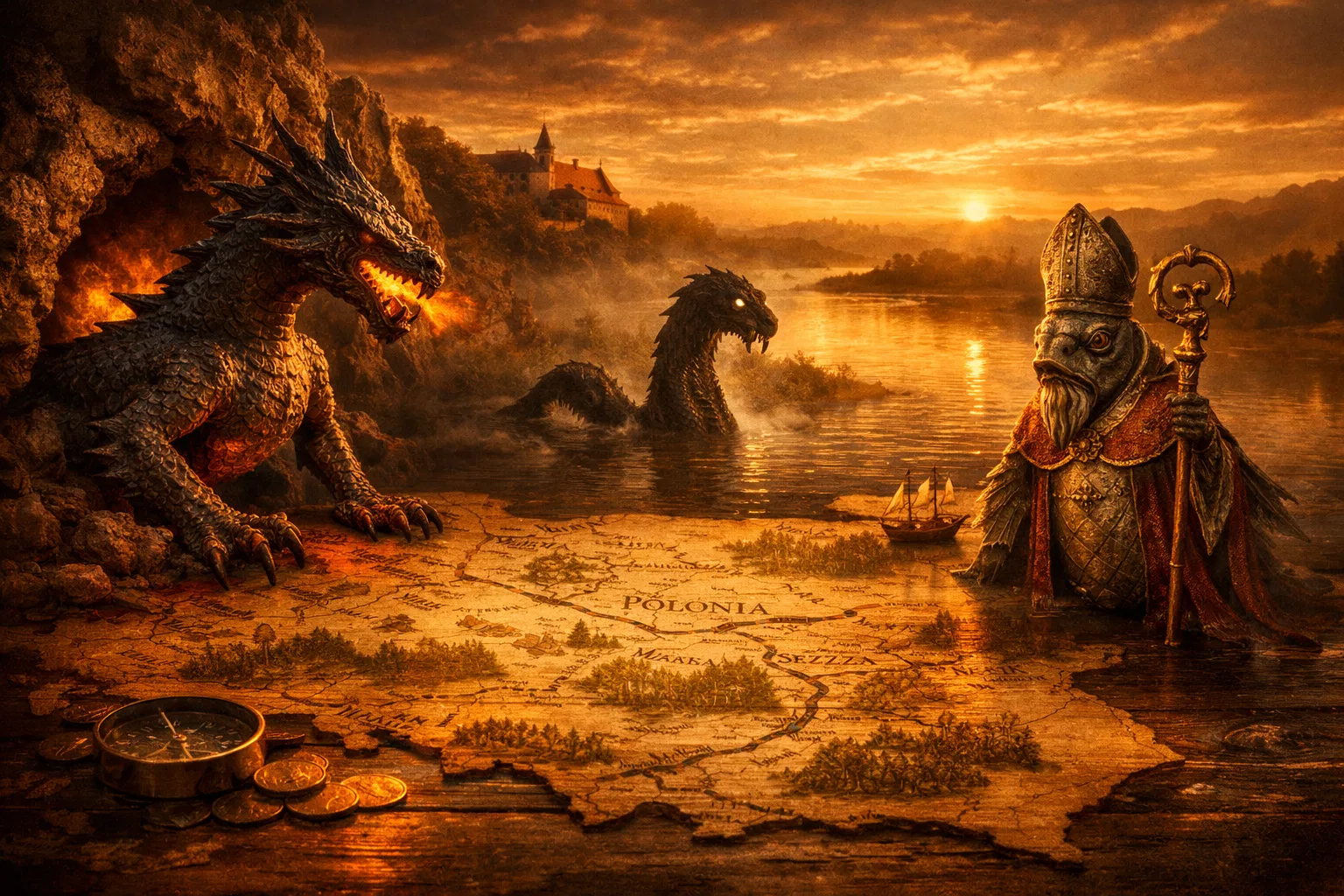
Poland’s best-known monster is the Wawel Dragon of Kraków. In the familiar version, the dragon lives in a cave beneath Wawel Hill, consumes livestock or human victims and is defeated with a sulphur-filled animal carcass. After eating the bait, it drinks from the Vistula until it bursts.
The story has changed substantially over time. The oldest surviving version appears in the chronicle of Master Vincent, written around the turn of the thirteenth century. In that account, the sons of the legendary ruler Krak defeat the creature. A later chronicler credits the king himself, while the now-famous clever cobbler was not introduced until the end of the sixteenth century.[Wawel Castle]wawel.krakow.plWawel Castle Dragon's denWawel CastleDragon's den - Wawel Royal Castle - official websiteThe Legend The oldest version of a legend about the dragon of Wawel, rela…
These changes are important because they show a legend evolving through literature rather than a chain of wildlife reports. There is no credible historical evidence that witnesses repeatedly encountered an unknown reptile beneath Kraków. The cave is real, but the existence of a cave does not verify the creature attached to it.
The dragon nevertheless has a powerful physical afterlife. Visitors can enter the cave beneath Wawel Castle, while the metal dragon sculpture installed nearby breathes real fire and has become one of Kraków’s most recognisable attractions. In January 2025, the sculpture temporarily stopped breathing fire while its gas system was examined for excessive fuel use—a wonderfully mundane maintenance problem for a legendary beast.[krakow.travel]krakow.travelKraków TravelThe legend of the Wawel DragonThe Wawel Dragon was a beast which lived in a den under Wawel Hill and terrorised all the inha…
Palaeontology has added another playful layer. A large prehistoric reptile discovered in Poland was given a scientific name honouring the Wawel Dragon. The animal lived roughly 210 million years ago and may have reached about six metres in length, but it was not the historical source of medieval sightings. The name commemorates the legend rather than proving it.[Wawel Castle]wawel.krakow.plWawel Castle Wawel DragonWawel Castle Wawel Dragon
The Wawel Dragon is therefore central to Poland’s monster culture while remaining outside cryptozoology in the strict sense. It is a literary and civic creature: old enough to feel historical, visible enough to drive tourism and flexible enough to be retold for each generation.
The strange Sea Bishop report
One of Poland’s most intriguing early “monster reports” concerns the Sea Bishop, a fish-like humanoid supposedly captured in 1531. The French naturalist Guillaume Rondelet later wrote that he had seen an image of a sea monster found in Poland and brought before the king. According to the story, the creature made signs indicating that it wished to return to the sea; once taken to the water, it escaped.[mythicalcreatures.edwardworthlibrary.ie]mythicalcreatures.edwardworthlibrary.ieOpen source on edwardworthlibrary.ie.
The case belongs to a period when European natural histories mixed observation, hearsay, inherited classical material and moral symbolism. Creatures were often depicted as marine versions of recognised human roles: sea monks, sea bishops and other beings whose fins or folds resembled clothing. An unusual ray, seal, squid or damaged fish could be interpreted through familiar religious imagery, especially when the description passed through several witnesses and illustrators.
There is no specimen, securely contemporary eyewitness statement or physical documentation that would allow the Polish Sea Bishop to be treated as evidence for an unknown species. Even its precise location and transmission history are uncertain. Its value lies elsewhere: it shows how a remarkable catch could be converted into a courtly anecdote and then preserved by printed natural history.
The Sea Bishop also marks a useful boundary. It is more than a timeless folktale because it was presented as an event that happened in a particular year. Yet it is less than a modern sighting case because the surviving account is remote, illustrated and impossible to test. It sits between folklore, early science and news.
Mountain “Yeti” stories and the problem of scale
The Tatra Mountains provide Poland’s most convincing setting for an ape-like mystery creature. They are steep, wooded in their lower reaches, frequently obscured by mist and shared across the Polish–Slovak border. They also support real large mammals, including brown bears, wolves and deer. Tatra National Park research uses tracks, droppings, genetics and other field evidence to study known wildlife; its scientific output includes work on bear dens, wolves, foxes and woodland species, but not evidence for an unknown ape.[Environment & Society Portal]environmentandsociety.orgEnvironment & Society Portal Profoundly National Yet Transboundary: The TatraEnvironment & Society Portal Profoundly National Yet Transboundary: The Tatra
The best-publicised Polish “Yeti” episode appeared in 2009, when shaky footage of a dark, upright-looking figure on a Tatra slope circulated internationally. The recording never produced a body, tracks, hair or a repeatable location-based investigation. Its fame came mainly from the visual ambiguity of a distant figure and from headlines linking the mountains to the Himalayan Yeti tradition.
Such footage has several ordinary weaknesses. A person in dark clothing can appear unusually broad when seen at a distance. A bear briefly standing upright can look humanoid. Camera shake makes proportions difficult to judge, while slopes remove reliable information about height. Compression and repeated online copying further erase detail.
There is also no deep Polish tradition of a giant undiscovered mountain ape comparable to the Himalayan Yeti or North American Bigfoot. Applying the word “Yeti” to an unclear Tatra figure imports a ready-made international story. The landscape supplies atmosphere, but the label supplies most of the monster.
The absence of good evidence does not prove that every witness was dishonest. Mountain observations are often brief and genuinely confusing. It does mean that the Tatra reports remain isolated ambiguous sightings, not a coherent biological case.
Phantom cats are plausible animals, but poor evidence for hidden populations
Large-cat reports occupy a different category because the claimed animal is usually familiar: a puma, panther, lynx or cheetah rather than a wholly unknown species. In January 2026, authorities in north-western Poland warned people away from woodland after footage appeared to show a large exotic cat. Specialists reportedly considered possibilities including a puma or cheetah, although the available images did not establish the species conclusively.[TVP World]tvpworld.comTVP World Big cat sightings put Polish village on alertTVP World Big cat sightings put Polish village on alert
This is closer to an escaped-animal investigation than classical cryptozoology. Europe has a recurring problem with exotic pets that are privately owned, kept illegally or poorly registered. When a large cat appears in an unexpected landscape, escape or release is normally more plausible than the discovery of a native breeding population.
Misidentification remains common. Domestic cats can look enormous when filmed without a scale reference. Dogs, deer and wild boar may be distorted by darkness, distance or low-resolution cameras. Poland also has a native wild cat and a population of Eurasian lynx, although neither normally resembles a black panther when seen clearly.
A convincing case for an established exotic population would require more than repeated stories. Investigators would expect recoverable tracks, droppings, kills showing consistent bite patterns, hair suitable for genetic testing, clear camera-trap images and evidence of more than one individual. Poland’s scattered reports have not produced that combination.
Nevertheless, phantom-cat cases should not automatically be dismissed as fantasy. Unlike a lake dragon, a puma can escape from captivity. The sensible position is therefore case-by-case: a particular sighting may involve a real exotic animal, while the broader legend of permanently roaming panthers can still be exaggerated by repeated misidentifications.
Why water, caves and forests attract monsters
Poland’s recurring monster locations are not random. They are places where normal perception is unreliable and where older stories already offer a language for interpreting uncertainty.
Reservoirs and lakes hide scale and distance. Swimming deer, large fish, water birds, floating vegetation and boat wakes can create humps, heads or serpentine movement. Polluted or sediment-rich water makes identification even harder. The Zegrze monster turned precisely this lack of visibility into comedy.
Caves provide real openings into unseen spaces. The chamber beneath Wawel Hill gives the dragon a physical address, allowing visitors to move through the legend even though there is no zoological case.
Mountain slopes distort size. A person, bear or tree stump observed across a valley may lack any reliable reference point. Cloud, snow patches and unstable handheld footage increase the ambiguity.
Forests permit encounters that are brief and partly obstructed. Poland’s recovering populations of large mammals also mean that people can genuinely meet animals they are unused to seeing. A known species in an unexpected place may be remembered as something unknown.
These conditions explain why sincere testimony can coexist with mistaken conclusions. A witness may accurately report that a large dark form moved through water or trees while being wrong about what produced it. Eyewitness honesty and creature identity are separate questions.

Folklore, hoax and animal report are not the same thing
Polish monster stories become clearer when separated into four overlapping categories.
- Traditional folklore: The Wawel Dragon and regional serpents belong primarily to inherited narrative. Their stories change through chronicles, oral retelling and children’s culture.
- Historical marvel reports: The Sea Bishop was presented as an event but survives through early printed natural history rather than testable evidence.
- Media-created monsters: The Zegrze Reservoir creature was intentionally invented, then acquired a local life beyond its creator.
- Potential animal incidents: Big-cat alarms may begin with a real animal, an escape or an ordinary species seen poorly.
Confusion arises when one category is treated as another. A medieval chronicle is not a field report. An admitted radio invention should not be listed as an unresolved zoological mystery. Conversely, a modern police warning about a possible escaped puma should not be dismissed simply because similar stories have become folklore.
This classification does not make the stories less entertaining. It makes their development easier to understand.
Monsters as local heritage
Poland’s creatures have survived largely because they are useful cultural symbols. The Wawel Dragon gives Kraków a recognisable mascot, a visitor attraction and a story linked to a specific landscape. The Zegrze monster preserves memories of summer radio, polluted water and recreation near Warsaw. The Sea Bishop connects the Polish coast to the strange illustrated zoology of Renaissance Europe.
Recent heritage work has made this relationship between place and monster more explicit. In 2025, researchers associated with the Polish Academy of Sciences presented a map of legendary beings connected with Pomerania, a historical region now divided between Poland and Germany. Drawing on folklore and the visual style of Renaissance cartography, the project located dragons, mermaids, devils and other beings within the landscape rather than presenting them as biological discoveries.[notesfrompoland.com]notesfrompoland.comNotes From Poland Polish researchers create “Map of Monsters” from regionalNotes From Poland Polish researchers create “Map of Monsters” from regional
That approach suits Poland’s material particularly well. The country’s monster tradition is geographically rich but zoologically thin. Its creatures explain dangerous caves, polluted waters, unsettling forests and local identities more successfully than they demonstrate unknown animals.
What would count as strong evidence?
Most Polish mystery-creature stories lack the evidence needed to move from folklore or anecdote into zoology. A serious claim would need several independent forms of support:
- clear photographs or video with a known location, date and scale;
- tracks or remains that qualified zoologists could examine;
- hair, tissue or droppings yielding reproducible genetic results;
- repeated observations in the same habitat by independent witnesses;
- evidence that rules out known wildlife, people, escaped pets and deliberate fabrication;
- ecological evidence that the environment could support a breeding population.
No major Polish monster case currently meets that standard. The best-documented case is the Zegrze Reservoir Monster, and what is documented most clearly is its invention. The most famous case, the Wawel Dragon, can be traced through changing literary versions. The most biologically plausible cases involve escaped or misidentified known animals rather than undiscovered species.
Poland’s monsters remain worth studying because proof of a hidden animal is not their only possible significance. They show how a country remembers its landscapes, turns environmental unease into humour, converts old legends into tourism and repeatedly gives uncertain shapes a familiar name.
Amazon book picks
Further Reading
No matched book cards were available for What Really Lurks Behind Poland's Monster Stories?, so this fallback keeps a direct Amazon reading path visible.
Topical books
Zegrze Reservoir monster guide
Browse books, explainers and reference titles related to this topic.
Search AmazonRelated search
Polish radio folklore guide
Browse books, explainers and reference titles related to this topic.
Search AmazonRelated search
Kraków folklore history
Browse books, explainers and reference titles related to this topic.
Search AmazonEndnotes
1.
Source: Wikipedia
Title: Paskuda z Zalewu Zegrzyńskiego
Link:https://pl.wikipedia.org/wiki/Paskuda_z_Zalewu_Zegrzy%C5%84skiego
Source snippet
June 19, 2007 — Jej twórcą był Wojciech Mazurkiewicz. W 1976 roku Edward Hulewicz nagrał piosenkę pt. „Paskuda”, która opowiadała o fikcy...
Published: June 19, 2007
2.
Source: radiopogoda.pl
Title: Był jednym z ojców “Teleexpressu”
Link:https://radiopogoda.pl/ciekawostki/byl-jednym-z-ojcow-teleexpressu-stworzyl-tez-polskiego-potwora
Source snippet
Stworzył też polskiego...27 Jun 2025 — Według legendy stwór miał odżywiać się ściekami, co stanowiło nawiązanie do zanieczyszczonej wody...
3.
Source: mythicalcreatures.edwardworthlibrary.ie
Link:https://mythicalcreatures.edwardworthlibrary.ie/sea-creatures/sea-bishop/
4.
Source: culture.pl
Link:https://culture.pl/en/article/10-fantastic-beasts-from-poland-where-to-find-them
5.
Source: Wikipedia
Link:https://en.wikipedia.org/wiki/Glawackus
6.
Source: Wikipedia
Title: Lake monster
Link:https://en.wikipedia.org/wiki/Lake_monster
7.
Source: Wikipedia
Title: List of zoo escapes
Link:https://en.wikipedia.org/wiki/List_of_zoo_escapes
8.
Source: Wikipedia
Title: Eglė the Queen of Serpents
Link:https://en.wikipedia.org/wiki/Egl%C4%97_the_Queen_of_Serpents
9.
Source: Wikipedia
Title: Wojciech Mazurkiewicz (dziennikarz)
Link:https://pl.wikipedia.org/wiki/Wojciech_Mazurkiewicz_%28dziennikarz%29
10.
Source: Wikipedia
Title: Wawel Dragon
Link:https://en.wikipedia.org/wiki/Wawel_Dragon
11.
Source: miejskielegendy.fandom.com
Link:https://miejskielegendy.fandom.com/pl/wiki/Paskuda_z_Zalewu_Zegrzy%C5%84skiego
Source snippet
Potwór ten był podobno obserwowany przez kilka lat, publikowane były też jego wyobrażenia i wywiady ze świadkami. Paskuda...Read more...
12.
Source: wawel.krakow.pl
Title: Wawel Castle Dragon’s den
Link:https://wawel.krakow.pl/en/exhibition-constant/dragon-s-den
Source snippet
Wawel CastleDragon's den - Wawel Royal Castle - official websiteThe Legend The oldest version of a legend about the dragon of Wawel, rela...
13.
Source: krakow.travel
Link:https://krakow.travel/en/artykul/115/the-legend-of-the-wawel-dragon
Source snippet
Kraków TravelThe legend of the Wawel DragonThe Wawel Dragon was a beast which lived in a den under Wawel Hill and terrorised all the inha...
14.
Source: wawel.krakow.pl
Title: Wawel Castle Wawel Dragon
Link:https://wawel.krakow.pl/en/exhibition-constant/wawel-dragon-did-it-really-exist
15.
Source: environmentandsociety.org
Title: Environment & Society Portal Profoundly National Yet Transboundary: The Tatra
Link:https://www.environmentandsociety.org/arcadia/profoundly-national-yet-transboundary-tatra-national-parks
16.
Source: tvpworld.com
Title: TVP World Big cat sightings put Polish village on alert
Link:https://tvpworld.com/91327853/puma-or-cheetah-spotted-in-northern-poland-prompting-forest-closures
17.
Source: notesfrompoland.com
Title: Notes From Poland Polish researchers create “Map of Monsters” from regional
Link:https://notesfrompoland.com/2025/01/03/polish-researchers-create-map-of-monsters-from-regional-folklore/
18.
Source: scienceinpoland.pl
Link:https://scienceinpoland.pl/en/news/news%2C106012%2Cresearchers-create-elaborate-map-pomeranian-monsters-inspired-renaissance
19.
Source: tvpworld.com
Title: ancient sea monster resurfaces with rare fossil find in polish lake
Link:https://tvpworld.com/82181695/ancient-sea-monster-resurfaces-with-rare-fossil-find-in-polish-lake
20.
Source: tvpworld.com
Title: rare beaver spotted chilling in polands tatra mountains
Link:https://tvpworld.com/92923974/rare-beaver-spotted-chilling-in-polands-tatra-mountains
21.
Source: tvpworld.com
Link:https://tvpworld.com/84328085/polish-monster-map-wins-praise-for-merging-folklore-with-pioneering-cartographic-techniques
22.
Source: wawelcastle.org
Title: the legend of the wawel dragon exploring krakow s most famous myth
Link:https://wawelcastle.org/blog/the-legend-of-the-wawel-dragon-exploring-krakow-s-most-famous-myth
23.
Source: cryptidz.fandom.com
Title: Fiskerton Phantom
Link:https://cryptidz.fandom.com/wiki/Fiskerton_Phantom
24.
Source: cryptidz.fandom.com
Link:https://cryptidz.fandom.com/wiki/Category%3APoland
25.
Source: karwansaraypublishers.com
Title: the wawel dragon
Link:https://www.karwansaraypublishers.com/blogs/medieval-world-blog/the-wawel-dragon?srsltid=AfmBOoqnFBJn-m6Lmi6j44XVZEk5cj9SRkGB0jbSrYguLqWIY2JGTBus
Additional References
26.
Source: apnews.com
Link:https://apnews.com/article/0e97b7ec714f1db8a5a8a5b549d4d92c
Source snippet
Experts will examine the gas feeds of the 6-meter-tall sculpture to find ways to reduce energy costs. Created by sculptor Bronislaw Chrom...
27.
Source: gazetapowiatowa.pl
Title: nasza historia jezioro zegrzynskie konczy 60 n1736149
Link:https://gazetapowiatowa.pl/artykul/nasza-historia-jezioro-zegrzynskie-konczy-60-n1736149
Source snippet
przez dziennikarza i poetę Wojciecha Mazurkiewicza. Bliskość Warszawy oraz walory...Read more...
28.
Source: youtube.com
Title: The Striga: Monster from Slavic (Witcher) Mythology
Link:https://www.youtube.com/watch?v=ySGRJpXTrkM
Source snippet
The Strange Vampire Owl of Slavic Mythology - Strzyga...
29.
Source: history.co.uk
Link:https://www.history.co.uk/articles/strange-sea-serpent-sightings-from-history
30.
Source: instagram.com
Link:https://www.instagram.com/p/DU-UwvUDcpV/
31.
Source: facebook.com
Link:https://www.facebook.com/notesfrompoland/posts/a-one-eyed-manul-wild-cat-called-bo%C5%BCenka-has-escaped-from-pozna%C5%84-zoo-which-suspe/1366752612137684/
32.
Source: facebook.com
Link:https://www.facebook.com/groups/1351735364879765/posts/7172913462761897/
33.
Source: hungarytoday.hu
Link:https://hungarytoday.hu/black-panther-in-danger-kishunhalas-hungary-wild-big-cats-wildlife/
34.
Source: instagram.com
Link:https://www.instagram.com/reel/DVj-TKjjlQP/
35.
Source: facebook.com
Link:https://www.facebook.com/EUinterpreters/videos/have-you-ever-explored-the-tatra-mountains-in-southern-poland-%EF%B8%8F-if-so-you-might-/565837049847567/
Amazon book picks
Further Reading
Books and field guides related to What Really Lurks Behind Poland's Monster Stories?. Use these as the next step if you want deeper reading beyond the article.
Abominable Science!
Examines how monster claims, media stories and folklore become accepted narratives.
The Book of Imaginary Beings
Covers legendary creatures and how monster traditions develop across cultures.
Monsters
Explores dragons, lake monsters and other legendary beings similar to those discussed in Poland.

The Penguin Book of Dragons
Useful background for Poland's dragon traditions and medieval monster lore.
Topic Tree
Follow this branch
Related pages 192
- Antigua Cryptids
- Maldives Monsters
- Malta Monsters
- Qatar Monsters
- Argentina Monsters
- +187 more in sidebar