Within Portugal Monsters
What Haunted Portugal's Roads After Dark?
Portuguese transformation legends turned wolves, dogs, horses and other familiar animals into frightening travellers of the night.
On this page
- How Portuguese werewolf transformations were supposed to work
- The tardo and other animal shaped night beings
- Wolves, loose animals and mistaken encounters
Page outline Jump by section
Introduction
Among Portugal’s strangest creature traditions, the most unsettling are not dragons or sea monsters but the beings said to haunt lonely roads after dark. In older Portuguese folklore, travellers crossing remote hills, streams and crossroads were warned that some of the figures they encountered might not be what they seemed. A beggar, a wandering dog, a horse on an empty track or a shadowy animal moving beside the road could, according to tradition, be a cursed human “running their fate” through the night. Rather than focusing on a single wolf-man, Portuguese stories developed a broader idea of transformation in which people could take the form of wolves, dogs, horses, donkeys, goats and other animals. These legends reveal less about unknown creatures than about how rural communities explained strange encounters in darkness, isolation and dangerous landscapes.[theportugueselady.substack.com]theportugueselady.substack.comWerewolves and Vampires in Portuguese Folklore - Triton's WellJune 12, 2024 — What defines a werewolf in portuguese folklore is the trans…
How Portuguese werewolf transformations were supposed to work
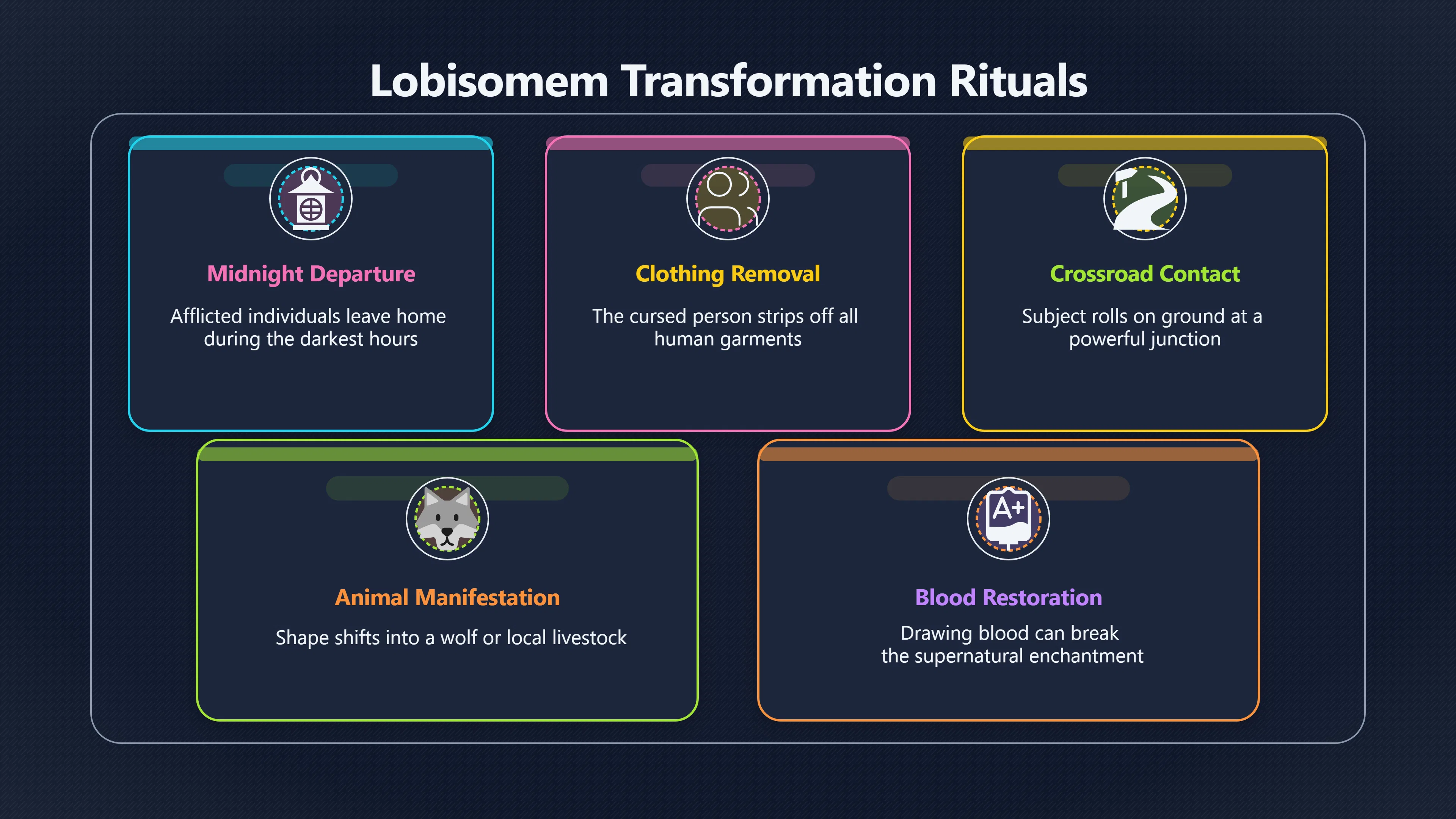
One of the most distinctive features of Portuguese werewolf lore is that the creature was not always expected to become a wolf. Traditional accounts collected by folklorists describe the lobisomem as a cursed person whose fate compelled them to leave home at night and transform into whatever animal form destiny required. In some regions the curse was believed to fall upon a seventh son, while other traditions linked it to inherited fate, broken religious obligations or supernatural punishment. Unlike the aggressive movie werewolf, the Portuguese version was often portrayed as a tragic figure trapped in an unwanted cycle.[Doris V. Sutherland]dorisvsutherland.comDoris VSutherlandWerewolf Wednesday: Rodney Gallop on Portuguese…May 15, 2024 — 15 May 2024 — The Portuguese lobisomem, though the object of…
The transformation itself was frequently tied to roads and crossroads. Nineteenth-century accounts from Portugal describe the afflicted person stripping off clothing at midnight, reaching a crossroads or isolated path, rolling on the ground and changing shape after contact with a place where an animal had previously rolled. The resulting form depended on the animal associated with that spot. A person might therefore become a wolf, dog, horse, donkey or goat rather than a single standard beast.[Wikipedia]WikipediaOpen source on wikipedia.org.
Several recurring elements appear in Portuguese descriptions:
- The change usually happened at night and away from settlements.
- Crossroads were considered especially powerful locations.
- The transformed individual wandered long distances before dawn.
- The condition was generally viewed as a curse rather than a chosen power.
- Drawing blood from the creature could sometimes break the enchantment and restore the victim to human life.[wikipedia.org]WikipediaOpen source on wikipedia.org.
This emphasis on fate helps explain why Portuguese stories often treat the werewolf with a mixture of fear and sympathy. The creature is dangerous because it has lost control, not because it deliberately seeks evil.[Doris V. Sutherland]dorisvsutherland.comDoris VSutherlandWerewolf Wednesday: Rodney Gallop on Portuguese…May 15, 2024 — 15 May 2024 — The Portuguese lobisomem, though the object of…
Why crossroads and night roads mattered
Many European werewolf traditions favour forests, but Portuguese accounts repeatedly return to roads, paths and crossroads. These were places where travellers moved between villages and where accidents, robberies and unexplained noises could easily become stories.
Crossroads carried additional symbolic weight in folk belief. They marked boundaries between communities, ownership and even between the human world and the supernatural. A traveller encountering an unfamiliar animal at such a location after midnight entered a setting already charged with suspicion and expectation.[Wikipedia]WikipediaOpen source on wikipedia.org.
Roads also provided a practical stage for storytelling. Rural Portugal was crossed by long routes used by shepherds, traders, smugglers and labourers. Journeys often began before dawn or ended after sunset. Strange animal behaviour, fleeting glimpses in poor light and the loneliness of travel all contributed to tales of shape-shifting beings encountered far from witnesses.[nomadit.co.uk]nomadit.co.ukA Horse-Shaped Werewolf Runs Up and Down in the…In Dona Joaquina (94)'s narration, the werewolf appears in the shape of a horse…
The tardo and other animal-shaped night beings
Portuguese folklore contains more than the familiar werewolf. One related figure is the tardo, a supernatural being capable of assuming different animal forms. Traditional descriptions portray it as a restless shape-shifter moving through the countryside at night. Some accounts state that if its curse remained unbroken for seven years, it could ultimately become a werewolf-like creature.[Wikipedia]WikipediaOpen source on wikipedia.org.
Another connected idea is that of the corredor or “runner”. This was not a separate monster so much as a cursed person compelled to “run fate” through the landscape. The runner could appear as a wolf, dog or other animal while carrying out a supernatural obligation. Folklore suggested that causing the creature to bleed might free it from the curse.[wikipedia.org]WikipediaOpen source on wikipedia.org.
Stories also describe spectral dog-like beings associated with wandering souls. These figures blur the line between ghost stories and shape-shifting traditions. What links them is the idea that familiar animals seen on deserted roads might conceal something human, cursed or supernatural beneath the surface.[Wikipedia]WikipediaOpen source on wikipedia.org.

When the werewolf appeared as a horse
One of the most surprising aspects of Portuguese folklore is the number of stories in which the “werewolf” is not wolf-like at all. Folklore research from northern Portugal has documented narratives in which the transformed figure appears as a horse racing through mountain landscapes at night. In one tale recorded from the border region, a horse-shaped werewolf accompanies smugglers through remote hills before vanishing into the darkness.[nomadit.co.uk]nomadit.co.ukA Horse-Shaped Werewolf Runs Up and Down in the…In Dona Joaquina (94)'s narration, the werewolf appears in the shape of a horse…
These stories make more sense when viewed through the broader Portuguese concept of transformation. The curse was not necessarily about becoming a wolf. It was about becoming an animal. Horses, donkeys, dogs and goats were all familiar parts of rural life and therefore plausible forms for a supernatural traveller to adopt.[theportugueselady.substack.com]theportugueselady.substack.comWerewolves and Vampires in Portuguese Folklore - Triton's WellJune 12, 2024 — What defines a werewolf in portuguese folklore is the trans…
For people walking isolated roads, a lone horse appearing where none should be could be just as unsettling as a wolf. In regions where wolves were becoming rarer, horse-shaped or dog-shaped night beings may even have seemed more believable than a literal wolf-man.[Wikipedia]WikipediaOpen source on wikipedia.org.
Wolves, loose animals and mistaken encounters
The most likely explanation for many road-haunting legends is a mixture of folklore and ordinary encounters with animals. Portugal historically supported populations of the Iberian wolf, and wolves remained a genuine source of fear in some regions for centuries. Knowledge that wolves existed made stories about transformed humans easier to accept.[Wikipedia]WikipediaOpen source on wikipedia.org.
Yet many descriptions fit more mundane possibilities:
- Free-roaming dogs seen in poor light.
- Escaped livestock wandering roads at night.
- Horses or donkeys encountered unexpectedly on isolated tracks.
- Misidentification caused by darkness, fog or fatigue.
- Folklore expectations influencing how witnesses interpreted unusual sights.[Wikipedia]WikipediaOpen source on wikipedia.org.
Notably, Portuguese traditions themselves often acknowledge uncertainty. Some nineteenth-century writers remarked that people repeated stories about werewolves but rarely tested them directly. The legends survived because they were compelling explanations for mysterious encounters rather than because anyone produced convincing evidence of actual transformations.[Wikipedia]WikipediaOpen source on wikipedia.org.
From feared traveller to folklore figure
Today, Portugal’s shape-shifting road legends survive mainly through folklore collections, ethnographic studies and local storytelling. Modern reports of werewolves are extremely rare, and there is no recognised body of evidence suggesting that unknown shape-shifting creatures roam Portuguese roads.
What remains fascinating is the mechanism of the legend. Portuguese folklore transformed ordinary landscapes—crossroads, streams, mountain tracks and village roads—into places where identity itself could become uncertain. A traveller meeting a dog, horse or wolf after midnight was not simply encountering an animal. According to tradition, they might be witnessing a neighbour, relative or stranger trapped inside a supernatural fate. That idea, more than any claim of a hidden species, is what makes Portugal’s road-haunting shape-shifters one of the country’s most memorable monster traditions.[substack.com]theportugueselady.substack.comWerewolves and Vampires in Portuguese Folklore - Triton's WellJune 12, 2024 — What defines a werewolf in portuguese folklore is the trans…
Amazon book picks
Further Reading
Books and field guides related to What Haunted Portugal's Roads After Dark?. Use these as the next step if you want deeper reading beyond the article.
The Werewolf in Lore and Legend
Directly relevant to Portuguese shape-changing and werewolf traditions.
The Encyclopedia of Vampires, Werewolves, and Other Monsters
Covers werewolves and related folklore across Europe.
The Book of Were-Wolves
Explores traditional beliefs about human-to-animal transformation.
The Book of Imaginary Beings
Provides wider context for shape-shifters and legendary creatures.
eBay marketplace picks
Marketplace Samples
Live-tested eBay searches with available results related to this page.
Endnotes
1.
Source: theportugueselady.substack.com
Link:https://theportugueselady.substack.com/p/the-werewolves-and-vampires-in-portuguese
Source snippet
Werewolves and Vampires in Portuguese Folklore - Triton's WellJune 12, 2024 — What defines a werewolf in portuguese folklore is the trans...
Published: June 12, 2024
2.
Source: Wikipedia
Link:https://pt.wikipedia.org/wiki/Lobisomem
3.
Source: dorisvsutherland.com
Title: Doris V
Link:https://dorisvsutherland.com/2024/05/15/werewolf-wednesday-rodney-gallop-on-portuguese-werewolves-1936/
Source snippet
SutherlandWerewolf Wednesday: Rodney Gallop on Portuguese...May 15, 2024 — 15 May 2024 — The Portuguese lobisomem, though the object of...
Published: May 15, 2024
4.
Source: kaimaciel.tumblr.com
Title: The Portuguese Werewolf
Link:https://kaimaciel.tumblr.com/post/666477315016065024/the-portuguese-werewolf
Source snippet
The Portuguese Werewolf - kaimaciel Kai's Blog30 Oct 2021 — Tardo. Tardo is a kind of goblin, a mutant being that assumes the forms...
5.
Source: nomadit.co.uk
Link:https://nomadit.co.uk/conference/isfnr2026/paper/92252
Source snippet
A Horse-Shaped Werewolf Runs Up and Down in the...In Dona Joaquina (94)'s narration, the werewolf appears in the shape of a horse...
6.
Source: Wikipedia
Link:https://en.wikipedia.org/wiki/Lobisomem
7.
Source: mythus.fandom.com
Link:https://mythus.fandom.com/wiki/Lobisomem
Additional References
8.
Source: reddit.com
Link:https://www.reddit.com/r/werewolves/comments/1bhc8rz/the_uniqueness_of_the_werewolf_called_lobisomem/
Source snippet
The uniqueness of the Werewolf (called Lobisomem) in...In folklore, the cursed man must wallow on a crossroads or sty during his t...
9.
Source: starlitden.wordpress.com
Link:https://starlitden.wordpress.com/2024/03/22/a-portuguese-mythical-creature-the-tragedies-of-the-portuguese-werewolf/
Source snippet
A Portuguese Mythical Creature: The Tragedies of... - StarlitDen22 Mar 2024 — The Portuguese Werewolf in popular folklore, usu...
10.
Source: europeanfolktales.com
Link:https://europeanfolktales.com/the-werewolf-of-the-crossroads/
Source snippet
The Werewolf of the Crossroads: Portugal Folktale22 Feb 2026 — A haunting Portuguese legend about a cursed seventh son, faith, and redemp...
11.
Source: youtube.com
Title: Northern Portuguese Myths & Legends: Peeira (The Wolf fairy) S1 E3
Link:https://www.youtube.com/watch?v=VGQK6OzgF9w
Source snippet
The Fascinating She-Wolf of Portuguese Mythology - Peeira...
12.
Source: facebook.com
Link:https://www.facebook.com/groups/121665091874474/posts/1930556120985353/
13.
Source: facebook.com
Link:https://www.facebook.com/groups/999676100052953/posts/6725025614184611/
14.
Source: youtube.com
Title: O Lobisomem de Alenquer
Link:https://www.youtube.com/watch?v=_33ro9oQcqM
Source snippet
Northern Portuguese Myths & Legends: Peeira (The Wolf fairy) S1 E3...
15.
Source: youtube.com
Title: A Maldição do Sétimo Filho: A Terrível Lenda do Lobisomem em Portugal
Link:https://www.youtube.com/watch?v=d77UWqJC1XI
Source snippet
O Lobisomem de Alenquer...
16.
Source: youtube.com
Link:https://www.youtube.com/shorts/G7ltpyjFNo4
17.
Source: youtube.com
Title: The Fascinating She-Wolf of Portuguese Mythology
Link:https://www.youtube.com/watch?v=g99Mr677AZY
Source snippet
Encenação da Lenda "Lobisomem"...
Topic Tree