Within Korean Mystery Beasts
Which Animals Become Korean Monsters?
Leopard cats, bears, boar and unusual woodland sounds can turn brief encounters into convincing monster reports.
On this page
- Leopard cats and other elusive forest mammals
- Bears, boar and dogs seen in poor conditions
- How echoes, darkness and expectation distort encounters
Page outline Jump by section
Introduction
Many South Korean monster stories begin with a very ordinary problem: somebody sees an animal for only a few seconds. A shape moves across a mountain trail at dusk, strange cries echo through a valley, or a pair of glowing eyes appears at the edge of a forest. In a country where steep mountains, dense woodland and expanding suburbs sit close together, brief wildlife encounters can easily become stories about mysterious beasts.

This does not mean that every unusual sighting is simply invented. Rather, some reports that later acquire a monster-like reputation may start with real animals seen under poor conditions. Leopard cats, wild boar, free-ranging dogs and, increasingly, Asiatic black bears can all look surprisingly strange when glimpsed at night or from a distance. Combined with expectation, local rumours and the natural tendency of memory to fill in missing details, ordinary wildlife can become something much more mysterious.
Which Real Animals Are Most Often Mistaken for Monsters?
South Korea has relatively few large wild mammals compared with many countries, but the species that remain are often elusive and rarely seen clearly.
Leopard cats and other elusive forest mammals
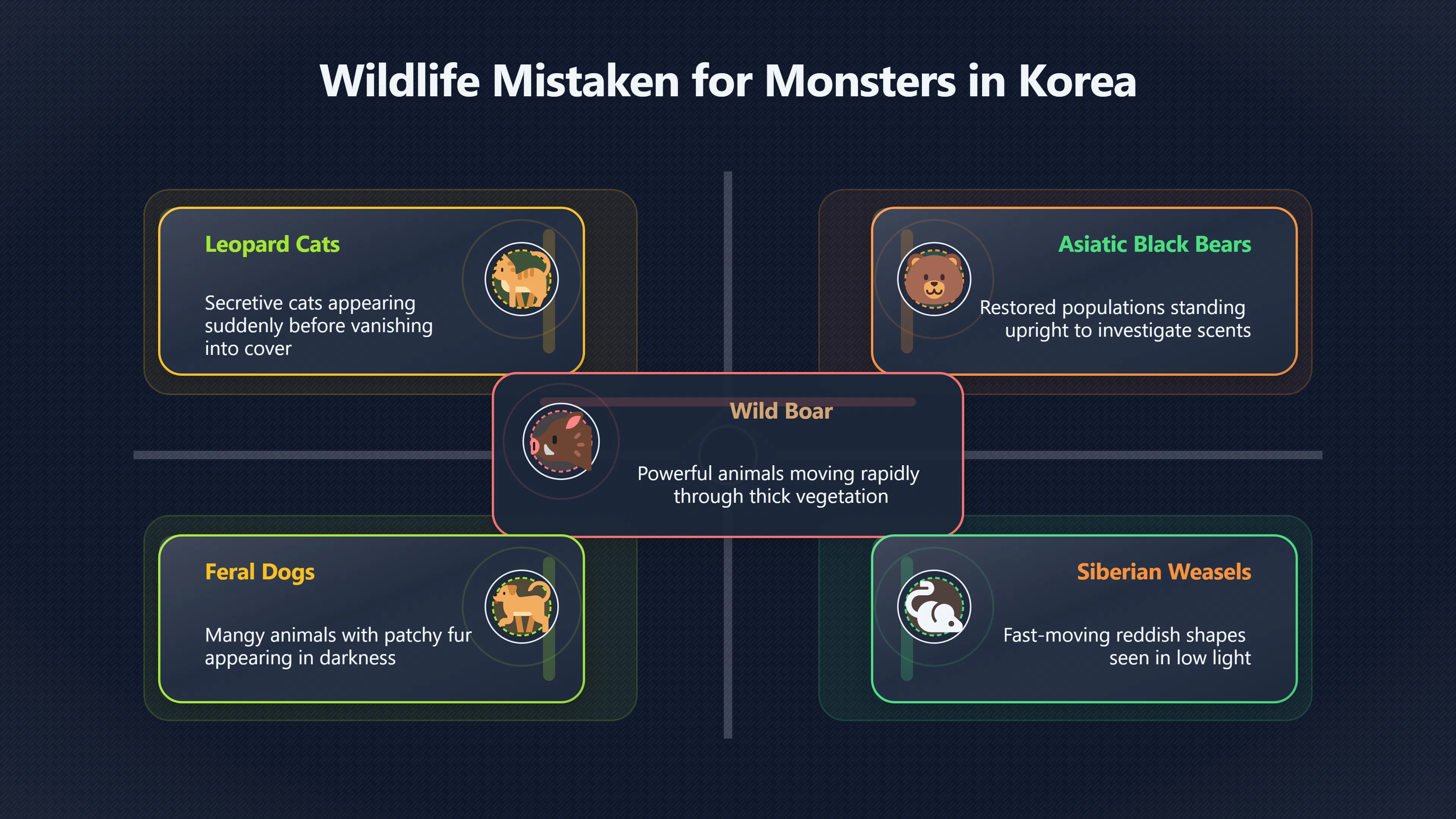
The leopard cat is South Korea’s only surviving wild cat species. Although small compared with a leopard or tiger, it is secretive, mostly active in low light, and capable of appearing suddenly before vanishing into cover. Camera-trap surveys and conservation studies show that leopard cats occupy a wide variety of habitats, from deep forest to rural and coastal landscapes. They are also present in areas surprisingly close to human settlement.[go.kr]me.go.krKorea National Park Service. Leopard cat has the smallest bodyMinistry of EnvironmentEndangered species, Leopard cat, inhabit BukhansanLeopard cat known as the top-level predator in Korea's ecosystem…
A brief glimpse can be misleading. A leopard cat viewed through vegetation may appear larger than it really is. Reflected eyeshine at night can make the animal seem unnatural, while partial views of its spotted coat may encourage witnesses to imagine a larger feline predator.
Other mammals can produce similar confusion:
- Siberian weasels appear as fast-moving reddish shapes.
- Martens can look unusually long-bodied and unfamiliar.
- Raccoon dogs often appear larger than expected in poor light.
- Deer seen head-on through brush can produce odd silhouettes.
Most witnesses do not observe these animals long enough for careful identification. The brain often reconstructs the missing details afterwards, especially when the encounter was startling.
Bears, Boar and Dogs Seen in Poor Conditions
The largest wildlife-related source of genuine surprise in modern South Korea may be the return of the Asiatic black bear.
For much of the twentieth century, bears became extremely rare in the South. Conservation programmes centred on Jirisan National Park have gradually restored the population, and the number of bears in and around the region has grown steadily over the past two decades. Conservation organisations and Korean authorities report a successful recovery, with dozens of animals now living in the wild.[IUCN]iucn.org20th Anniversary of the Asiatic Black Bear RestorationNov 25, 2024 — The Asiatic black bear restoration project has now resulted in a…
Because many people have never seen a wild bear, an unexpected encounter can feel extraordinary. A bear standing upright to investigate a scent may briefly resemble a human-shaped figure. Long shoulder fur can exaggerate its size. Even wildlife officials note that bear sightings attract strong public attention despite the animals generally avoiding people.[Climate Energy Ministry]mcee.go.krClimate Energy Ministry Asiatic Black Bear Activity Ramps Up: Visitor GuidelinesClimate Energy MinistryAsiatic Black Bear Activity Ramps Up: Visitor Guidelines…May 13, 2025 — Meanwhile, Asiatic black bears are high…
Wild boar create a different kind of confusion. They are common, powerful and capable of moving through thick vegetation with surprising speed. A witness hearing crashing sounds in darkness may imagine a much larger creature. When seen only in outline, a large boar can appear unusually bulky or oddly proportioned.
Free-ranging and feral dogs also contribute to monster reports. Mangy dogs, animals with patchy fur loss or unusual body condition, have fuelled mystery-animal stories in many countries. In South Korea’s mountain-edge communities, an unhealthy dog glimpsed briefly can appear far stranger than it would in daylight.

Why Sounds Often Create Monsters Before Anyone Sees Them
Many Korean monster stories begin with hearing rather than seeing.
Mountain environments distort sound. Valleys reflect calls, slopes redirect echoes and wind changes apparent direction. A sound can seem much closer or farther away than it really is.
Animals produce noises that people often find unsettling:
- Foxes can emit screams resembling human distress.
- Deer make harsh calls that sound unlike the gentle image many people have of deer.
- Boar produce grunts, squeals and explosive bursts of noise in undergrowth.
- Birds active at night can create calls that seem completely unfamiliar.
Acoustic researchers have long noted that people are poor at identifying unfamiliar wildlife sounds without training. Echoes and environmental distortion make the task even harder.[arXiv]arxiv.orgarXiv Modelling Animal Biodiversity Using Acoustic Monitoring and Deep LearningarXiv Modelling Animal Biodiversity Using Acoustic Monitoring and Deep Learning
This matters because many Korean monster legends involve unusual voices, cries or calls heard in forested mountains. Once a witness becomes convinced that something strange is present, later sounds may be interpreted through that expectation.
How Darkness and Expectation Distort Encounters
Psychologists often describe perception as a partnership between what reaches the eyes and what the brain expects to find.
In practical terms, this means that low-light sightings are especially vulnerable to error. A person does not simply observe a moving shape. They interpret it.
Several factors make monster interpretations more likely:
Brief duration. Most unusual wildlife encounters last only seconds.
Poor visibility. Fog, rain, darkness and dense vegetation remove identifying details.
Distance errors. Without clear reference points, people often misjudge size and range.
Prior stories. Someone who has heard local monster tales is more likely to interpret an ambiguous sighting through that framework.
Memory reconstruction. Repeated retelling can gradually add details that were not noticed during the original encounter.
This process does not require dishonesty. Witnesses may sincerely report what they believe they saw, even when later investigation suggests a more ordinary explanation.
Why Misidentifications Persist
Wildlife explanations are often less memorable than monster stories. “A leopard cat crossed the path” rarely spreads as widely as “a strange beast watched me from the trees.”
Folklore researchers have long argued that animal stories help communities interpret uncertain experiences. Real wildlife provides the raw material, while local culture supplies meaning. A distant shape, a frightening noise or an unexpected encounter becomes easier to remember when attached to a narrative.
In South Korea, where mountains remain central to recreation, folklore and local identity, this process continues today. Modern legends such as the Jangsan tiger may draw heavily from internet culture and horror storytelling, yet they still gain plausibility from the fact that genuine animals inhabit the same landscapes. A witness who knows leopard cats, boar or even bears are present may become more willing to believe that an even stranger creature could also be hiding in the forest.
The result is a recurring pattern: ordinary wildlife creates an unusual moment, uncertainty fills the gaps, and a monster is born from a mixture of observation, imagination and the enduring mystery of Korea’s mountains.
eBay marketplace picks
Marketplace Samples
Live-tested eBay searches with available results related to this page.
Endnotes
1.
Source: mdpi.com
Title: Moreover, they maintain relatively stable populations,
Link:https://www.mdpi.com/2076-3417/7/9/912
Source snippet
Habitat Potential Mapping of Marten (Martes flavigula) and...by S Lee · 2017 · Cited by 28 — Leopard cats are distributed within a w...
2.
Source: iucn.org
Link:https://iucn.org/blog/202411/20th-anniversary-asiatic-black-bear-restoration-coexistence-walking-together-nature-and
Source snippet
20th Anniversary of the Asiatic Black Bear RestorationNov 25, 2024 — The Asiatic black bear restoration project has now resulted in a...
3.
Source: iucn.org
Title: saving wild asiatic black bears korea
Link:https://iucn.org/news/asia/201905/saving-wild-asiatic-black-bears-korea
Source snippet
Saving wild Asiatic black bears in Korea28 May 2019 — Since the implementation of the Asiatic Black Bear Restoration Project, the num...
Published: May 2019
4.
Source: arxiv.org
Title: arXiv Modelling Animal Biodiversity Using Acoustic Monitoring and Deep Learning
Link:https://arxiv.org/abs/2103.07276
5.
Source: me.go.kr
Title: Korea National Park Service. Leopard cat has the smallest body
Link:https://me.go.kr/eng/web/board/read.do%3Bjsessionid%3Dc8SHVBXy6UNTACiYLi97eu2HOunG6Ef-97VYvf6a.mehome1?boardCategoryId=&boardId=348746&boardMasterId=522&decorator=&maxIndexPages=10&maxPageItems=10&menuId=461&orgCd=&pagerOffset=1080&searchKey=&searchValue=
Source snippet
Ministry of EnvironmentEndangered species, Leopard cat, inhabit BukhansanLeopard cat known as the top-level predator in Korea's ecosystem...
6.
Source: mcee.go.kr
Title: Climate Energy Ministry Asiatic Black Bear Activity Ramps Up: Visitor Guidelines
Link:https://mcee.go.kr/eng/web/board/read.do%3Bjsessionid%3DWre15KUJhi-o4Lfu2f5mGsmQJ6nVKo0hEzXj1Cdc.mehome2?boardCategoryId=&boardId=1742780&boardMasterId=522&decorator=&maxIndexPages=10&maxPageItems=10&menuId=461&orgCd=&pagerOffset=200&searchKey=&searchValue=
Source snippet
Climate Energy MinistryAsiatic Black Bear Activity Ramps Up: Visitor Guidelines...May 13, 2025 — Meanwhile, Asiatic black bears are high...
Published: May 13, 2025
7.
Source: me.go.kr
Link:https://www.me.go.kr/eng/web/board/read.do%3Bjsessionid%3DVCuK0IJDE75kAbGd7e3tkSvHB91cygFSV968k69L.mehome1?boardCategoryId=&boardId=6&boardMasterId=523&decorator=&maxIndexPages=10&maxPageItems=10&menuId=458&orgCd=&pagerOffset=0&searchKey=&searchValue=
8.
Source: Wikipedia
Link:https://en.wikipedia.org/wiki/Korea
9.
Source: dictionary.cambridge.org
Link:https://dictionary.cambridge.org/dictionary/english/south
10.
Source: mammalwatching.com
Link:https://www.mammalwatching.com/gd_place/korea/
11.
Source: mcee.go.kr
Link:https://mcee.go.kr/eng/web/board/read.do%3Bjsessionid%3Dok6JnN5Lqkv8zEijCufn_U6YXfpiy4O45pbBHDvQ.mehome2?boardCategoryId=&boardId=652&boardMasterId=522&decorator=&maxIndexPages=10&maxPageItems=10&menuId=461&orgCd=&pagerOffset=1520&searchKey=&searchValue=
Additional References
12.
Source: researchgate.net
Link:https://www.researchgate.net/publication/349163657_Update_on_the_range_of_leopard_cats_in_the_Republic_of_Korea
Source snippet
Update on the range of leopard cats in the Republic of KoreaHere, we present data supporting the current distribution of the...
13.
Source: asianews.network
Title: bear with us conservation success story or public hazard
Link:https://asianews.network/bear-with-us-conservation-success-story-or-public-hazard/
Source snippet
Asia NewsBear with us: Conservation success story or public hazard?Feb 23, 2024 — Two decades later, in 2024, the Korean National Park Se...
14.
Source: youtube.com
Title: Why Korea’s DMZ Became an Accidental Wildlife Paradise
Link:https://www.youtube.com/watch?v=yvAoeqBWCBI
Source snippet
Korean wildlife Asiatic black bear leopard cat Exploring South Korea's Diverse Wildlife: Land Animals Edition #animal2024 CuteAnimal_JC...
15.
Source: youtube.com
Link:https://www.youtube.com/watch?v=mn_O2wa9WC0
Source snippet
This Is Wildlife 2 - Part 3 - Leopard Cat_#003...
16.
Source: youtube.com
Link:https://www.youtube.com/watch?v=wMA7ZoWBgjQ
Source snippet
20 Years of Jirisan Asiatic Black Bear Restoration...Population Increases 15-fold / KBS 2024.11.02...
17.
Source: researchgate.net
Link:https://www.researchgate.net/publication/327154779_Modelling_of_a_reintroduced_Asiatic_Black_Bear_population_in_South_Korea_with_recommendations_for_future_conservation
18.
Source: facebook.com
Link:https://www.facebook.com/WWF/posts/asiatic-black-bears-are-experiencing-a-dramatic-revival-after-their-return-to-th/10158752735551305/
19.
Source: katiensafari.com
Link:https://katiensafari.com/wildlife-news/leopard-cat/
20.
Source: facebook.com
Link:https://www.facebook.com/groups/The.jimcorbett.group/posts/10167633789710408/
21.
Source: bearbiology.org
Link:https://www.bearbiology.org/the-eight-bear-species/ursus-thibetanus-asiatic-black-bear/
Topic Tree