Within New Zealand Cryptids
Are Taniwha Monsters, Guardians or Both?
Taniwha stories connect dangerous waters, tribal histories and guardianship traditions that cannot be reduced to mystery animals alone.
On this page
- What taniwha are in Maori tradition
- Famous taniwha places and stories
- Why cryptid labels can misrepresent them
Page outline Jump by section
Introduction
Taniwha are often introduced to overseas audiences as New Zealand’s equivalent of dragons, lake monsters or sea serpents. That comparison is useful only in a very limited sense. In Māori tradition, taniwha are powerful beings associated with rivers, lakes, springs, harbours, caves and coastal waters. Some are dangerous, some are protective, and many are both at once. They are tied to particular places, tribal histories and relationships with the landscape rather than to the idea of an unknown animal waiting to be discovered.[Te Ara Encyclopedia of New Zealand]teara.govt.nzTe Ara Encyclopedia of New ZealandStory: TaniwhaSep 22, 2012 — Taniwha are supernatural creatures in Māori tradition, similar to serpents…
For anyone exploring New Zealand’s creature folklore, taniwha are essential because they sit at the boundary between monster story, sacred geography, environmental knowledge and ancestral memory. Attempts to treat them simply as cryptids or mystery animals often miss the most important point: taniwha traditions explain why certain waterways matter, why some places are feared, and how communities understand their relationship with powerful natural forces.[ResearchGate]researchgate.net365291940 Taking taniwha seriouslydangerous places to. swim – thus the taniwha is presented to the…Read more…
Are Taniwha Monsters, Guardians or Both?
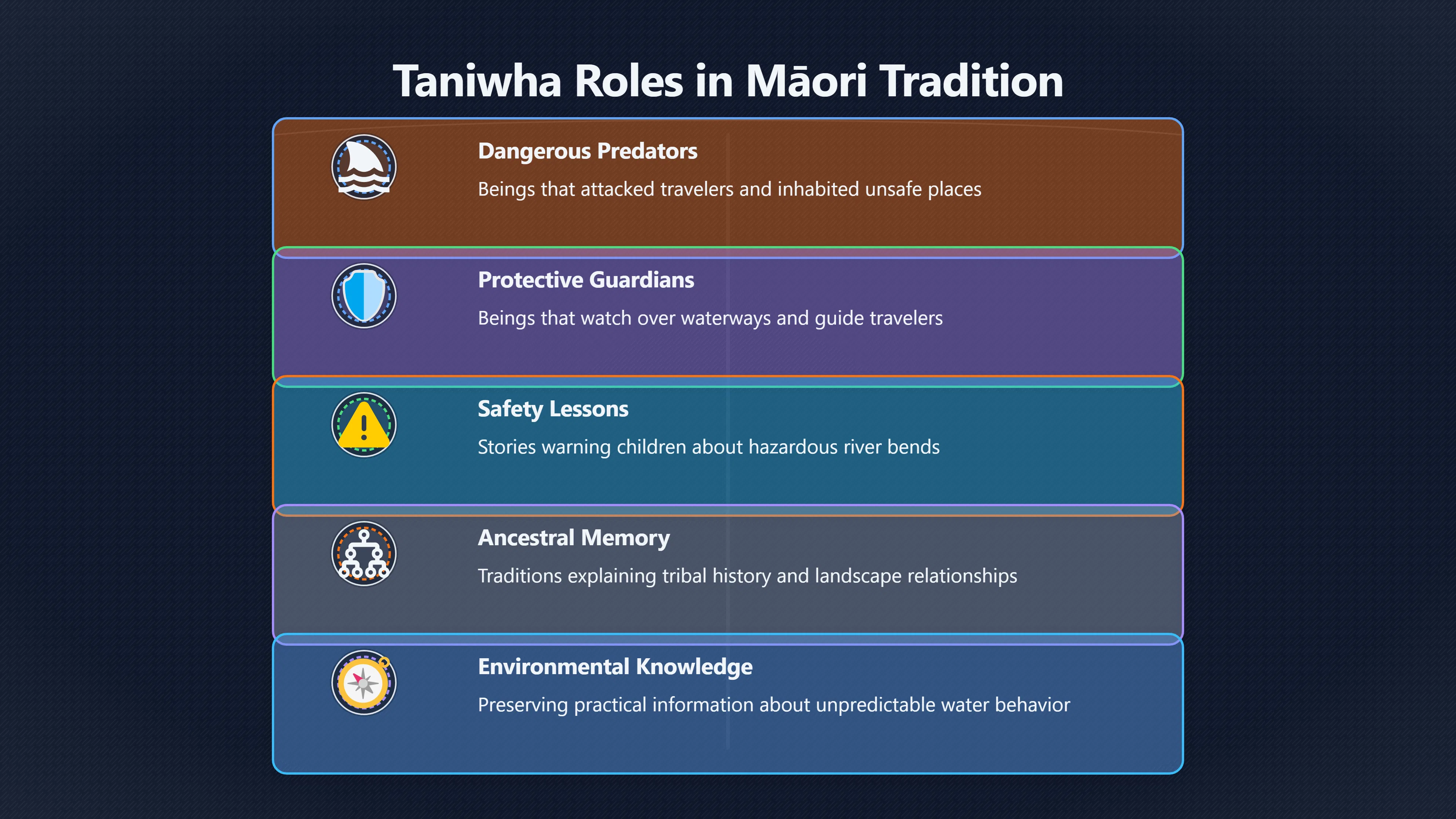
The answer depends on the story, the location and the community telling it. Māori traditions describe taniwha in many forms. They may resemble giant reptiles, sharks, whales, fish, eels or entirely supernatural beings. They are often associated with deep pools, river bends, caves, harbour entrances and stretches of dangerous sea.[Te Ara Encyclopedia of New Zealand]teara.govt.nzTe Ara Encyclopedia of New ZealandTaniwhaThey usually lived in or near the water – lakes, rivers or the sea. They hid in lairs known as r…
Some taniwha are remembered as predators. Traditional stories tell of beings that attacked travellers, captured people or inhabited places considered unsafe. In many narratives, heroes eventually confront and defeat these dangerous creatures.[Te Ara Encyclopedia of New Zealand]teara.govt.nzpage 1Te Ara Encyclopedia of New ZealandWhat are taniwha?22 Sept 2012 —… dangerous waterways – areas that people avoided. In some traditions…
At the same time, many taniwha act as guardians. Such beings protect tribes, watch over waterways, warn of danger and help guide travellers. Communities might acknowledge them through ritual observances and treat the places connected to them with special respect.[Te Ara Encyclopedia of New Zealand]teara.govt.nzTe Ara Encyclopedia of New ZealandStory: TaniwhaSep 22, 2012 — Taniwha are supernatural creatures in Māori tradition, similar to serpents…
This apparent contradiction is not unusual. A taniwha may be frightening precisely because it protects a place. Modern scholars have noted that stories warning children about a taniwha living at a particular river bend can function as practical safety lessons, discouraging swimming in hazardous water while also expressing a deeper cultural relationship with that location.[ResearchGate]researchgate.net365291940 Taking taniwha seriouslydangerous places to. swim – thus the taniwha is presented to the…Read more…
Why Waterways Matter So Much
Unlike many monster traditions centred on forests or mountains, taniwha stories are overwhelmingly linked to water. Rivers, springs, harbours and coastal passages are recurring settings because waterways have always been vital routes for travel, food gathering, settlement and tribal identity.[Te Ara Encyclopedia of New Zealand]teara.govt.nzTe Ara Encyclopedia of New ZealandTaniwhaThey usually lived in or near the water – lakes, rivers or the sea. They hid in lairs known as r…
Many taniwha are associated with places where water behaves in unpredictable ways:
- Deep pools that conceal hazards.[Wikipedia]WikipediaTaniwhaIn Māori mythology, taniwha are large supernatural beings that live in deep pools in rivers, dark caves, or in the sea, especially…
- Fast currents and whirlpools.
- Dangerous river bends.
- Harbour entrances with strong tides.
- Treacherous coastal channels and reefs.[govt.nz]teara.govt.nzTe Ara Encyclopedia of New ZealandTaniwhaThey usually lived in or near the water – lakes, rivers or the sea. They hid in lairs known as r…
Seen through this lens, taniwha traditions often preserve practical environmental knowledge. A place remembered as the lair of a taniwha is frequently a place where caution is required. The supernatural story and the physical landscape reinforce one another.[ResearchGate]researchgate.net365291940 Taking taniwha seriouslydangerous places to. swim – thus the taniwha is presented to the…Read more…
The traditions also connect waterways to ancestry. Rivers and springs are not simply resources but living parts of a community’s history. The taniwha linked to those places become guardians of both people and place.[Waikato River]waikatoriver.org.nzWaikato RiverA History of the Waikato River and Its Catchmentpast 700 to 800 years. A well-known saying about the Waikato River uses tani…
Famous Taniwha Places and Stories
Poutini and the West Coast
One of the best-known taniwha traditions concerns Poutini, a guardian associated with pounamu, or New Zealand greenstone. According to tradition, Poutini protected the precious stone and travelled along the South Island’s West Coast. The story helps explain the deep cultural importance of the region’s pounamu sources and connects landscape, travel and spiritual guardianship.[LINZ]linz.govt.nzOpen source on govt.nz.
Rather than describing an unidentified creature inhabiting a lake, the tradition links a supernatural being to the history and significance of a treasured resource. Poutini remains one of the clearest examples of a taniwha functioning as a guardian rather than a monster.[LINZ]linz.govt.nzOpen source on govt.nz.
Ngake and Whātaitai in Wellington
The Wellington Harbour tradition of Ngake and Whātaitai is another influential example. In these stories, powerful taniwha help explain the shape of the landscape itself. Their actions are linked to the formation of harbour features and nearby landforms, turning geography into a living story rather than a collection of physical facts.[Mātauranga Māori]eng.mataurangamaori.tki.org.nzOpen source on tki.org.nz.
For modern visitors, the harbour may look like a natural geological feature. Within the tradition, however, it is also a place marked by the actions of powerful beings whose presence remains woven into local identity.[Mātauranga Māori]eng.mataurangamaori.tki.org.nzOpen source on tki.org.nz.

The Waiapu River Guardians
The Waiapu River on the East Coast is associated with several taniwha believed to protect both the river and the communities living beside it. Accounts describe taniwha positioned at important locations within the river system, guarding people and territory.[Wikipedia]WikipediaWaiapu RiverWaiapu River
Stories connected with bridges, floods and drownings illustrate how these traditions remained relevant even after colonial-era development projects altered the landscape. The river is not remembered merely as a waterway but as a spiritually significant environment inhabited by powerful guardians.[Wikipedia]WikipediaWaiapu RiverWaiapu River
Te Waikoropupū Springs
The remarkable Te Waikoropupū Springs in Golden Bay are considered sacred and are associated with the female taniwha Huriawa. The springs are among the clearest examples of a water site where environmental importance and spiritual significance overlap. Local traditions describe Huriawa as a protector connected to the movement and clearing of waterways.[Wikipedia]WikipediaTe Waikoropupū SpringsTe Waikoropupū Springs
Here, the taniwha tradition serves not as a monster tale but as part of a broader understanding of why the springs deserve protection and respect.[Wikipedia]WikipediaTe Waikoropupū SpringsTe Waikoropupū Springs
When Taniwha Enter Modern Public Life
Taniwha are not confined to distant folklore. They continue to appear in discussions about land use, infrastructure and environmental management.
One of the most widely reported examples involved Karutahi, a taniwha associated with a site in the Waikato region. During planning for a highway project, concerns were raised that construction could affect the taniwha’s lair. The eventual rerouting of the road attracted national attention and sparked debate about how Māori cultural values should be considered in modern development decisions.[Te Ara Encyclopedia of New Zealand]teara.govt.nzOpen source on govt.nz.
To some observers, such cases appeared to involve belief in a literal monster. For many Māori participants, however, the issue was not zoology. It concerned the protection of culturally significant places, ancestral traditions and relationships with the landscape.[Te Ara Encyclopedia of New Zealand]teara.govt.nzOpen source on govt.nz.
These debates reveal that taniwha remain active cultural realities rather than relics of a vanished past.[ResearchGate]researchgate.net365291940 Taking taniwha seriouslydangerous places to. swim – thus the taniwha is presented to the…Read more…
Why Cryptid Labels Can Misrepresent Taniwha
From a cryptozoological perspective, it is tempting to classify taniwha alongside lake monsters or sea serpents. Both involve large creatures associated with water, and some descriptions sound superficially similar.[Te Ara Encyclopedia of New Zealand]teara.govt.nzTe Ara Encyclopedia of New ZealandStory: TaniwhaSep 22, 2012 — Taniwha are supernatural creatures in Māori tradition, similar to serpents…
The problem is that cryptid categories usually assume a hidden biological animal. Most taniwha traditions are not concerned with undiscovered species. They are concerned with guardianship, danger, ancestry, sacred places and the moral relationship between people and the environment.[ResearchGate]researchgate.net365291940 Taking taniwha seriouslydangerous places to. swim – thus the taniwha is presented to the…Read more…
A river taniwha may explain why a location is dangerous, why a place is revered, or why a community feels responsible for protecting a waterway. Those functions differ significantly from claims that a surviving prehistoric reptile or unknown aquatic animal inhabits a lake.[ResearchGate]researchgate.net365291940 Taking taniwha seriouslydangerous places to. swim – thus the taniwha is presented to the…Read more…
That does not mean taniwha are irrelevant to New Zealand’s monster traditions. Quite the opposite. They are arguably the country’s most important creature stories. The key is recognising that they occupy a different category from most cryptids. They are place-based supernatural beings embedded in living cultural traditions, not merely candidates for zoological investigation.[Te Ara Encyclopedia of New Zealand]teara.govt.nzTe Ara Encyclopedia of New ZealandStory: TaniwhaSep 22, 2012 — Taniwha are supernatural creatures in Māori tradition, similar to serpents…
The Lasting Role of Taniwha in New Zealand Folklore
Taniwha endure because they do several jobs at once. They explain dangerous waterways, embody tribal histories, mark sacred places, encode environmental knowledge and provide memorable stories about the landscape. In some traditions they are terrifying monsters. In others they are loyal protectors. Often they are both, depending on how people approach the places they guard.[Te Ara Encyclopedia of New Zealand]teara.govt.nzTe Ara Encyclopedia of New ZealandTaniwhaThey usually lived in or near the water – lakes, rivers or the sea. They hid in lairs known as r…
For readers interested in New Zealand’s creature lore, taniwha are therefore best understood not as a single monster species but as a rich network of traditions tied to rivers, springs, harbours and coasts across the country. Their continuing presence in stories, place names, environmental debates and cultural memory shows why they remain central to understanding New Zealand’s most distinctive water-linked folklore.[e-tangata.co.nz]e-tangata.co.nza taniwha in the citya taniwha in the city
Amazon book picks
Further Reading
Books and field guides related to Are Taniwha Monsters, Guardians or Both?. Use these as the next step if you want deeper reading beyond the article.
Maori Myths & Legendary Tales
Contains narratives that help explain taniwha as guardians and dangers.
Reed Book of Maori Mythology
Directly relevant to taniwha traditions and Māori cosmology.
Tikanga Maori
Provides cultural context often missing from cryptid-style interpretations.
Mythology
Rating: 2.5/5 from 14 Google Books ratings
Appeals to readers comparing legendary beings across cultures.
Endnotes
1.
Source: researchgate.net
Title: 365291940 Taking taniwha seriously
Link:https://www.researchgate.net/publication/365291940_Taking_taniwha_seriously
Source snippet
dangerous places to. swim – thus the taniwha is presented to the...Read more...
2.
Source: Wikipedia
Link:https://en.wikipedia.org/wiki/Taniwha
Source snippet
TaniwhaIn Māori mythology, taniwha are large supernatural beings that live in deep pools in rivers, dark caves, or in the sea, especially...
3.
Source: twinkl.com
Title: What is a Taniwha?
Link:https://www.twinkl.com/teaching-wiki/taniwha
Source snippet
Māori / New Zealand LegendsTaniwha are revered powerful creatures from traditional Māori stories. They live in deep pools, rivers, dark c...
4.
Source: Wikipedia
Link:https://en.wikipedia.org/wiki/Ruatoria
5.
Source: linz.govt.nz
Link:https://www.linz.govt.nz/our-work/new-zealand-geographic-board/place-name-stories/maori-oral-history-atlas/poutini-guardian-taniwha
6.
Source: Wikipedia
Title: Waiapu River
Link:https://en.wikipedia.org/wiki/Waiapu_River
7.
Source: Wikipedia
Title: Te Waikoropupū Springs
Link:https://en.wikipedia.org/wiki/Te_Waikoropup%C5%AB_Springs
8.
Source: teara.govt.nz
Link:https://teara.govt.nz/en/taniwha
Source snippet
Te Ara Encyclopedia of New ZealandStory: TaniwhaSep 22, 2012 — Taniwha are supernatural creatures in Māori tradition, similar to serpents...
9.
Source: teara.govt.nz
Link:https://teara.govt.nz/en/taniwha/print
Source snippet
Te Ara Encyclopedia of New ZealandTaniwhaThey usually lived in or near the water – lakes, rivers or the sea. They hid in lairs known as r...
10.
Source: teara.govt.nz
Title: page 1
Link:https://teara.govt.nz/en/taniwha/page-1
Source snippet
Te Ara Encyclopedia of New ZealandWhat are taniwha?22 Sept 2012 —... dangerous waterways – areas that people avoided. In some traditions...
11.
Source: waikatoriver.org.nz
Link:https://waikatoriver.org.nz/history/
Source snippet
Waikato RiverA History of the Waikato River and Its Catchmentpast 700 to 800 years. A well-known saying about the Waikato River uses tani...
12.
Source: eng.mataurangamaori.tki.org.nz
Link:https://eng.mataurangamaori.tki.org.nz/Support-materials/Te-Reo-Maori/Maori-Myths-Legends-and-Contemporary-Stories/Ngake-and-Whataitai-the-taniwha-of-Wellington-harbour
13.
Source: teara.govt.nz
Link:https://teara.govt.nz/en/video/10898/protecting-karutahis-lair
14.
Source: e-tangata.co.nz
Title: a taniwha in the city
Link:https://e-tangata.co.nz/reflections/a-taniwha-in-the-city/
15.
Source: scribd.com
Link:https://www.scribd.com/document/515856704/Taniwha
16.
Source: diveski.co.nz
Link:https://www.diveski.co.nz/blog/2025/02/14/taniwha/
17.
Source: garlandmag.com
Link:https://garlandmag.com/article/taniwha/
18.
Source: itsmth.fandom.com
Link:https://itsmth.fandom.com/wiki/Taniwha
19.
Source: beastsoflegend.com
Link:https://beastsoflegend.com/bestiary/oceania-2/taniwha/
Additional References
20.
Source: maoridictionary.co.nz
Title: Te Aka Māori Dictionarytaniwha
Link:https://maoridictionary.co.nz/search?keywords=taniwha
Source snippet
(noun) water spirit, monster, dangerous water creature, powerful creature, chief, powerful leader, something or someone awesome - taniwha...
21.
Source: youtube.com
Title: The Clash of the Auckland Taniwha (Sea Monsters)
Link:https://www.youtube.com/watch?v=BU3vAMMmC9s
Source snippet
Wellington Harbour's taniwha - Roadside Stories...
22.
Source: instagram.com
Link:https://www.instagram.com/p/DYW2svnTJJM/
23.
Source: facebook.com
Link:https://www.facebook.com/victoriaoltgalerii/videos/in-m%C4%81ori-mythology-a-taniwha-is-a-powerful-supernatural-being-often-described-as/766337676256700/
24.
Source: facebook.com
Link:https://www.facebook.com/groups/theaitribe/posts/3965881136957423/
25.
Source: te.com
Link:https://www.te.com/en/home.html
26.
Source: kikomoana.com
Link:https://www.kikomoana.com/
27.
Source: thetaniwha.co.nz
Link:https://www.thetaniwha.co.nz/
28.
Source: facebook.com
Link:https://www.facebook.com/groups/aotearoanzhistory/posts/1278263043996055/
29.
Source: youtube.com
Title: “The Legend of the Taniwha” – A Maori Legend
Link:https://www.youtube.com/watch?v=uLArT6gd9eg
Source snippet
Katharine's Creatures Episode 90: Taniwha...
Topic Tree