The Creatures Behind Peru's Monster Legends
Peru’s mystery-creature tradition is not built around one national monster. It is a meeting point of several different kinds of strange-animal story: enormous serpents in the Amazon, a seal-like beast once reported at Lake Titicaca, bear-human figures in the Andes, and fantastical monsters imported or distorted by colonial print culture.
Page outline Jump by section
Introduction
The evidence for unknown large animals is weak. There are old testimonies, recurring oral traditions and habitats where observation is genuinely difficult, but no verified bodies, diagnostic photographs, genetic samples or museum specimens establish a Peruvian cryptid as a new large species. Peru remains fascinating because its legends sit unusually close to real zoological wonders: anacondas, Andean bears, giant aquatic frogs and rare rainforest mammals all give the stories an ecological foothold without proving their supernatural or oversized claims.[bg.ac.rs]doi.fil.bg.ac.rsFolkloric Narratives of the Peruvian AmazoniaApril 11, 2022 — by DD Benavides — This is the Yacumama, protector of the waters of the Amazon, an over- whelming natural force that hunt…
The Yacumama: serpent, guardian or giant anaconda?
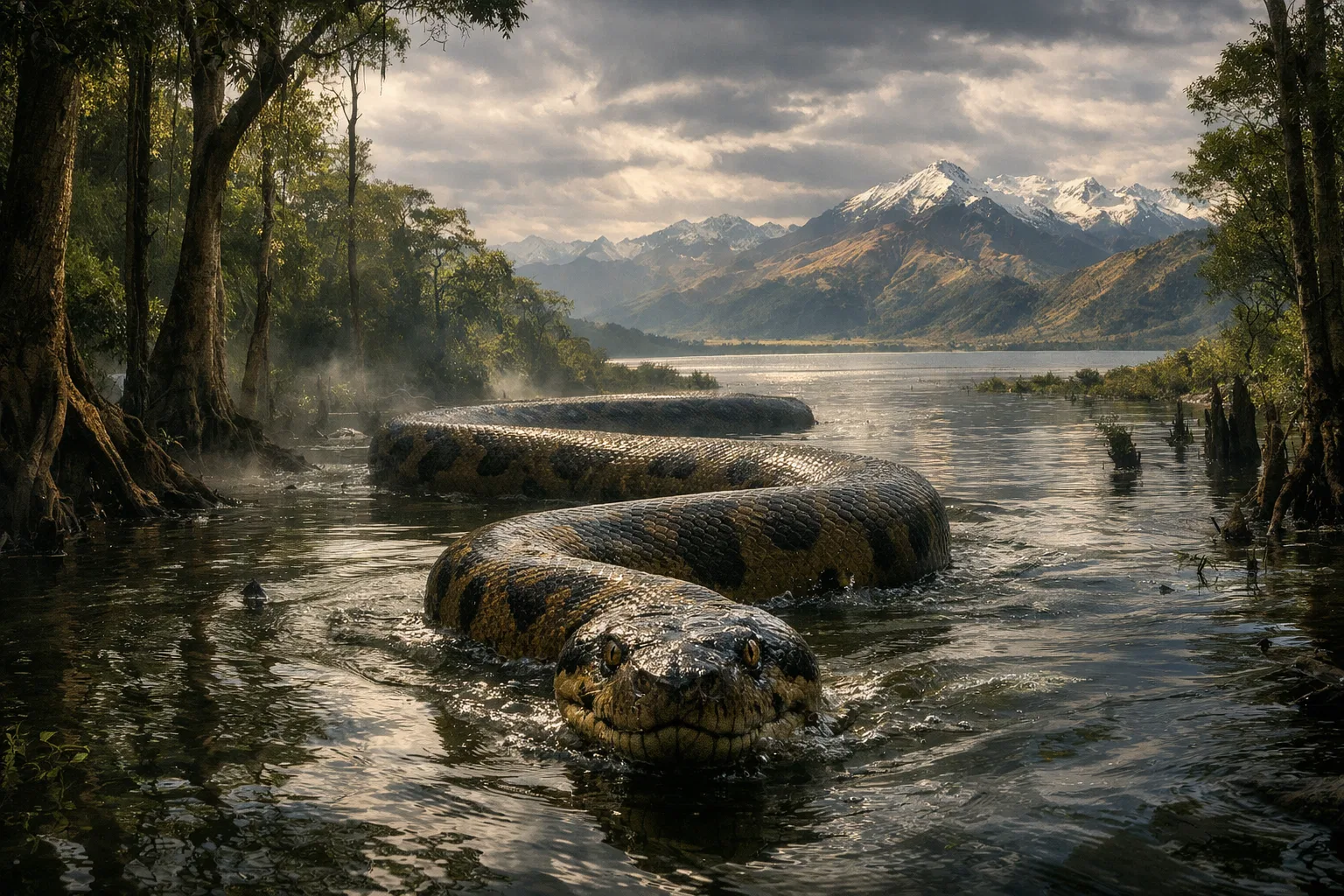
The Yacumama is the creature most strongly associated with Peru’s Amazonian monster lore. It is remembered as an immense aquatic serpent living in deep rivers, lagoons and flooded forest. Depending on the telling, it creates whirlpools, produces violent movements of water, draws nearby animals towards it or punishes people who exploit its domain. It is therefore more than a frightening snake: it personifies the danger, fertility and authority of the water itself.
Academic discussion of Peruvian Amazonian narratives identifies the Yacumama as a protector of the waters and an overwhelming natural force, not merely an unusually large reptile. A recent comparative study of snake mythology likewise describes the figure as a great anaconda associated with guardianship, creation and the source of life. These meanings matter because cryptozoological retellings frequently remove the spiritual and moral dimensions, leaving only the attention-grabbing question of whether a 30- or 50-metre snake might exist.[doi.fil.bg.ac.rs]doi.fil.bg.ac.rsFolkloric Narratives of the Peruvian AmazoniaApril 11, 2022 — by DD Benavides — This is the Yacumama, protector of the waters of the Amazon, an over- whelming natural force that hunt…
Real anacondas explain why the legend has such physical conviction. Green anacondas inhabit slow-moving waters and flooded tropical environments and rank among the world’s heaviest snakes. The Smithsonian’s National Zoo gives a possible upper length of about nine metres, although exceptionally large measurements are difficult to verify and popular accounts routinely exaggerate them. Even a five- or six-metre snake seen briefly in muddy water can appear considerably longer when its body is partly submerged, curved or hidden by vegetation.[National Zoo]nationalzoo.si.eduNational ZooGreen anacondaThey can reach lengths of 30 feet (9 meters), diameters of 12 inches (30.5 centimeters) and can weigh 550 pound…
That makes several explanations compatible rather than mutually exclusive:
- Folklore: the Yacumama is a culturally meaningful master of water, with powers no biological animal is expected to possess.
- Animal encounters: sightings of genuine anacondas, large boas, floating logs or several animals moving through vegetation may reinforce the story.
- Size inflation: fear, poor visibility and repeated retelling can turn a large snake into one of impossible proportions.
- Modern cryptid culture: television, websites and social media often present folkloric measurements as eyewitness zoology, even when no specimen or original report supports them.
No reliable physical evidence currently bridges the gap between the real anaconda and the colossal creature of legend. The sensible conclusion is not that every witness invented an encounter, but that the Yacumama belongs primarily to living folklore, with known snakes providing a believable shape for a much larger idea.

The Sachamama and the forest that moves
The Sachamama is commonly paired with the Yacumama but occupies the forest rather than open water. It is usually imagined as a vast, ancient serpent lying so still that plants, fungi and sometimes small trees grow across its back. A traveller may mistake it for a fallen trunk, ridge or patch of ground until the landscape begins to move.
Some Peruvian traditions connect the two serpent mothers within a wider cosmology: one is associated with water and the other with vegetation or the forest. In this framework they can change into features or forces of the world rather than behaving like ordinary animals. The Sachamama’s camouflage is therefore not just a hunting trick. It expresses the unsettling possibility that the apparently solid forest is alive, watchful and capable of swallowing an intruder.[Wikipedia]WikipediaMitología de la Amazonía del PerúMitología de la Amazonía del Perú
Cryptid catalogues sometimes convert the Sachamama into a precisely measured beast, complete with armour, unusual appendages and extreme dimensions. Such specifications should be treated cautiously. They often come from later summaries rather than documented biological encounters, and different versions disagree on basic anatomy. The stable core is simpler: an immense serpent or serpent-like forest mother, concealed beneath vegetation and almost indistinguishable from the land.
There are obvious natural prompts for the image. Huge fallen trees become covered in vines; exposed roots resemble coils; boas can remain motionless for long periods; and thick vegetation breaks an observer’s view into misleading fragments. None accounts for every symbolic feature, but they show how rainforest experience can sustain a creature that is both animal and landscape.
What was reported at Lake Titicaca?
Peru’s clearest historical “lake monster” case comes from Lake Titicaca, although the sightings described in the best-known source cluster mainly around locations now on the Bolivian side of the lake. In his 1910 book The Islands of Titicaca and Koati, archaeologist and ethnologist Adolph Bandelier recorded widespread belief in a large aquatic animal resembling either a seal or a sea cow. He did not see it himself.[Internet Archive]archive.orgInternet Archive Full text of "The islands of Titicaca and KoatiInternet Archive Full text of "The islands of Titicaca and Koati
Bandelier was told that animals seen near the Strait of Tiquina in May 1895 were about twelve feet long, with bear-like heads, moderate tufts of hair and smooth coffee-brown coats. Witnesses reportedly saw them resting on beaches before they entered the water. He also mentioned a tooth alleged to have come from one, but provided no demonstration that it belonged to an unknown lake mammal. A suggested alternative was an exceptionally large catfish, although the reported hair and shore-resting behaviour did not fit that explanation neatly.[Internet Archive]archive.orgInternet Archive Full text of "The islands of Titicaca and KoatiInternet Archive Full text of "The islands of Titicaca and Koati
This is stronger historical material than many internet lake-monster stories because it can be traced to a named author and a contemporary publication. It is still far from proof. Bandelier was collecting second-hand accounts, some relating to events roughly fifteen years earlier. There is no preserved skin, skeleton, photograph or reliably identified tooth, and the descriptions combine features of several animals.
Possible explanations include:
- A local mammal seen badly: an otter or other shoreline animal might acquire extraordinary proportions through distance and expectation.
- A known animal outside familiar context: large fish, water birds or livestock carcasses can produce brief, confusing profiles.
- Folklore attached to repeated ambiguous sightings: once a community expects an aquatic beast, unrelated observations may be interpreted as the same creature.
- An unsupported unknown-animal hypothesis: a breeding population of large aquatic mammals would require food, reproduction and a continuing physical presence, yet no confirmed remains have emerged.
Lake Titicaca does contain a genuinely extraordinary animal: the Titicaca water frog, the world’s largest fully aquatic frog. Its loose skin, underwater life and unusual proportions make it an excellent example of how strange the lake’s real fauna can be, but it cannot explain reports of a twelve-foot, furry, beach-resting animal.[zoo-berlin.de]zoo-berlin.deOpen source on zoo-berlin.de.
The Titicaca beast is therefore best classed as an unresolved historical report rather than an established modern sighting tradition. Its importance lies less in proving a hidden lake mammal than in showing how testimony, local belief and early ethnographic writing could combine into a durable cryptid case.
The Andean bear behind the “ape-man”
Stories of hairy, humanlike beings occur across the Andes under several related names and forms. Modern cryptid writers sometimes group them with Bigfoot or the Yeti, but in Peru the most relevant real animal is the Andean or spectacled bear. It is South America’s only living bear and has a prominent place in Andean stories, ceremonies and ideas about the boundary between human society and the wild.
The resemblance is not purely visual. A bear can stand upright, manipulate objects with its forelimbs and leave tracks whose overlapping impressions may look disturbingly human. Folklore also attributes human desires and social behaviour to bears, including tales of unions between bears and women. Research on the cultural history of the Andean bear describes a striking body of folklore built around precisely these human-animal similarities.[ResearchGate]researchgate.netMysterious Ucumari: The Andean Bear in Nature and CultureHuman associations with the spectacled bear give it a minor role in…
This does not mean every account is simply a misidentified bear. Some figures are ritual characters, moral beings or inhabitants of a sacred landscape rather than zoological claims. The bear-associated dancer seen in Andean pilgrimage traditions, for example, cannot be reduced to an alleged wild primate. The categories overlap, but they are not identical.
Where a report concerns a large, dark, hairy animal walking briefly on two legs in cloud forest or steep mountain terrain, the spectacled bear is a strong practical explanation. Its rarity may actually increase its power to generate unusual reports: people can live within its wider range without often seeing one clearly. Habitat loss, persecution and fragmented populations also make encounters sporadic and memorable.[wildlifefund.nl]wildlifefund.nlOpen source on wildlifefund.nl.
Claims of a separate Peruvian ape-like species would need much better evidence. South America has no known native apes, while bears already provide the size, upright posture and established cultural associations found in many stories.
The monster that was never really Peruvian
One of the strangest creatures repeatedly listed as a “Peruvian cryptid” is the eighteenth-century Monster of Lake Fagua. Prints depicted a spectacular hybrid with a human-like face, horns, large ears, claws, bat wings, a scaled body and two tails. Text accompanying the image claimed that the monster had been captured near a lake in territory described through confused colonial geography as Chile, Peru or the Kingdom of Santa Fe.
The creature is valuable to Peru’s monster history precisely because it was almost certainly not an animal report. Research into the print’s circulation places it within the eighteenth-century Atlantic trade in sensational images, political allegory and recycled monster anatomy. Surviving versions changed names and locations as publishers copied one another, while the beast itself drew on a long European tradition of composite monsters.[JHI Blog]jhiblog.orgOpen source on jhiblog.org.
Its shifting location is a warning against reading old monster broadsides as straightforward field reports. “Peru” could function in European popular print as a distant colonial setting rather than a precise geographical claim. Exotic distance made the impossible creature easier to sell.
The Lake Fagua image belongs to media history, satire and propaganda, not to evidence for an unknown Peruvian species. Yet it anticipates a very modern process: a striking picture is separated from its original context, copied repeatedly, assigned a cleaner backstory and eventually presented online as a forgotten cryptid.
Why Peru produces convincing monster stories
Peru contains unusually varied environments within one country: Pacific waters, coastal desert, high Andean lakes, cloud forest and vast Amazonian river systems. These landscapes do not prove hidden monsters, but they create excellent conditions for mystery. Water hides scale, rainforest vegetation restricts visibility, steep terrain makes pursuit difficult and many animals are active at night.
The country’s biodiversity also discourages an overly dismissive response. Scientific expeditions continue to document species that are new to formal science, including small mammals, fish, amphibians and invertebrates. A major survey in north-western Peru reported dozens of candidate new species and relied partly on the knowledge of Indigenous participants who already recognised animals unfamiliar to outside researchers. Such discoveries demonstrate that zoological knowledge is incomplete, especially for small or highly localised species. They do not make a breeding population of gigantic serpents or lake mammals automatically plausible.[The Guardian]theguardian.comThe expedition revealed four new mammals, a spiny mouse, a short-tailed fruit bat, a dwarf squirrel, and the rare amphibious mouse, found…
Large unknown animals face a higher evidential threshold than small frogs, rodents or insects. They require substantial food, leave tracks and remains, reproduce over generations and are increasingly likely to be detected by cameras, environmental DNA surveys, fisheries or local land use. The bigger and more numerous a claimed animal must be, the harder it is to explain the continuing absence of physical evidence.
Peru’s strongest mystery-beast traditions survive because they work on more than one level. The Yacumama expresses the power and ownership of water. The Sachamama makes the forest itself animate. Bear-human stories explore the border between civilisation and wilderness. The Titicaca animal preserves a cluster of intriguing but unverified testimonies. The Lake Fagua monster shows how publishers can manufacture a creature and attach it to a distant country.
Folklore, sightings and zoology
The most useful way to understand Peru’s creatures is to keep four categories separate, even when a single story crosses between them.
Folkloric beings are parts of a cultural system. Their transformations, supernatural powers and relationships with people may be more important than their anatomy.
Witness claims describe something a person believes they saw. They deserve accurate recording, but sincerity does not guarantee correct identification or scale.
Media monsters are created or radically reshaped through newspapers, prints, television and online repetition. Their apparent detail may increase even as their connection to an original event weakens.
Plausible animal explanations begin with species already present in the habitat: anacondas in Amazonian water, Andean bears in mountain forests, large fish beneath an opaque lake surface or ordinary carcasses transformed by decomposition.
On that basis, Peru has a rich and distinctive monster tradition but no securely verified giant cryptid. Its stories are most rewarding when neither extreme is imposed on them: they need not be treated as zoological fact, and they should not be dismissed as meaningless superstition. They preserve encounters with dangerous landscapes, real animals, inherited cosmologies and the powerful human habit of turning a glimpse into a creature.

Amazon book picks
Further Reading
Books and field guides related to What Really Lurks Behind Peru's Monster Legends?. Use these as the next step if you want deeper reading beyond the article.
Field Guide To Bigfoot, Yeti, & Other Mystery Primates Worldwide
Covers global cryptid traditions and provides context for Peruvian monster claims.
Abominable Science!
Matches the article's evidence-based examination of monster legends.
Shamanism: archaic techniques of ecstasy, tr
Helps explain spiritual and mythic interpretations of animal beings.
eBay marketplace picks
Marketplace Samples
Live-tested eBay searches with available results related to this page.



Endnotes
1.
Source: doi.fil.bg.ac.rs
Title: Folkloric Narratives of the Peruvian Amazonia
Link:https://doi.fil.bg.ac.rs/pdf/journals/folk/2021-2/folk-2021-6-2-5.pdf
Source snippet
April 11, 2022 — by DD Benavides — This is the Yacumama, protector of the waters of the Amazon, an over- whelming natural force that hunt...
Published: April 11, 2022
2.
Source: researchgate.net
Link:https://www.researchgate.net/publication/301253862_Mysterious_Ucumari_The_Andean_Bear_in_Nature_and_Culture
Source snippet
Mysterious Ucumari: The Andean Bear in Nature and CultureHuman associations with the spectacled bear give it a minor role in...
3.
Source: Wikipedia
Title: Green anaconda
Link:https://en.wikipedia.org/wiki/Green_anaconda
4.
Source: Wikipedia
Title: Mitología de la Amazonía del Perú
Link:https://es.wikipedia.org/wiki/Mitolog%C3%ADa_de_la_Amazon%C3%ADa_del_Per%C3%BA
5.
Source: archive.org
Title: Internet Archive Full text of “The islands of Titicaca and Koati”
Link:https://archive.org/stream/b24853562/b24853562_djvu.txt
6.
Source: zoo-berlin.de
Link:https://www.zoo-berlin.de/en/species-conservation/worldwide/titicaca-water-frog
7.
Source: researchgate.net
Link:https://www.researchgate.net/publication/238400109_A_god_forsaken_The_sacred_bear_in_Andean_iconography_and_cosmology
8.
Source: wildlifefund.nl
Link:https://wildlifefund.nl/en/project/spectacled-bears-peru/
9.
Source: Wikipedia
Title: Spectacled bear
Link:https://en.wikipedia.org/wiki/Spectacled_bear
10.
Source: archive.org
Link:https://www.archive.org/stream/islandstiticaca00bandgoog/islandstiticaca00bandgoog_djvu.txt
11.
Source: archive.org
Link:https://archive.org/download/southamericaobse01bryc/southamericaobse01bryc.pdf
12.
Source: ia601207.us.archive.org
Link:https://ia601207.us.archive.org/3/items/incasofperu00mark/incasofperu00mark.pdf
13.
Source: archive.org
Link:https://archive.org/stream/fishesofwesterns00eige/fishesofwesterns00eige_djvu.txt
14.
Source: archive.org
Link:https://archive.org/download/antiquitiesof00savi/antiquitiesof00savi.pdf
15.
Source: dn790001.ca.archive.org
Link:https://dn790001.ca.archive.org/0/items/relationofdiscov00pizauoft/relationofdiscov00pizauoft.pdf
16.
Source: archive.org
Link:https://archive.org/stream/Cryptozoology_201608/Cryptozoology_djvu.txt
17.
Source: archive.org
Link:https://archive.org/download/perulandofcontra00bing/perulandofcontra00bing.pdf
18.
Source: archive.org
Link:https://archive.org/download/incasofperu00markiala/incasofperu00markiala.pdf
19.
Source: Wikipedia
Link:https://en.wikipedia.org/wiki/Yacumama
20.
Source: Wikipedia
Title: Monster of Lake Fagua
Link:https://en.wikipedia.org/wiki/Monster_of_Lake_Fagua
21.
Source: researchgate.net
Link:https://www.researchgate.net/publication/390353635_Mythology_and_Zoosemiotics_Exploring_Snake_Narratives_in_Greek_Aztec_and_Amazonian_Cultures
22.
Source: nationalzoo.si.edu
Link:https://nationalzoo.si.edu/animals/green-anaconda
Source snippet
National ZooGreen anacondaThey can reach lengths of 30 feet (9 meters), diameters of 12 inches (30.5 centimeters) and can weigh 550 pound...
23.
Source: theguardian.com
Link:https://www.theguardian.com/environment/2024/dec/20/blob-headed-fish-and-amphibious-mouse-among-27-new-species-found-in-thrilling-peru-expedition
Source snippet
The expedition revealed four new mammals, a spiny mouse, a short-tailed fruit bat, a dwarf squirrel, and the rare amphibious mouse, found...
24.
Source: abookofcreatures.com
Link:https://abookofcreatures.com/2017/03/20/sachamama/
Source snippet
A Book of CreaturesSachamama20 Mar 2017 — Sachamama, “Mother of the Forest”, is one of the three ancient snake mothers of the Peruvian Am...
25.
Source: jhiblog.org
Link:https://www.jhiblog.org/2023/08/14/the-monster-of-the-lagoon-on-the-circulation-of-images-and-ideas-in-the-eighteenth-century-atlantic-world/
26.
Source: cryptidz.fandom.com
Link:https://cryptidz.fandom.com/wiki/Yacumama
27.
Source: cryptidz.fandom.com
Link:https://cryptidz.fandom.com/wiki/Sachamama
28.
Source: cryptidz.fandom.com
Title: Monster of Lake Fagua
Link:https://cryptidz.fandom.com/wiki/Monster_of_Lake_Fagua
29.
Source: itsmth.fandom.com
Title: Monster of Lake Fagua
Link:https://itsmth.fandom.com/wiki/Monster_of_Lake_Fagua
30.
Source: nationalzoo.com.au
Link:https://www.nationalzoo.com.au/green-anaconda
31.
Source: kids.nationalgeographic.com
Link:https://kids.nationalgeographic.com/animals/reptiles/facts/anaconda
32.
Source: monstropedia.org
Link:https://www.monstropedia.org/index.php/Yacumama
Additional References
33.
Source: youtube.com
Title: Yacumama: The Legend That Breathes Below! | Expedition X S3 E11
Link:https://www.youtube.com/watch?v=r0kDLMX2l-0
Source snippet
THE PISHTACO, ONE OF THE BIGGEST KILLERS | Draw My Life...
34.
Source: youtube.com
Title: NEW CRYPTID Coming to PERU?! EW Won’t Confirm Nor Deny
Link:https://www.youtube.com/watch?v=DmKUuxfqMlM
Source snippet
Yacumama: The Legend That Breathes Below! | Expedition X S3 E11...
35.
Source: facebook.com
Link:https://www.facebook.com/TheFolklorePodcast/posts/today-january-8th-in-1923-a-newspaper-headline-in-the-cordova-daily-times-declar/1370280215112895/
36.
Source: reddit.com
Link:https://www.reddit.com/r/Cryptozoology/comments/1nvld5b/are_there_cryptid_from_andes_mountains_beside/
37.
Source: citizen-conservation.org
Link:https://citizen-conservation.org/wp-content/uploads/2024/08/CC-Breeding-Guidelines_Telmatobius-culeus_07-2024.pdf
38.
Source: reddit.com
Link:https://www.reddit.com/r/Cryptozoology/comments/1ip5kia/do_you_guys_consider_the_yacumama_giant_anaconda/
39.
Source: facebook.com
Link:https://www.facebook.com/AnimalPlanet/posts/forrest-galante-travels-to-peru-this-week-to-investigate-mysterious-sightings-mi/10159146688848375/
40.
Source: scribd.com
Link:https://www.scribd.com/document/824177073/Monica-Juneja-Imaging-the-Revolution
41.
Source: activerain.com
Link:https://activerain.com/blogsview/3341132/green-anaconda-at-the-national-zoo-in-washington–dc
42.
Source: facebook.com
Link:https://www.facebook.com/groups/1002571683091379/posts/9649807441701050/
Topic Tree
Follow this branch
Related pages 192
- Antigua Cryptids
- Maldives Monsters
- Malta Monsters
- Qatar Monsters
- Argentina Monsters
- +187 more in sidebar