Indonesia's Strange Beasts Between Folklore and Evidence
Indonesia’s mystery-creature tradition is not one neat monster story. It is a scattered archipelago of forest people, giant lizards, flying shapes, dragon-serpents, guardian beasts and local reports shaped by rainforest, volcanoes, islands and oral tradition.
Page outline Jump by section
Introduction
That combination makes Indonesia unusually interesting. It is a place where folklore, real biodiversity, colonial-era collecting, conservation tourism and modern cryptozoology overlap. The useful question is not “which monsters are real?” but “what kind of claim is being made, where did it come from, and what would count as good evidence?”
Where Indonesia’s mystery beasts cluster
Indonesia’s strongest monster traditions are tied to specific landscapes rather than to the whole nation equally. Sumatra supplies the classic hidden-primate story, especially around Kerinci and the forests of the Bukit Barisan range. Flores supplies the most famous “little people” debate because genuine fossil hominins were found there. Java and Seram supply the winged-creature stories, while Bali, Java and Sumatra carry older religious and folkloric beings such as dragon-serpents, protective animal spirits and hybrid guardians.[aseanbiodiversity.org]aseanbiodiversity.orgASEAN Centre for Biodiversity Kerinci-Seblat National ParkASEAN Centre for Biodiversity Kerinci-Seblat National Park
The geography matters. Kerinci-Seblat National Park is one of Southeast Asia’s largest conservation areas, with lowland, hill, montane and sub-alpine forest, mountain lakes and a long list of rare wildlife including tiger, elephant, tapir, sun bear, gibbons and macaques. That is exactly the sort of habitat where a fleeting view of a real animal can become a strange report, but also exactly the sort of place that keeps “could something still be hidden?” stories alive.[ASEAN Centre for Biodiversity]aseanbiodiversity.orgASEAN Centre for Biodiversity Kerinci-Seblat National ParkASEAN Centre for Biodiversity Kerinci-Seblat National Park
Orang Pendek: Sumatra’s small upright forest figure
The Orang Pendek is Indonesia’s headline cryptid. Reports usually describe a short, powerfully built, hairy, upright-walking creature in Sumatra’s forests, especially in and around Kerinci. The name is commonly translated as “short person”, but the tradition is not a single fixed zoological description. Some accounts sound like a small ape; others lean towards a wild forest human; still others include folkloric details that make the creature less like an animal and more like a being of story.[The Guardian]theguardian.comThe Guardian On the trail of the orang pendek, Sumatra's mystery apeThe Guardian On the trail of the orang pendek, Sumatra's mystery ape
The modern Western version of the case was shaped by colonial and traveller reports from the early twentieth century. One often-repeated 1927 account describes a Dutch plantation worker, A. H. W. Cramer, claiming to have seen a long-haired, dark-skinned creature at close range near Kerinci, after which it allegedly left small human-like footprints. Later expeditions and popular cryptozoology books kept the story alive, and twenty-first-century searches have added claims of footprints, hair samples and eyewitness interviews, but not a specimen, clear video or published evidence strong enough to establish a new species.[The Guardian]theguardian.comThe Guardian On the trail of the orang pendek, Sumatra's mystery apeThe Guardian On the trail of the orang pendek, Sumatra's mystery ape
The strongest reason readers stay interested is that Sumatra is not an empty stage. It has real primates, bears, dense forest, steep terrain and remote areas where animal observation is difficult. The weakest part of the case is the evidential gap: after many decades of claims, the available material still consists mainly of testimony, ambiguous tracks, disputed hairs and second-hand summaries. That does not make every witness dishonest. It does mean the Orang Pendek remains a claim, not a confirmed animal.
Several ordinary explanations remain plausible:
- Sun bears and other mammals: the Malayan sun bear occurs in Sumatra and can look surprisingly human when briefly upright, especially in poor visibility or at an odd angle.[kniu.kemendikdasmen.go.id]kniu.kemendikdasmen.go.idOpen source on go.id.
- Known primates: siamangs, gibbons, macaques and orangutans are part of Sumatra’s wider wildlife context, even though individual Orang Pendek reports often stress features that witnesses say do not match them.[ASEAN Centre for Biodiversity]aseanbiodiversity.orgASEAN Centre for Biodiversity Kerinci-Seblat National ParkASEAN Centre for Biodiversity Kerinci-Seblat National Park
- Folklore plus real encounters: a person who already knows a forest-being tradition may interpret a sudden animal sighting through that local vocabulary.
- Cryptozoology amplification: once a creature becomes known internationally, later sightings are often retold through the more standardised “mystery ape” version.
The result is a good case study in evidence-aware cryptid reading. Orang Pendek is not just a throwaway monster. It sits in a real forest, has a long reporting tradition and belongs to local knowledge as well as outsider fascination. But without diagnostic remains, verified DNA, unambiguous footage or repeatable field evidence, it should be treated as an unresolved folklore-and-sighting complex rather than a discovered primate.
Ebu Gogo and the “hobbit” problem on Flores
Flores changed global interest in Indonesian wild-person stories because archaeologists found Homo floresiensis there: a small extinct human relative popularly nicknamed the “hobbit”. Smithsonian’s Human Origins programme describes Homo floresiensis remains as known only from Flores, with fossils dating roughly between 100,000 and 60,000 years ago and associated stone tools extending to about 50,000 years ago. The estimated height of the best-known female skeleton is about 106 cm.[Human Origins]humanorigins.si.eduOpen source on si.edu.
This discovery gave new life to stories of small hairy beings from Flores, especially the Ebu Gogo. Popular accounts describe Ebu Gogo as small forest people in the folklore of the Nage people, sometimes said to mumble, eat crops and behave in ways that are half-human and half-monstrous. Anthropologist Gregory Forth argued that such traditions deserved more serious attention as possible memories of unusual hominins, and the idea quickly became irresistible to media because it connected folklore with a real fossil surprise.[Aeon]aeon.coInvestigating Homo floresiensis and the myth of the ebu gogo | Aeon IdeasInvestigating Homo floresiensis and the myth of the ebu gogo | Aeon Ideas
The connection is fascinating but fragile. One major problem is geography and culture: the Ebu Gogo tradition is associated with the Nage, while the Liang Bua cave finds come from a different part of Flores associated with different communities. Another problem is chronology. Early excitement included the possibility that Homo floresiensis survived much later, but revised dating moved the youngest known fossils and tools back to around 50,000 years ago, making direct memory much harder to defend.[Aeon]aeon.coInvestigating Homo floresiensis and the myth of the ebu gogo | Aeon IdeasInvestigating Homo floresiensis and the myth of the ebu gogo | Aeon Ideas
For a cryptid page, the key distinction is simple: Homo floresiensis is real palaeoanthropology; Ebu Gogo is folklore; the proposed bridge between them is speculative. That does not make the folklore worthless. It shows how quickly a scientific discovery can transform the meaning of an older story. Before 2004, Ebu Gogo could be read as a local wild-person tale. After the “hobbit” discovery, it became part of a global argument about oral memory, extinction and the possibility of unknown human relatives. The story changed because the evidence around it changed, not because the creature itself was found.
Ahool and Orang Bati: winged creatures in the night forest
Indonesia’s winged cryptids are more fragile as evidence than Orang Pendek, but they are vivid enough to persist in monster catalogues. The Ahool is usually placed in Java, especially mountain rainforest in the west of the island, and is described as a large bat-like or bird-like creature named after its supposed cry. Some versions inflate it into a flying ape or even a pterosaur-like survivor, but those are later cryptozoological embellishments rather than confirmed natural-history claims.[fandom.com]cryptidarchives.fandom.comOpen source on fandom.com.
The sensible explanation starts with sound and silhouette. A loud nocturnal bird, a large fruit bat, an owl call, a startled observer and dense forest can create a memorable encounter without requiring an unknown giant animal. Specialist summaries of the Ahool tradition often note that the source chain is thin and that much of the modern account derives from cryptozoological retelling rather than a broad archive of independent local documentation.[fandom.com]cryptidarchives.fandom.comOpen source on fandom.com.
The Orang Bati, usually linked with Seram in Maluku, is even more folkloric in modern English sources: a winged human or ape-like being, sometimes said to menace children. That kind of detail is a warning sign for literal zoology, because child-stealing monsters are a common folkloric pattern across cultures. Still, the tale fits Indonesia’s wider monster ecology: islands, forested mountains, night sounds and real large flying animals provide the raw material for a creature that feels locally grounded even when the evidence is not zoological.[fandom.com]cryptidz.fandom.comCryptid Wiki Orang Bati | Cryptid WikiCryptid Wiki Orang Bati | Cryptid Wiki
The Komodo dragon: when “dragon” reports became zoology
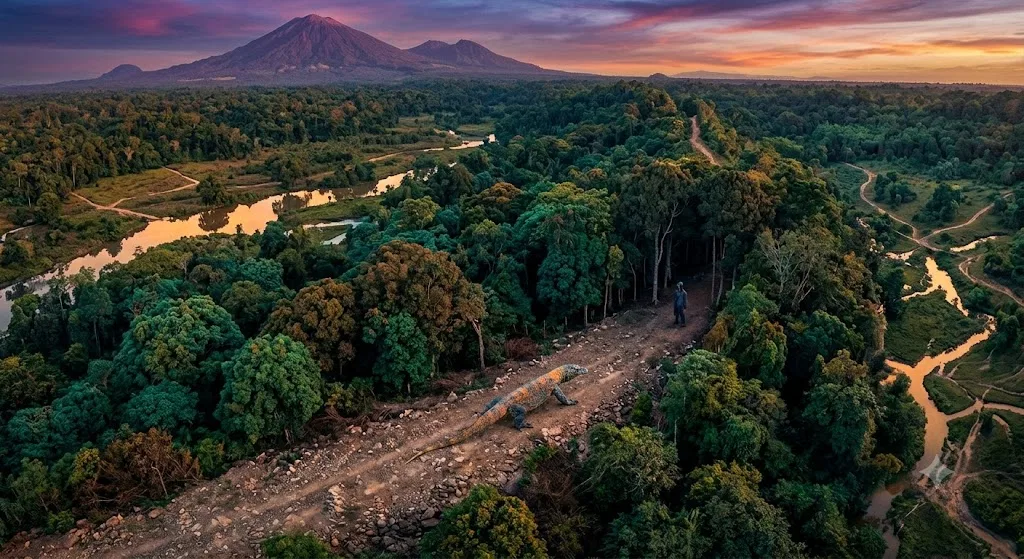
The Komodo dragon is not a cryptid today. It is a recognised species, Varanus komodoensis, and one of Indonesia’s most famous animals. But it belongs in any careful discussion of Indonesian mystery beasts because its entry into Western science resembles the first act of a cryptid story: rumours of a huge “land crocodile” reached Dutch colonial officials in the early twentieth century, specimens followed, and Peter Ouwens formally described the species in 1912.[The Guardian]theguardian.comhere be dragons the million year journey of the komodo dragonhere be dragons the million year journey of the komodo dragon
This is not a simple “monsters are real” lesson. Local people already knew the animal; Western science was late to document it. The better lesson is about method. The Komodo dragon moved from report to recognised species because physical specimens, skins, photographs, captive animals and scientific description followed the stories. That is exactly what has not happened for Orang Pendek, Ahool or similar Indonesian claims.[The Guardian]theguardian.comhere be dragons the million year journey of the komodo dragonhere be dragons the million year journey of the komodo dragon
The Komodo dragon also shows how real animals can keep mythic force after confirmation. It is the world’s largest living lizard, has a restricted Indonesian range, draws conservation tourism and remains culturally “dragon-like” even though it no longer belongs to mystery zoology. The Smithsonian notes both the conservation pressure created by its limited range and the tourism incentive around Indonesian sites where the animals still live.[National Zoo]nationalzoo.si.eduOpen source on si.edu.
Folklore creatures are not failed cryptids
Not every Indonesian monster should be squeezed into a hidden-animal frame. Naga, Garuda, Barong and other animal-shaped beings belong primarily to religion, performance, art and folklore. They matter for this country-level cryptid history because they show how animal forms carry meaning: serpents can be cosmic or watery powers, birds can be royal or divine, and guardian beasts can protect a village or appear in dance. But these are not normally claims that an unknown biological species is hiding in the forest.[Wikipedia]WikipediaBarong (mythologyBarong (mythology
That distinction improves the whole subject. A dragon-serpent in a creation story, a masked guardian in Balinese performance and a witness report of an unknown biped in Kerinci are different kinds of evidence. Treating them all as “cryptids” flattens local culture and makes the animal question muddier. Indonesia’s mystery-creature tradition is strongest when folklore is allowed to be folklore and sightings are assessed as sightings.
Why Indonesia is fertile ground for monster reports
Indonesia has the ingredients that make mystery-animal traditions durable. It is a vast island country with enormous biodiversity, difficult terrain, dense forests, active volcanoes, deep seas and hundreds of local languages and oral traditions. The Tropical Rainforest Heritage of Sumatra alone includes three national parks, around 10,000 plant species, 201 mammal species and roughly 580 bird species, including many endemics and threatened animals.[kniu.kemendikdasmen.go.id]kniu.kemendikdasmen.go.idOpen source on go.id.
Those conditions do two things at once. They make it plausible that ordinary observers sometimes see unfamiliar animals poorly, especially at dawn, dusk or in thick vegetation. They also make it tempting to imagine that something wholly unknown could remain out of sight. The evidence-aware position sits between those extremes: Indonesia’s ecosystems are genuinely rich and sometimes surprising, but modern zoology requires more than a good story.
The country’s cryptid afterlives also reflect tourism and media. Komodo dragons became conservation icons. Orang Pendek became a draw for documentaries and expedition narratives. Homo floresiensis turned Flores folklore into international speculation. Ahool and Orang Bati live mostly through cryptid lists, podcasts, fan art and monster videos. Each stage changes the creature: a local account becomes a national curiosity, then an international “case”, then a pop-culture image.
How to read Indonesian cryptid claims
The most useful way to approach Indonesia’s creature traditions is to sort each case by evidence type.
Folklore-first beings include many dragons, guardian animals and spirit-beasts. Their value lies in story, ritual, place and symbolism, not in proving a new species.
Witness-claim creatures include Orang Pendek and some winged-beast reports. These deserve careful handling because they may involve real observations, but their evidence remains testimonial unless supported by reliable physical material.
Science-adjacent legends include Ebu Gogo after the Homo floresiensis discovery. The fossil species is real; the claim that folklore preserves a memory of it is debated and currently weak.
Former mystery animals include the Komodo dragon in its Western scientific history. It shows that dramatic local animal reports can sometimes lead to real zoological discovery, but only when specimens and repeatable evidence arrive.
That framework keeps the wonder without losing proportion. Indonesia’s strange-creature map is not a catalogue of proven monsters. It is a layered record of forests, islands, animals, fossils, oral traditions, colonial encounters and modern media — with a few stories still strange enough to make readers look twice at the treeline.

Amazon book picks
Further Reading
Books and field guides related to Indonesia's Strange Beasts Between Folklore and Evidence. Use these as the next step if you want deeper reading beyond the article.
The Malay Archipelago
Foundational observations on Indonesian wildlife, geography and exploration.
In the Realm of the Diamond Queen
Provides cultural context for Indonesian oral traditions and local knowledge.
Cryptozoology A to Z
Covers many famous global mystery-animal traditions including lesser-known cases.
eBay marketplace picks
Marketplace Samples
Live-tested eBay searches with available results related to this page.


Endnotes
1.
Source: aeon.co
Title: Investigating Homo floresiensis and the myth of the ebu gogo | Aeon Ideas
Link:https://aeon.co/ideas/investigating-homo-floresiensis-and-the-myth-of-the-ebu-gogo
2.
Source: kniu.kemendikdasmen.go.id
Link:https://kniu.kemendikdasmen.go.id/penghargaan/world-heritage/tropical-rainforest-heritage-of-sumatra
3.
Source: cryptidarchives.fandom.com
Link:https://cryptidarchives.fandom.com/wiki/Ahool
4.
Source: Wikipedia
Title: Orang Pendek
Link:https://en.wikipedia.org/wiki/Orang_Pendek
5.
Source: cryptidz.fandom.com
Title: Cryptid Wiki Orang Bati | Cryptid Wiki
Link:https://cryptidz.fandom.com/wiki/Orang_Bati
6.
Source: seasia.co
Title: unknown creature indonesia s winged man
Link:https://seasia.co/2018/05/06/unknown-creature-indonesia-s-winged-man
7.
Source: Wikipedia
Title: Bati people
Link:https://en.wikipedia.org/wiki/Bati_people
8.
Source: Wikipedia
Title: Komodo dragon
Link:https://en.wikipedia.org/wiki/Komodo_dragon
9.
Source: Wikipedia
Title: Barong (mythology)
Link:https://en.wikipedia.org/wiki/Barong_%28mythology%29
10.
Source: Wikipedia
Link:https://en.wikipedia.org/wiki/Garuda
11.
Source: Wikipedia
Title: Mythology of Indonesia
Link:https://en.wikipedia.org/wiki/Mythology_of_Indonesia
12.
Source: cryptidz.fandom.com
Title: Monsters of Indonesia
Link:https://cryptidz.fandom.com/wiki/Monsters_of_Indonesia
13.
Source: cryptidz.fandom.com
Title: Ebu Gogo
Link:https://cryptidz.fandom.com/wiki/Ebu_Gogo
14.
Source: cryptidz.fandom.com
Title: Ine Weu and Poti Wolo
Link:https://cryptidz.fandom.com/wiki/Ine_Weu_and_Poti_Wolo
15.
Source: cryptidz.fandom.com
Title: Orang Pendek
Link:https://cryptidz.fandom.com/wiki/Orang_Pendek
16.
Source: cryptidz.fandom.com
Link:https://cryptidz.fandom.com/wiki/Ahool
17.
Source: cryptidz.fandom.com
Link:https://cryptidz.fandom.com/wiki/Siwil
18.
Source: cryptidz.fandom.com
Title: Orang Gadang
Link:https://cryptidz.fandom.com/wiki/Orang_Gadang
19.
Source: cryptidz.fandom.com
Link:https://cryptidz.fandom.com/wiki/Category%3AIndonesia
20.
Source: cryptidz.fandom.com
Title: List of Cryptids
Link:https://cryptidz.fandom.com/wiki/List_of_Cryptids
21.
Source: cryptidz.fandom.com
Title: Category:Southeast Asia
Link:https://cryptidz.fandom.com/wiki/Category%3ASoutheast_Asia
22.
Source: cryptozoology.fandom.com
Title: Orang Pendek
Link:https://cryptozoology.fandom.com/wiki/Orang_Pendek
23.
Source: cryptidarchives.fandom.com
Title: Beruang rambai
Link:https://cryptidarchives.fandom.com/wiki/Beruang_rambai
24.
Source: Wikipedia
Title: Ebu gogo
Link:https://en.wikipedia.org/wiki/Ebu_gogo
25.
Source: Wikipedia
Title: Orang pendek
Link:https://id.wikipedia.org/wiki/Orang_pendek
26.
Source: Wikipedia
Title: European Broadcasting Union
Link:https://en.wikipedia.org/wiki/European_Broadcasting_Union
27.
Source: Wikipedia
Title: Homo floresiensis
Link:https://en.wikipedia.org/wiki/Homo_floresiensis
28.
Source: Wikipedia
Title: Sumatran orangutan
Link:https://en.wikipedia.org/wiki/Sumatran_orangutan
29.
Source: Wikipedia
Title: Orang Pendek
Link:https://ms.wikipedia.org/wiki/Orang_Pendek
30.
Source: Wikipedia
Title: Orang pendek
Link:https://hu.wikipedia.org/wiki/Orang_pendek
31.
Source: Wikipedia
Title: Orang pendek
Link:https://tr.wikipedia.org/wiki/Orang_pendek
32.
Source: Wikipedia
Title: Orang Pendek
Link:https://vi.wikipedia.org/wiki/Orang_Pendek
33.
Source: Wikipedia
Title: orgওৰাং পেণ্ডেক
Link:https://as.wikipedia.org/wiki/%E0%A6%93%E0%A7%B0%E0%A6%BE%E0%A6%82_%E0%A6%AA%E0%A7%87%E0%A6%A3%E0%A7%8D%E0%A6%A1%E0%A7%87%E0%A6%95
34.
Source: Wikipedia
Title: org오랑 펜덱
Link:https://ko.wikipedia.org/wiki/%EC%98%A4%EB%9E%91_%ED%8E%9C%EB%8D%B1
35.
Source: ebu.ch
Link:https://www.ebu.ch/home
36.
Source: ebu.ch
Link:https://www.ebu.ch/about
37.
Source: youtube.com
Title: Orang Pendek: The Mysterious Creature Hiding in Indonesia’s Jungles
Link:https://www.youtube.com/watch?v=sMNFx6oaVSk
Source snippet
Ahool - A Demonic Flying Cryptid...
38.
Source: youtube.com
Link:https://www.youtube.com/watch?v=JBJpbd7OnFc
Source snippet
Ebu Gogo: The Vanished Humanoids of Indonesia...
39.
Source: theguardian.com
Title: The Guardian On the trail of the orang pendek, Sumatra’s mystery ape
Link:https://www.theguardian.com/science/blog/2011/sep/08/orang-pendek-sumatra-mystery-ape
40.
Source: theguardian.com
Title: here be dragons the million year journey of the komodo dragon
Link:https://www.theguardian.com/science/2017/may/17/here-be-dragons-the-million-year-journey-of-the-komodo-dragon
41.
Source: nationalzoo.si.edu
Link:https://nationalzoo.si.edu/animals/komodo-dragon
42.
Source: aseanbiodiversity.org
Title: ASEAN Centre for Biodiversity Kerinci-Seblat National Park
Link:https://www.aseanbiodiversity.org/asean-heritage-parks/kerinci-seblat-national-park/
43.
Source: humanorigins.si.edu
Link:https://humanorigins.si.edu/evidence/human-fossils/species/homo-floresiensis
44.
Source: theguardian.com
Title: evidence elusive orang pendek
Link:https://www.theguardian.com/science/2011/oct/07/evidence-elusive-orang-pendek
45.
Source: biologyonline.com
Title: Bio Tutorials & Dictionary Online Ahool
Link:https://www.biologyonline.com/articles/ahool
46.
Source: facebook.com
Title: The West
Link:https://www.facebook.com/WVBigfootMuseum/photos/orang-pendekthis-cryptid-hails-from-sumatra-and-has-stories-that-appear-to-go-ba/921289720011549/
47.
Source: science.howstuffworks.com
Title: orang pendek
Link:https://science.howstuffworks.com/science-vs-myth/strange-creatures/orang-pendek.htm
48.
Source: humanorigins.si.edu
Title: hobbits flores indonesia
Link:https://humanorigins.si.edu/research/asian-research-projects/hobbits-flores-indonesia
49.
Source: historicmysteries.com
Title: orang pendek
Link:https://www.historicmysteries.com/unexplained-mysteries/orang-pendek/21386/
50.
Source: wordnik.com
Link:https://www.wordnik.com/words/Kerinci
51.
Source: bigfootencounters.com
Title: orang pendek
Link:https://www.bigfootencounters.com/biology/orang-pendek.htm
52.
Source: uk.linkedin.com
Link:https://uk.linkedin.com/company/ebu
53.
Source: lairofmythics.com
Link:https://lairofmythics.com/blogs/cryptid-case-files/ahool?srsltid=AfmBOorm5dgIWRIbptsP-38gZVNZDfzjkDZ4zmPwY7QYlGt3gnbdK9wN
54.
Source: globalconservation.org
Title: komodo dragon
Link:https://globalconservation.org/endangered-species/komodo-dragon
55.
Source: wildsumatra.com
Title: orang pendek
Link:https://www.wildsumatra.com/orang-pendek/
56.
Source: whc.unesco.org
Link:https://whc.unesco.org/en/list/1167/
Additional References
57.
Source: researchgate.net
Link:https://www.researchgate.net/publication/303859523_THE_CONCEPTUALIZATION_OF_GARUDA_MYTHS_IN_INDONESIA_AND_THAILAND_A_MYTHOLOGICAL_STUDY
58.
Source: researchgate.net
Link:https://www.researchgate.net/publication/41017164_Flores_after_floresiensis_Implications_of_local_reaction_to_recent_palaeoanthropological_discoveries_on_an_eastern_Indonesian_island
59.
Source: reddit.com
Link:https://www.reddit.com/r/Cryptozoology/comments/1puy9zh/7_cryptid_from_my_country_indonesia/
60.
Source: orangutanssp.org
Link:https://www.orangutanssp.org/conservation.html
61.
Source: facebook.com
Link:https://www.facebook.com/HISTORYZA/videos/-dive-deep-into-the-mysterious-sumatran-jungle-as-we-uncover-the-legend-of-orang/1790727615140036/
62.
Source: ebu.co.uk
Link:https://www.ebu.co.uk/home
63.
Source: reddit.com
Link:https://www.reddit.com/r/bigfoot/comments/1tu09iy/first_ever_video_footage_of_the_orang_pendek_of/
64.
Source: instagram.com
Link:https://www.instagram.com/reel/DT1a_asjsjE/
65.
Source: facebook.com
Link:https://www.facebook.com/100080897791852/posts/garuda-garuda-mitos-hindu-ave-fantasia/983296114376973/
66.
Source: facebook.com
Link:https://www.facebook.com/balitattoo/posts/garuda-taksaka-dragon-are-the-creature-of-balinese-hindu-mythology/10156167843708451/
Topic Tree
Follow this branch
Related pages 192
- Antigua Cryptids
- Maldives Monsters
- Malta Monsters
- Qatar Monsters
- Argentina Monsters
- +187 more in sidebar