Within Polish Monsters
Was Krakow's Wawel Dragon Ever More Than Legend?
Krakow's famous dragon grew through centuries of storytelling and now survives through monuments, tourism and popular culture.
On this page
- How the medieval story changed
- Why the cave is not evidence of a creature
- The fire breathing statue and modern tourism
Page outline Jump by section
Introduction
The Wawel Dragon is Poland’s most famous monster, yet it is also one of the clearest examples of a legendary creature whose importance comes from storytelling rather than evidence. For centuries, the dragon has been linked to Wawel Hill in Kraków, where a real limestone cave beneath the royal castle became attached to an evolving tale of a man-eating beast. The story changed repeatedly as chroniclers, writers and local traditions reshaped it, adding new heroes and new details. What survived was not proof of a hidden animal, but one of the strongest civic myths in Polish culture.

Today the dragon remains remarkably alive. Visitors can walk through the cave associated with the legend, watch a bronze dragon breathe fire beside the River Vistula and encounter the creature throughout Kraków’s tourism, public art and local identity. The Wawel Dragon is therefore best understood as a case study in how a medieval monster can outlive belief and become part of a city’s everyday landscape.[krakow.pl]wawel.krakow.plWawel Castle Dragon's denThe Legend | Google Arts & Culture. The…Read more…
How the Medieval Story Changed
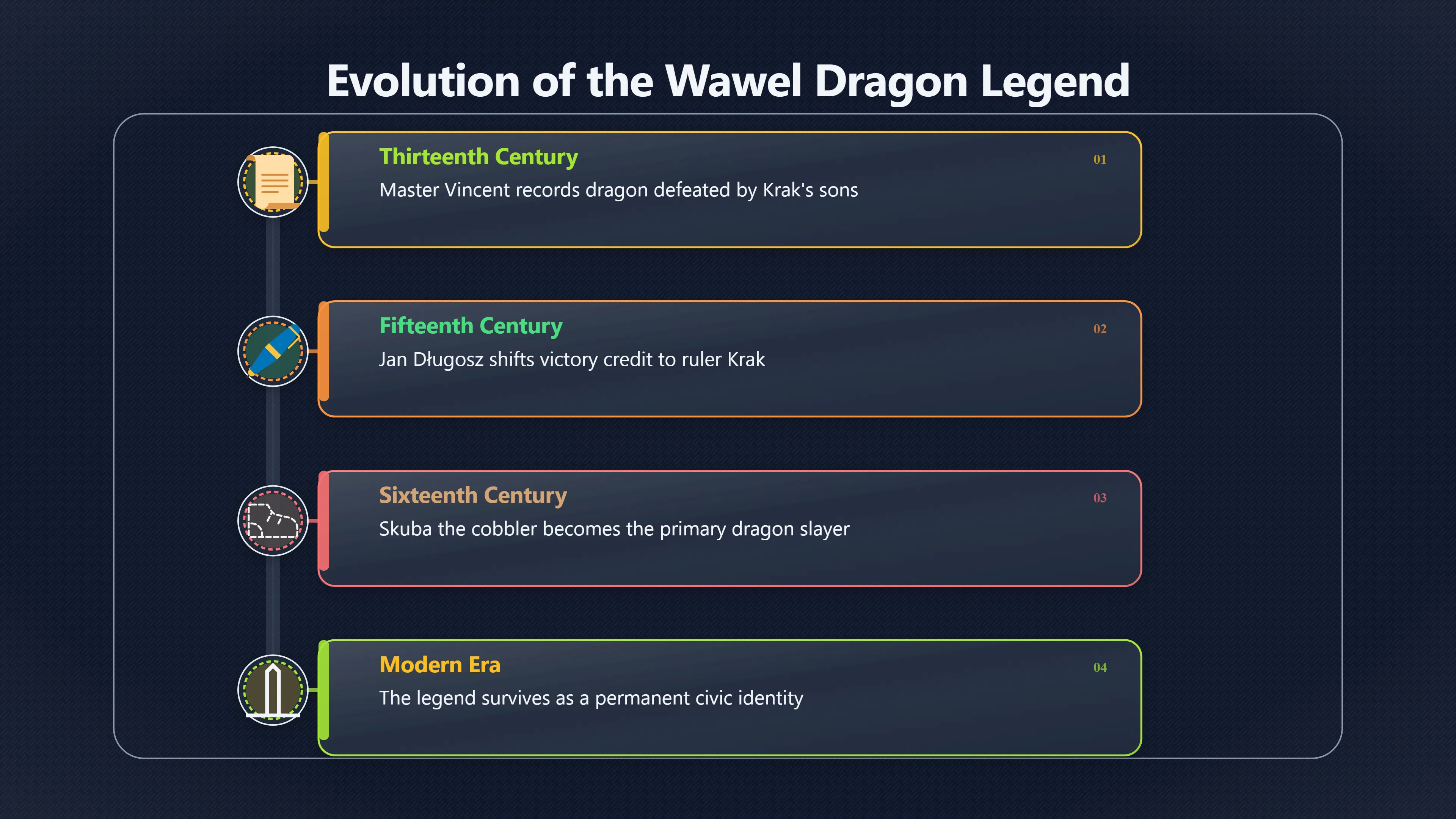
One reason the Wawel Dragon stands apart from modern cryptid claims is that historians can watch the legend changing over time in surviving written sources.
The oldest known version appears in the early thirteenth-century chronicle of Master Vincent (Wincenty Kadłubek). In this account, a dragon terrorises the region around Kraków and is ultimately defeated through a trick involving sulphur-stuffed bait. However, the heroes are not the familiar cobbler from modern retellings. Instead, the dragon is overcome by the sons of the legendary ruler Krak.[Wikipedia]WikipediaWawel DragonWawel Dragon
Later chroniclers altered key details. Fifteenth-century historian Jan Długosz shifted more responsibility for the dragon’s defeat to Krak himself and expanded the narrative. By the late sixteenth century, another major change appeared: the clever shoemaker or cobbler, often called Skuba, became the dragon-slayer. This is now the version most visitors recognise.[Wikipedia]WikipediaWawel DragonWawel Dragon
These changes matter because they reveal how the story developed through literature and folklore. If Kraków had experienced centuries of consistent reports of a mysterious animal, historians would expect a relatively stable description. Instead, the dragon’s identity, enemies and method of defeat all evolved as writers adapted the tale for new audiences. The surviving evidence points to a living legend rather than a record of repeated encounters with an unknown creature.[Wikipedia]WikipediaWawel DragonWawel Dragon
Why the Cave Is Not Evidence of a Creature
A common misunderstanding is that the existence of the Dragon’s Den somehow supports the existence of the dragon itself. In reality, the relationship works in the opposite direction: a real cave provided a convincing setting for a story.
The cave beneath Wawel Hill is genuine and has been known for centuries. It is a natural limestone formation opening toward the Vistula River. Archaeological research has shown that the area around Wawel Hill was occupied long before the legend was written down, making it an obvious focal point for stories about the origins of Kraków.[SuperCracow.com]supercracow.comThe Real Story Behind Krakow's Dragon LegendMarch 20, 2026 — The cave beneath Wawel Hill has existed for thousands of years, and archaeol…
However, there is no historical record of zoological investigations uncovering evidence for a giant reptile, unknown predator or surviving dragon. The cave’s existence demonstrates only that the storytellers had a dramatic location to work with. Many cultures attach monsters to caves, cliffs and unusual landscape features because such places already feel mysterious and dangerous.[Wawel Castle]wawel.krakow.plWawel Castle Dragon's denThe Legend | Google Arts & Culture. The…Read more…
Another detail sometimes cited as evidence involves large bones displayed at Wawel Cathedral. Medieval people occasionally interpreted whale bones or fossil remains as dragon relics. Modern understanding, however, identifies such remains as belonging to known animals rather than legendary beasts. Their significance lies in showing how earlier generations interpreted unusual discoveries, not in proving that dragons existed.[Wikipedia]WikipediaWawel DragonWawel Dragon
From a cryptid perspective, the Wawel Dragon lacks the features usually associated with an animal mystery. There is no chain of eyewitness reports, no physical traces tied to a living species and no recurring modern sightings. The evidence trail leads into folklore, not zoology.

What Might Have Inspired the Legend?
Although there is no evidence for a real dragon, historians have long discussed possible influences on the story.
Some researchers have noted similarities between the Wawel Dragon and other dragon-slaying traditions from Europe and the Near East. The use of sulphur-filled bait has parallels in older literary traditions, while themes of a community threatened by a monster and saved through ingenuity appear across many cultures.[Wikipedia]WikipediaWawel DragonWawel Dragon
The legend may also reflect deeper symbolic themes. Dragons often represented chaos, danger or hostile forces that had to be overcome before a settlement could flourish. In that sense, the dragon functions less as an animal and more as a narrative obstacle standing between wilderness and civilisation. The tale helps explain how Kraków’s legendary founders transformed a threatening landscape into a successful city.[Wikipedia]WikipediaWawel DragonWawel Dragon
Whatever its precise origins, the story became increasingly tied to Kraków itself. The dragon was no longer just a monster; it became part of the city’s foundation myth and an emblem of local identity.
The Fire-Breathing Statue and Modern Tourism
The most visible stage of the dragon’s afterlife began in the twentieth century.
In 1972, sculptor Bronisław Chromy’s bronze Wawel Dragon was installed near the cave entrance beside the Vistula. Standing roughly six metres tall, the sculpture transformed an old legend into a permanent landmark. Its most famous feature is a natural-gas mechanism that allows it to breathe real fire at regular intervals.[krakow.pl]wawel.krakow.plWawel Castle Dragon's denThe Legend | Google Arts & Culture. The…Read more…
The statue quickly became one of Kraków’s best-known attractions. Visitors emerging from the Dragon’s Den encounter a creature that appears to confirm the legend, at least theatrically. Children wait for the next burst of flame, photographers gather by the riverbank and guidebooks routinely present the dragon as an essential stop alongside the royal castle itself.[krakow.pl]wawel.krakow.plWawel Castle Dragon's denThe Legend | Google Arts & Culture. The…Read more…
The sculpture’s popularity is so great that interruptions to its fire-breathing function sometimes become national news. In recent years, maintenance and fuel-consumption concerns temporarily halted the flames, drawing attention precisely because the dragon has become such an expected part of the Kraków experience.[Popular Science]popsci.comkrakow dragon sculptureIt is inspired by the ancient tale of the…
What is striking is that modern tourism does not depend on convincing people a dragon once existed. Visitors enjoy participating in the legend regardless of whether they treat it as history, folklore or fantasy.

How a Monster Became a Civic Symbol
Many legendary creatures fade as belief declines. The Wawel Dragon followed a different path.
Rather than disappearing, it became a symbol that could mean different things to different people. For children, it is a fairy-tale monster. For historians, it is a window into medieval storytelling. For Kraków, it is a civic mascot linked to the city’s origins. For tourists, it is one of Poland’s most memorable attractions.[Wawel Castle]wawel.krakow.plWawel Castle Dragon's denThe Legend | Google Arts & Culture. The…Read more…
This transformation explains why the dragon occupies an unusual place within Poland’s monster traditions. Unlike lake-monster reports, mystery cats or alleged ape-men, the Wawel Dragon is not sustained by claims that a hidden creature may still exist. Its survival depends on culture rather than evidence.
That cultural afterlife has proved remarkably durable. More than seven centuries after the earliest written versions appeared, the dragon still guards the riverbank below Wawel Hill, breathing fire for crowds and reminding visitors that legends can become as permanent as the places that inspired them.[krakow.pl]wawel.krakow.plWawel Castle Dragon's denThe Legend | Google Arts & Culture. The…Read more…
Amazon book picks
Further Reading
Books and field guides related to Was Krakow's Wawel Dragon Ever More Than Legend?. Use these as the next step if you want deeper reading beyond the article.

The Penguin Book of Dragons
Directly relevant to understanding the Wawel Dragon within wider dragon traditions.
Polish Folklore and Myth
Provides cultural background for Polish legends including dragon narratives.
dragonology the complete book of dragons
Introduces dragon lore and mythology in an accessible format.
eBay marketplace picks
Marketplace Samples
Live-tested eBay searches with available results related to this page.



Endnotes
1.
Source: wawel.krakow.pl
Title: Wawel Castle Dragon’s den
Link:https://wawel.krakow.pl/en/exhibition-constant/dragon-s-den
Source snippet
The Legend | Google Arts & Culture. The...Read more...
2.
Source: Wikipedia
Title: Wawel Dragon
Link:https://en.wikipedia.org/wiki/Wawel_Dragon
3.
Source: supercracow.com
Link:https://www.supercracow.com/the-real-story-behind-krakows-dragon-legend-fact-or-fiction/
Source snippet
The Real Story Behind Krakow's Dragon LegendMarch 20, 2026 — The cave beneath Wawel Hill has existed for thousands of years, and archaeol...
Published: March 20, 2026
4.
Source: Wikipedia
Title: Wawel Dragon (statue)
Link:https://en.wikipedia.org/wiki/Wawel_Dragon_%28statue%29
5.
Source: krakow.travel
Link:https://krakow.travel/en/artykul/115/the-legend-of-the-wawel-dragon
Source snippet
Kraków TravelThe legend of the Wawel DragonTo commemorate the vanquishing of the Dragon, Bronisław Chromy designed a sculpture of the bea...
6.
Source: popsci.com
Title: krakow dragon sculpture
Link:https://www.popsci.com/science/krakow-dragon-sculpture/
Source snippet
It is inspired by the ancient tale of the...
7.
Source: facebook.com
Link:https://www.facebook.com/groups/596526160767608/posts/did-you-know-theres-firebreathing-dragon-living/2537060683380803/
8.
Source: houseofattractions.club
Title: Wawel Dragon
Link:https://houseofattractions.club/en/dragon-of-wawel/
9.
Source: wawelcastle.org
Title: the legend of the wawel dragon exploring krakow s most famous myth
Link:https://wawelcastle.org/blog/the-legend-of-the-wawel-dragon-exploring-krakow-s-most-famous-myth
10.
Source: wawel.krakow.pl
Title: the dragon s garden bronislaw chromy s works at wawel
Link:https://wawel.krakow.pl/en/exhibition-temporary/the-dragon-s-garden-bronislaw-chromy-s-works-at-wawel
11.
Source: karwansaraypublishers.com
Title: the wawel dragon
Link:https://www.karwansaraypublishers.com/blogs/medieval-world-blog/the-wawel-dragon?srsltid=AfmBOoqqSPJ6YrVUMs0bpKfX5PLoQ9GnCPIflwPVjjsFBwPcq22tRlkb
Additional References
12.
Source: apnews.com
Link:https://apnews.com/article/0e97b7ec714f1db8a5a8a5b549d4d92c
Source snippet
Experts will examine the gas feeds of the 6-meter-tall sculpture to find ways to reduce energy costs. Created by sculptor Bronislaw Chrom...
13.
Source: polen.travel
Link:https://www.polen.travel/no/underground-tourist-routes/dragon-s-den
Source snippet
(DE)Dragon's DenThe cave is associated with the legend of the Wawel Dragon, commemorated by a statue in front of the lower opening create...
14.
Source: krakow-trip.com
Title: wawel dragon legend
Link:https://www.krakow-trip.com/guides/wawel-dragon-legend/
Source snippet
Krakow TripWawel Dragon legend: the founding myth of Kraków29 May 2026 — At the cave exit, bronze dragon statue by sculptor Bronisław Chr...
Published: May 2026
15.
Source: youtube.com
Title: Fire breathing dragon at Wawel Castle / Smok Wawelski
Link:https://www.youtube.com/watch?v=_S9DDM8rBLs
Source snippet
Wawel Dragon (Smok Wawelski) - Fire Breathing Dragon in Kraków...
16.
Source: youtube.com
Title: The Dragon of Kraków: Smok Wawelski (Legend)
Link:https://www.youtube.com/watch?v=LLFhMJBqRc8
Source snippet
Fire breathing dragon at Wawel Castle / Smok Wawelski - Kraków Poland - ECTV...
17.
Source: facebook.com
Link:https://www.facebook.com/groups/250411290152241/posts/916365920223438/
18.
Source: tripadvisor.co.uk
Link:https://www.tripadvisor.co.uk/Attraction_Review-g274772-d11899193-Reviews-Monument_of_the_Wawel_Dragon-Krakow_Lesser_Poland_Province_Southern_Poland.html
19.
Source: stradomhouse.com
Link:https://stradomhouse.com/en/the-wawel-dragon-and-the-dragons-den/
20.
Source: krakowurbantours.com
Link:https://krakowurbantours.com/the-legend-of-krakows-wawel-dragon/
21.
Source: klm.co.kr
Link:https://www.klm.co.kr/en/travel-guide/inspiration/history-envelops-the-wawel
Topic Tree