Within Colombia Monsters
Is There Really a Monster in Lake Tota?
Lake Tota is Colombia's clearest lake-monster case, but its trail leads more to sacred water lore than zoological proof.
On this page
- The lake, the claims and the famous black creature
- Muisca tradition, colonial retellings and changing meanings
- Why the evidence stays thin and what might explain it
Page outline Jump by section
Introduction
The Lake Tota monster is Colombia’s closest equivalent to the famous lake-monster traditions of Scotland’s Loch Ness or Argentina’s Nahuelito. Yet the most interesting part of the story is not the possibility of an unknown animal. It is the way a sacred Indigenous tradition, colonial-era reports and modern cryptid culture became woven together around the country’s largest natural freshwater lake.

If the question is whether there is convincing evidence for a giant unknown creature living in Lake Tota today, the answer is no. The legend rests on historical descriptions, folklore and a small number of reported sightings rather than physical remains, photographs, biological samples or repeatable observations. What keeps the story alive is not strong zoological evidence but the remarkable cultural history attached to the lake itself.[Wikipedia]WikipediaMonster of Lake TotaMonster of Lake Tota
The Lake, the Claims and the Famous Black Creature
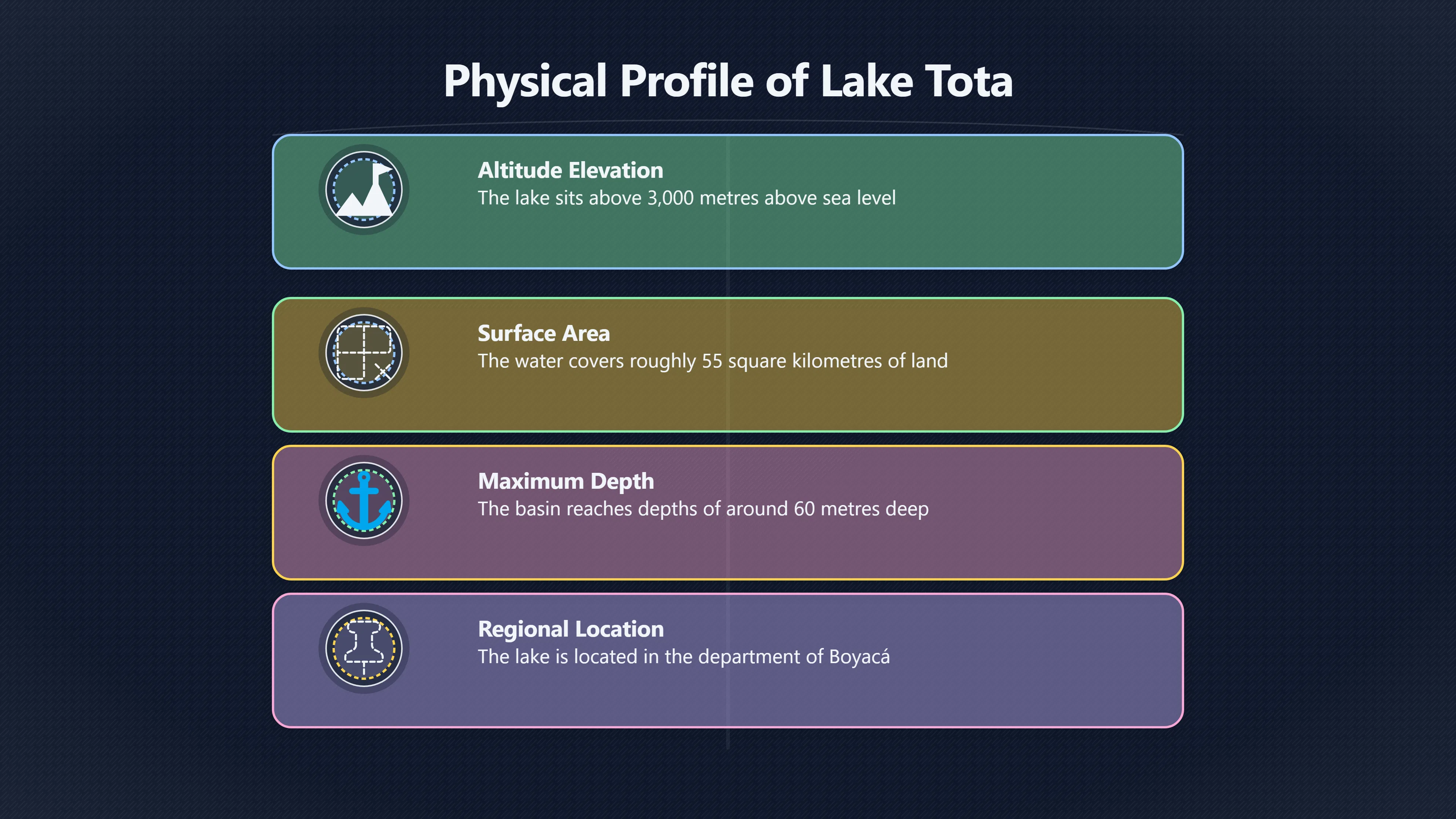
Lake Tota lies in the department of Boyacá at more than 3,000 metres above sea level. Covering roughly 55 square kilometres and reaching depths of around 60 metres, it is large enough to inspire mystery and isolation, especially in earlier centuries when local traditions travelled largely by word of mouth.[wikipedia.org]WikipediaLake TotaLake Tota
The creature most often associated with the lake is known as the Monster of Lake Tota or, in some retellings, the “devil whale”. The most famous description traces back to colonial accounts that attributed information to local Indigenous people and to early Spanish observers. The creature was described as a black fish-like being with a head resembling that of an ox and a size greater than a whale. Later writers repeated and embellished the image, helping establish the monster as one of the most unusual creatures in Colombian folklore.[Wikipedia]WikipediaMonster of Lake TotaMonster of Lake Tota
One reason the story attracts attention is the striking mismatch between the description and the setting. Lake Tota is a mountain lake, not an ocean. A whale-sized creature would be extraordinary in such an environment. That very improbability helped transform the account from local tradition into a mystery discussed by cryptid enthusiasts.[Wikipedia]WikipediaLake TotaLake Tota
The historical record contains references to alleged sightings, including reports repeated by the seventeenth-century historian Lucas Fernández de Piedrahita. However, these accounts survive as written recollections rather than direct, independently verifiable observations. There is no surviving specimen, sketch made from life, physical trace or contemporary investigation that would allow modern researchers to test the claims.[Wikipedia]WikipediaMonster of Lake TotaMonster of Lake Tota
Muisca Tradition, Colonial Retellings and Changing Meanings
The strongest evidence for the monster’s importance is cultural rather than biological. Lake Tota occupied a significant place in the worldview of the Muisca people, who lived across the highlands of central Colombia before Spanish conquest. The lake was associated with sacred geography, ritual activity and origin stories.[Wikipedia]WikipediaLake TotaLake Tota
In Muisca traditions concerning the creation of the lake, a powerful serpent-like being appears in stories about conflict, transformation and the formation of the landscape. Later retellings describe a dark serpent or monstrous creature connected to supernatural forces inhabiting the area before the lake came into existence. These narratives place the creature within a mythological framework rather than presenting it as an ordinary animal.[Wikipedia]WikipediaMonstruo del Lago de TotaMonstruo del Lago de Tota
This distinction matters because many modern summaries blur together two different ideas:
- A sacred or mythological being within Muisca cosmology.
- A possible undiscovered animal living in the lake.
Colonial writers often recorded Indigenous traditions through European assumptions about dragons, devils and monsters. As stories passed through generations of retelling, the symbolic meaning could become harder to separate from the idea of a literal creature.[Wikipedia]WikipediaMonstruo del Lago de TotaMonstruo del Lago de Tota
Some modern researchers and interpreters have even suggested that the Lake Tota being is best understood as an archetypal or divine creature within Muisca belief rather than as a zoological mystery. Under that interpretation, asking whether the monster exists physically may miss the original purpose of the story.[Wikipedia]WikipediaMonstruo del Lago de TotaMonstruo del Lago de Tota
Why the Evidence Stays Thin
The Lake Tota monster occupies an unusual position in Colombian folklore because it is famous enough to be treated as a cryptid yet lacks the evidence usually sought by cryptozoologists.
Several problems repeatedly appear when the evidence is examined closely.
The historical accounts are second-hand
Most descriptions trace back to colonial-era texts written long after the supposed observations occurred. The famous “black fish with an ox-like head” description survives through later authors rather than through a detailed eyewitness report that can be independently checked.[Wikipedia]WikipediaMonster of Lake TotaMonster of Lake Tota
There is no physical evidence
No bones, carcasses, tissue samples, scales or other biological remains have ever been produced. Unlike some mystery-animal cases that at least generate disputed photographs or tracks, Lake Tota’s legend is overwhelmingly textual and folkloric.[Wikipedia]WikipediaMonster of Lake TotaMonster of Lake Tota
There are no convincing modern sightings
The monster remains well known in folklore and tourism discussions, but there is no substantial modern body of sightings comparable to major lake-monster flaps elsewhere in the world. Reports are sporadic and usually repeat older traditions rather than adding new evidence.[Wikipedia]WikipediaMonster of Lake TotaMonster of Lake Tota
The lake’s ecology creates difficulties
Lake Tota supports fish and bird life, but biologists have not documented anything remotely resembling the giant creature of legend. A large breeding population of unknown whale-sized animals would be extremely difficult to hide indefinitely in a lake that has been inhabited, studied and used by people for centuries.[wikipedia.org]WikipediaLake TotaLake Tota
What Might People Have Been Seeing?
Because the evidence is so limited, explanations remain speculative. Several possibilities are often discussed.
Symbolic storytelling. The simplest explanation is that the creature was primarily mythological from the beginning: a sacred serpent, dragon-like force or supernatural guardian associated with water and landscape creation. This interpretation fits well with Muisca origin traditions.[Wikipedia]WikipediaMonstruo del Lago de TotaMonstruo del Lago de Tota
Misidentified animals. Large fish, floating debris, unusual wave patterns or brief glimpses of wildlife can generate monster reports in lakes around the world. Once a legend exists, ambiguous observations are more likely to be interpreted through that legend.[Wikipedia]WikipediaMonster of Lake TotaMonster of Lake Tota
Colonial exaggeration. Early descriptions often passed through multiple storytellers before reaching print. An unusual local tale could easily become more dramatic when filtered through European ideas about dragons, sea monsters and marvels of the New World.[Wikipedia]WikipediaMonster of Lake TotaMonster of Lake Tota
The power of place. Large bodies of water naturally encourage mystery. Deep, cold lakes conceal what lies beneath the surface, and humans have repeatedly attached monster stories to such environments, from Scotland to Patagonia. Lake Tota fits that pattern remarkably well.[Wikipedia]WikipediaMonster of Lake TotaMonster of Lake Tota

Why the Monster Still Matters
The Lake Tota monster remains important not because it is a strong candidate for an undiscovered species, but because it sits at the meeting point of folklore, history and identity. It is one of the few Colombian creature traditions that can genuinely be compared with the classic lake-monster legends known around the world.[Wikipedia]WikipediaMonster of Lake TotaMonster of Lake Tota
The evidence problem is therefore the key to understanding the legend. The more closely the case is examined as zoology, the weaker it becomes. The more closely it is examined as a story about sacred landscapes, Indigenous traditions and centuries of retelling, the richer it becomes. Lake Tota’s monster survives not because science has failed to explain it, but because the legend has continually adapted to new audiences—from Muisca storytellers to colonial chroniclers, modern tourists and cryptid enthusiasts.[Wikipedia]WikipediaMonstruo del Lago de TotaMonstruo del Lago de Tota
eBay marketplace picks
Marketplace Samples
Live-tested eBay searches with available results related to this page.




Endnotes
1.
Source: Wikipedia
Title: Monster of Lake Tota
Link:https://en.wikipedia.org/wiki/Monster_of_Lake_Tota
2.
Source: Wikipedia
Title: Lake Tota
Link:https://en.wikipedia.org/wiki/Lake_Tota
3.
Source: Wikipedia
Title: Monstruo del Lago de Tota
Link:https://es.wikipedia.org/wiki/Monstruo_del_Lago_de_Tota
4.
Source: Wikipedia
Title: Muisca mythology
Link:https://en.wikipedia.org/wiki/Muisca_mythology
5.
Source: youtube.com
Title: The Devil Whale of Lake Tota: Colombia’s Forgotten Monster
Link:https://www.youtube.com/watch?v=2DQTvPHw-uI
Source snippet
Lake Tota - Colombia's largest lake and a sacred site to the ancient Muisca.... The Devil Whale of Lake Tota: Colombia's Forgotten Monst...
6.
Source: youtube.com
Title: The Monster of Lake Tota
Link:https://www.youtube.com/watch?v=zAUPhHUd0j0
Source snippet
The Devil Whale of Lake Tota: Colombia's Forgotten Monster...
7.
Source: livinglakes.org
Link:https://livinglakes.org/tota-lake/
Source snippet
Living Lakes Network -Tota LakeThe largest lake in the country, Tota is a tropical high elevation lake nestled on the eastern ridge of th...
8.
Source: cryptidz.fandom.com
Title: Monster of Lake Tota
Link:https://cryptidz.fandom.com/wiki/Monster_of_Lake_Tota
Source snippet
of Lake Tota - Cryptid Wiki - FandomHe described the monster as "A fish with a black head like an ox and larger... Babi Ngepet • Badajoz...
9.
Source: van-helsing-own-story.fandom.com
Title: Monster of Lake Tota
Link:https://van-helsing-own-story.fandom.com/wiki/Monster_of_Lake_Tota
Source snippet
of Lake Tota | Van Helsing Own Story Wiki - FandomHe described the monster as "A fish with a black head like an ox and larger than a whal...
Additional References
10.
Source: facebook.com
Link:https://www.facebook.com/groups/1002571683091379/posts/8220153657999776/
Source snippet
Monster of Lake Tota, a mysterious creature in ColombiaMonster of Lake Tota, Colombia, South America I just came across a YouTube video o...
11.
Source: hangar1publishing.com
Link:https://hangar1publishing.com/blogs/cryptids/lake-tota-monster?srsltid=AfmBOooTH2wZvYzBvmhtk49d9fgr04PHJ4gFtsscUH8l7IMo6aUjv3Vz
12.
Source: hangar1publishing.com
Link:https://hangar1publishing.com/blogs/cryptids/lake-tota-monster?srsltid=AfmBOorTg3aB7b1UpKFlGgL5qMXIG1hXGNtlAgQV-QYV1nRijY_Pgpk2
Source snippet
The Legendary Lake Tota Monster... Muisca territories, described the creature as "a fish with a black head like an ox an...
13.
Source: reddit.com
Link:https://www.reddit.com/r/Cryptozoology/comments/1k86s3f/the_totas_lake_monster_in_colombia_another/
Source snippet
The Tota´s lake monster in Colombia, another variant of...The Monster of Lake Tota: A creature that allegedly inhabits the largest...
14.
Source: colombiareports.com
Title: colombias largest lake deemed one of the most threatened
Link:https://colombiareports.com/colombias-largest-lake-deemed-one-of-the-most-threatened/
Source snippet
Colombia's largest lake deemed one of the most threatened17 Aug 2012 — Colombia's largest lake, Tota, located in the central Boyaca depar...
15.
Source: facebook.com
Link:https://www.facebook.com/100064430090083/posts/the-monster-of-lake-tota-is-a-legendary-aquatic-animal-known-in-many-works-as-di/5021155521252872/
Source snippet
n a whale" (Lucas Fernández de Piedrahita, 1676) and Antonio de...Read more...
16.
Source: cryptozoo-oscity.blogspot.com
Title: mysterious creature of lake tota
Link:https://cryptozoo-oscity.blogspot.com/2019/06/mysterious-creature-of-lake-tota.html
Source snippet
CryptoZoo OscityMysterious creature of Lake Tota18 Jun 2019 — The monster was also defined as "a monstrous fish", "a black monster... Th...
17.
Source: scribd.com
Title: Monster of Lake Tota Wikipedia
Link:https://www.scribd.com/document/818414222/Monster-of-Lake-Tota-Wikipedia
Source snippet
Monster of Lake Tota: Myth and History | PDFHe described the monster as "A fish with a black head like an ox and larger than a whale" (Lu...
18.
Source: jasonrobertsonline.com
Title: Jason Robertson Online A Smattering of Lake Monsters
Link:https://jasonrobertsonline.com/a-smattering-of-lake-monsters/
Source snippet
On the high plateau of the... black head like an ox and larger than a whale was discovered.Read more...
19.
Source: rewild.org
Title: the skinny on the search for the fat catfish
Link:https://www.rewild.org/blog/the-skinny-on-the-search-for-the-fat-catfish
Source snippet
26 Jul 2023 — At 164 feet (50 meters) deep, with water around 55 degrees Fahrenheit (12 degrees Celsius), the lake only boasts a handful...
Topic Tree