Cryptid Reports from Burundi's Waters
Burundi’s strongest mystery-animal tradition is not a crowded bestiary of named cryptids, but a tight cluster of stories around water: the northern end of Lake Tanganyika, the Rusizi Delta, large crocodiles, hippos, and a few old reports of something stranger moving in the lake.
Page outline Jump by section
Why Burundi’s monster stories gather around Lake Tanganyika
Lake Tanganyika gives Burundi the perfect landscape for aquatic legend. It is not a small village lake where every inlet is familiar: it is one of the world’s great freshwater basins, shared by Burundi, the Democratic Republic of the Congo, Tanzania and Zambia. FAO background material gives it an area of about 32,900 square kilometres, a maximum depth of 1,470 metres, and a total length of hundreds of kilometres, with Burundi holding only a small share of the lake’s surface and shoreline. Those figures matter because vast water, cliffs, reedbeds, poor visibility, night fishing, and dangerous animals are exactly the conditions in which monster reports tend to form.[FAOHome]fao.orgHome Lake Tanganyika Research | Background | General FeaturesHome Lake Tanganyika Research | Background | General Features
The northern end of the lake is especially important for Burundi. The Rusizi River flows into Lake Tanganyika near Bujumbura, creating wetlands that support crocodiles, hippos, birds and fish. Protected Planet lists Parc National de la Rusizi as a protected area in Burundi covering 106.73 square kilometres, and conservation research on the Ruzizi Delta records crocodile and hippo habitat on both the Burundian and Congolese sides of the delta.[Protected Planet]protectedplanet.netProtected Planet Explore the World's Protected AreasProtected Planet Explore the World's Protected Areas
This setting helps explain why Burundi’s monster material is less about forest apes, winged beasts or phantom cats, and more about something seen at the waterline. A huge crocodile slipping below the surface, a hippo surfacing in reeds, otters swimming in a line, floating vegetation, or a wake seen at dusk can all become more impressive in retelling. The lake is real, the animals are real, and the uncertainty often lies in what a frightened or excited witness thought they saw.
The Lake Tanganyika monster: Burundi’s classic cryptid claim
The Lake Tanganyika monster is the closest thing Burundi has to a traditional cryptozoological lake monster. The story is usually treated as a regional lake tradition rather than a purely Burundian one, because Tanganyika borders four countries. Still, one of the most striking reports is explicitly placed on the Burundi portion of the lake.
Cryptid summaries trace early lake-monster references to an 1893 account by Joseph Augustus Moloney, in which a missionary at Mpala was said to have seen a thirty-foot “sea serpent” in Lake Tanganyika. Later reports gathered around tusked, saurian, serpentine or shark-like creatures, but they do not form a single consistent animal. That is the first warning sign: the “monster” changes shape depending on who is telling the story.[Cryptid Archives]cryptidarchives.fandom.comLake Tanganyika monsterLake Tanganyika monster
The most famous Burundi-linked sighting is the 1914 Thierfelder account. According to later cryptozoological summaries, German doctor M. V. Thierfelder, working during a sleeping-sickness epidemic, was near a bay on the Burundi shore with a teacher named Ilsgensmeier when they reportedly saw a huge animal come from the lake. The creature was described as serpent-like, but not moving like an ordinary snake. Instead, several loops rose vertically above the water. It was said to be brown, smooth or furry, lacking legs, and to have fin-like structures near the head. Thierfelder reportedly compared the head more to a mammal than a snake, while later writers noted that the size estimate may have been badly exaggerated.[Cryptid Archives]cryptidarchives.fandom.comLake Tanganyika monsterLake Tanganyika monster
The story is vivid because it has details that do not sound like a generic “big snake”: vertical undulation, otters nearby, a mammal-like head, and a body said to be without scales. But it is weak as evidence. The account is known through later publication and secondary cryptozoological retellings; it is not supported by a specimen, photograph, track, carcass or repeatable local identification. The claimed size also strains belief. A fifty-metre animal in a lake that has been fished, travelled and studied for generations would need a breeding population, food supply, and repeated sightings far stronger than the record provides.
A sceptical reading does not have to mock the witness. A group of otters, waves interacting with a partly submerged log, a swimming crocodile seen from an odd angle, or a chain of surfacing animals could create the impression of loops. The “fur” detail is especially interesting because wet mammal fur, floating plant matter, or a slick surface seen in glare can all be misread at distance. The report remains a good strange story, but it is not strong evidence for an unknown species.

Gustave: when a real crocodile becomes a monster legend
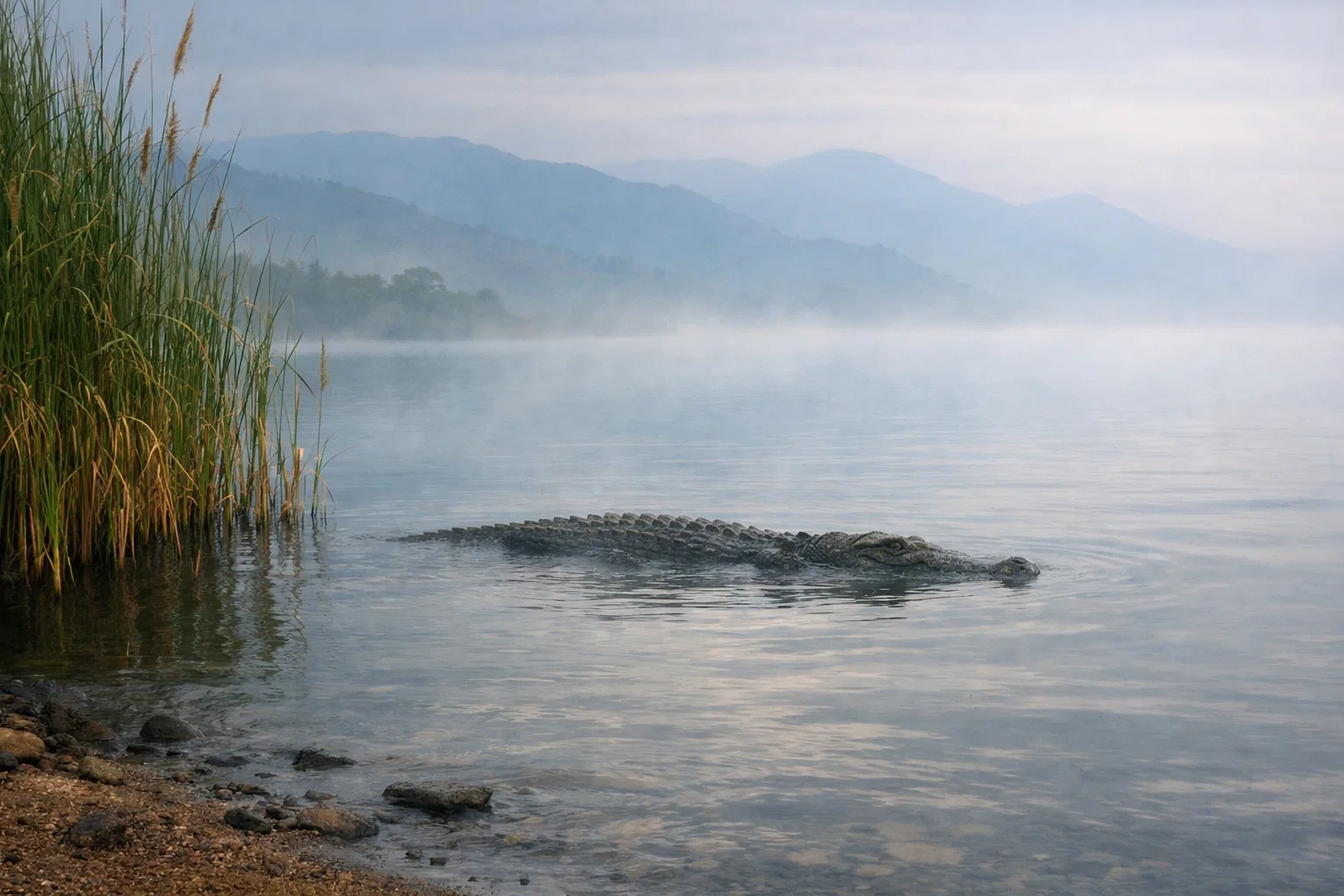
Gustave is Burundi’s most famous monster figure, even though he is not supposed to be an unknown animal. He is described as a very large male Nile crocodile associated with the Rusizi River and the northern shores of Lake Tanganyika. National Geographic reported in 2009 that Gustave had reappeared after a period of inactivity and cited tracker Patrice Faye’s estimate that the animal was about 20 feet long, around a ton in weight and roughly sixty years old. The same report also noted that attacks attributed to Gustave dated back to 1987, while cautioning that it was doubtful one crocodile could be responsible for every death blamed on him.[National Geographic]nationalgeographic.comOpen source on nationalgeographic.com.
That caveat is crucial. Gustave’s legend often appears with claims of hundreds of victims, but the exact figure is not well verified. In monster folklore, a named predator can become a container for many fears: real attacks, missing people, rumours, political violence, dangerous river crossings, and the ordinary terror of sharing water with crocodiles. National Geographic itself framed Gustave as both a confirmed killer and a creature surrounded by larger-than-life reputation.[National Geographic]nationalgeographic.comOpen source on nationalgeographic.com.
The ecological background supports the existence of large crocodiles in the area without proving every dramatic claim. A 2023 study of crocodile ecology and conservation in the Ruzizi Delta recorded both Nile crocodiles and slender-snouted crocodiles, using interviews and direct observation between 2019 and 2021. It found higher crocodile densities in the protected Burundian delta than in the unprotected Congolese delta, showing that the region really is a crocodile landscape rather than merely a story setting.[Zenodo]zenodo.orgOpen source on zenodo.org.
Gustave’s folklore power comes from three overlapping facts: crocodiles do kill people, the Rusizi-Lake Tanganyika zone is genuine crocodile habitat, and one unusually large scarred animal was repeatedly singled out by local observers and trackers. What remains uncertain is the inflated arithmetic of the legend — especially the idea that one crocodile personally accounts for all the deaths sometimes assigned to him.
Crocodiles, hippos and the real danger behind the stories
Burundi’s water-monster traditions are easiest to understand when set beside everyday human-wildlife conflict. Along Lake Tanganyika and the Rusizi system, people fish, collect water, cross wetlands, farm close to shorelines and move through places also used by crocodiles and hippos. Conservation material from the wider Ruzizi Plain notes that wetlands along the river, ponds and Lake Tanganyika are crocodile and hippo habitats, and that degraded habitat can push animals and people into more dangerous contact. It also states plainly that crocodiles and hippos are injured and killed, and that they in turn injure and kill people.[CEBioS]cebios.naturalsciences.beCEBio SMicrosoft WordCEBio SMicrosoft Word
This is why Gustave feels different from a purely imaginary monster. The fear is not symbolic only. A person standing near the water’s edge can genuinely be attacked. Hippos, too, are not gentle background animals; they are powerful, territorial mammals that can overturn boats or charge on land. The Ruzizi Delta has also been the subject of recent ecological work on hippo conservation, with research reporting hundreds of hippos across the Burundian and Congolese delta during 2019–2021.[ResearchGate]researchgate.netOpen source on researchgate.net.
For readers interested in cryptids, this matters because many monster traditions sit on a border between folklore and animal behaviour. A lake serpent may be a misread wake. A “demon crocodile” may be a real reptile with a reputation that grows larger than its body. A story of a huge water beast may preserve practical local knowledge: avoid reedbeds, do not enter the water at night, do not assume a still surface is safe.
Folklore roots: why Burundi has fewer named cryptids online
A striking feature of Burundi research is how sparse the public English-language record is for named local monsters. Searches for Burundian mythical creatures produce far less than searches for better-known regional figures from the Congo Basin, Uganda, Rwanda or West Africa. That does not mean Burundi lacks oral tradition. It means that local narratives have not been packaged online in the same way as Nessie, Bigfoot or the Mokele-mbembe.
Burundi shares cultural and historical links with neighbouring Rwanda, including traditions around Imana, spirits, royal memory, oral performance and animal tales. However, those traditions should not be flattened into a convenient “monster list”. The best-known public sources for Rwandan and Burundian belief are often broad, uneven, or more focused on religion, kingship and moral tales than on mystery animals. That makes Burundi a good example of a country where the absence of a tidy English cryptid catalogue is itself important.[Wikipedia]WikipediaOpen source on wikipedia.org.
Animal folklore still matters. Across oral traditions, animal tales often carry environmental knowledge: predator and prey, cleverness and danger, greed and survival. Research on folk-zoological knowledge in folktales argues that animal stories frequently encode real-world relationships among animals and between animals and humans. That helps explain why crocodiles, hippos and lake creatures can become story figures without needing to be “cryptids” in a strict modern sense.[arXiv]arxiv.orgOpen source on arxiv.org.
For Burundi, then, the most responsible approach is not to invent a monster catalogue from thin sources. It is to recognise a layered tradition: local oral knowledge, dangerous wetland animals, colonial-era lake rumours, modern media fascination with Gustave, and internet cryptid culture retrofitting those materials into a monster map.
What explanations make the most sense?
The simplest explanations for Burundi’s mystery-animal reports are not boring; they are grounded in the country’s actual ecology.
Large crocodiles. Nile crocodiles are present in the Lake Tanganyika-Rusizi system, and a very large individual could easily become a named monster. Gustave shows how a known species can acquire a legendary identity when attacks, scars, failed capture attempts and rumour accumulate around one animal.[National Geographic]nationalgeographic.comOpen source on nationalgeographic.com.
Hippos and partial sightings. A hippo surfacing, diving or moving through reeds can look strange, especially in low light or from a boat. Hippos also help explain why water-beast stories can be attached to real fear rather than pure fantasy.
Otters, waves and grouped animals. The Thierfelder story itself involved otters nearby, according to later retellings. Several animals surfacing in sequence can create the impression of one long body, and waves can make humps appear to rise and sink.
Floating logs and vegetation. Lake Tanganyika’s size, currents and shore vegetation make floating debris a plausible source for some “serpent” impressions, especially where an observer sees only part of an object at a distance.
Colonial-era amplification. Several Tanganyika monster reports come through European travellers, missionaries, naturalists or later cryptozoological writers. That does not make every report false, but it does mean the stories passed through filters: translation, exoticism, hunting culture, colonial science, and the appetite for strange African beasts.
The strongest evidence supports real dangerous animals and real local caution. The weakest evidence supports a single unknown giant creature. Between those poles lies the interesting part: how people make sense of an environment where something genuinely can rise from the water and kill.
How the legend changed in modern media
The older Lake Tanganyika monster belongs to the age of explorers’ books, missionary anecdotes, natural-history speculation and later cryptozoological catalogues. It is a “what did they see?” mystery. Gustave belongs to a newer media world: wildlife documentaries, online articles, horror cinema, social media posts and listicles about the world’s deadliest animals.
National Geographic’s Gustave coverage openly placed him alongside famous monsters such as Nessie, yet separated him from purely apocryphal creatures by presenting him as a real crocodile with a disputed but deadly record. That framing helped move Gustave from local predator to global monster celebrity.[National Geographic]nationalgeographic.comOpen source on nationalgeographic.com.
The legend also fed pop culture. The 2007 horror film Primeval was inspired by stories of a giant man-eating crocodile in Burundi, though, like most monster films, it turned messy reality into a simpler creature-feature premise. This is a common afterlife for cryptid-adjacent stories: a dangerous animal becomes a named villain, then a movie monster, then an internet meme, while the original local context fades.
Tourism writing sometimes repeats the legend too, especially when describing the northern end of Lake Tanganyika or warning visitors about crocodiles. That can make Burundi’s wildlife sound thrilling, but it risks blurring useful safety information with inflated folklore. The responsible version is more interesting anyway: the Rusizi and Tanganyika shore are living ecosystems where conservation, fishing, fear, and storytelling all meet.
What Burundi’s cryptid record really shows
Burundi does not currently offer strong evidence for a confirmed unknown monster species. Its cryptid record is better understood as a small but fascinating water-beast tradition built from three sources: the old Lake Tanganyika monster reports, the modern legend of Gustave, and the real ecology of crocodiles, hippos and deep-water uncertainty.
The Lake Tanganyika monster remains the most “classic” cryptid: strange, serpentine, poorly evidenced, and attached to a huge lake. Gustave is more culturally powerful because he sits closer to reality. He is a known type of animal made legendary by size, fear and disputed numbers. The Rusizi wetlands provide the bridge between them: a place where dangerous animals are not imaginary, but where stories can easily grow larger than the evidence.
That makes Burundi’s monster tradition less like a catalogue of fantasy beasts and more like a case study in how real landscapes create legends. Deep water hides scale. Reeds hide movement. Crocodiles turn caution into story. And once a name like Gustave attaches to fear, the animal becomes more than an animal: it becomes the shape people give to danger at the edge of the lake.
Amazon book picks
Further Reading
Books and field guides related to What Lurks in Burundi's Waters?. Use these as the next step if you want deeper reading beyond the article.
The Book of Imaginary Beings
Appeals to readers exploring monster traditions worldwide.
eBay marketplace picks
Marketplace Samples
Live-tested eBay searches with available results related to this page.

Endnotes
1.
Source: fao.org
Title: Home Lake Tanganyika Research | Background | General Features
Link:https://www.fao.org/fishery/static/LTR/GEN.HTM
2.
Source: zenodo.org
Link:https://zenodo.org/records/8001787
3.
Source: researchgate.net
Link:https://www.researchgate.net/publication/379001653_Hippos_Ecology_Conservation_and_Management_in_the_Ruzizi_Delta_Northern_End_of_Lake_Tanganyika_in_Burundi_and_the_Democratic_Republic_of_Congo
4.
Source: Wikipedia
Link:https://en.wikipedia.org/wiki/Imana
5.
Source: Wikipedia
Title: Folklore in Rwanda
Link:https://en.wikipedia.org/wiki/Folklore_in_Rwanda
6.
Source: arxiv.org
Link:https://arxiv.org/abs/1907.03969
7.
Source: folktales.africa
Title: the clever hare and the ferocious lion a burundian folktale
Link:https://folktales.africa/the-clever-hare-and-the-ferocious-lion-a-burundian-folktale/
8.
Source: folktales.africa
Title: the drum that spoke truth
Link:https://folktales.africa/the-drum-that-spoke-truth/
9.
Source: Wikipedia
Title: List of lake monsters
Link:https://en.wikipedia.org/wiki/List_of_lake_monsters
10.
Source: Wikipedia
Link:https://en.wikipedia.org/wiki/Lukwata
11.
Source: Wikipedia
Title: Category:West African legendary creatures
Link:https://en.wikipedia.org/wiki/Category%3AWest_African_legendary_creatures
12.
Source: Wikipedia
Title: Lake Tanganyika
Link:https://en.wikipedia.org/wiki/Lake_Tanganyika
13.
Source: Wikipedia
Title: Gustave (crocodile)
Link:https://en.wikipedia.org/wiki/Gustave_%28crocodile%29
14.
Source: Wikipedia
Link:https://nl.wikipedia.org/wiki/Gustave
15.
Source: Wikipedia
Title: Rusizi National Park
Link:https://en.wikipedia.org/wiki/Rusizi_National_Park
16.
Source: Wikipedia
Title: Joseph Moloney
Link:https://en.wikipedia.org/wiki/Joseph_Moloney
17.
Source: researchgate.net
Link:https://www.researchgate.net/publication/379001351_Crocodile_ecology_conservation_and_Management_in_the_Ruzizi_Delta_Northern_End_of_Lake_Tanganyika_in_Burundi_and_the_Democratic_Republic_of_Congo
18.
Source: nationalgeographic.com
Link:https://www.nationalgeographic.com/adventure/article/serial-killer-croc-gustave-spotted-in-burundi
19.
Source: cryptidarchives.fandom.com
Title: Lake Tanganyika monster
Link:https://cryptidarchives.fandom.com/wiki/Lake_Tanganyika_monster
20.
Source: protectedplanet.net
Title: Protected Planet Explore the World’s Protected Areas
Link:https://www.protectedplanet.net/900788
21.
Source: cebios.naturalsciences.be
Title: CEBio SMicrosoft Word
Link:https://cebios.naturalsciences.be/wp-content/uploads/2023/06/Engl_flyer_Bashonga_HK.pdf
22.
Source: protectedplanet.net
Link:https://www.protectedplanet.net/country/BDI
23.
Source: protectedplanet.net
Link:https://www.protectedplanet.net/region/AF
24.
Source: protectedplanet.net
Link:https://www.protectedplanet.net/country/RWA
25.
Source: beastsoflegend.com
Title: West Africa
Link:https://beastsoflegend.com/bestiary/africa/west/
26.
Source: cryptidz.fandom.com
Title: Category:Lake Monster
Link:https://cryptidz.fandom.com/wiki/Category%3ALake_Monster
27.
Source: catalog.hathitrust.org
Link:https://catalog.hathitrust.org/Record/008397479
28.
Source: nanetya-foundation.org
Link:https://nanetya-foundation.org/category/african-stories/burundi/page/2/
29.
Source: ebsco.com
Title: lake tanganyika
Link:https://www.ebsco.com/research-starters/environmental-sciences/lake-tanganyika
30.
Source: thehorrorcollection.com
Title: the lake tanganyika monster
Link:https://thehorrorcollection.com/the-lake-tanganyika-monster/
31.
Source: africa-safaris.com
Title: Lake Tanganyika
Link:https://www.africa-safaris.com/blog-post/lake-tanganyika-deepest-lake-in-africa
Additional References
32.
Source: youtube.com
Title: GUSTAVE, THE INVINCIBLE MONSTER OF BURUNDI
Link:https://www.youtube.com/watch?v=_yxVZ6FQcpE
Source snippet
Lake Tanganyika's Mystery: A Man-Eating Crocodile | GEDEON DOC...
33.
Source: tumblr.com
Link:https://www.tumblr.com/briefbestiary/770143226058440704/a-remarkably-smooth-furred-lake-monster-with-only
34.
Source: facebook.com
Link:https://www.facebook.com/groups/21786920284/posts/10171717190035285/
35.
Source: artsonthemove.co.uk
Link:https://www.artsonthemove.co.uk/resources/african-folk-tales.php
36.
Source: chameleons.info
Link:https://www.chameleons.info/en/chameleon-tales-africa/
37.
Source: programmeppi.org
Link:https://www.programmeppi.org/en/projects/protection-communautaire-des-hippopotames-de-la-ruzizi-et-lac-tanganyika/
38.
Source: instagram.com
Link:https://www.instagram.com/p/DaI8NwRDH4q/
39.
Source: facebook.com
Link:https://www.facebook.com/groups/21786920284/posts/10171799376595285/
40.
Source: britannica11.org
Link:https://britannica11.org/article/26-0417-s5/tanganyika
41.
Source: facebook.com
Link:https://www.facebook.com/ScientificMr/posts/gustave-is-perhaps-the-most-famous-crocodile-in-the-world-a-massive-nile-crocodi/1547900636703226/
Topic Tree
Follow this branch
Related pages 192
- Antigua Cryptids
- Maldives Monsters
- Malta Monsters
- Qatar Monsters
- Argentina Monsters
- +187 more in sidebar