Where Wildlife Becomes Legend on Volcanic Islands
São Tomé and Príncipe does not have a well-documented national cryptid comparable with Scotland’s Loch Ness Monster or the Congo Basin’s Mokele-mbembe. No strong, recurring case emerges from reliable zoological literature, major news archives or established collections of Santomean folklore.
Page outline Jump by section
Introduction
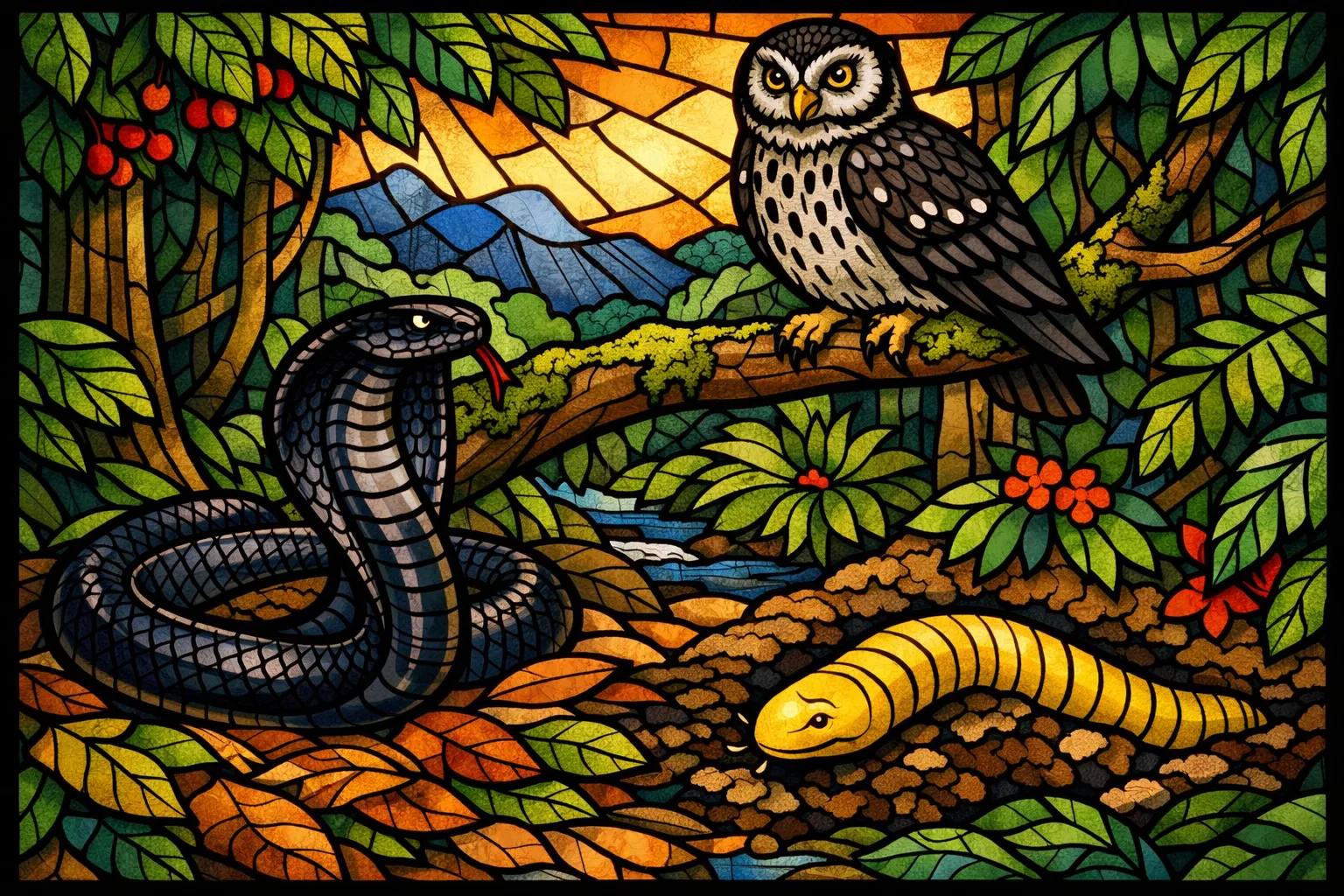
The most important figures are the ossobó, a real bird transformed into a literary and symbolic presence; the clever tortoise of traditional stories; and two snake-like animals that can look extraordinary to visitors, the black cobra and the limbless amphibian known locally as the cobra bobo. These are not undiscovered monsters. Their interest lies in how an isolated volcanic archipelago can make genuine animals seem legendary, and how oral storytelling turns familiar wildlife into tricksters, warnings and national symbols.[jstor.org]jstor.orgOssobó: Myth, History, and Intertextuality in Santomean…by J Staller · 2016 · Cited by 5 — Veiga's ossobó poems reinforce, or rep…
Why there is no single famous Santomean cryptid
The available record is unusually thin when it comes to classic cryptozoological material. There is no securely sourced sequence of monster sightings, no recognised lake-monster tradition, no sustained newspaper “flap” involving an unidentified beast and no body of photographs, tracks or specimens claimed as evidence for a large unknown animal.
That scarcity is itself informative. São Tomé and Príncipe consists of small oceanic islands whose native land-mammal fauna is limited. São Tomé has an endemic shrew and several bats, while monkeys, rats, pigs and other mammals were introduced by people. Príncipe’s documented native terrestrial fauna is similarly modest, although its birds, reptiles, amphibians and invertebrates show remarkable island endemism. Such ecosystems can conceal small species from science, but they offer little ecological room for an undiscovered population of giant apes, big cats or other large terrestrial predators.[wikipedia.org]WikipediaWildlife of São Tomé and PríncipeWildlife of São Tomé and Príncipe
The dense interior forest still provides excellent monster-story scenery. Steep volcanic terrain, heavy rain, tangled vegetation and restricted visibility can make ordinary encounters brief and ambiguous. Yet atmosphere should not be mistaken for evidence. In São Tomé and Príncipe, the stronger material concerns known animals whose appearance, behaviour or cultural meaning has become larger than life.
The animals that come closest to cryptid territory
The black cobra: an “introduced monster” that was actually endemic
São Tomé’s black cobra is the closest thing the country has to a genuine cryptozoological reversal. For many years, the snake was treated as a population of mainland forest cobras supposedly brought to the island by Portuguese settlers to control rats. That introduction story was repeated so widely that the animal could be regarded as an invasive danger rather than part of the island’s natural heritage.
A 2017 taxonomic study overturned that account. Researchers found that the cobra represented a distinct species, now named Naja peroescobari, which is endemic to São Tomé. In other words, the mysterious animal was real, but the popular explanation of its origin was wrong. The case shows how folklore-like historical repetition can influence even modern assumptions about wildlife.[ResearchGate]researchgate.netResearchGate(PDF) The "Cobra-Preta" of São Tomé Island, Gulf of…26 Sept 2017 — The Cobra-Preta (black snake in Portuguese) of Sao Tomé…
The snake’s appearance helps explain its fearsome reputation. It is large, dark and venomous, and encounters in forest or plantation vegetation may be sudden. A startled witness may remember a particularly big specimen as enormous, especially when its full body cannot be seen clearly. There is no good evidence that the island supports a separate population of unknown giant snakes, however. The documented cobra is already impressive enough to account for many dramatic reports.
The cobra also illustrates the danger of treating every local animal story as either literal fact or foolish superstition. Islanders were dealing with a real hazardous species, while scientists had misunderstood its history. The eventual solution came not from monster hunting but from specimen comparison, anatomy, genetics and taxonomy.
Cobra bobo: the “snake” that is not a snake
An even stranger-looking animal lives beneath São Tomé’s soil. The cobra bobo is a caecilian, a limbless burrowing amphibian that resembles a smooth worm or small snake. It is endemic to the island and occurs from low elevations to high ground, including forest, farmland and plantations. Individuals may be bright yellow, making them especially startling when rain or disturbed soil brings them into view.[amphibiaweb.org]amphibiaweb.orgOpen source on amphibiaweb.org.
For an observer unfamiliar with caecilians, the animal can seem anomalous: it has no visible legs, lives underground and does not fit the usual popular image of a frog or salamander. Its local name reinforces the snake comparison, even though it belongs to a different branch of the amphibian family tree.
The cobra bobo is therefore a useful model for how mystery-animal reports begin. A short glimpse produces an approximate description; the local name encourages a mistaken category; and repetition may enlarge or simplify the original encounter. In this case, scientific collections and genetic studies leave little mystery about the animal’s identity, although research has revealed considerable variation between populations across the island.[PLOS]journals.plos.orgDermophiidae: Schistometopum thomense) Reveals Strong…by RE Stoelting · 2014 · Cited by 25 — The oceanic island of São Tomé in the…
Folklore creatures rather than hidden species
Santomean animal folklore is richer than its formal cryptid record. Traditional stories commonly use animals as speaking, reasoning characters whose adventures explain physical features, social behaviour or moral consequences. These tales belong to oral literature rather than eyewitness zoology.
The best-documented recurring figure is Sun Tataluga, or Mr Tortoise. Stories collected in São Tomé and Príncipe present the tortoise as clever, ambitious and sometimes selfish. One tale explains the tortoise’s cracked shell through a local version of the widespread African story in which an earthbound animal attempts to attend a feast in the sky. Another uses a dispute over fish to expose greed and manipulation within a household.[com.br]literatura.ftd.com.brFTD LiteraturaSoyas de Sun TatalugaEsta obra reúne três contos populares de São Tomé e Príncipe protagonizados por Sun Tataluga, personag…
Such stories should not be filed as reports of anomalous talking animals. Their purpose is social and imaginative. The tortoise’s behaviour provides a memorable way to discuss intelligence, appetite, pride, deception and the consequences of overreaching. Related traditions across Atlantic Africa feature crafty hares, spiders, frogs and tortoises, suggesting that Santomean tales form part of a wider storytelling network carried and transformed through African languages, creoles, migration and colonial history.[Comum]comum.rcaap.ptOpen source on rcaap.pt.
Other popular tales give animals human capacities before explaining why those powers disappeared. A Santomean story about dogs, for example, describes a time when they could speak and makes the loss of speech the consequence of betrayal. The creature element is openly fabulous: it establishes an imagined earlier world in order to explain the familiar world of the audience.[Scribd]ro.scribd.comOpen source on scribd.com.
The ossobó: real bird, mythical voice
The ossobó occupies a special position because it is neither an unknown animal nor merely a stock fable character. It is a real bird whose call and forest presence have gathered layers of literary, historical and symbolic meaning.
Scholarly work on Santomean literature traces the ossobó through oral tradition and poetry, showing how writers repeatedly reinterpreted the bird. It may represent the natural forest, memory, aspiration, warning or the experience of a people shaped by slavery and colonial rule. The creature’s identity therefore changes according to the storyteller: it can be an observed bird, a speaking literary figure or an emblem of the islands themselves.[jstor.org]jstor.orgOssobó: Myth, History, and Intertextuality in Santomean…by J Staller · 2016 · Cited by 5 — Veiga's ossobó poems reinforce, or rep…
This is closer to myth-making than cryptozoology. No one needs to prove that the bird exists. The mystery lies in what its voice means. That distinction matters because online lists of “cryptids by country” often flatten culturally complex beings into monster entries. Doing so with the ossobó would strip away the very quality that makes it important: its passage between landscape, oral memory, literature and national identity.
Its cultural afterlife also extends beyond print. Santomean filmmaker Silas Tiny used the bird in the title of O Canto do Ossobó, demonstrating that the image remains useful in modern artistic discussion of island history and identity.[Taylor & Francis Online]tandfonline.comOpen source on tandfonline.com.

Could sea monsters arise around the islands?
The surrounding Gulf of Guinea provides more plausible conditions for mistaken “monster” sightings than the islands’ forests do. Deep water, changing light and brief surface appearances can distort the size and shape of marine animals. São Tomé and Príncipe lies in waters visited by whales, dolphins and large sea turtles, any of which can produce a dramatic silhouette when seen at distance.
Humpback whales occur seasonally offshore, while several sea-turtle species use the islands’ beaches or coastal waters. Leatherback turtles are particularly relevant to sea-monster interpretation because exceptionally large adults have dark, ridged backs and can surface unexpectedly. A partial view of a turtle, whale, line of dolphins or floating debris could easily become a serpentine or humped creature in memory.[wikipedia.org]WikipediaWildlife of São Tomé and PríncipeWildlife of São Tomé and Príncipe
Yet there is no well-supported Santomean sea-serpent case around which a national legend has formed. The marine setting supplies possibilities for future tales, not evidence of an established unknown species. Modern wildlife tourism also tends to identify the animals rather than mystify them. Guided turtle and whale excursions present spectacular encounters as conservation experiences, replacing the old “something enormous in the water” reaction with species recognition and ecological interpretation.[Príncipe Collection Hotel & Resorts]principecollection.comOpen source on principecollection.com.
What most likely explains mystery-animal reports
Where unusual creature claims do arise in São Tomé and Príncipe, several explanations deserve consideration before an unknown species is proposed.
- Known endemic animals: The black cobra, cobra bobo and numerous unusual birds can look unfamiliar even to experienced travellers.
- Introduced wildlife: Mona monkeys, feral pigs, rats and other introduced mammals may be glimpsed in conditions that obscure size or identity.
- Marine misidentification: Whales, dolphins, turtles, fish schools and floating timber can appear elongated, many-humped or much larger than they are.
- Oral-story transformation: A moral tale may later be retold as something that supposedly happened to a named person or at a real location.
- Translation and labelling: Local animal names do not always correspond neatly to English zoological categories. Calling a caecilian a “cobra”, for example, can create a false impression before the animal has even been described.
- Tourism exaggeration: Dense rainforest and unusual wildlife are strong selling points. Promotional writing may casually turn a rare but known species into a “prehistoric”, “mysterious” or “legendary” creature.
The black cobra case cautions against dismissing every strange claim too quickly, because scientific assumptions can be wrong. At the same time, its discovery does not validate giant-snake legends or suggest that every island rumour conceals a new species. It shows what convincing resolution looks like: physical specimens, detailed comparison, published research and a result that other specialists can examine.[ResearchGate]researchgate.netResearchGate(PDF) The "Cobra-Preta" of São Tomé Island, Gulf of…26 Sept 2017 — The Cobra-Preta (black snake in Portuguese) of Sao Tomé…
A country of remarkable animals, not proven monsters
São Tomé and Príncipe’s creature lore is most rewarding when it is not forced into the mould of a conventional cryptid hunt. The islands offer no persuasive evidence for a surviving prehistoric beast, giant ape, phantom cat or unknown sea serpent. What they do offer is a subtler mixture of animal fables, symbolic birds, misunderstood reptiles and genuinely unusual endemic wildlife.
The ossobó shows how a real creature can become a voice of history and identity. Sun Tataluga demonstrates how animals carry humour and moral argument through oral storytelling. The cobra bobo explains how unfamiliar anatomy can produce instant mystery, while the black cobra provides the rare case in which science corrected a long-standing account of an animal’s origins.
The central lesson is not that monsters are hiding in the forest. It is that islands can make the boundary between ordinary and extraordinary unusually porous. In São Tomé and Príncipe, the most memorable “mystery beasts” are often real animals viewed through the equally powerful lenses of isolation, fear, storytelling and cultural memory.
Amazon book picks
Further Reading
Books and field guides related to Where Wildlife Becomes Legend on Volcanic Islands. Use these as the next step if you want deeper reading beyond the article.
The Song Of The Dodo
Explains how isolated islands create unusual wildlife and legends.
The Sixth Extinction
Touches on biodiversity and rare species that can seem legendary.
The field guide to Bigfoot, Yeti, and other mystery primates...
Provides global context for places lacking a famous national cryptid.
eBay marketplace picks
Marketplace Samples
Live-tested eBay searches with available results related to this page.

Endnotes
1.
Source: jstor.org
Link:https://www.jstor.org/stable/10.2979/reseafrilite.47.4.01
Source snippet
Ossobó: Myth, History, and Intertextuality in Santomean...by J Staller · 2016 · Cited by 5 — Veiga's ossobó poems reinforce, or rep...
2.
Source: researchgate.net
Link:https://www.researchgate.net/publication/320043542_The_Cobra-Preta_of_Sao_Tome_Island_Gulf_of_Guinea_is_a_new_species_of_Naja_Laurenti_1768_Squamata_Elapidae
Source snippet
ResearchGate(PDF) The "Cobra-Preta" of São Tomé Island, Gulf of...26 Sept 2017 — The Cobra-Preta (black snake in Portuguese) of Sao Tomé...
3.
Source: journals.plos.org
Link:https://journals.plos.org/plosone/article?id=10.1371%2Fjournal.pone.0104628
Source snippet
Dermophiidae: Schistometopum thomense) Reveals Strong...by RE Stoelting · 2014 · Cited by 25 — The oceanic island of São Tomé in the...
4.
Source: Wikipedia
Title: Wildlife of São Tomé and Príncipe
Link:https://en.wikipedia.org/wiki/Wildlife_of_S%C3%A3o_Tom%C3%A9_and_Pr%C3%ADncipe
5.
Source: unesdoc.unesco.org
Link:https://unesdoc.unesco.org/ark%3A/48223/pf0000227335
Source snippet
Species diversity of wild fauna in the reserve e results from the surveys conducted among the inhabitants show that there are more than 3...
6.
Source: unesdoc.unesco.org
Link:https://unesdoc.unesco.org/ark%3A/48223/pf0000246972
Source snippet
UNESCO DocumentationFinal report of the Project on the Impact of Climate Change...The indigenous terrestrial fauna of Príncipe Island, a...
7.
Source: researchgate.net
Link:https://www.researchgate.net/profile/Luis-Ceriaco/publication/320043542_The_Cobra-Preta_of_Sao_Tome_Island_Gulf_of_Guinea_is_a_new_species_of_Naja_Laurenti_1768_Squamata_Elapidae/links/5f3ba5e5458515b7292a5e3d/The-Cobra-Preta-of-Sao-Tome-Island-Gulf-of-Guinea-is-a-new-species-of-Naja-Laurenti-1768-Squamata-Elapidae.pdf
8.
Source: amphibiaweb.org
Link:https://amphibiaweb.org/species/1937
9.
Source: ro.scribd.com
Link:https://ro.scribd.com/doc/232945310/Quando-Os-Caes-Deixaram-de-Falar
10.
Source: researchgate.net
Link:https://www.researchgate.net/publication/313484033_Ossobo_Myth_History_and_Intertextuality_in_Santomean_Literature
11.
Source: unesco.org
Title: biosphere reserves are evolving pockets hope
Link:https://www.unesco.org/en/articles/biosphere-reserves-are-evolving-pockets-hope
12.
Source: articles.unesco.org
Title: PORTUGAL National Report 2025
Link:https://articles.unesco.org/sites/default/files/medias/fichiers/2025/09/PORTUGAL%20National%20Report%202025.pdf
13.
Source: articles.unesco.org
Title: SC 25 CONF.237 13 EN New BRs
Link:https://articles.unesco.org/sites/default/files/medias/fichiers/2025/08/SC-25-CONF.237-13_EN_New_BRs.pdf
14.
Source: data.unesco.org
Link:https://data.unesco.org/explore/dataset/mab001/table/?flg=en-us
15.
Source: unesdoc.unesco.org
Link:https://unesdoc.unesco.org/ark%3A/48223/pf0000394620
16.
Source: unesdoc.unesco.org
Link:https://unesdoc.unesco.org/ark%3A/48223/pf0000227212
17.
Source: data.unesco.org
Link:https://data.unesco.org/explore/dataset/mab001/table/?flg=fr-fr
18.
Source: unesdoc.unesco.org
Link:https://unesdoc.unesco.org/ark%3A/48223/pf0000397874.locale%3Dfr
19.
Source: researchgate.net
Link:https://www.researchgate.net/publication/320868292_Species_Account_Citation_AmphibiaWeb_Schistometopum_thomense_Sao_Tome_Caecilian_httpamphibiaweborgspecies1937_University_of_California_Berkeley_CA_USA
20.
Source: Wikipedia
Title: Water spirit
Link:https://en.wikipedia.org/wiki/Water_spirit
21.
Source: Wikipedia
Link:https://en.wikipedia.org/wiki/Kobold
22.
Source: Wikipedia
Title: List of fairy tales
Link:https://en.wikipedia.org/wiki/List_of_fairy_tales
23.
Source: Wikipedia
Title: Philothamnus thomensis
Link:https://en.wikipedia.org/wiki/Philothamnus_thomensis
24.
Source: Wikipedia
Title: Naja peroescobari
Link:https://en.wikipedia.org/wiki/Naja_peroescobari
25.
Source: Wikipedia
Title: Schistometopum thomense
Link:https://en.wikipedia.org/wiki/Schistometopum_thomense
26.
Source: literatura.ftd.com.br
Link:https://literatura.ftd.com.br/obra/soyas-de-sun-tataluga/
Source snippet
FTD LiteraturaSoyas de Sun TatalugaEsta obra reúne três contos populares de São Tomé e Príncipe protagonizados por Sun Tataluga, personag...
27.
Source: telanon.info
Title: livro soyas de sun tataluga
Link:https://www.telanon.info/cultura/2015/09/17/20106/livro-soyas-de-sun-tataluga/
28.
Source: comum.rcaap.pt
Link:https://comum.rcaap.pt/bitstreams/720a4f32-9cd9-4cb5-84ca-4699d752ae4d/download
29.
Source: tandfonline.com
Link:https://www.tandfonline.com/doi/full/10.1080/01436597.2025.2478570
30.
Source: principecollection.com
Link:https://www.principecollection.com/en/experiences/turtle-watching
31.
Source: archipelagochoice.com
Link:https://www.archipelagochoice.com/our-destinations/sao-tome-and-principe/experiences/turtle-watching/
32.
Source: beastsoflegend.com
Link:https://beastsoflegend.com/bestiary/africa/central/
33.
Source: repositorium.uminho.pt
Link:https://repositorium.uminho.pt/bitstreams/d712c00d-ceea-4999-98a1-c8eb089c4500/download
34.
Source: brilliantmaps.com
Title: cryptids by country
Link:https://brilliantmaps.com/cryptids-by-country/
35.
Source: islandbiodiversityrace.wordpress.com
Link:https://islandbiodiversityrace.wordpress.com/category/snakes/
36.
Source: tilife.org
Title: Sea Serpent
Link:https://tilife.org/BackIssues/Archive/tabid/393/articleType/ArticleView/articleId/2254/Sea-Serpent.html
Additional References
37.
Source: youtube.com
Title: An Hour in Sao Tome and Principe: Sea Turtles, Cocoa Beans and Medicinal Plants
Link:https://www.youtube.com/watch?v=FVXcCnd6znQ
Source snippet
Birdwatching in São Tomé and Príncipe, the African Galapagos...
38.
Source: youtube.com
Title: Endemism gone wild: Bird evolution in the Gulf of Guinea Islands
Link:https://www.youtube.com/watch?v=xpAMuI888C8
Source snippet
Schistometopum thomense (São Tomé Caecilian, cobra bobo)...
39.
Source: youtube.com
Title: The Tropical Giant on the Brink of Extinction
Link:https://www.youtube.com/watch?v=C8SmNPo9yn4
Source snippet
An Hour in Sao Tome and Principe: Sea Turtles, Cocoa Beans and Medicinal Plants...
40.
Source: youtube.com
Title: Schistometopum thomense (São Tomé Caecilian, cobra bobo)
Link:https://www.youtube.com/watch?v=nENlpTtrZ_8
Source snippet
The Tropical Giant on the Brink of Extinction...
41.
Source: instagram.com
Link:https://www.instagram.com/p/DMB6AQGsCaQ/?hl=en
42.
Source: academia.edu
Link:https://www.academia.edu/6897808/Postcolonialism_and_religiosity_in_African_literatures
43.
Source: history.co.uk
Link:https://www.history.co.uk/articles/strange-sea-serpent-sightings-from-history
44.
Source: repositorium.uminho.pt
Link:https://repositorium.uminho.pt/bitstreams/797b1e00-e563-43fa-8ca7-c165481f2ef9/download
45.
Source: instagram.com
Link:https://www.instagram.com/reel/DHCCehHRAN3/?hl=en
46.
Source: facebook.com
Link:https://www.facebook.com/TerribleMaps/posts/countries-in-europe-whose-national-animals-are-extinct-or-mythicalby-usimple_pen/782067751248351/
Topic Tree
Follow this branch
Related pages 192
- Antigua Cryptids
- Maldives Monsters
- Malta Monsters
- Qatar Monsters
- Argentina Monsters
- +187 more in sidebar