Within Nicaragua Monsters
Is the Sisimite Really Nicaragua's Bigfoot?
The shaggy sisimite belongs to a wider Central American tradition, but Nicaragua's rainforests give the legend a convincing local setting.
On this page
- What the sisimite is said to look like
- How the legend crossed Central America
- Monkeys, big cats and other explanations
Page outline Jump by section
Introduction
The Sisimite is often described as Central America’s answer to Bigfoot: a huge, shaggy, human-like creature said to haunt mountains, caves and deep forests. In Nicaragua, however, the story occupies an unusual position. The creature is certainly known in the country, especially in regions influenced by wider Central American folklore, yet there is little evidence for a strong, distinct Nicaraguan tradition of Sisimite sightings. Instead, Nicaragua appears to have inherited the legend as part of a broader regional network of stories stretching through Honduras, Guatemala and neighbouring countries.[Wikipedia]WikipediaOpen source on wikipedia.org.
That does not make the legend unimportant. Nicaragua’s rainforests, remote mountain zones and sparsely populated wilderness areas provide exactly the sort of landscape in which tales of hidden forest beings thrive. The question is not whether Nicaragua has a famous Bigfoot equivalent with hundreds of documented encounters. Rather, it is whether a travelling Central American legend found a convincing home in Nicaraguan forests and became attached to local ideas about wilderness, danger and unexplained sounds in the jungle.[Paradigm]reference-global.comeas8, 2021 — by KM Hudson · 2021 — Today, similarly monstrous and dangerous supernatural beings, often called sisimite, are widely believed…
What the Sisimite Is Said to Look Like
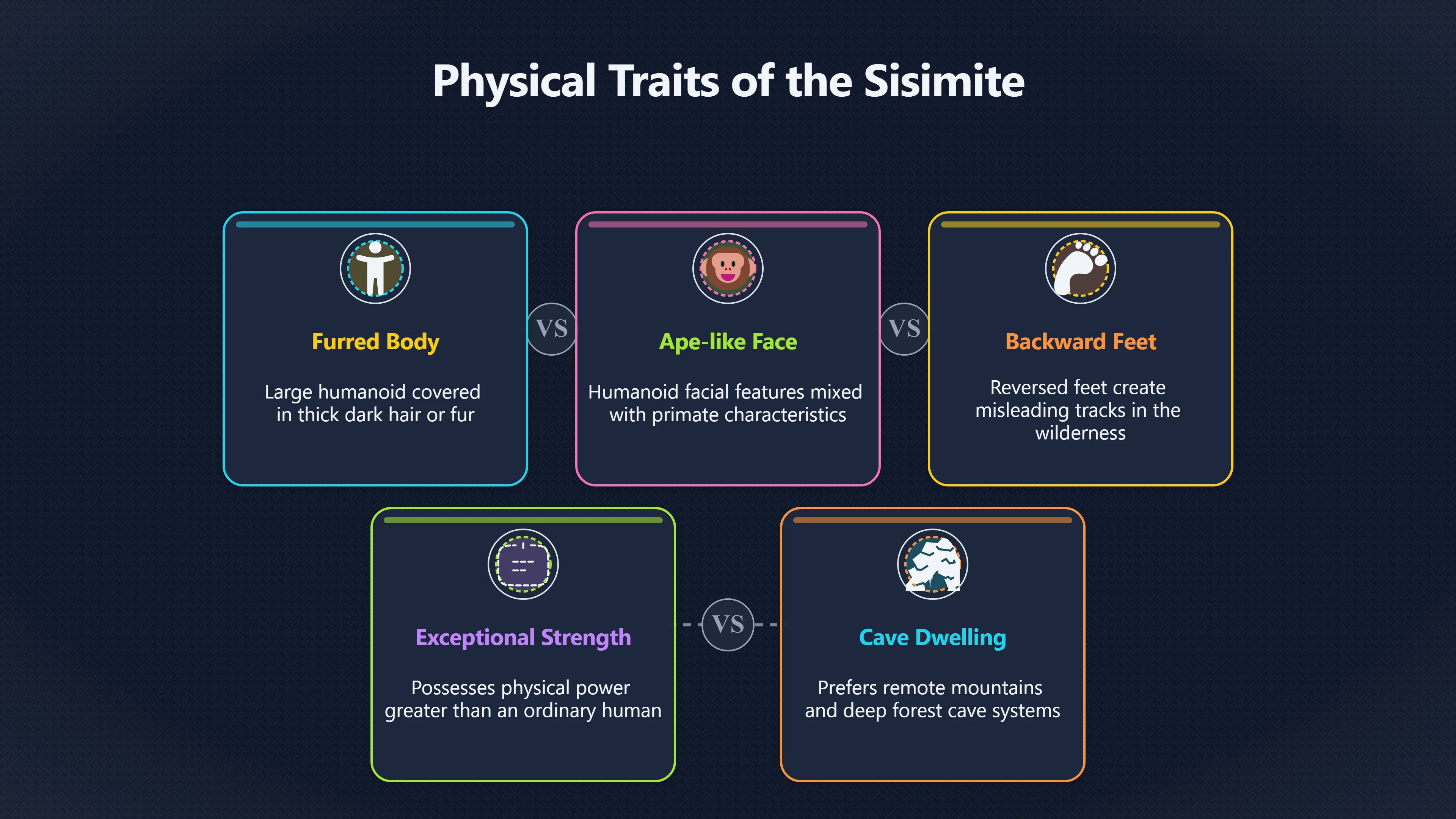
Descriptions of the Sisimite are remarkably consistent across Central America. Witness stories and folklore portray a large, powerful humanoid covered in dark hair or fur, standing upright and possessing a mixture of human and ape-like features. It is typically said to be larger and stronger than an ordinary person.[Wikipedia]WikipediaOpen source on wikipedia.org.
Several details appear repeatedly:
- A heavily furred body.
- A human-like face with ape-like characteristics.[facebook.com]facebook.comSource details in endnotes.
- Exceptional strength.
- Large footprints.
- Feet turned backwards, creating misleading tracks.
- A preference for caves, mountains and remote forest areas.[Wikipedia]WikipediaOpen source on wikipedia.org.
The backwards-foot motif is especially important. Rather than functioning as evidence of an unknown animal, it belongs to a long tradition of supernatural folklore across Mesoamerica. Creatures with reversed feet appear in several regional legends and are often associated with trickery, danger or the wilderness beyond human control.[Wikipedia]WikipediaOpen source on wikipedia.org.
This feature alone distinguishes the Sisimite from the North American Bigfoot tradition. Bigfoot stories generally attempt to describe a flesh-and-blood animal. The Sisimite, by contrast, often occupies a borderland between monster, spirit and wild forest guardian.[Reddit]reddit.comThe Sisimité is a cryptid primate reported from CentralTata Duhende(duende) as the creature with backwards feet and no thumbs. These are more considered…
How the Legend Crossed Central America
The strongest evidence suggests that the Sisimite is not primarily a Nicaraguan creation. Folklore researchers and historical accounts consistently place the creature’s cultural centre in Honduras, where it became one of the country’s best-known legendary beings. From there, related traditions appear in Guatemala, Belize, El Salvador and Nicaragua under slightly different names and descriptions.[Wikipedia]WikipediaOpen source on wikipedia.org.
The creature’s name is often linked to older Mesoamerican traditions and may ultimately derive from concepts associated with the Nahua tzitzimime, supernatural beings that evolved and changed as stories moved through different cultures. Scholars examining these traditions have noted that modern Sisimite-type creatures frequently inhabit remote landscapes and function as warnings about venturing beyond safe social spaces.[Paradigm]reference-global.comeas8, 2021 — by KM Hudson · 2021 — Today, similarly monstrous and dangerous supernatural beings, often called sisimite, are widely believed…
For Nicaragua, this wider regional context matters. The country shares ecological zones, migration routes and cultural connections with its neighbours. Folktales have historically travelled along the same paths as traders, settlers, hunters and Indigenous communities. As a result, Nicaragua inherited many Central American supernatural traditions rather than developing entirely separate versions.[Paradigm]reference-global.comeas8, 2021 — by KM Hudson · 2021 — Today, similarly monstrous and dangerous supernatural beings, often called sisimite, are widely believed…
This helps explain why references to the Sisimite appear in Nicaragua but rarely emerge as a uniquely Nicaraguan cryptid with a large archive of local newspaper reports or famous encounter cases.
Why Nicaragua’s Forests Make the Story Feel Plausible
Even though documented Nicaraguan Sisimite reports are scarce, the country’s geography gives the legend unusual staying power.
Eastern Nicaragua contains extensive tropical forests, including parts of the Bosawás Biosphere Reserve, one of the largest remaining rainforest regions in Central America. Large areas remain difficult to access and support a wide range of wildlife. In such environments, unfamiliar sounds, fleeting glimpses and misunderstood animal encounters can easily acquire folkloric explanations.[Paradigm]reference-global.comeas8, 2021 — by KM Hudson · 2021 — Today, similarly monstrous and dangerous supernatural beings, often called sisimite, are widely believed…
For generations, stories of a giant forest-dweller have served practical purposes:
- Warning children against wandering into dangerous terrain.
- Explaining mysterious noises at night.
- Reinforcing respect for remote wilderness.
- Providing a memorable embodiment of the forest’s unpredictability.[Folktales America]folktalesamerica.comFolktales America El Sisimite (Itacayo): The Mountain Giant of HondurasFolktales America El Sisimite (Itacayo): The Mountain Giant of Honduras
In this sense, the Sisimite resembles many wilderness beings worldwide. The creature becomes a way of talking about landscapes that feel larger, older and less controllable than human settlements.
Is There Any Actual Evidence?
From a cryptozoological perspective, the evidence for a real Sisimite in Nicaragua is extremely thin.
Unlike some famous Bigfoot regions in North America, Nicaragua has not produced a substantial body of claimed footprints, photographs, hair samples or recurring modern sighting investigations associated specifically with the Sisimite. Most references point back to folklore rather than independently documented encounters.[Wikipedia]WikipediaOpen source on wikipedia.org.
The available material generally falls into three categories:
Traditional stories. These are oral narratives passed through communities and often include supernatural elements such as reversed feet, impossible strength or magical behaviour.[Wikipedia]WikipediaOpen source on wikipedia.org.
Second-hand reports. Accounts are frequently attributed to a friend, relative or elder rather than a directly recorded witness.[Reddit]reddit.comThe Sisimité is a cryptid primate reported from CentralTata Duhende(duende) as the creature with backwards feet and no thumbs. These are more considered…
Modern cryptid reinterpretations. Internet discussions and popular cryptid databases sometimes recast the Sisimite as a hidden ape species, even though the older folklore often treats it as something more supernatural than zoological.[Cryptid Archives]cryptidarchives.fandom.comCryptid Archives SisemitéCryptid Archives Sisemité
The result is a legend that is culturally rich but poorly supported as evidence for an undiscovered primate.
Monkeys, Big Cats and Other Explanations
If people in Nicaragua believed they encountered a Sisimite, what might they actually have seen?
One possibility is simple misidentification. Nicaragua’s forests contain wildlife capable of producing startling sounds and brief, confusing sightings. Howler monkeys are famous for calls that can sound far larger and more threatening than the animals themselves. In dense vegetation, hearing a powerful roar without seeing its source can easily encourage stories about something enormous lurking in the trees.
Large cats offer another explanation. Jaguars and pumas are elusive, mostly nocturnal and capable of leaving impressions on witnesses who encounter them unexpectedly. Although nobody would mistake a jaguar for a giant ape in good conditions, poor visibility and fear can dramatically alter perception.[RUTA]ruta.orgFolklore and legends in Central AmericaFolklore and legends in Central America - RUTA6 May 2025 — El Sisimite is often portrayed as a guardian of the forest. Its presence s…
A third explanation is cultural rather than biological. Once a story becomes familiar, ambiguous experiences are often interpreted through that story. An unexplained footprint, a strange cry in the forest or a glimpse of movement at dusk can become evidence of the creature people already know about. Folklore scholars frequently describe this process as one reason legends persist long after their original context has changed.[ResearchGate]researchgate.netTzitzimime and their Relatives as Enforcers of Social Control28 Apr 2026 — This paper traces the development of these creatur…
Nicaragua’s Bigfoot or Something Different?
Calling the Sisimite “Nicaragua’s Bigfoot” is useful as a shorthand, but it can also be misleading.
Bigfoot is usually presented as a hidden animal awaiting scientific discovery. The Sisimite traditionally occupies a broader role. It is a monster, wilderness spirit, cautionary tale and cultural symbol all at once. Its backwards feet, cave-dwelling habits and supernatural reputation place it firmly within the world of folklore even when modern writers compare it to an undiscovered ape.[Wikipedia]WikipediaOpen source on wikipedia.org.
For Nicaragua, the most accurate view is that the Sisimite represents a regional Central American legend that found fertile ground in the country’s vast forests. The landscape makes the story feel believable, but the surviving evidence points far more strongly toward folklore than toward a hidden species. The mystery lies not in proof of an unknown ape, but in how a shared forest legend travelled across borders and became part of Nicaragua’s wider tradition of strange creatures and unexplained wilderness tales.[reference-global.com]reference-global.comeas8, 2021 — by KM Hudson · 2021 — Today, similarly monstrous and dangerous supernatural beings, often called sisimite, are widely believed…
Amazon book picks
Further Reading
Books and field guides related to Is the Sisimite Really Nicaragua's Bigfoot?. Use these as the next step if you want deeper reading beyond the article.
Latin American Folktales
Provides cultural context for Central American legendary beings.
The Field Guide to Bigfoot and Other Mystery Primates
Directly relevant to comparisons between the Sisimite and Bigfoot.
The World of Lore: Monstrous Creatures
Explores monster traditions similar to the Sisimite legend.
eBay marketplace picks
Marketplace Samples
Live-tested eBay searches with available results related to this page.
Endnotes
1.
Source: Wikipedia
Link:https://en.wikipedia.org/wiki/Sisimito
2.
Source: Wikipedia
Link:https://es.wikipedia.org/wiki/Sisimite
3.
Source: ruta.org
Title: Folklore and legends in Central America
Link:https://www.ruta.org/folklore-and-legends-in-central-america/
Source snippet
Folklore and legends in Central America - RUTA6 May 2025 — El Sisimite is often portrayed as a guardian of the forest. Its presence s...
Published: May 2025
4.
Source: Wikipedia
Link:https://en.wikipedia.org/wiki/Cipit%C3%ADo
5.
Source: researchgate.net
Link:https://www.researchgate.net/publication/356421193_A_Monstrous_morality_Tzitzimime_and_their_relatives_as_enforcers_of_social_control
Source snippet
Tzitzimime and their Relatives as Enforcers of Social Control28 Apr 2026 — This paper traces the development of these creatur...
6.
Source: reddit.com
Title: The Sisimité is a cryptid primate reported from Central
Link:https://www.reddit.com/r/Cryptozoology/comments/11rhbzy/the_sisimit%C3%A9_is_a_cryptid_primate_reported_from/
Source snippet
Tata Duhende(duende) as the creature with backwards feet and no thumbs. These are more considered...
7.
Source: reference-global.com
Title: eas 2021 0020
Link:https://reference-global.com/download/article/10.2478/eas-2021-0020.pdf
Source snippet
8, 2021 — by KM Hudson · 2021 — Today, similarly monstrous and dangerous supernatural beings, often called sisimite, are widely believed...
8.
Source: folktalesamerica.com
Link:https://folktalesamerica.com/the-sisimite-honduran-folktale/
Source snippet
Folktales AmericaThe Sisimite: Honduran Folktale - FolktalesAmerica.com1 Nov 2025 — The Sisimite is a legendary creature from Honduran fo...
9.
Source: folktalesamerica.com
Title: Folktales America El Sisimite (Itacayo): The Mountain Giant of Honduras
Link:https://folktalesamerica.com/el-sisimite-itacayo-the-mountain-giant-of-honduras/
10.
Source: cryptidarchives.fandom.com
Title: Cryptid Archives Sisemité
Link:https://cryptidarchives.fandom.com/wiki/Sisemit%C3%A9
11.
Source: facebook.com
Link:https://www.facebook.com/unrulynationn/posts/sisimito-the-backward-footed-beast-of-belize/122118916436417000/
Additional References
12.
Source: arxiv.org
Link:https://arxiv.org/abs/2006.10045
13.
Source: youtube.com
Title: A Maya Archeological Site Guard Shares Encounters with Legendary Creatures
Link:https://www.youtube.com/watch?v=fmG1Aac8Ew0
Source snippet
The Devil's Snare | The Vampire Vine of Nicaragua...
14.
Source: instagram.com
Link:https://www.instagram.com/p/DBp2O_Ts7yH/?hl=en
15.
Source: facebook.com
Link:https://www.facebook.com/CorozalDaily/posts/the-legendary-sisimitebelize-yucatec-maya-sisimite-native-to-the-world-of-the-ma/2911652189051137/
16.
Source: facebook.com
Link:https://www.facebook.com/andycolonvo/videos/the-5-strangest-creatures-of-latin-america/1438464107354727/
17.
Source: instagram.com
Link:https://www.instagram.com/reel/DXQwRHeEa-W/
18.
Source: youtube.com
Title: Críptidos: Search for Cryptids of Mexico
Link:https://www.youtube.com/watch?v=x5KMjT9QTso
Source snippet
A Maya Archeological Site Guard Shares Encounters with Legendary Creatures...
19.
Source: youtube.com
Title: The Native Bigfoot
Link:https://www.youtube.com/watch?v=7zJhJsdoTYQ
Source snippet
Críptidos: Search for Cryptids of Mexico - Part 1...
20.
Source: youtube.com
Title: The Devil’s Snare | The Vampire Vine of Nicaragua
Link:https://www.youtube.com/watch?v=Ai1c94w97s8
21.
Source: youtube.com
Title: Cryptids & Myths of North America
Link:https://www.youtube.com/watch?v=R-rx79tjCFQ
Source snippet
The Native Bigfoot...
Topic Tree