Within Japan Cryptids
When Does Folklore Become A Cryptid?
Japan's river beings and squat mystery snakes show how warnings, old illustrations, bounties and festivals can turn folklore into searches.
On this page
- River warnings and water beings
- The tsuchinoko search tradition
- Mummies, mascots and tourist afterlives
Page outline Jump by section
Introduction
Japan offers some of the clearest examples of how folklore can gradually transform into something that looks very much like a modern cryptid. Rather than beginning as claims about undiscovered animals, many Japanese creature stories started as cautionary tales, local spirits, religious traditions or illustrated monsters. Over time, some of them acquired eyewitness reports, newspaper coverage, reward money, search expeditions and tourist attractions. The result is a blurred zone where folklore and cryptozoology overlap.

Two creatures illustrate this process particularly well. The kappa began as a river-dwelling being used in stories about the dangers of water. The tsuchinoko, by contrast, evolved into a mystery-animal hunt, complete with bounties and organised search parties. Together they show how legends can move from folklore into the realm of alleged animal sightings without ever becoming confirmed zoological discoveries.[wikipedia.org]WikipediaKappa (folkloreKappa (folklore
River Warnings And Water Beings
The kappa is one of Japan’s most famous supernatural creatures. Traditionally described as a water-dwelling being associated with rivers, ponds and lakes, it appears in stories across the country under dozens of regional names. Its appearance varies, but common features include a turtle-like shell, webbed limbs and an association with waterways.[wikipedia.org]WikipediaKappa (folkloreKappa (folklore
What makes the kappa important in a discussion of cryptids is not the creature itself but its social function. For centuries, kappa stories acted as warnings about dangerous water. Children were told that river creatures might drag careless swimmers beneath the surface. Even today, some communities place kappa-themed warning signs near rivers and ponds as a memorable way of communicating water safety.[wikipedia.org]WikipediaKappa (folkloreKappa (folklore
This origin separates the kappa from many Western cryptids. The story was not initially asking whether an unknown animal existed. It was explaining why rivers should be treated with caution. In many regions, the creature was also linked with water deities and local religious traditions, giving it a role beyond simple monster tales.[Wikipedia]WikipediaKappa (folkloreKappa (folklore
Yet folklore can invite literal interpretation. Old accounts described encounters, footprints, attacks on livestock and unusual creatures seen near water. Once these stories were recorded in books and local histories, some readers began treating them less as symbolic tales and more as reports of a mysterious being. The boundary between legend and alleged observation became increasingly porous.[Wikipedia]WikipediaKappa (folkloreKappa (folklore
From Folk Spirit To Possible Creature
A recurring pattern in cryptid history is the reinterpretation of older folklore as evidence of an undiscovered animal. The kappa demonstrates this perfectly.
During the Edo period, scholars and collectors catalogued strange creatures, including water beings that later generations would identify as kappa. The National Diet Library notes that dedicated works discussing such creatures were being compiled as early as the early nineteenth century. This helped transform oral tradition into something resembling a body of records.[Wikipedia]WikipediaKappa (folkloreKappa (folklore
In modern times, stories about alleged kappa remains have further blurred the distinction. Various temples, private collections and local institutions have displayed supposed kappa mummies or skeletal fragments. These specimens have attracted curiosity, but none has provided accepted evidence for a real species. Instead, they function much like mermaid mummies elsewhere in the world: fascinating cultural artefacts that reveal how strongly people want folklore to leave physical traces.[Wikipedia]WikipediaKappa (folkloreKappa (folklore
The Tsuchinoko Search Tradition
If the kappa shows folklore drifting toward cryptozoology, the tsuchinoko shows folklore becoming a full-scale cryptid hunt.
Descriptions of the creature are surprisingly consistent. Witnesses and legends portray it as a short, snake-like animal with an unusually thick middle section. Reports often claim it can jump, roll, move in unexpected ways or make unusual sounds. Depending on the region, it appears under several different names, but the broad image remains recognisable.[Wikipedia]WikipediaOpen source on wikipedia.org.
Unlike the kappa, which is deeply embedded in supernatural tradition, the tsuchinoko is often discussed as though it might be an undiscovered animal. Sighting reports increased dramatically during the late twentieth century, particularly during the 1980s. Newspapers, magazines and television programmes treated the creature as a mystery that might be solved through field searches rather than folklore research.[Wikipedia]WikipediaOpen source on wikipedia.org.
The turning point came when local authorities realised that cryptid hunting could attract visitors. In 1988, officials in Shimokitayama, Nara Prefecture, organised a major expedition and offered a reward for the creature’s capture. Hundreds of participants joined the search. No tsuchinoko was found, but the event succeeded in creating publicity and establishing the creature as a modern Japanese cryptid.[Wikipedia]WikipediaOpen source on wikipedia.org.
Why The Search Never Ends
The tsuchinoko survives because it occupies a useful middle ground.
Unlike a clearly supernatural monster, it could theoretically be a real animal. Unlike an ordinary snake, it is unusual enough to inspire speculation. Suggested explanations include misidentified vipers, unusual body shapes caused by recently fed snakes, distorted sightings, local folklore influencing perception, or simple storytelling traditions. None has completely eliminated the legend because the creature’s description is flexible enough to absorb new reports.[Wikipedia]WikipediaOpen source on wikipedia.org.
Reward money has also helped keep the story alive. Over the years, towns and organisations have offered increasingly dramatic bounties for proof of the creature. The reward itself becomes news, generating fresh interest regardless of whether evidence appears. In this sense, the tsuchinoko functions as both a mystery animal and a cultural event.[Wikipedia]WikipediaOpen source on wikipedia.org.
Annual festivals continue the tradition. Search parties, themed events and local celebrations transform the hunt into a communal activity. Participants may not genuinely expect to discover a new species, but they enjoy taking part in a living legend. A 2024 festival in Gifu Prefecture reportedly attracted hundreds of searchers, demonstrating the enduring appeal of the story.[Mainichi]mainichi.jp800 join search party for legendary 'tsuchinoko' creature in…7 May 2024 — The 32nd Tsuchinoko Festa was held in the central Ja…
Mummies, Mascots And Tourist Afterlives
One of the most revealing features of Japanese creature traditions is what happens after belief fades.
In many countries, cryptid stories either collapse under scrutiny or persist as fringe mysteries. In Japan, they often evolve into local heritage. Kappa legends are attached to streams, shrines, statues and mascots. Towns such as Tōno have embraced their association with kappa folklore, turning legendary locations into attractions that celebrate regional identity rather than claiming scientific proof.[Wikipedia]WikipediaTōno, IwateTōno, Iwate
The tsuchinoko follows a similar pattern. Search grounds become parks, festivals become annual traditions and mystery creatures become mascots. The creature’s economic value often exceeds any value it might have as biological evidence. Visitors arrive, souvenirs are sold and the legend gains another generation of supporters.[Wikipedia]WikipediaOpen source on wikipedia.org.
Purported monster remains play a comparable role. Alleged kappa mummies, displayed in temples, museums or private collections, are usually more significant as cultural objects than as zoological specimens. They demonstrate how communities preserve folklore by giving it a physical presence. Visitors can see something tangible, even when the underlying claim remains unproven.[Wikipedia]WikipediaKappa (folkloreKappa (folklore

When Does Folklore Become A Cryptid?
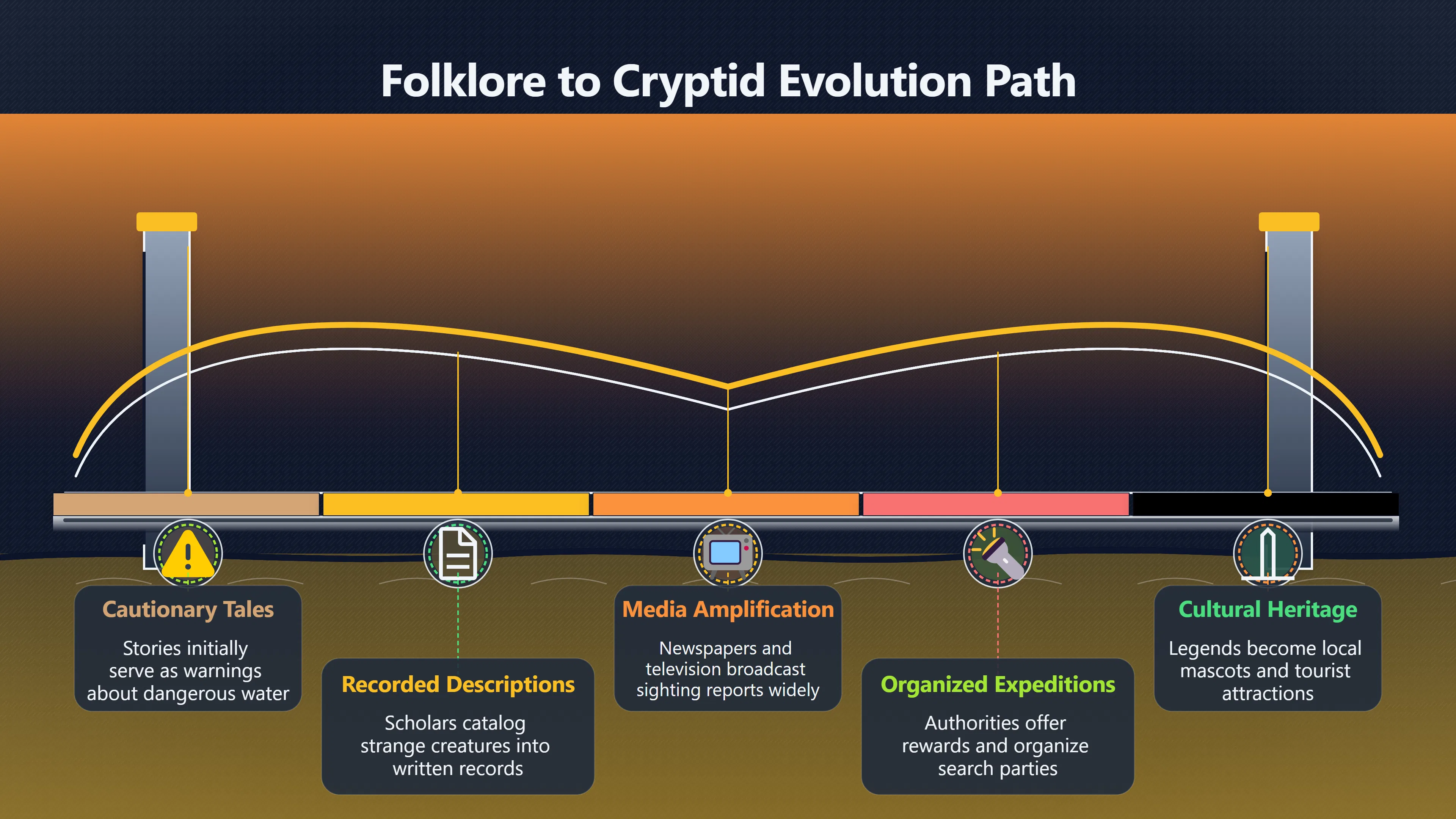
The Japanese examples suggest there is no single moment when folklore becomes a cryptid. Instead, several stages tend to appear:
- A traditional story explains a danger, landscape or local belief.
- The creature acquires recorded descriptions and named locations.
- Witnesses begin reporting encounters as real events.
- Newspapers, magazines or television amplify the reports.
- Searches, rewards or investigations are organised.
- Tourism and local identity keep the story alive even when evidence remains elusive.
The kappa and the tsuchinoko occupy different points along this spectrum. The kappa remains primarily a folklore being that occasionally attracts literal interpretation. The tsuchinoko has become a classic cryptid-style mystery, pursued through searches and bounties despite a lack of convincing evidence. Together they illustrate a broader pattern in Japan: legends do not simply disappear. They adapt, becoming part folklore, part entertainment, part local heritage and, sometimes, part cryptid hunt.[Wikipedia]WikipediaKappa (folkloreKappa (folklore
Amazon book picks
Further Reading
Books and field guides related to When Does Folklore Become A Cryptid?. Use these as the next step if you want deeper reading beyond the article.
The Book of Yokai
Directly addresses how folklore creatures are understood in modern culture.
eBay marketplace picks
Marketplace Samples
Live-tested eBay searches with available results related to this page.




Endnotes
1.
Source: Wikipedia
Title: Kappa (folklore)
Link:https://en.wikipedia.org/wiki/Kappa_%28folklore%29
2.
Source: jeepe.jp
Link:https://www.jeepe.jp/en/articles/what-is-kappa-1617
Source snippet
Japan Travel GuideKappa: Japan's Water Yokai of Rivers & Folklore | JeePeKappa tales have been passed down as folkloric devices t...
3.
Source: Wikipedia
Link:https://en.wikipedia.org/wiki/Tsuchinoko
4.
Source: onmarkproductions.com
Link:https://www.onmarkproductions.com/html/kappa.shtml
Source snippet
Kappa - River Imp (Kami) in Japanese Shinto and Buddhist...Kappa are Japanese flesh-eating water imps who live in rivers, lakes, ponds...
5.
Source: blog.gaijinpot.com
Title: cautionary kappa folktales and modern japan
Link:https://blog.gaijinpot.com/cautionary-kappa-folktales-and-modern-japan/
Source snippet
18 Sept 2023 — Gradually, signs depicted with kappa warnings were placed near potentially dangerous bodies of water in Japanese towns and...
6.
Source: Wikipedia
Link:https://de.wikipedia.org/wiki/Tsuchinoko
7.
Source: Wikipedia
Link:https://fr.wikipedia.org/wiki/Tsuchinoko
8.
Source: mainichi.jp
Link:https://mainichi.jp/english/articles/20240507/p2a/00m/0na/009000c
Source snippet
800 join search party for legendary 'tsuchinoko' creature in...7 May 2024 — The 32nd Tsuchinoko Festa was held in the central Ja...
Published: May 2024
9.
Source: Wikipedia
Title: Tōno, Iwate
Link:https://en.wikipedia.org/wiki/T%C5%8Dno%2C_Iwate
10.
Source: sumikko-gurashi.fandom.com
Link:https://sumikko-gurashi.fandom.com/wiki/Tsuchinoko
Source snippet
Sumikko Gurashi Wiki - FandomMuch like Bigfoot in America, Tsuchinoko has had a bounty for its capture by the local government of Yoshiic...
11.
Source: japanesetales.com
Link:https://japanesetales.com/kappa/
Source snippet
The Kappa – An intriguing Japanese Monster7 Jun 2019 — The Kappa is one of Japan's most famous monsters it is an amphibious yokai demon o...
Additional References
12.
Source: sidestreetjapan.com
Link:https://sidestreetjapan.com/kappa/
Source snippet
Kappa: Japan's Most Famous Mythical CreatureLearn what the kappa is, read a short tale inspired by its legend, and explore real places in...
13.
Source: facebook.com
Link:https://www.facebook.com/groups/derpetology/posts/780617086390286/
Source snippet
Tsuchinoko a Japanese mythological creature found in japanOther mummies found in the temples are the Kappa mummies, which is arguably the...
14.
Source: tvtropes.org
Link:https://tvtropes.org/pmwiki/pmwiki.php/Main/Tsuchinoko
15.
Source: ancient-origins.net
Link:https://www.ancient-origins.net/articles/strange-origin-kappa-japanese-water-imp
Source snippet
The Strange Origin of the Kappa: Japanese Water ImpAccording to legend, there was once a kappa that looked especially like a human child...
16.
Source: reddit.com
Link:https://www.reddit.com/r/Cryptozoology/comments/1qwbuk3/deep_dive_into_the_tsuchinoko_archives_my/
Source snippet
k to the Edo period (1700s), long before exotic vipers or Blue-...Read more...
17.
Source: facebook.com
Link:https://www.facebook.com/61574974992206/posts/did-you-know-theres-a-creature-in-japanese-folklore-that-lives-in-rivers-and-pon/122159326214832499/
Source snippet
Imp, Water Sprite Origin = Japan (with Chinese & Hindu...Read more...
18.
Source: cryptidz.fandom.com
Title: Cryptid Wiki Tsuchinoko | Cryptid Wiki
Link:https://cryptidz.fandom.com/wiki/Tsuchinoko
Source snippet
Cryptid WikiTsuchinoko | Cryptid Wiki - FandomOn May 3rd an annual Tsuchinoko Festival is held in Higashishirakawa in Gifu prefecture whe...
19.
Source: uncannyjapan.com
Title: hunting for a tsuchinoko
Link:https://uncannyjapan.com/podcast/hunting-for-a-tsuchinoko/
Source snippet
(Ep. 108)15 Sept 2022 — The tsuchinoko is a mysterious, mythical creature that can be seen and heard all over Japan since ancient times...
20.
Source: arigatotravel.com
Title: what are japans yokai
Link:https://arigatotravel.com/blog/what-are-japans-yokai
Source snippet
What Are Japan's Famous Yokai?6 Sept 2025 — Another of Japan's most beloved Yokai is the kappa. Easily recognizable, kappa are depicted a...
21.
Source: facebook.com
Title: The Folklore Podcast
Link:https://www.facebook.com/TheFolklorePodcast/posts/naaaaaaw-isnt-he-cute-this-is-the-kappa-a-river-creature-which-is-one-of-the-thr/1450264300447819/
Source snippet
Kappa have been used to warn children of the dangers lurking in rivers and lakes, as kappa have been often said to try to lure pe...
Topic Tree