Within Nepal Cryptids
Why Did Everest Become Yeti Country?
Everest routes, high passes and Sherpa communities turned scattered mountain stories into Nepal's best-known mystery-animal tradition.
On this page
- Where sightings and tracks cluster
- How expeditions spread the legend
- From local mountain being to global cryptid
Page outline Jump by section
Introduction
The Yeti became Nepal’s most famous mystery-animal story not simply because of folklore, but because the Everest region placed local mountain traditions directly in the path of twentieth-century exploration. The Khumbu—the homeland of many Sherpa communities and the gateway to Everest—provided the perfect setting: remote valleys, high glaciers, dangerous passes, and a steady stream of climbers, journalists, and photographers eager to document the unknown. By the middle of the twentieth century, reports from this region had transformed the Yeti from a largely local mountain being into an international sensation. Yet the history of those reports is more complicated than the familiar image of a giant ape roaming snowy peaks. It is a story of footprints, monastery relics, expedition publicity, tourism, and an ongoing debate over whether witnesses encountered an unknown creature, misunderstood wildlife, or something shaped by folklore and expectation.[Wikipedia]WikipediaApril 17, 2026 — Mount Everest in 1951, Eric Shipton took photographs of a number of large prints in the snow, at about 6,000 m (20,000 f…

Why Did Everest Become Yeti Country?
Long before the Yeti became a global cryptid, the Everest region was already associated with stories of mysterious beings inhabiting remote mountains. What changed was access. When Nepal opened to foreign mountaineering expeditions in the twentieth century, Everest became one of the world’s most closely watched landscapes. Every unusual track, rumour, or local story suddenly had an international audience.
The Khumbu stood at the centre of this transformation. Trekking routes linked villages, monasteries, glaciers, and high passes. Expedition teams relied heavily on Sherpa guides and porters, who often shared local stories about strange creatures said to inhabit wilderness areas beyond normal settlement. Journalists accompanying or reporting on expeditions amplified these accounts, and newspapers eagerly embraced the idea of an “Abominable Snowman” living among the world’s highest mountains.[wikipedia.org]Wikipedia1951 British Mount Everest reconnaissance expeditionThe expedition reconnoitred various possible routes for climbing Mount Everest from Nepal concluding that the one via the Khumbu Icefall…
Unlike many cryptid traditions that remained regional curiosities, the Yeti became attached to one of the most famous places on Earth. Every Everest season offered the possibility of another sighting, another set of tracks, or another expedition seeking evidence.
Where Sightings and Tracks Cluster
Yeti reports in Nepal are strongly concentrated around the Everest and Khumbu region rather than being evenly distributed across the country.
Several locations appear repeatedly in historical accounts:
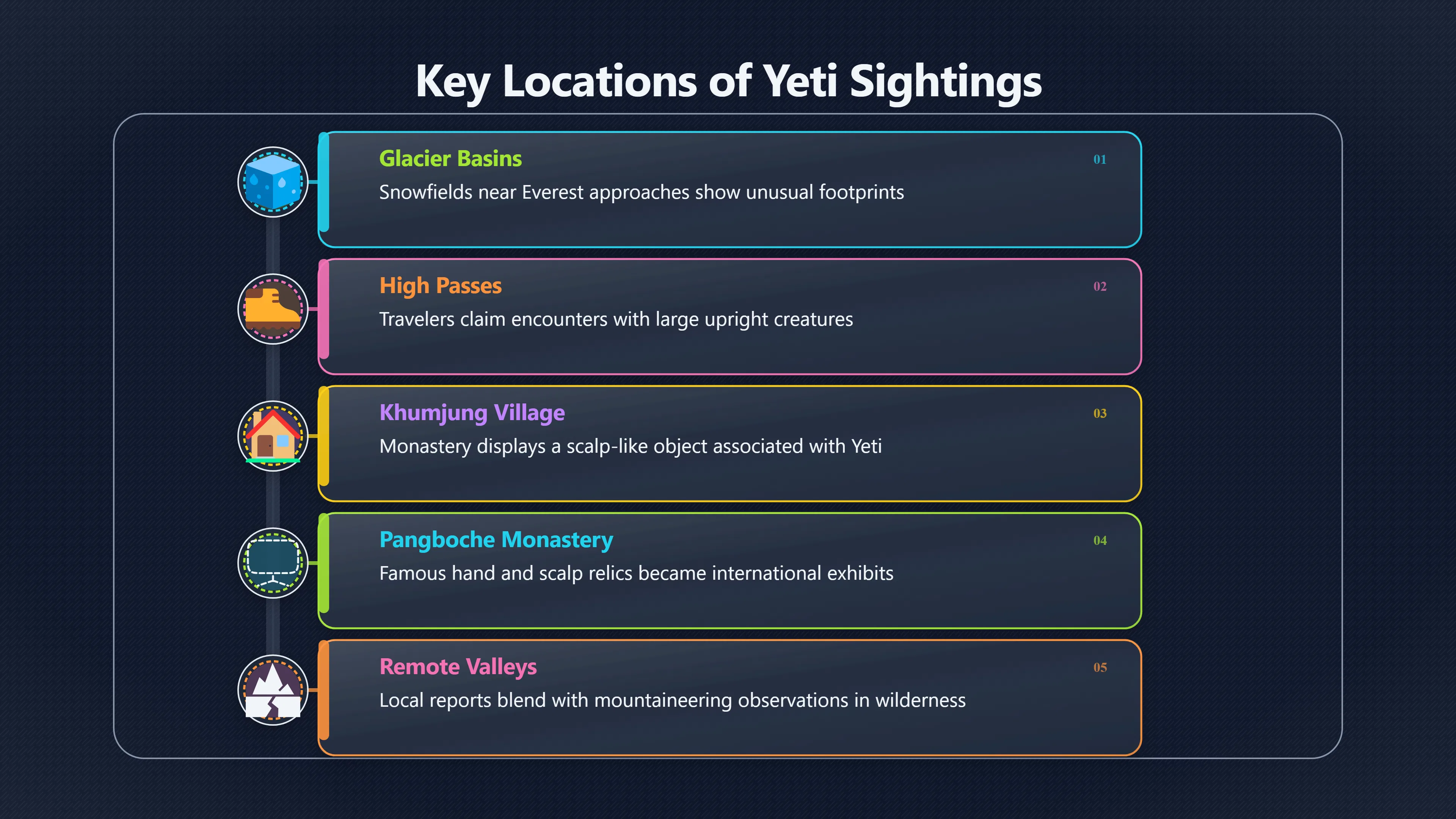
- Glacier basins and snowfields near Everest approaches, where unusual footprints were most often reported.
- High passes connecting valleys, where travellers occasionally claimed encounters with large, upright creatures.
- Villages such as Khumjung and Pangboche, which became associated with relics said to come from Yetis.
- Remote valleys bordering the higher Himalaya, where local reports blended with mountaineering observations.[wikipedia.org]WikipediaApril 17, 2026 — Mount Everest in 1951, Eric Shipton took photographs of a number of large prints in the snow, at about 6,000 m (20,000 f…
The geography itself encouraged mystery. Snow alters footprints rapidly. Wind reshapes tracks. Melting and refreezing can enlarge ordinary animal prints into forms that appear surprisingly human-like. In terrain where visibility can change within minutes, even experienced mountaineers sometimes struggled to identify what they were seeing. These environmental conditions became an important part of later sceptical explanations.[alpinejournal.org.uk]alpinejournal.org.ukKarakoram the footprints belonged to the yeti, E Shipton, The…
The Footprints That Changed Everything
No single piece of Yeti evidence had a greater impact than the footprint photographs taken during Eric Shipton’s 1951 Everest reconnaissance expedition.
While exploring approaches to Everest from Nepal, Shipton and colleagues photographed a series of large tracks in snow. One image, showing a footprint beside an ice axe for scale, became one of the most famous photographs in cryptid history. The prints appeared unusually large and displayed an odd arrangement of toe-like shapes. Newspapers around the world reproduced the image, and for many readers it became visual proof that something unknown inhabited the Himalaya.[wikipedia.org]WikipediaApril 17, 2026 — Mount Everest in 1951, Eric Shipton took photographs of a number of large prints in the snow, at about 6,000 m (20,000 f…
The photograph remains influential because it captured a genuine mystery rather than an obvious fake. Even today there is disagreement about what produced the tracks. Suggestions have included bears, wolves, snow distortion, overlapping prints, or a combination of environmental effects. Yet none of these explanations has completely removed the image from Yeti lore. The footprint became the symbol of the Everest Yeti, reproduced in books, magazines, documentaries, and museum exhibits for decades.[alpinejournal.org.uk]alpinejournal.org.ukKarakoram the footprints belonged to the yeti, E Shipton, The…
How Expeditions Spread the Legend
The Everest region did not merely generate Yeti reports; it exported them.[curiousarchive.com]curiousarchive.comeverest yeti shiptonCurious ArchiveThe Yeti Footprints of Mount Everest, as Photographed by Eric…Jul 13, 2022 — At around 15-16,000 feet, Shipton and Ward…
During the 1950s, Everest expeditions attracted unprecedented media attention. Climbers returned home with stories from places that few outsiders had ever visited. Accounts of unusual tracks, distant figures, and local traditions circulated through newspapers, radio broadcasts, travel books, and later television programmes. The Yeti became intertwined with the romance of Himalayan exploration itself.[AAC Publications]publications.americanalpineclub.orgAAC Publications Asia, Nepal, Abominable SnowmanEric Shipton, leader of the post-monsoon British reconnaissance expedition to the S. side of Mount Everest…Read more…
A series of dedicated Yeti investigations followed. Wealthy American adventurer Tom Slick sponsored expeditions specifically aimed at gathering evidence. Researchers interviewed local residents, searched for tracks, collected hair samples, and examined monastery relics. These expeditions rarely produced conclusive results, but they generated extensive publicity and ensured that the Khumbu remained the centre of the global Yeti hunt.[Wikipedia]WikipediaPangboche HandPangboche Hand
The pattern became self-reinforcing. Because climbers expected to hear Yeti stories in the Everest region, they paid attention to reports they might have ignored elsewhere. Every new expedition arrived already aware of the legend, making the Khumbu both a real landscape and a stage on which the Yeti story continued to evolve.

The Monasteries That Became Part of the Mystery
Two Khumbu villages became especially important in Yeti history: Khumjung and Pangboche.
At Khumjung Monastery, visitors were shown a scalp-like object said to be associated with a Yeti. At Pangboche Monastery, a hand and scalp became internationally famous after being photographed and investigated by foreign researchers. These objects were treated locally as significant religious relics long before they became cryptozoological exhibits.[World Travel Family]worldtravelfamily.comthe yeti skull at khumjung monastery nepalWorld Travel FamilyKhumjung Nepal (& Khumjung Monastery Yeti Skull)14 Mar 2025 — Further along the trail, near Pangboche, another monaste…
The Pangboche hand in particular developed a remarkable history. Portions were secretly removed for scientific examination during the late 1950s. Decades later, DNA analysis of a surviving finger fragment identified it as human rather than evidence of an unknown species. The affair revealed how strongly foreign investigators wanted physical proof and how easily local sacred objects could become entangled in international Yeti speculation.[Wikipedia]WikipediaPangboche HandPangboche Hand
For many visitors, these relics seemed like tangible evidence. For others, they illustrated how folklore, religion, and tourism could become intertwined. Either way, the monasteries helped cement the Everest region’s reputation as the heart of Yeti country.
From Local Mountain Being to Global Cryptid
One reason the Everest Yeti story remains fascinating is that the creature changed as it travelled.
In local traditions, mysterious mountain beings were not always described as giant apes wandering glaciers. Stories varied by place and circumstance. Some accounts portrayed powerful wilderness beings, while others resembled cautionary tales linked to remote landscapes. As these stories reached Western audiences, they were increasingly reshaped into the image of a single undiscovered animal waiting to be found.[Wikipedia]WikipediaApril 17, 2026 — Mount Everest in 1951, Eric Shipton took photographs of a number of large prints in the snow, at about 6,000 m (20,000 f…
The global version of the Yeti became simpler and more creature-focused than many local traditions. Magazine illustrations depicted a shaggy giant striding through snow. Films and adventure stories reinforced the image. Everest supplied the dramatic backdrop, while the Yeti became a symbol of unexplored wilderness at a time when much of the world seemed already mapped and known.
What Explanations Have Been Offered?
The strongest modern explanations focus on known Himalayan wildlife and environmental conditions rather than an undiscovered ape.
Bears are central to many sceptical interpretations. Himalayan brown bears and other regional bear species can leave tracks that become distorted by melting snow. Under certain conditions, overlapping hind and front footprints can create surprisingly human-like impressions. Mountaineer Reinhold Messner, after years of investigating Yeti traditions, eventually argued that many reports could be traced to rare bears and the folklore surrounding them rather than a hidden primate.[theguardian.com]theguardian.comOpen source on theguardian.com.
Other explanations include:
- Snow expansion and weather distortion altering ordinary tracks.
- Misidentification of wildlife seen briefly in difficult conditions.
- Folklore influencing how unusual experiences are interpreted.
- Media exaggeration turning ambiguous observations into dramatic stories.[alpinejournal.org.uk]alpinejournal.org.ukKarakoram the footprints belonged to the yeti, E Shipton, The…
Importantly, these explanations do not require deliberate hoaxes. Many famous reports may have begun with genuine observations that became increasingly mysterious through retelling.
Why the Khumbu Still Defines the Yeti
The Everest region remains the symbolic homeland of the Yeti because it contains all the ingredients that created the legend: dramatic terrain, enduring local traditions, famous footprint cases, monastery relics, and a long history of exploration.
Today trekkers in the Khumbu still encounter Yeti stories in villages, museums, lodges, and monasteries. The legend has become part of the region’s cultural identity and tourism appeal. Yet its endurance is not solely commercial. The Yeti survives because it sits at the intersection of two powerful ideas: the human desire to explain strange experiences and the enduring sense that high Himalayan landscapes still contain mysteries.
Whether viewed as folklore, cryptid tradition, cultural symbol, or a long-running case of mistaken identity, the Yeti reports of Everest and the Khumbu remain the most influential mystery-animal stories in Nepal. The tracks photographed on remote snowfields and the relics preserved in mountain monasteries transformed a regional tradition into one of the world’s most recognisable legends—and ensured that Everest would remain, in the popular imagination, Yeti country.[wikipedia.org]WikipediaApril 17, 2026 — Mount Everest in 1951, Eric Shipton took photographs of a number of large prints in the snow, at about 6,000 m (20,000 f…
Amazon book picks
Further Reading
Books and field guides related to Why Did Everest Become Yeti Country?. Use these as the next step if you want deeper reading beyond the article.
The Snow Leopard
Conveys the remoteness and cultural landscape behind Yeti traditions.
eBay marketplace picks
Marketplace Samples
Live-tested eBay searches with available results related to this page.


Endnotes
1.
Source: Wikipedia
Link:https://en.wikipedia.org/wiki/Yeti
Source snippet
April 17, 2026 — Mount Everest in 1951, Eric Shipton took photographs of a number of large prints in the snow, at about 6,000 m (20,000 f...
Published: April 17, 2026
2.
Source: Wikipedia
Title: 1951 British Mount Everest reconnaissance expedition
Link:https://en.wikipedia.org/wiki/1951_British_Mount_Everest_reconnaissance_expedition
Source snippet
The expedition reconnoitred various possible routes for climbing Mount Everest from Nepal concluding that the one via the Khumbu Icefall...
3.
Source: Wikipedia
Title: Pangboche Hand
Link:https://en.wikipedia.org/wiki/Pangboche_Hand
4.
Source: alpinejournal.org.uk
Link:https://www.alpinejournal.org.uk/Contents/Contents_1999_files/AJ%201999%2081-87%20Ward%20Footprints.pdf
Source snippet
Karakoram the footprints belonged to the yeti, E Shipton, The...
5.
Source: Wikipedia
Link:https://en.wikipedia.org/wiki/Reinhold
6.
Source: Wikipedia
Title: Eric Shipton
Link:https://en.wikipedia.org/wiki/Eric_Shipton
7.
Source: youtube.com
Title: National Geographic
Link:https://www.youtube.com/watch?v=KRIDFYI7itI
Source snippet
Special: Khumjung monastery, Yeti scalp...
8.
Source: youtube.com
Title: Special: Khumjung monastery, Yeti scalp
Link:https://www.youtube.com/watch?v=6q1cyzOKr3Q
Source snippet
THE KHUMBU | Hiking in The Shadow of Everest...
9.
Source: youtube.com
Title: THE KHUMBU | Hiking in The Shadow of Everest
Link:https://www.youtube.com/watch?v=77VmzGDUd5M
Source snippet
New Yeti Sightings In Bhutan Emerge | Expedition Unknown: Hunt for the Yeti E3...
10.
Source: publications.americanalpineclub.org
Title: AAC Publications Asia, Nepal, Abominable Snowman
Link:https://publications.americanalpineclub.org/articles/12195238101/Asia-Nepal-Abominable-Snowman
Source snippet
Eric Shipton, leader of the post-monsoon British reconnaissance expedition to the S. side of Mount Everest...Read more...
11.
Source: worldtravelfamily.com
Title: the yeti skull at khumjung monastery nepal
Link:https://worldtravelfamily.com/the-yeti-skull-at-khumjung-monastery-nepal/
Source snippet
World Travel FamilyKhumjung Nepal (& Khumjung Monastery Yeti Skull)14 Mar 2025 — Further along the trail, near Pangboche, another monaste...
12.
Source: nationalgeographic.com
Title: yeti abominable snowman bear daniel taylor
Link:https://www.nationalgeographic.com/animals/article/yeti-abominable-snowman-bear-daniel-taylor
Source snippet
Talk us through...Read more...
13.
Source: theguardian.com
Link:https://www.theguardian.com/books/2000/aug/10/travelbooks.samwollaston
14.
Source: exhibits.americanalpineclub.org
Link:https://exhibits.americanalpineclub.org/clubhouse/yeti/06.html
15.
Source: reinholdjewelers.com
Link:https://reinholdjewelers.com/
16.
Source: thebump.com
Link:https://www.thebump.com/b/reinhold-baby-name
17.
Source: fischerverlage.de
Link:https://www.fischerverlage.de/buch/reinhold-messner-yeti-legende-und-wirklichkeit-9783104908335
18.
Source: alpin.de
Link:https://www.alpin.de/home/news/21756/artikel_yeti_oder_braunbaer_das_ist_hier_die_frage.html
19.
Source: hollywoodandallthat.com
Title: yeti footprints
Link:https://hollywoodandallthat.com/tag/yeti-footprints/
Additional References
20.
Source: curiousarchive.com
Title: everest yeti shipton
Link:https://www.curiousarchive.com/everest-yeti-shipton/
Source snippet
Curious ArchiveThe Yeti Footprints of Mount Everest, as Photographed by Eric...Jul 13, 2022 — At around 15-16,000 feet, Shipton and Ward...
21.
Source: youtube.com
Title: New Yeti Sightings In Bhutan Emerge | Expedition Unknown: Hunt for the Yeti E3
Link:https://www.youtube.com/watch?v=9rCoKjCCXH0
Source snippet
The Mystery of the Yeti: Legends of the Himalayas...
22.
Source: reinholdcorp.com
Link:https://reinholdcorp.com/about-us/
23.
Source: facebook.com
Link:https://www.facebook.com/groups/mounteverest8848M/posts/1869838577157881/
24.
Source: reddit.com
Link:https://www.reddit.com/r/HighStrangeness/comments/silsvh/has_anyone_read_my_quest_for_the_yeti_by/
25.
Source: amazon.de
Link:https://www.amazon.de/-/en/My-Quest-Yeti-Confronting-Himalayas/dp/0230768482?tag=searcht-20
26.
Source: goodreads.com
Link:https://www.goodreads.com/book/show/17269157-my-quest-for-the-yeti
27.
Source: amazon.de
Link:https://www.amazon.de/-/en/My-Quest-Yeti-Confronting-Himalayas/dp/031227078X?tag=searcht-20
28.
Source: abebooks.com
Link:https://www.abebooks.com/book-search/title/quest-yeti-confronting-himalayas/author/reinhold-messner/first-edition/
29.
Source: facebook.com
Link:https://www.facebook.com/groups/1002571683091379/posts/8001351249880019/
Topic Tree