Where Are Tuvalu's Monsters and Mystery Beasts?
Tuvalu does not appear to have a well-documented modern cryptid tradition resembling the Loch Ness Monster, Bigfoot or the recurring sea-serpent “flaps” found in some countries.
Page outline Jump by section
Introduction
The most important distinction is therefore between cryptid reports and traditional narratives. Tuvalu’s strange creatures generally belong to accounts explaining how islands, peoples and customs came into being. They are embedded in local history and relationships with the sea, rather than presented as zoological puzzles awaiting capture. The closest candidate to a recognisable “monster” is Tepuhi, a creator spirit described in traditions from Nanumaga as taking the form of a sea serpent. Even here, the surviving account is a creation myth, not a record of an animal repeatedly seen in modern waters.[wikipedia.org]WikipediaTuvaluan mythologyTuvaluan mythology
Why Tuvalu has few conventional cryptid cases
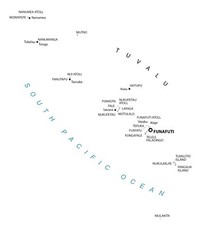
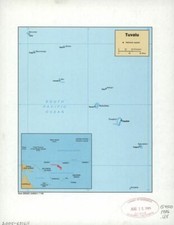
Tuvalu consists of nine small, low-lying coral islands and atolls scattered across a large area of the central Pacific. Its landscape is dominated by reefs, lagoons and open ocean rather than forests, mountains, extensive rivers or deep inland lakes—the environments that commonly support legends of hidden terrestrial beasts and lake monsters. Oral tradition remains an important source of history and identity, with spiritually significant places and stories continuing to shape islanders’ sense of place.[thecommonwealth.org]thecommonwealth.orgCommonwealth TuvaluCommonwealthTuvalu - Commonwealth SecretariatTuvalu is an island country in the west-central Pacific Ocean. It sits about halfway between…
This geography helps explain why Tuvalu’s legendary creatures are overwhelmingly maritime. Eels, flatfish, sharks, seabirds and serpent-like beings belong naturally to a culture formed around fishing, canoe travel and life on coral atolls. The islands’ stories often use the bodies and behaviour of familiar animals to make the landscape understandable: a flat fish becomes an image of flat land, while an eel’s long body resembles the trunk of a coconut palm.
That is different from claiming that an unknown giant eel or sea serpent still inhabits a particular lagoon. No credible source located for this survey identifies a continuing Tuvaluan sighting hotspot, a named contemporary mystery beast, a specimen, a photograph, sonar evidence or a sustained newspaper controversy. The absence of such material is itself the clearest finding. Tuvalu’s strongest creature traditions belong to folklore, sacred history and environmental symbolism—not conventional cryptozoology.
The Eel and the Flounder: creatures that made the islands
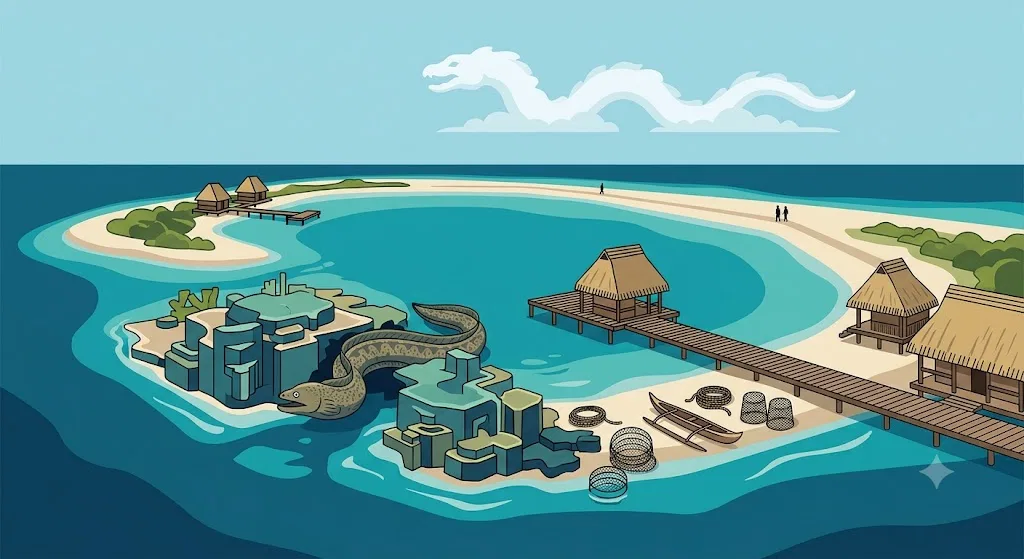
The best-known Tuvaluan animal story concerns the Eel and the Flounder. Versions differ in detail, but the central episode describes the two animals testing their strength with a heavy stone. Their contest turns into a struggle in which the Flounder is crushed flat and the Eel becomes long and thin. Their transformed bodies then provide models for the world around them: the Flounder’s shape corresponds to Tuvalu’s flat atolls, while the Eel’s narrow form becomes associated with the coconut palm. In one widely circulated version, the stone is divided into pieces that become the principal islands.[wikipedia.org]WikipediaTuvaluan mythologyTuvaluan mythology
For a reader approaching the story through cryptozoology, it may sound at first like a tale of an enormous supernatural eel. That interpretation misses its main purpose. The animals are not hidden species described by witnesses. They are creative beings whose physical forms explain visible features of island life. The story turns natural observation into a memorable account of origins.
The choice of an eel is particularly fitting. Moray eels are genuine reef animals with elongated bodies, powerful jaws and a habit of emerging from holes in coral. Seen unexpectedly underwater, a large moray can look distinctly serpentine. Linguistic evidence also shows that related Pacific words for eel or moray occur across Polynesian languages, reflecting the animal’s long-standing cultural familiarity throughout the region.[Pollex Online]pollex.eva.mpg.deOpen source on mpg.de.
Some retellings state that the story gave moray eels protected or restricted status in certain communities. Such claims should not be generalised carelessly across every island and period, because Tuvaluan traditions vary locally. The broader point is well supported: marine animals could carry historical, ancestral and spiritual meaning beyond their value as food.
Tepuhi, Nanumaga’s sea-serpent creator
Tepuhi is the Tuvaluan figure that most closely resembles a traditional sea monster. Accounts associated with Nanumaga describe Tepuhi as a spirit in the physical form of a sea serpent. In one creation narrative, the heavens and earth were originally pressed together. Tepuhi raised the sky, broke apart a continuous mass of land and created spaces for oceans and rivers. Other traditions give different explanations for the separation of earth and sky, illustrating how origin stories could coexist rather than forming one fixed national canon.[wikipedia.org]WikipediaTuvaluan mythologyTuvaluan mythology
Tepuhi is sometimes described as coming from Fiji, a detail that places the story within the wider world of Pacific voyaging and cultural exchange. Tuvalu’s island traditions preserve connections with Samoa, Tonga, Fiji, Tokelau and other neighbouring societies. Stories moved with travellers and settlers, then acquired local places, ancestors and meanings.[Wikipedia]WikipediaTuvaluan mythologyTuvaluan mythology
Calling Tepuhi a “Tuvaluan sea-serpent cryptid” would therefore be misleading. There is no securely documented sequence of modern witnesses claiming to have seen Tepuhi swimming off Nanumaga, nor a body of photographs or newspaper reports treating it as a flesh-and-blood animal. The tradition describes a world-forming spirit whose serpent shape conveys size, power and movement.
There is nevertheless an ecological reason why serpent imagery would feel convincing in the Pacific. Real sea snakes have flattened, paddle-like tails and spend much or all of their lives in tropical marine environments. Moray and conger eels can produce a similar impression, especially when only part of the animal is visible among reefs or at the surface. A distant eel, sea snake, floating rope, line of birds or swimming shark can all acquire exaggerated length when viewed briefly over moving water.[Australian Institute of Marine Science]aims.gov.auOpen source on aims.gov.au.
Giants, spirit ancestors and island founders
Several Tuvaluan island histories include founders or opponents of extraordinary size, strength or supernatural ancestry. Traditions from Funafuti and Vaitupu describe a founding figure associated with Samoa who is sometimes characterised as a giant. Nanumea’s founding ancestor, Tefolaha, is represented as partly human and partly spirit. Stories concerning his descendants include a conflict with the giant Tuulapoupou, who is defeated on the reef.[Wikipedia]WikipediaTuvaluan mythologyTuvaluan mythology
These figures belong more naturally to heroic and ancestral legend than to mystery-animal folklore. Their importance lies in explaining settlement, chiefly descent, land rights, ritual observances and relationships with other islands. A giant in this setting is not necessarily an alleged unknown primate or surviving prehistoric human. Exceptional size signals power and helps turn remembered conflict into a story that can be transmitted across generations.
Nanumea’s traditions also contain miraculous objects and landscape-forming episodes. Tefolaha’s weapon, the Kaumaile, is remembered as a treasured relic connected with victories and chiefly ancestry. Stories of Pai and Vau explain the formation of certain islets through sand spilled from baskets as the women leave Nanumea. Such narratives show how local geography, genealogy and the supernatural are woven together. Extracting one unusual being and labelling it a cryptid strips away much of what the story was meant to preserve.[Wikipedia]WikipediaTuvaluan mythologyTuvaluan mythology
What early written records actually preserve
One of the earliest widely cited written records of Funafuti’s legendary history was published by geologist William Johnson Sollas after the Royal Society’s 1896 coral-boring expedition. Sollas recorded material supplied by Erivara, a Funafuti chief, through the trader Jack O’Brien as interpreter. The account discusses former chiefs, ancestors, spirits and religious practices rather than a catalogue of unexplained animal sightings.[Nature]nature.comOpen source on nature.com.
Sollas reported traditions in which natural forces, birds and fishes had religious importance, followed by forms of spirit and ancestor veneration. One spirit was associated by name with a kind of seabird. The account also described ritual specialists who mediated between communities and supernatural powers. These observations reflect the interests and language of a nineteenth-century European collector, so they cannot be treated as a perfectly transparent record of pre-contact belief. Translation, selection and colonial assumptions all affected what reached print.
Christian missions also transformed the religious landscape of Tuvalu during the nineteenth century. Christianity began spreading through the islands from the 1860s, led initially by Pacific Islander converts and pastors as well as later European missionaries. Older beings and practices could be abandoned, reinterpreted as dangerous spirits, folded into family history or retained chiefly as cultural narratives.[Wikipedia]WikipediaChurch of TuvaluChurch of Tuvalu
This historical process helps explain why surviving accounts can look fragmentary. Some were written down only after major social change. Others remained specific to one island or family. A modern list of “Tuvaluan monsters” assembled from scattered summaries may therefore suggest a unified creature mythology that never existed in that exact form.
Could real animals explain serpent-like traditions?
A natural explanation does not mean that a traditional story arose from one mistaken sighting. Creation myths operate on a different level from eyewitness claims. Even so, Tuvalu’s marine environment contains animals capable of supplying vivid raw material for tales of enormous or supernatural creatures.
Moray and conger eels are the clearest candidates. They are long-bodied fish associated with reef crevices and deeper water. A biodiversity survey of Funafuti recorded local knowledge of a deep-water conger eel, while broader Pacific records confirm the familiarity of morays throughout island environments.[tuvalu-data.sprep.org]tuvalu-data.sprep.orgTUVALU R2R BIORAP Final FInalTUVALU R2R BIORAP Final FInal
Sea snakes have unmistakably serpent-like bodies and occur in tropical seas. Their ability to surface, dive and move with only a small portion of the body visible makes estimates of size difficult. Eels are also regularly mistaken for sea snakes, and vice versa, unless fins, tail shape and breathing behaviour can be observed clearly.[Australian Institute of Marine Science]aims.gov.auOpen source on aims.gov.au.
Sharks are another source of dramatic encounters. Surveys and community reports indicate that Tuvaluan waters support reef sharks as well as offshore and deep-water species. A fin, tail or group of animals moving in line can create a misleading silhouette, especially in rough seas or poor light. Around twenty shark species have been reported from Tuvalu in one national biodiversity assessment, although knowledge and names vary between atolls.[alofatuvalu.tv]alofatuvalu.tvOpen source on alofatuvalu.tv.
Floating debris and wave effects can complete the illusion. Coconut trunks, fishing gear and strings of surface-feeding animals may appear to undulate. Distance over open water removes reliable scale, while waves repeatedly conceal and reveal separate sections. This is one reason historical sea-serpent reports elsewhere have produced such varied proposed explanations, including whales, eels, squid and ordinary animals seen under unusual conditions. A study of one famous sea-serpent episode, for example, concluded that whale behaviour offered a more plausible explanation than an unknown reptile.[news.st-andrews.ac.uk]news.st-andrews.ac.ukSea serpent's sexy secretSea serpent's sexy secret
None of these possibilities proves that Tepuhi or the Eel and the Flounder began as misidentified wildlife. They simply show that Tuvalu’s reefs provide abundant real-life serpent forms from which storytellers could draw.
Why there is no Tuvaluan monster industry
In many countries, a local creature becomes a public cryptid only after newspapers, photographs, investigators and tourism businesses give it a stable name and appearance. Tuvalu shows little sign of that process. The country’s official tourism presentation emphasises its lagoons, reefs, marine environment, quiet atmosphere and cultural life rather than promoting a resident monster or mystery-beast trail.[Timeless Tuvalu]timelesstuvalu.comOpen source on timelesstuvalu.com.
Modern retellings of the Eel and the Flounder do circulate through cultural media, animation and online features. This gives the story a pop-cultural afterlife, but it remains an origin narrative rather than a monster hunt. The difference matters. A folkloric creator can be represented differently by each artist without anyone asking for zoological consistency. A cryptid, by contrast, usually develops an expected shape, habitat, behaviour and body of claimed evidence.
Tuvalu’s international image is also dominated by its vulnerability to environmental change and its vast maritime territory relative to its tiny land area. Marine conservation, fishing and the survival of island communities have far greater practical and cultural importance than speculative searches for unknown megafauna. Current conservation partnerships focus on protecting documented marine biodiversity and preventing illegal fishing.[Sea Shepherd Global]seashepherdglobal.orgSea Shepherd Global Why Protecting Tuvalu's Marine Life Is Crucial for OceanSea Shepherd Global Why Protecting Tuvalu's Marine Life Is Crucial for Ocean
Folklore, sightings and evidence should not be confused
Tuvalu’s creature material is easiest to understand when divided into three categories:
- Creation and ancestral traditions: The Eel and the Flounder, Tepuhi and giant founding figures explain landforms, origins, descent and the ordering of the world.
- Historically recorded beliefs: Nineteenth-century observers documented reverence for ancestors, spirits, natural forces, birds and fishes, though their accounts were filtered through translation and colonial viewpoints.
- Possible animal encounters: Sharks, eels, sea snakes and other marine animals can look strange or enormous in difficult viewing conditions, but no substantial archive currently establishes a recurring Tuvaluan mystery-animal case.
This separation prevents two opposite mistakes. One is to declare supernatural beings to be undiscovered animals. The other is to dismiss culturally important narratives as nothing more than confused wildlife observations. The stories may contain precise knowledge of reefs, animal forms and inter-island history even when they are not literal zoological reports.
The most defensible verdict
Tuvalu has compelling legendary creatures but no securely established national cryptid in the modern sense. Tepuhi is the strongest sea-monster-like figure, yet the available record identifies it as a creator spirit associated with Nanumaga, not an unknown animal reported by successive witnesses. The Eel and the Flounder are even more clearly mythic: their bodies explain the shapes of atolls and coconut palms, turning familiar marine life into a story of cosmic creation.
For readers interested in mystery animals, Tuvalu is valuable precisely because it exposes the limits of the cryptid label. Not every giant, serpent or extraordinary beast is a claim about hidden wildlife. In Tuvalu, strange creatures most often connect people with ancestry, landscape and the ocean. Their mystery lies less in whether they can be captured than in how island communities used animal forms to remember where their world came from.
Amazon book picks
Further Reading
Books and field guides related to Where Are Tuvalu's Monsters and Mystery Beasts?. Use these as the next step if you want deeper reading beyond the article.
Field Guide to Lake Monsters, Sea Serpents, and Other Mystery...
Most closely matches Pacific sea-serpent themes.
The Book of Imaginary Beings
Fits a page focused on legendary rather than zoological creatures.
eBay marketplace picks
Marketplace Samples
Live-tested eBay searches with available results related to this page.
Endnotes
1.
Source: Wikipedia
Title: Tuvaluan mythology
Link:https://en.wikipedia.org/wiki/Tuvaluan_mythology
2.
Source: archive.ph
Title: Tuvaluan Legends
Link:https://archive.ph/WwNzK
Source snippet
NanumagaNanumaga (from Tuvalu - A History, 1983, Institute of Pacific Studies). Map of Nanumaga. Nanumaga... sea-serpent, lifted the hea...
3.
Source: whc.unesco.org
Link:https://whc.unesco.org/en/tentativelists/6707/
Source snippet
Spiritually valued natural features and cultural places predate the...Read more...
4.
Source: devpolicy.org
Title: island song a week in tuvalu 20191018
Link:https://devpolicy.org/island-song-a-week-in-tuvalu-20191018/
Source snippet
Devpolicy BlogIsland song: a week in Tuvalu18 Oct 2019 — Hit in the stomach and badly injured, the eel magically cursed the flounder, who...
5.
Source: nature.com
Link:https://www.nature.com/nature/articles?page=4652&searchType=journalSearch&sort=PubDate&type=news-
6.
Source: Wikipedia
Title: Church of Tuvalu
Link:https://en.wikipedia.org/wiki/Church_of_Tuvalu
7.
Source: tuvalu-data.sprep.org
Title: TUVALU R2R BIORAP Final FInal
Link:https://tuvalu-data.sprep.org/system/files/TUVALU%20R2R%20BIORAP_Final_FInal.pdf
8.
Source: alofatuvalu.tv
Link:https://www.alofatuvalu.tv/US/05_a_tuvalu/05_page_tml/livret4light.pdf
9.
Source: news.st-andrews.ac.uk
Title: Sea serpent’s sexy secret
Link:https://news.st-andrews.ac.uk/archive/sea-serpents-sexy-secret/
10.
Source: youtube.com
Link:https://www.youtube.com/watch?v=WM1WhySdkaU
Source snippet
Wikipedia...
11.
Source: thecommonwealth.org
Title: Commonwealth Tuvalu
Link:https://thecommonwealth.org/our-member-countries/tuvalu
Source snippet
CommonwealthTuvalu - Commonwealth SecretariatTuvalu is an island country in the west-central Pacific Ocean. It sits about halfway between...
12.
Source: timelesstuvalu.com
Link:https://www.timelesstuvalu.com/
13.
Source: pollex.eva.mpg.de
Link:https://pollex.eva.mpg.de/entry/pusi.2/
14.
Source: aims.gov.au
Link:https://www.aims.gov.au/research-topics/marine-life/sea-snakes
15.
Source: figshare.swinburne.edu.au
Link:https://figshare.swinburne.edu.au/ndownloader/files/47646631
16.
Source: samuseum.sa.gov.au
Link:https://www.samuseum.sa.gov.au/getDocument/9kmwrg5p3
17.
Source: seashepherdglobal.org
Title: Sea Shepherd Global Why Protecting Tuvalu’s Marine Life Is Crucial for Ocean
Link:https://www.seashepherdglobal.org/latest-news/tuvalu-wildlife/
Additional References
18.
Source: frieze.com
Link:https://www.frieze.com/article/celeste-olalquiaga-tuvalu-issue-234
Source snippet
As Tides Rise, Tuvalu Faces a Future on the MetaverseIn the Tuvaluan origin myth Te Pusi mo te Ali (The Eel and the Flounder), thes...
19.
Source: youtube.com
Title: The Eel and The Flounder: The Creation Story of Tuvalu
Link:https://www.youtube.com/watch?v=vjXxaq6aTes
Source snippet
The Legend of Tauasa and the Stolen Garland...
20.
Source: scispace.com
Link:https://scispace.com/pdf/the-legendary-history-of-funafuti-ellice-group-1-44gkwkdhbl.pdf
21.
Source: scribd.com
Link:https://www.scribd.com/document/16850476/the-mythology-of-oceania
22.
Source: youtube.com
Title: The Legend of Tauasa and the Stolen Garland
Link:https://www.youtube.com/watch?v=B56VQRQZ_zo
Source snippet
Tuvalu's History in 3 Minutes...
23.
Source: youtube.com
Title: Tuvalu’s History in 3 Minutes
Link:https://www.youtube.com/watch?v=YyRrbeD14S0
Source snippet
Tuvalu A Journey Through Time and Tide...
24.
Source: everyculture.com
Title: Every Culture Tuvalu
Link:https://www.everyculture.com/Oceania/Tuvalu-Religion-and-Expressive-Culture.html
25.
Source: youtube.com
Title: Tuvalu A Journey Through Time and Tide
Link:https://www.youtube.com/watch?v=cJo7o_uLOcw
Topic Tree
Follow this branch
Related pages 192
- Antigua Cryptids
- Maldives Monsters
- Malta Monsters
- Qatar Monsters
- Argentina Monsters
- +187 more in sidebar