Within Tunisia Monsters
Which Monsters Live in Tunisian Folklore?
Ogres, enchanted animals and human-like beasts belong to Tunisia's storytelling tradition rather than reports of unknown species.
On this page
- Ogres, animal spouses and wilderness beings
- How oral tales changed between tellers
- Why folklore creatures are not automatically cryptids
Page outline Jump by section
Introduction
Tunisia’s strangest creatures are often found not in eyewitness reports or mystery-animal claims, but in folktales. Alongside stories of giant serpents and unusual beasts, Tunisian oral tradition preserves a rich population of ogres, enchanted animals, shape-shifting spouses and dangerous wilderness beings. These figures belong to the world of storytelling rather than zoology. They were passed from teller to teller in homes, markets and village gatherings, where they helped explain danger, reward cleverness, teach moral lessons and preserve collective memory.[Wikipedia]WikipediaCulture of TunisiaCulture of Tunisia
For readers interested in cryptids, these traditions matter because they show how monster imagery develops independently of claims about real unknown animals. A terrifying creature in a folktale is not automatically a cryptid. In Tunisia, many famous monster-like beings are best understood as cultural characters whose power comes from narrative meaning rather than alleged physical encounters.
Which Monsters Live in Tunisian Folklore?
Tunisian oral storytelling shares many themes with wider North African and Maghrebi traditions, blending Arab, Amazigh and local influences. The result is a folklore landscape populated by beings that are recognisably monstrous but rarely treated as hidden species.[Wikipedia]WikipediaCulture of TunisiaCulture of Tunisia
Ogres and man-eaters
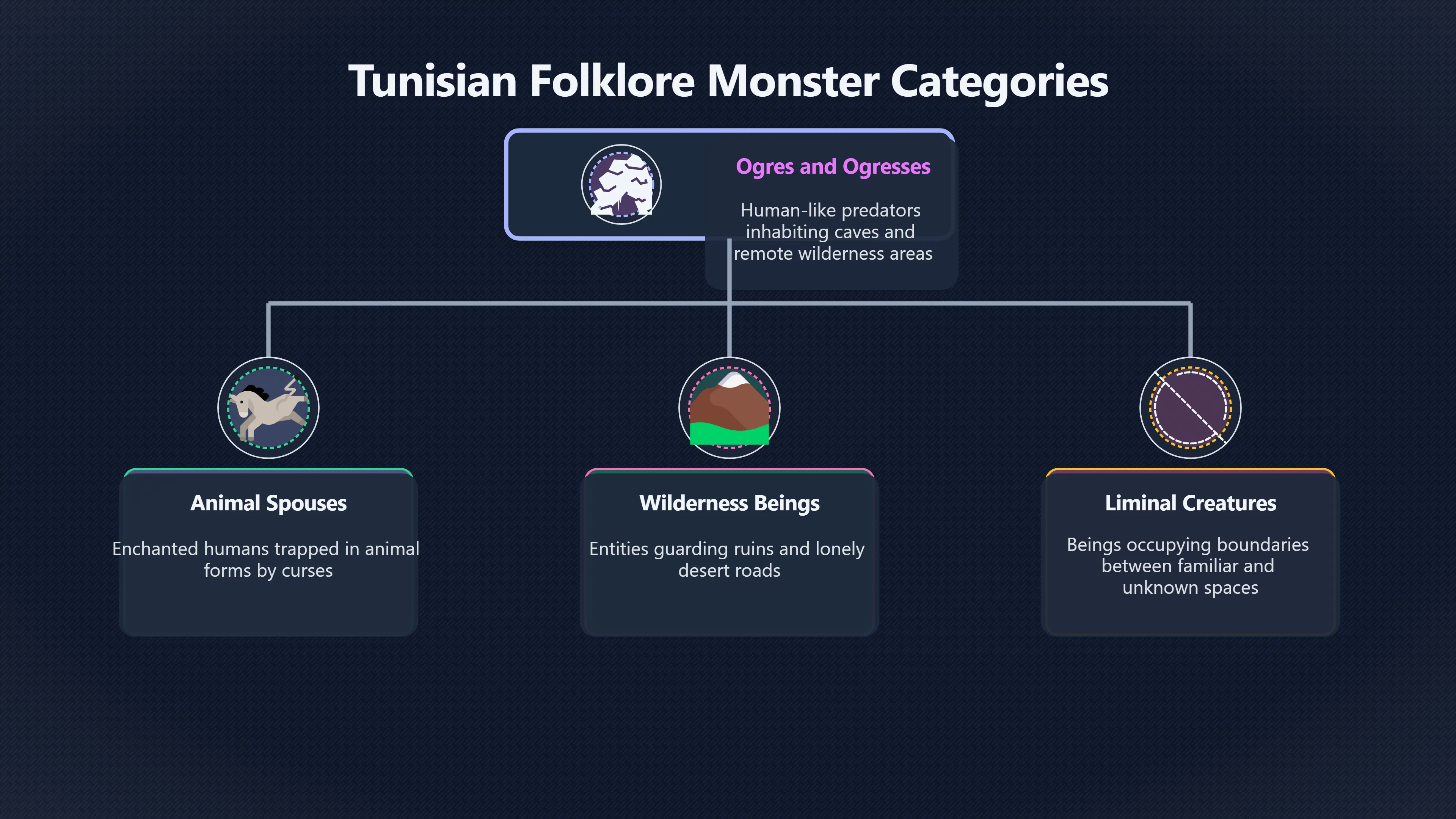
Among the most common folkloric monsters are ogres and ogresses. Across North African storytelling, these creatures appear as human-like predators living beyond the safety of settled communities. They inhabit caves, wildernesses and remote places, devouring travellers, children or the unwary. Rather than functioning as mysterious animals, they serve as narrative embodiments of danger and social disorder.[bu.edu]open.bu.eduEurope in the nineteenth century.Read moreBU RepositoryOgres, monsters, and demons in the oral narratives of AfricaMyth has been a topic of fascination since time immemorial b…
The ogress is particularly important in Maghrebi folklore. Related traditions describe wild-haired female man-eaters associated with sorcery, isolation and the untamed landscape. Their stories often pit ordinary people against overwhelming threats, rewarding intelligence and courage rather than physical strength.[Wikipedia]WikipediaOpen source on wikipedia.org.
These tales were never presented as zoological reports. An ogre could be enormous, magical, shape-shifting or impossibly powerful because the point of the story was symbolic rather than realistic.
Animal spouses and enchanted beings
Another recurring theme involves supernatural husbands or wives concealed beneath animal forms. Tunisian folktales include stories in which an apparently frightening creature is actually a cursed prince or enchanted human. One well-known Jewish-Tunisian tale centres on a prince trapped in the form of a donkey’s head who marries a princess before disappearing after a broken taboo. The story belongs to a much wider international family of “animal bridegroom” tales found across Europe, Africa and Asia.[Wikipedia]WikipediaThe Donkey's HeadThe Donkey's Head
Such creatures are monsters only on the surface. Their animal appearance creates mystery and tension, but the narrative ultimately concerns trust, loyalty and transformation. The creature’s true nature is human, and the plot focuses on relationships rather than encounters with unknown beasts.[Wikipedia]WikipediaThe Donkey's HeadThe Donkey's Head
These stories demonstrate how easily a modern reader could mistake folklore monsters for cryptids if the original cultural context is ignored.
Wilderness beings and liminal creatures
Many Tunisian tales also feature strange entities associated with deserts, mountains, ruins and lonely roads. These beings often occupy boundaries between the familiar and the unknown. They may test travellers, guard hidden places or represent the risks of leaving the protection of community life.[Wikipedia]WikipediaCulture of TunisiaCulture of Tunisia
Unlike a cryptid narrative, which usually asks whether an unknown animal exists, these stories assume a symbolic world in which extraordinary beings can appear whenever the tale requires them. The purpose is moral or dramatic rather than investigative.

How Oral Tales Changed Between Tellers
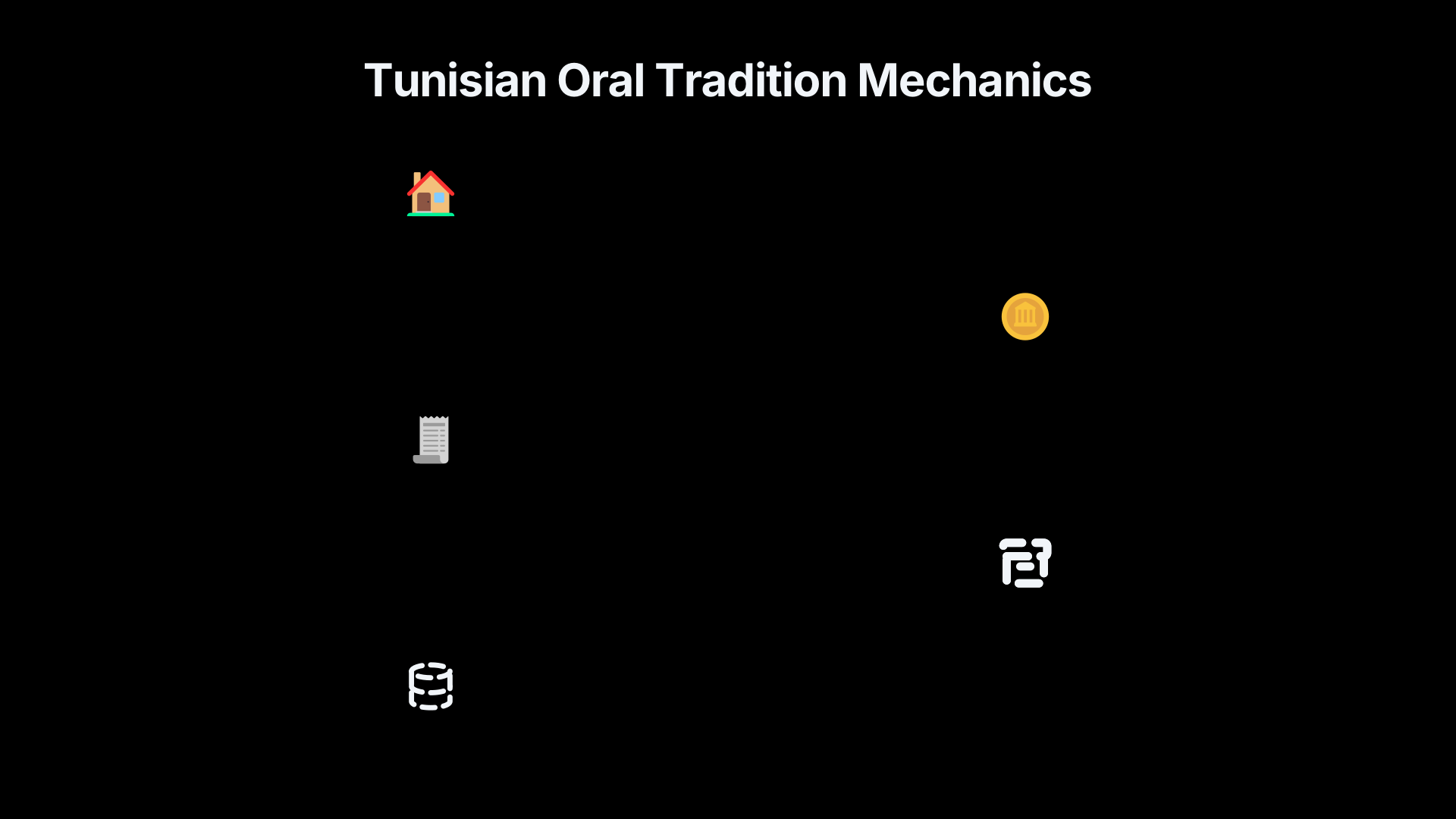
One reason folklore creatures can seem elusive is that they were never fixed in a single official version. Tunisia maintained a strong oral storytelling culture well into the twentieth century. Professional and amateur storytellers adapted tales for different audiences, locations and generations. Narratives changed with each retelling while preserving familiar themes and characters.[Wikipedia]WikipediaCulture of TunisiaCulture of Tunisia
A monster described as an ogress in one village might appear with different characteristics elsewhere. An enchanted animal could become a bird, donkey or another creature depending on the teller. Stories accumulated local details, family memories and regional references.[Academia]academia.eduAcademia(PDF) Women's oral narratives in TunisWomen in Tunisian society use oral narratives as a form of self-expression and identity for…
This fluidity matters because folklore creatures are often remembered through performance rather than documentation. Unlike modern cryptid claims, which usually depend on preserving witness testimony, folklore monsters thrive through variation. Their survival depends on change rather than consistency.
The role of collective memory
Researchers studying Tunisian oral narratives note that folktales function as a form of collective memory. Storytelling preserved social values, local history and cultural identity. Monster figures therefore acted less like biological creatures and more like narrative tools.[Wikipedia]WikipediaCulture of TunisiaCulture of Tunisia
An ogre might represent greed, isolation or predatory behaviour. An enchanted spouse might reflect ideas about marriage, trust or adulthood. The creature itself mattered, but its symbolic meaning mattered more.
Why Folklore Creatures Are Not Automatically Cryptids
The boundary between folklore and cryptozoology is often misunderstood. A cryptid is generally presented as a potentially real but unverified animal. Folklore monsters operate differently.
Several features distinguish most Tunisian folklore creatures from cryptid claims:
- They appear within clearly fictional or magical narratives.
- They possess supernatural powers without attempts at natural explanation.
- Their stories focus on moral lessons, family relationships or social values.
- Different versions freely alter the creature’s appearance and abilities.
- There is usually no tradition of collecting physical evidence, specimens or eyewitness testimony.[wikipedia.org]WikipediaCulture of TunisiaCulture of Tunisia
By contrast, genuine cryptid traditions usually involve recurring claims that an unknown animal exists in a particular place. Witnesses, tracks, photographs or alleged encounters become central to the story.
Tunisia’s folklore monsters therefore belong to a different category. They enrich the country’s monster heritage, but they do not generally represent attempts to describe undiscovered wildlife.
What These Creatures Reveal About Tunisia
Tunisian folklore monsters survive because they express anxieties and hopes that were meaningful to generations of storytellers. Ogres embody threats lurking beyond safe social spaces. Animal spouses explore trust and transformation. Wilderness beings give narrative form to the uncertainty of remote landscapes.[academia.edu]academia.eduAcademia(PDF) Women's oral narratives in TunisWomen in Tunisian society use oral narratives as a form of self-expression and identity for…
For anyone exploring Tunisia’s monster traditions, these tales are as important as the more famous stories of giant serpents or mystery beasts. They show that the country’s monster heritage is rooted not only in claims about strange creatures but also in the imaginative world of oral storytelling. The monsters endure because they carry cultural memory, not because anyone expects to find them roaming the countryside today.[wikipedia.org]WikipediaCulture of TunisiaCulture of Tunisia
Amazon book picks
Further Reading
Books and field guides related to Which Monsters Live in Tunisian Folklore?. Use these as the next step if you want deeper reading beyond the article.
The Arabian Nights
Contains many monster, ogre and supernatural motifs familiar across the Arab world.
![Cover for The Arabian Nights Entertainments [7 stories]](https://covers.openlibrary.org/b/id/1046897-M.jpg)
eBay marketplace picks
Marketplace Samples
Live-tested eBay searches with available results related to this page.
Endnotes
1.
Source: Wikipedia
Title: Culture of Tunisia
Link:https://en.wikipedia.org/wiki/Culture_of_Tunisia
2.
Source: academia.edu
Link:https://www.academia.edu/96983852/Womens_oral_narratives_in_Tunis
Source snippet
Academia(PDF) Women's oral narratives in TunisWomen in Tunisian society use oral narratives as a form of self-expression and identity for...
3.
Source: Wikipedia
Link:https://fr.wikipedia.org/wiki/Teryel
4.
Source: Wikipedia
Title: The Son of the Ogress
Link:https://en.wikipedia.org/wiki/The_Son_of_the_Ogress
5.
Source: Wikipedia
Title: The Donkey’s Head
Link:https://en.wikipedia.org/wiki/The_Donkey%27s_Head
6.
Source: Wikipedia
Link:https://en.wikipedia.org/wiki/Animal_as_Bridegroom
Source snippet
Animal as BridegroomIn folkloristics, "The Animal as Bridegroom" refers to a group of folk and fairy tales about a human woman marrying o...
7.
Source: Wikipedia
Title: Tunisian Arabic
Link:https://en.wikipedia.org/wiki/Tunisian_Arabic
8.
Source: folktales.africa
Link:https://folktales.africa/category/african-folktales/north-african-folktales/tunisian-folktales/
9.
Source: open.bu.edu
Title: Europe in the nineteenth century.Read more
Link:https://open.bu.edu/bitstreams/c57df790-754c-446c-a079-bdaa098d47d1/download
Source snippet
BU RepositoryOgres, monsters, and demons in the oral narratives of AfricaMyth has been a topic of fascination since time immemorial b...
10.
Source: saspublishers.com
Link:https://www.saspublishers.com/media/articles/SJAHSS_4101226-1232.pdf
Source snippet
SAS PublishersScholars Journal of Arts, Humanities and Social Sciences...by KM Kiarie — Ogre narratives are a popular genre in oral lite...
Additional References
11.
Source: scribd.com
Link:https://www.scribd.com/document/643214188/LIT-222-ORAL-NARRATIVES-1-pdf
Source snippet
Features and Types of Oral Narratives | PDFOGRE STORIES – Man trying to conquer evil. These are narratives about monsters- creature...
12.
Source: houseoflegends.me
Title: the animal bridegroom
Link:https://www.houseoflegends.me/blog/the-animal-bridegroom
Source snippet
House of LegendsAnimal As Bridegroom: The Folklore of Beauties and Beasts13 Aug 2024 — Our ancestors told stories about women and men who...
13.
Source: youtube.com
Title: True Encounters With Djinn Human Animal Hybrids in Kuwait, Morocco and Tanzania
Link:https://www.youtube.com/watch?v=9HaimxTEl9Y
Source snippet
Monsters. They're Us, Man: Crash Course World Mythology #36...
14.
Source: youtube.com
Title: The Forbidden Stories of Berber Gods and Spirits: Why Were They Kept Secret?
Link:https://www.youtube.com/watch?v=FHK1jH1_Mbs
Source snippet
THE OGRE OF IGHIL: The Human-Eater of the Berber Mountains...
15.
Source: youtube.com
Title: THE OGRE OF IGHIL: The Human-Eater of the Berber Mountains
Link:https://www.youtube.com/watch?v=TNBIHPkoHNM
Source snippet
True Encounters With Djinn Human Animal Hybrids in Kuwait, Morocco and Tanzania...
16.
Source: youtube.com
Title: Monsters from African Mythology
Link:https://www.youtube.com/watch?v=AAhCDfGzGuQ
Source snippet
"North African folklore" monsters Monsters from African Mythology WILD Mythology...
17.
Source: facebook.com
Link:https://www.facebook.com/groups/812069894297440/posts/910182981152797/
18.
Source: facebook.com
Link:https://www.facebook.com/groups/Quartzposting/posts/1619576088801967/
19.
Source: facebook.com
Link:https://www.facebook.com/groups/431357430001497/posts/597611910042714/
20.
Source: reddit.com
Link:https://www.reddit.com/r/Tunisia/comments/jogp9e/myths_and_legends_in_tunisia/
Topic Tree