Monsters of Sudan's River Stories
Sudan does not have a well-documented modern “national cryptid” comparable to Scotland’s Loch Ness Monster. Its mystery-creature tradition is older, more local and more closely tied to the Nile, dangerous wildlife and oral folklore.
Page outline Jump by section
Introduction
That distinction matters. Colonial-era books and archives used “Sudan” for a much larger political territory, so later cryptozoology writers often filed southern swamp monsters under Sudan even when their reported habitats now lie in another country. Within present-day Sudan, the surviving record is therefore best understood as a mixture of Nubian river folklore, encounters with formidable real animals, colonial collecting and occasional internet hoaxes—not evidence that an unknown giant species has been established.
What creature traditions belong to Sudan?
The clearest traditions fall into three overlapping groups.
Nile beings and river people appear in northern and central Sudanese folklore. These are not always animals. Some are invisible spirits, small aquatic people or beings associated with fertility, marriage and the dangerous generosity of the river.
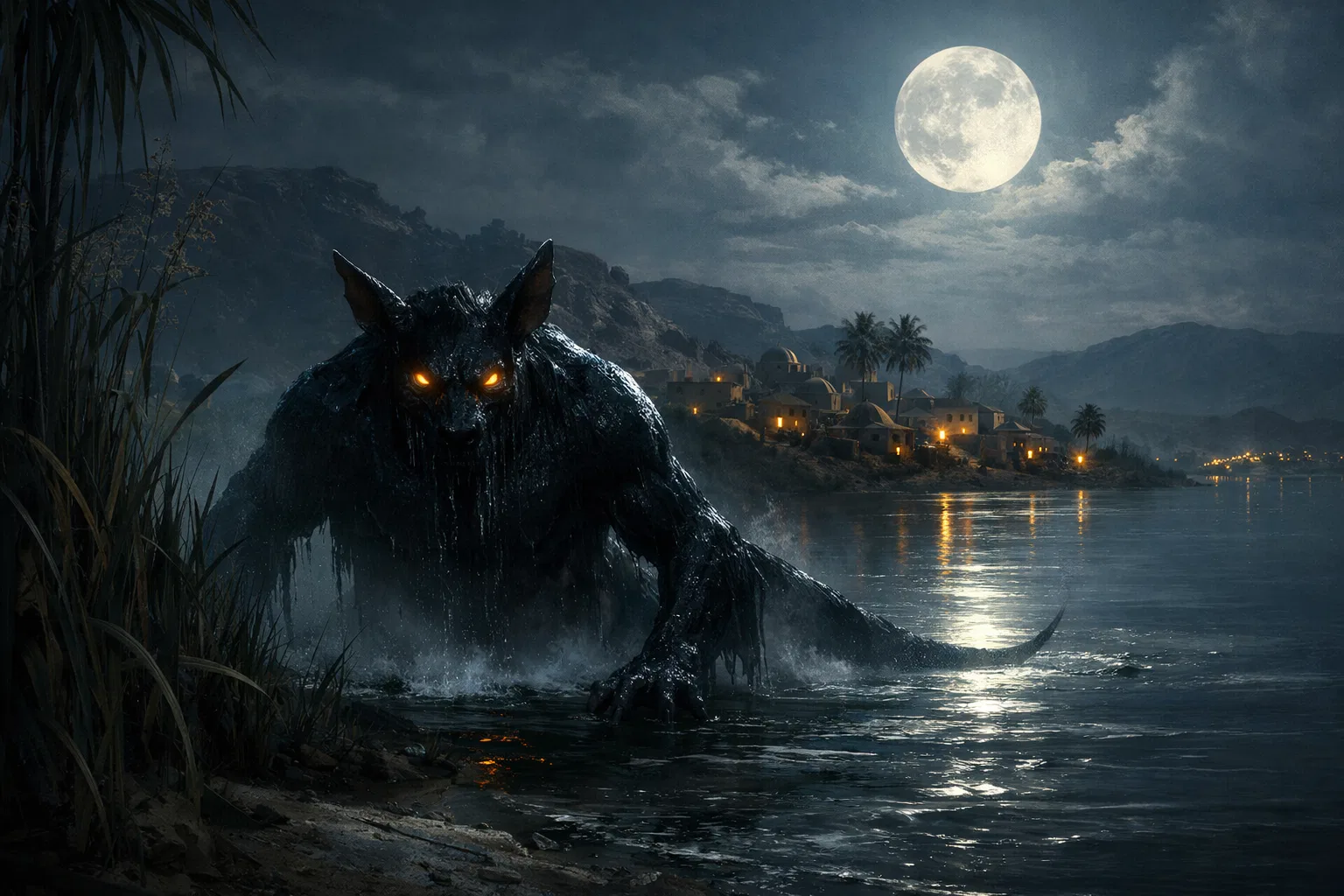
Monster-like river predators include Aman Doger, a creature associated with the Nubian Nile. It behaves more like a supernatural ambusher than a zoological unknown, although its body combines recognisable animal features.
Historical “Sudanese” cryptids from the south, especially the lau, were reported in White Nile marshes during the period when present-day Sudan and South Sudan formed one country. They remain important to the history of Sudanese cryptozoology, but their reported locations are now largely in South Sudan.
This gives Sudan an unusual monster tradition. Rather than a single beast repeatedly photographed or pursued by expeditions, it has a layered river mythology in which folklore, animals and place are difficult to separate cleanly.
Aman Doger, the monster of the Nubian Nile
Aman Doger is the most distinctive creature associated with the Nubian Nile tradition. Folklorist John G. Kennedy documented belief in the being among Egyptian Nubians in a 1970 paper, describing it as a feared spirit-monster said to emerge from the Nile at night and prey upon people. Nubian culture and settlement historically extend across the modern Egypt–Sudan border, so the tradition belongs to a shared river region rather than fitting neatly inside one present-day state.[JSTOR]jstor.orgAman Doger: Nubian Monster of the Nileby JG Kennedy · 1970 · Cited by 6 — AMONG THE EGYPTIAN NUBIANS there survive beliefs in a fear…
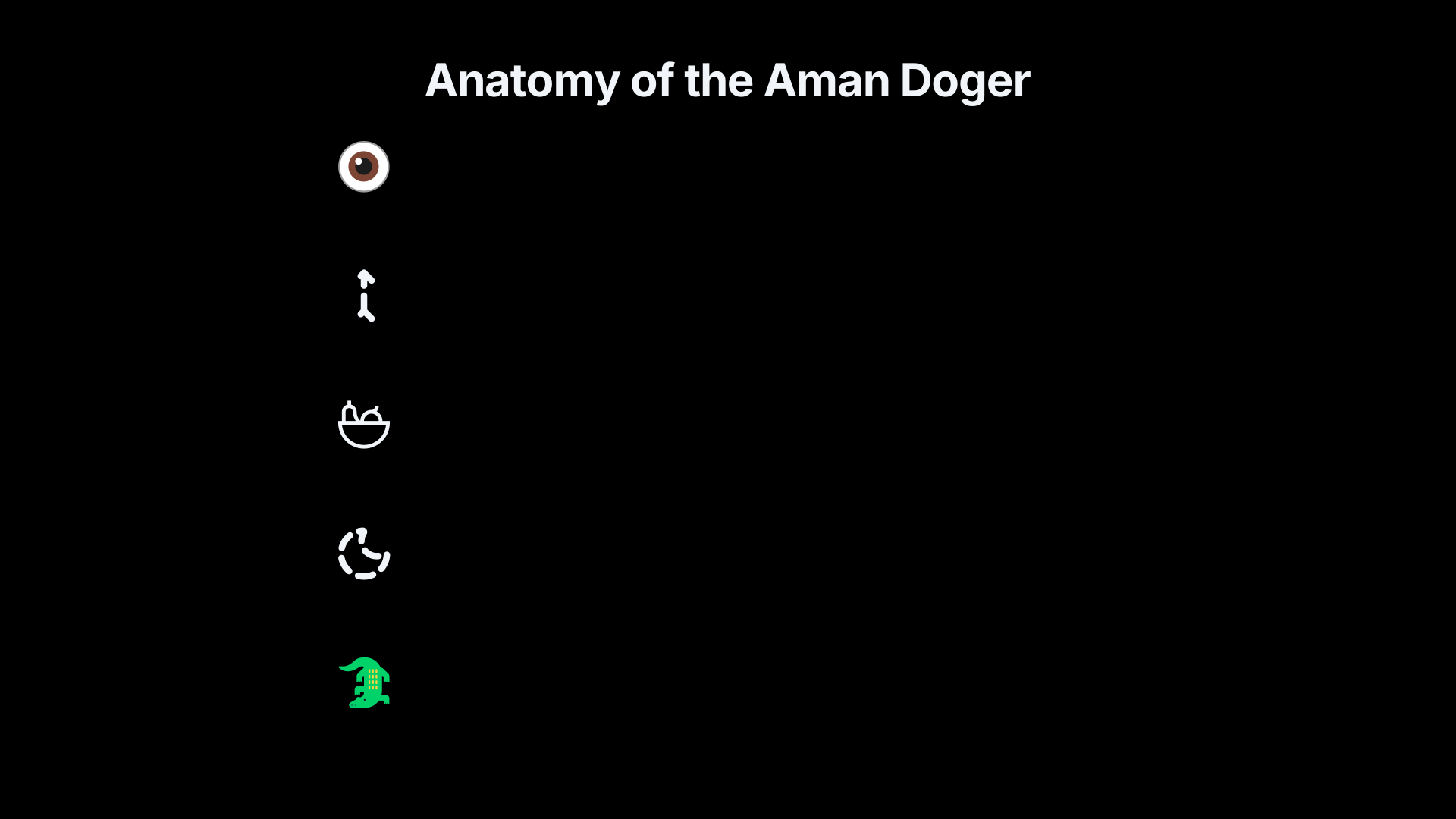
Descriptions collected and retold vary, but the creature is commonly given black or dark skin, large ears, donkey-like legs, a long tail and striking vertical eyes. Some versions make it a child-eater; others say it attacks women or steals valuables and food. A recent folklore treatment, drawing on Kennedy’s study, describes an appetite for dates and children and emphasises its fiery eyes and mismatched animal anatomy.[Mythological Africans]mythologicalafricans.substack.comMythological Africans Meet the Aman DogerMythological AfricansMeet the Aman Doger - Mythological Africans…
These features should not be read as a field guide to an undiscovered mammal. Aman Doger behaves according to the logic of a cautionary monster. It comes from the river after dark, threatens vulnerable people and combines familiar traits into something deliberately wrong-looking. Its value lies less in zoological identification than in the fears it expresses: night travel, deep water, predation and the uncertainty of what may rise from the Nile.
A naturalistic interpretation is still possible at the level of inspiration. Nile crocodiles can remain almost invisible at the waterline, strike rapidly and take people or livestock. Hippopotamuses, historically present farther north than many readers might expect, are also dangerous around water. Donkeys, crocodiles and other familiar animals may have supplied individual features without any single species explaining the whole creature. Aman Doger is therefore better treated as a folkloric composite than as a garbled report of one hidden animal.
The Nile was already full of hidden beings
Aman Doger sits within a much broader Sudanese tradition of an inhabited, spiritually active river. In 1919, J. W. Crowfoot published an account of Nile folklore and ritual in Sudan Notes and Records. The material described invisible river beings, offerings of dates and grain, and stories about small pale creatures or people who could not survive for long outside the water.[Women's literacy in Sudan]womensliteracysudan.blogWomen's literacy in Sudan Angels of The Nile – Women's literacy in SudanWomen's literacy in Sudan Angels of The Nile – Women's literacy in Sudan
One story told of a fisherman whose net caught a young girl near the meeting of the White and Blue Niles. She identified herself as one of the River Folk and was eventually returned to the water. The point of such a tale is not that an aquatic human population was being reported in a modern biological sense. It presents the Nile as a social world with its own inhabitants, rules and claims upon human respect.[Women's literacy in Sudan]womensliteracysudan.blogWomen's literacy in Sudan Angels of The Nile – Women's literacy in SudanWomen's literacy in Sudan Angels of The Nile – Women's literacy in Sudan
The distinction between these beings and cryptids is important. Cryptozoology usually asks whether a reported creature might be a flesh-and-blood animal unknown to science. River Folk belong more securely to spiritual and social tradition. Yet the two categories overlap in popular retellings because both place intelligent or dangerous presences beneath apparently ordinary water.
This older folklore also explains why simple “monster sighting” summaries can be misleading. A creature encountered in a Sudanese story may be a spirit, ancestor, warning figure, transformed animal or narrative test rather than a proposed species. Removing that cultural function can turn a meaningful tradition into little more than a monster catalogue.
The lau and the problem of the old Sudan
The lau is often promoted online as Sudan’s great river cryptid: an enormous snake-like animal living in deep marsh water, sometimes equipped with a crest, whiskers, tentacles or coarse hair. Early written references appeared in the 1920s. Accounts associated the creature with Nuer, Dinka and Shilluk communities and placed it in wetlands around the Bahr el Ghazal, Bahr el Zeraf, Lake No, Malakal and the Sudd.[Cryptid Archives]cryptidarchives.fandom.comCryptid Archives Lau | Encyclopaedia of Cryptozoology | FandomCryptid Archives Lau | Encyclopaedia of Cryptozoology | Fandom
Those locations are now overwhelmingly in South Sudan. South Sudan became independent on 9 July 2011, so a present-day country guide should not quietly transfer the lau’s main reported range into the Republic of Sudan.[United Nations Peacekeeping]peacekeeping.un.orgited Nations Peacekeeping Referendum in Southern Sudan. UNMISited Nations PeacekeepingReferendum in Southern Sudan. UNMIS - United Nations Mission in the Sudan…
The confusion survives because colonial and early postcolonial writers used “Sudan” for the former unified territory. Cryptozoology reference works then repeated the label without always updating the geography. The lau still belongs in Sudan’s historical cryptid record, but it is more accurately treated as a cross-border archival legacy and a major South Sudanese mystery-beast tradition.
Descriptions were inconsistent from the beginning. Some witnesses or informants described a giant python reaching roughly 12 metres; others gave lengths of 30 metres or more. It might have a crane-like crest, catfish whiskers, grabbing hairs, a horn-like projection or no such feature at all. It was said to rumble, leave furrows through vegetation, seize people from canoes or kill by its glance. One source recorded that the creature was already extinct, even while later accounts continued to treat it as present.[Cryptid Archives]cryptidarchives.fandom.comCryptid Archives Lau | Encyclopaedia of Cryptozoology | FandomCryptid Archives Lau | Encyclopaedia of Cryptozoology | Fandom
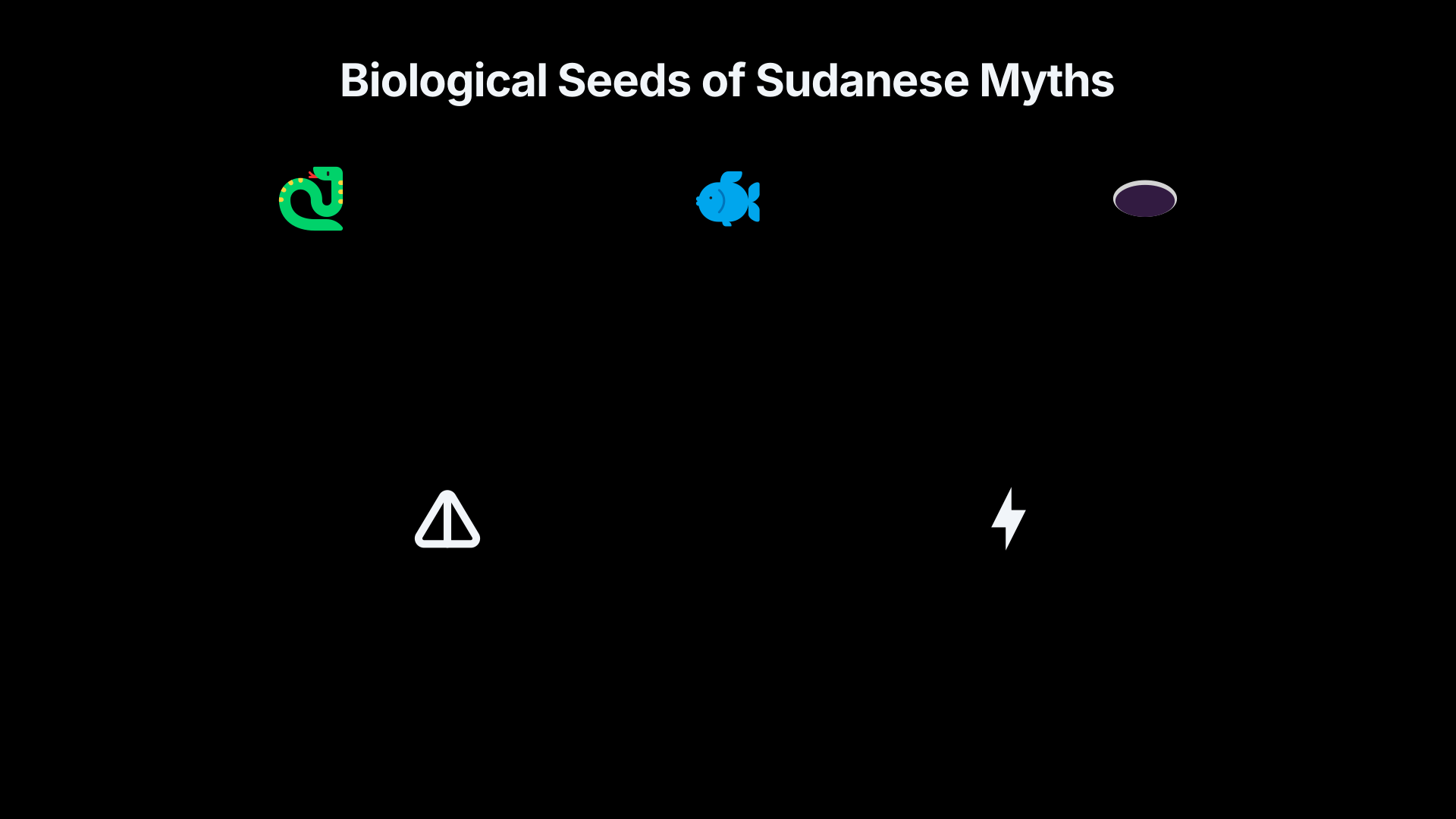
That instability points towards a composite legend rather than a single consistently observed animal. Several real creatures could have fed it:
- African rock pythons supplied the long, powerful, semi-aquatic body.
- Large catfish supplied whiskers, muddy-water habits and occasional surface disturbances.
- Lungfish supplied an elongated shape, burrowing behaviour and surprising aggression when handled.
- Bichirs supplied prominent dorsal finlets that might be remembered as a crest.
- Electric catfish offered a possible natural seed for stories about a creature whose contact or glance brought sudden harm.
No known species matches the complete description, especially the enormous lengths. The most economical explanation is that several animals, dangerous-water incidents and supernatural motifs were gathered under one name. Even Bernard Heuvelmans, an influential advocate of cryptozoology, recognised that the lau accounts were unusually contradictory and considered the possibility that the term covered multiple serpentine water animals.[Cryptid Archives]cryptidarchives.fandom.comCryptid Archives Lau | Encyclopaedia of Cryptozoology | FandomCryptid Archives Lau | Encyclopaedia of Cryptozoology | Fandom

Real animals behind Sudan’s monster stories
Sudan’s landscapes give folklore plenty of convincing raw material. The Nile and its tributaries contain large fish, crocodiles and monitor lizards, while deserts, rocky country and savanna margins support snakes, hyenas and other animals capable of producing alarming encounters.
Crocodiles are the most obvious source of river-monster imagery. They can appear as little more than eyes or a dark line before disappearing, and their attacks may leave no surviving witness able to describe what happened. In Nubian culture, however, crocodiles are not simply villains. They have also functioned as powerful symbols and protective or fortunate beings, showing how one animal can inspire fear, reverence and tourist spectacle at the same time.[AW]thearabweekly.comegypts nubians tame crocodiles selfie snapping touristsSudan and crocodiles represent an important physical totem of blessings in Nubian belief. In Gharb Soheil, a Nubian village near Aswan…
Large fish can become exaggerated in memory, particularly when seen briefly in turbid water. Archaeological and historical evidence from Nubia records Nile perch, catfish, tilapia and other fishes as important parts of daily life, ritual and artistic representation.[Ancient Near East Today]anetoday.orgAncient Near East Today A Bestiary of Ancient NubiaAncient Near East TodayA Bestiary of Ancient Nubia - The Ancient Near East Today… A large catfish surfacing beside a small boat does not require an unknown species to become the beginning of a memorable story.
Hyenas occupy another borderland between animal and monster. Beliefs in human beings who become hyenas occur across north-eastern Africa and have sometimes been attributed to Sudan. Such tales often grow from real nocturnal behaviour: hyenas approach settlements, scavenge around graves or refuse, produce uncanny calls and may attack people. The transformation element belongs to folklore, but the fear beneath it has a recognisable ecological source.[Wikipedia]WikipediaOpen source on wikipedia.org.
Snakes and monitors can likewise seem much larger during a sudden encounter. Distance, poor light and fear distort scale, while the absence of a photograph allows each retelling to add another metre, horn or mane. This does not mean witnesses are necessarily dishonest. Honest perception is still vulnerable to surprise, expectation and the difficulty of judging size in water or vegetation.
Archives preserved the stories but also reshaped them
Much of the accessible written record comes through Sudan Notes and Records, a journal published from 1918 into the late twentieth century. It preserved a vast amount of information on language, archaeology, folklore, rivers, fish and local custom that might otherwise have been lost.[sudanmemory.org]sudanmemory.orgOpen source on sudanmemory.org.
At the same time, its early material was often recorded by colonial officials, missionaries and outside scholars. Their accounts remain valuable, but they reflect translation choices, unequal relationships and the expectations of their period. A local term for a spirit, dangerous animal, taboo place or category of beings could be flattened into “monster”. Different traditions might also be merged because an outsider thought their creatures sounded similar.
Cryptozoology added another layer. Writers seeking undiscovered animals tended to extract the most physical details—length, colour, tracks, horns—and downplay ritual or moral meaning. In the lau’s case, a variable wetland tradition was gradually reimagined as a candidate giant reptile, prehistoric survivor or huge catfish. The transformation says as much about twentieth-century monster hunting as it does about the original accounts.
The best way to read these archives is therefore neither to dismiss them nor to accept them literally. They preserve genuine testimony about belief, landscape and dangerous encounters, but not necessarily evidence of an unknown species.
Hoaxes and the social-media afterlife
Modern Sudan-related monster claims increasingly circulate as detached images rather than locally rooted stories. A striking example was a photograph said to show a bizarre four-eyed animal found in Sudan. Fact-checkers traced the image not to a biological discovery but to an artificial object resembling a toy or figurine.[Snopes]snopes.comfour eyed animal sudanfour eyed animal sudan
This pattern is now common worldwide. An unusual carcass, sculpture, model or digitally altered picture is assigned to a remote location, often without a named witness, date, specimen or original photographer. “Found in Sudan” becomes an atmosphere rather than verifiable provenance.
A useful credibility test is straightforward. Strong zoological evidence should provide a traceable location, an original image or specimen, independent examination and enough anatomical material for identification. Repeated reposts of the same picture do not create independent confirmation. Neither does a dramatic caption.
Sudan’s real folklore is richer than these generic viral fakes because it is attached to particular communities, waters and social meanings. The Aman Doger is memorable because it belongs to a Nubian river world. The lau matters because it emerged from White Nile wetland traditions and colonial-era testimony. A context-free “mutant animal” image has none of that depth.
What the evidence supports
There is no strong mainstream zoological evidence for a surviving giant unknown animal unique to present-day Sudan. No securely documented specimen, diagnostic tissue, repeatable track record or clear sequence of modern observations has established one.
What Sudan does possess is a substantial mystery-creature heritage built from several different things:
- Nubian accounts of dangerous beings emerging from the Nile;
- traditions of River Folk and invisible water powers;
- historical reports collected when Sudan included today’s South Sudan;
- encounters with crocodiles, large fish, snakes, monitors and hyenas;
- later cryptozoological attempts to turn variable stories into candidate species;
- modern viral images whose claimed Sudanese origins often collapse under checking.
The most interesting conclusion is therefore not that Sudan lacks monster stories. It is that its stories resist the modern expectation that every monster must be either a new animal or a hoax. Many belong to a river-centred way of understanding danger, fertility, boundaries and unseen neighbours. The Nile is not merely the backdrop. It is the reason these beings exist in the forms remembered.
Amazon book picks
Further Reading
Books and field guides related to What Monsters Lurk in Sudan's River Stories?. Use these as the next step if you want deeper reading beyond the article.
African Myths of Origin
Covers African oral traditions that help frame Sudanese creature stories.
The Hero with a Thousand Faces
Provides broad context for monster, river-spirit and folklore traditions.

Encyclopedia of African Folklore
Contains background on African belief systems and oral traditions.
eBay marketplace picks
Marketplace Samples
Live-tested eBay searches with available results related to this page.

Endnotes
1.
Source: jstor.org
Link:https://www.jstor.org/stable/539665
Source snippet
Aman Doger: Nubian Monster of the Nileby JG Kennedy · 1970 · Cited by 6 — AMONG THE EGYPTIAN NUBIANS there survive beliefs in a fear...
2.
Source: Wikipedia
Link:https://en.wikipedia.org/wiki/Werehyena
3.
Source: sudanmemory.org
Link:https://www.sudanmemory.org/cms/81/
4.
Source: Wikipedia
Title: Sudan Notes and Records
Link:https://en.wikipedia.org/wiki/Sudan_Notes_and_Records
5.
Source: snopes.com
Title: four eyed animal sudan
Link:https://www.snopes.com/fact-check/four-eyed-animal-sudan/
6.
Source: Wikipedia
Title: List of cryptids
Link:https://en.wikipedia.org/wiki/List_of_cryptids
7.
Source: jstor.org
Link:https://www.jstor.org/stable/41716393
8.
Source: discovery.com
Title: Mythical Animals Turned Out to Be Real
Link:https://www.discovery.com/nature/Mythical-Animals-Turned-Out-to-Be-Real
9.
Source: thearabweekly.com
Title: egypts nubians tame crocodiles selfie snapping tourists
Link:https://thearabweekly.com/egypts-nubians-tame-crocodiles-selfie-snapping-tourists
Source snippet
Sudan and crocodiles represent an important physical totem of blessings in Nubian belief. In Gharb Soheil, a Nubian village near Aswan...
10.
Source: mythologicalafricans.substack.com
Title: Mythological Africans Meet the Aman Doger
Link:https://mythologicalafricans.substack.com/p/meet-the-aman-doger
Source snippet
Mythological AfricansMeet the Aman Doger - Mythological Africans...
11.
Source: womensliteracysudan.blog
Title: Women’s literacy in Sudan Angels of The Nile – Women’s literacy in Sudan
Link:https://womensliteracysudan.blog/2022/01/26/angels-of-the-nile/
12.
Source: cryptidarchives.fandom.com
Title: Cryptid Archives Lau | Encyclopaedia of Cryptozoology | Fandom
Link:https://cryptidarchives.fandom.com/wiki/Lau
13.
Source: peacekeeping.un.org
Title: ited Nations Peacekeeping Referendum in Southern Sudan. UNMIS
Link:https://peacekeeping.un.org/sites/default/files/past/unmis/referendum.shtml
Source snippet
ited Nations PeacekeepingReferendum in Southern Sudan. UNMIS - United Nations Mission in the Sudan...
14.
Source: anetoday.org
Title: Ancient Near East Today A Bestiary of Ancient Nubia
Link:https://anetoday.org/bestiary-ancient-nubia/
Source snippet
Ancient Near East TodayA Bestiary of Ancient Nubia - The Ancient Near East Today...
15.
Source: cryptidz.fandom.com
Link:https://cryptidz.fandom.com/wiki/Lau
16.
Source: cryptidz.fandom.com
Title: List of Cryptids
Link:https://cryptidz.fandom.com/wiki/List_of_Cryptids
17.
Source: cryptidarchives.fandom.com
Link:https://cryptidarchives.fandom.com/wiki/Ab%C5%ABqarn
18.
Source: mythus.fandom.com
Link:https://mythus.fandom.com/wiki/Werehyena
19.
Source: peacekeeping.un.org
Link:https://peacekeeping.un.org/sites/default/files/past/unmis/background.shtml
20.
Source: instagram.com
Link:https://www.instagram.com/mythological_africans/
21.
Source: abookofcreatures.com
Link:https://abookofcreatures.com/category/sudan/
22.
Source: mythologicalafricans.substack.com
Title: up the white nile
Link:https://mythologicalafricans.substack.com/p/up-the-white-nile
23.
Source: science.howstuffworks.com
Link:https://science.howstuffworks.com/science-vs-myth/strange-creatures/cryptids.htm
24.
Source: amazon.co.uk
Title: Sudan Notes And Records
Link:https://www.amazon.co.uk/Sudan-notes-records/dp/9354154395?tag=searcht-20
25.
Source: brickthology.com
Link:https://brickthology.com/category/cryptid/
Additional References
26.
Source: atlasobscura.com
Link:https://www.atlasobscura.com/articles/monster-mythology-werehyena
Source snippet
Atlas ObscuraThe Myth of the Werehyena and the Fear of the Other in...27 Oct 2020 — According to legend, werehyenas have long plagued pl...
27.
Source: youtube.com
Link:https://www.youtube.com/watch?v=0JNb6bj3vKM
Source snippet
The Untamed Nile - Secrets of Africa's Greatest River Revealed...
28.
Source: youtube.com
Title: Catching A Monster In The Nile | River Monsters
Link:https://www.youtube.com/watch?v=JAJnUTh8km4
Source snippet
Fishing The Rift Valley: Nile Perch Caught In The 'Devil's Cauldron' | River Monsters...
29.
Source: facebook.com
Link:https://www.facebook.com/XinhuaNewsAgency/posts/a-nubian-village-in-southern-egypt-prides-itself-as-a-place-specializing-in-rais/841301194699083/
30.
Source: abookofcreatures.com
Link:https://abookofcreatures.com/tag/african-folklore/page/2/
31.
Source: geotoys.com
Link:https://geotoys.com/blogs/geotoys-blog/cryptids-across-continents-global-legends-of-mystery-and-myth?srsltid=AfmBOoovKu6wBzRbfnkYhAcpLRkRa62BrL5ldRjoM_XXHwbtIX83N6ly
32.
Source: facebook.com
Link:https://www.facebook.com/cgtnafrica/posts/egypts-nubian-community-preserve-nile-crocodile-species/1230321835800865/
33.
Source: hangar1publishing.com
Link:https://hangar1publishing.com/blogs/cryptids/famous-cryptid-hoaxes?srsltid=AfmBOorvXr9ZAgl51DzdL3tIT5EdXipvHCyFTRO1Cm6n8vlUjn-yPQVK
34.
Source: archive.org
Link:https://archive.org/stream/journalofbomb41121939bomb/journalofbomb41121939bomb_djvu.txt
35.
Source: archive.org
Link:https://archive.org/stream/unicorn00etti/unicorn00etti_djvu.txt
Topic Tree
Follow this branch
Related pages 192
- Antigua Cryptids
- Maldives Monsters
- Malta Monsters
- Qatar Monsters
- Argentina Monsters
- +187 more in sidebar