Within Syrian Monsters
Are Syria's Mystery Beasts Really Hyenas?
Rare predators, poor visibility and alarming night sounds can turn ordinary wildlife encounters into reports of unknown beasts.
On this page
- Why striped hyenas look and sound monstrous
- The Latakia panic and other predator reports
- How to separate sightings from folklore and rumour
Page outline Jump by section
Introduction
When modern Syrians report a strange predator in the hills, hear eerie cries outside a village, or swap stories about a beast glimpsed at dusk, the explanation is often less mysterious than it first appears. Unlike countries with a single famous monster legend, Syria’s recurring “mystery beast” scares usually grow out of encounters with real carnivores: striped hyenas, wolves, jackals and, more rarely, rumours of predators thought to have vanished long ago. The combination of rugged terrain, declining wildlife populations, limited field surveys in some regions and the persistence of folklore creates ideal conditions for uncertainty. A large animal seen briefly at night can quickly become a tale of an unknown creature.

That does not mean every report is easily dismissed. Syria’s carnivore fauna has been imperfectly documented, and several large predators disappeared from the country during the twentieth century. Yet the strongest evidence points not towards undiscovered monsters, but towards misunderstood wildlife whose appearance and behaviour already seem strange enough.[ZooKeys]zookeys.pensoft.netZoo Keys Carnivores of SyriaCarnivores of Syria - ZooKeys - Pensoft Publishersby M Masseti · 2009 · Cited by 41 — The aim of this research is to outline the l…
Are Syria’s Mystery Beasts Really Hyenas?
In many cases, the answer is probably yes.
The striped hyena is one of the most misunderstood animals in the Middle East. Unlike the larger spotted hyena familiar from African wildlife documentaries, the striped hyena is generally solitary, secretive and primarily a scavenger. It survives by feeding on carrion, refuse and small prey rather than by hunting large animals. Despite this, it has accumulated centuries of fearful folklore that makes it an unusually effective generator of monster stories.[ResearchGate]researchgate.netHyaenidae) in Palestine الضبع المُخطط السوري في فلسطينMarch 1, 2020 — Syrian Striped Hyaena “Two hyenas are reported murdered…
Syria still supports striped hyenas, although they are uncommon and often difficult to observe directly. Surveys of Syrian carnivores recorded the species in several parts of the country and noted local reports from the coastal mountains and other regions. Researchers also observed that the species may occasionally approach settled areas, a behaviour that can alarm residents unfamiliar with the animal.[ZooKeys]zookeys.pensoft.netZoo Keys Carnivores of SyriaCarnivores of Syria - ZooKeys - Pensoft Publishersby M Masseti · 2009 · Cited by 41 — The aim of this research is to outline the l…
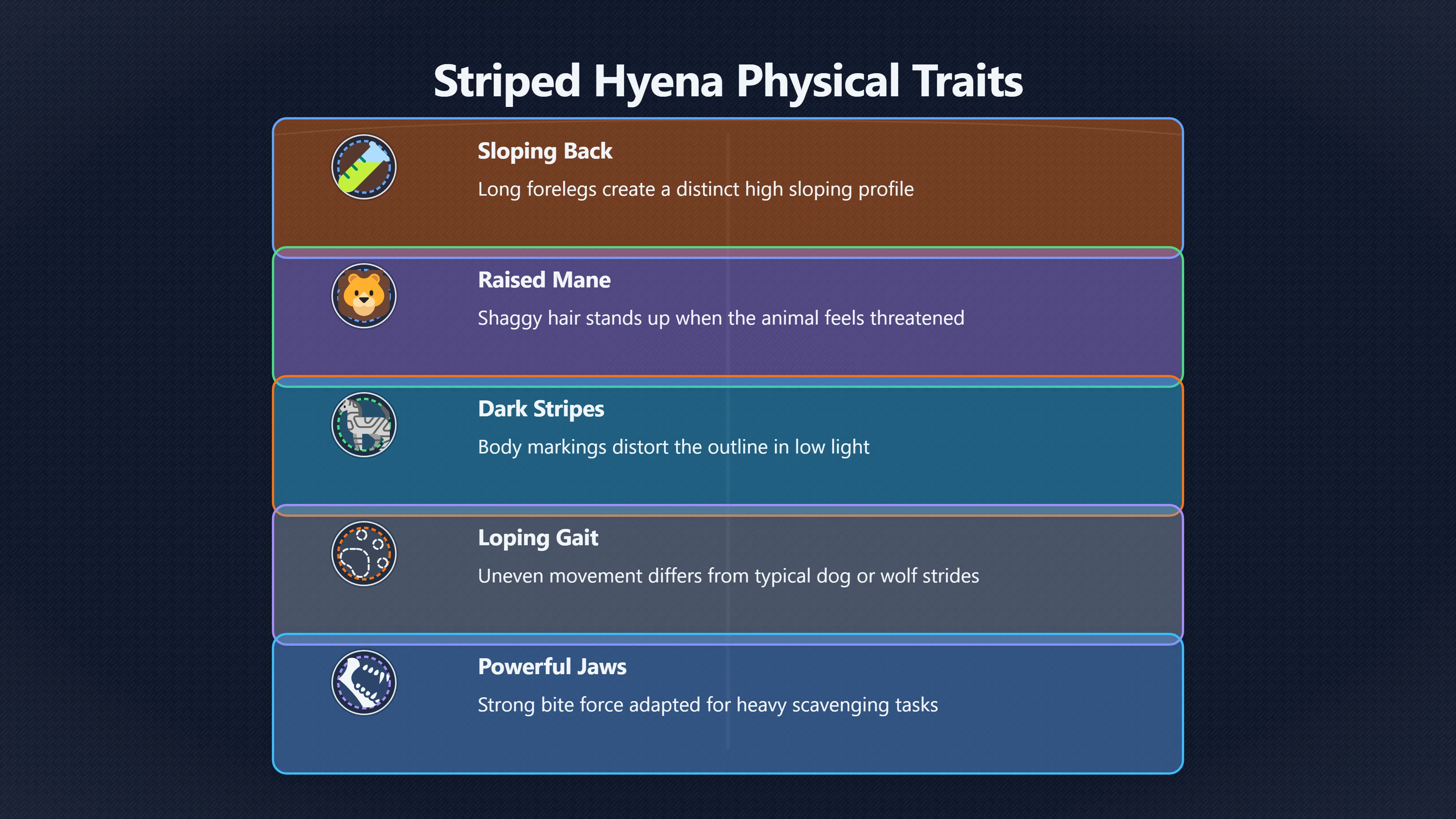
For someone encountering a striped hyena unexpectedly, the animal can look remarkably unnatural. Its features include:
- A high, sloping back created by long forelegs.
- A shaggy mane that can be raised when threatened.
- Dark body stripes that distort its outline in poor light.
- A loping, uneven gait unlike that of dogs or wolves.
- Powerful jaws associated with scavenging behaviour.
Seen briefly by torchlight or vehicle headlights, these characteristics can make a hyena appear larger, stranger and more threatening than it really is.
Why striped hyenas look and sound monstrous
The striped hyena carries cultural baggage stretching back centuries. Across parts of the Middle East, hyenas became associated with graveyards, night wandering, shape-shifting tales and supernatural beings. Folklore collected from various Arab traditions describes hyenas as creatures capable of mesmerising people, collaborating with spirits or displaying uncanny intelligence. These beliefs are not evidence about actual animal behaviour, but they strongly influence how sightings are interpreted.[Wikipedia]WikipediaStriped hyenaStriped hyena
Their vocalisations add to the effect. Although striped hyenas are generally quieter than spotted hyenas, they can produce unsettling growls, yelps and calls that sound unfamiliar to people accustomed to domestic animals. In remote villages, especially where large predators have become rare, unusual noises are easily transformed into stories about unknown beasts.
The Latakia Panic and Other Predator Reports
Syria’s coastal region around Latakia occupies a special place in mystery-animal discussions. The mountains and forests of the area historically supported a richer carnivore community than much of the rest of the country. They also became associated with stories about surviving large predators after species such as the leopard disappeared from Syria.
The last widely cited reports of the Syrian leopard come from the coastal mountains during the mid-twentieth century. As the animal vanished, rumours persisted that isolated individuals still survived in remote valleys. Whenever livestock were found killed or witnesses reported seeing a large shadowy predator, speculation often jumped beyond wolves or hyenas to the possibility of a hidden leopard. Researchers, however, have not produced convincing modern evidence that a breeding leopard population survives in Syria.[ZooKeys]zookeys.pensoft.netZoo Keys Carnivores of SyriaCarnivores of Syria - ZooKeys - Pensoft Publishersby M Masseti · 2009 · Cited by 41 — The aim of this research is to outline the l…
This pattern appears repeatedly in predator scares:
- An unusual livestock loss or night-time sighting occurs.
- Local discussion expands the event into a report of an unknown beast.
- The story absorbs older fears about vanished predators.
- Evidence remains limited to eyewitness testimony.
- More ordinary explanations become likely when details are examined.
The process is familiar in mystery-animal cases around the world. In Syria, however, the history of genuine predator decline gives the rumours extra credibility. People know that large carnivores once lived there, making it easier to imagine that one might still survive unseen.

Why Wolves Also Become Mystery Animals
Wolves are another important source of mystery-beast reports.
The grey wolf remains one of Syria’s largest surviving predators and has been recorded from various parts of the country. Because wolves are naturally wary of people, direct sightings are often brief and occur at dawn, dusk or night. Under those conditions, size estimates become unreliable. A large wolf can easily be remembered as something much bigger.[ZooKeys]zookeys.pensoft.netZoo Keys Carnivores of SyriaCarnivores of Syria - ZooKeys - Pensoft Publishersby M Masseti · 2009 · Cited by 41 — The aim of this research is to outline the l…
Recent reports from north-eastern Syria continue to describe wolf attacks on livestock, sometimes alongside reports involving hyenas. Such incidents reinforce public awareness of large predators and can fuel rumours when animals are seen only partially or from a distance.[شبكة آسو الاخبارية]aso-network.comشبكة آسو الاخباريةWolves and hyena attacks worry livestock breeders in…November 28, 2024 — 21 Dec 2024 — Wolves and hyena attacks worr…
Several factors encourage misidentification:
- Wolves viewed at night often appear larger than they are.
- Mangy wolves can develop unusual silhouettes that look unfamiliar.
- Crossbreeding with dogs in some regions can produce atypical appearances.
- Witnesses rarely observe the animal for long enough to identify it confidently.
Historically, many famous “mystery beasts” elsewhere in the world were eventually explained as wolves, large dogs or wolf-dog hybrids. The same possibility applies to a number of Syrian predator stories.
How Folklore and Wildlife Become Entangled
One reason Syrian mystery-beast stories remain compelling is that folklore and zoology overlap.
Real predators occupy landscapes already filled with older stories. A striped hyena crossing a road at midnight is a biological event. A witness who already associates hyenas with supernatural traditions may interpret the same sighting very differently. Folklore does not create the animal, but it shapes the narrative that grows around it.[Wikipedia]WikipediaStriped hyenaStriped hyena
This blending is particularly powerful in places where wildlife is rarely seen. As carnivore populations decline, people lose everyday familiarity with them. The next encounter becomes unusual, and unusual encounters attract stories.
The result is not a clear boundary between fact and legend but a spectrum:
- Documented wildlife: confirmed wolves, hyenas and other carnivores.
- Misidentifications: real animals reported as something stranger.
- Rumours: stories spreading beyond the available evidence.
- Folklore: older cultural traditions attached to real predators.
- Cryptid-style claims: suggestions that an unknown or supposedly extinct beast survives.
Most Syrian mystery-animal reports fall somewhere in the middle of this spectrum rather than at either extreme.
How to Separate Sightings from Folklore and Rumour
When evaluating a Syrian predator story, a few questions are more useful than asking whether a monster exists.
First, was the animal observed clearly enough for identification? A daylight encounter lasting several minutes is far more valuable than a brief glimpse at night.
Second, does the description match known wildlife? Raised manes, striped coats, scavenging behaviour and unusual gaits often point towards striped hyenas. Large dog-like forms with long legs and pack behaviour may indicate wolves.
Third, is there physical evidence? Tracks, photographs, camera-trap images, DNA samples and carcasses carry much more weight than retellings of a sighting.
Finally, does the claim require a new species or merely a known animal in an unexpected place? The simpler explanation is usually the stronger one.
In Syria, the available evidence overwhelmingly favours known predators over unknown monsters. Yet that conclusion does not make the stories less interesting. The real fascination lies in how a country’s surviving wolves and hyenas continue to generate legends, fears and mystery-beast reports long after many of its larger predators have disappeared. The animals are real; the monsters emerge from the uncertainty that surrounds them.
Amazon book picks
Further Reading
Books and field guides related to Are Syria's Mystery Beasts Really Hyenas?. Use these as the next step if you want deeper reading beyond the article.
Among the Bone Eaters
Directly addresses the real predator most often linked to Syrian mystery-beast fears.
The Beast in the Garden
Shows how real carnivores become sources of public panic and folklore.
Carnivores of the World
Provides scientific context for wolves, jackals and hyenas in the region.

eBay marketplace picks
Marketplace Samples
Live-tested eBay searches with available results related to this page.

Endnotes
1.
Source: researchgate.net
Title: 40846156 Carnivores of Syria
Link:https://www.researchgate.net/publication/40846156_Carnivores_of_Syria
Source snippet
(PDF) Carnivores of Syria28 Dec 2009 — ZooKeys December 2009 31 … extant Syrian carnivores amounts to 15 species, (Lat- takia) and Damasc...
Published: December 2009
2.
Source: researchgate.net
Link:https://www.researchgate.net/publication/341726256_The_Syrian_Striped_Hyaena_Hyaena_hyaena_syriaca_Matschie_1900_Carnivora_Hyaenidae_in_Palestine_aldb_almukhtt_alswry_fy_flstyn
Source snippet
Hyaenidae) in Palestine الضبع المُخطط السوري في فلسطينMarch 1, 2020 — Syrian Striped Hyaena “Two hyenas are reported murdered...
Published: March 1, 2020
3.
Source: Wikipedia
Link:https://en.wikipedia.org/wiki/Hyena
4.
Source: Wikipedia
Title: Striped hyena
Link:https://en.wikipedia.org/wiki/Striped_hyena
5.
Source: Wikipedia
Title: Wildlife of Syria
Link:https://en.wikipedia.org/wiki/Wildlife_of_Syria
6.
Source: zookeys.pensoft.net
Title: Zoo Keys Carnivores of Syria
Link:https://zookeys.pensoft.net/articles.php?id=2126
Source snippet
Carnivores of Syria - ZooKeys - Pensoft Publishersby M Masseti · 2009 · Cited by 41 — The aim of this research is to outline the l...
7.
Source: aso-network.com
Link:https://aso-network.com/?lang=en&p=38131
Source snippet
شبكة آسو الاخباريةWolves and hyena attacks worry livestock breeders in...November 28, 2024 — 21 Dec 2024 — Wolves and hyena attacks worr...
Published: November 28, 2024
Additional References
8.
Source: academia.edu
Title: Carnivores of Syria
Link:https://www.academia.edu/3259299/Carnivores_of_Syria
Source snippet
Academia(PDF) Carnivores of SyriaSyrian carnivores amounts to 15 species, ZooKeys 31: 229–252 (2009) Carnivores of Syria. Wolf, Canis lup...
9.
Source: reddit.com
Link:https://www.reddit.com/r/Syria/comments/1dubhgz/opposition_factions_in_idlib_announced_yesterday/
10.
Source: facebook.com
Link:https://www.facebook.com/groups/IsraelWildMammals/posts/25649256728073020/
11.
Source: youtube.com
Title: The Striped Hyena: The Silent Survivor
Link:https://www.youtube.com/watch?v=X7_uesBAVp0
Source snippet
The Striped Hyena: Africa's Most Mysterious Predator...
12.
Source: factcheck.afp.com
Title: photo has circulated online 2019 reports various countries about hyena attack
Link:https://factcheck.afp.com/photo-has-circulated-online-2019-reports-various-countries-about-hyena-attack
13.
Source: washingtonpost.com
Title: wolves and hyenas hunt together prove middle east peace is possible
Link:https://www.washingtonpost.com/news/animalia/wp/2016/03/19/wolves-and-hyenas-hunt-together-prove-middle-east-peace-is-possible/
14.
Source: kinhito.net
Link:https://www.kinhito.net/hinpyokai/nicky.cgi
15.
Source: youtube.com
Title: Striped Hyena walking
Link:https://www.youtube.com/watch?v=8-Bcjj7tOVo
Source snippet
Striped Hyenas: Africa's Stealthy Scavenger...
16.
Source: youtube.com
Title: The Striped Hyena: Africa’s Most Mysterious Predator
Link:https://www.youtube.com/watch?v=TnZQ0fNBR5Q
Source snippet
The Untold Secret Wolves of Arabia...
17.
Source: cambridge.org
Link:https://www.cambridge.org/core/journals/modern-intellectual-history/article/dreadful-enemies-the-beast-the-hyena-and-natural-history-in-the-enlightenment/6705668100FB7E68D37CABAE7CF4D6FB
Topic Tree