Within Turkmenistan Monsters
Which Real Animals Could Look Like Monsters?
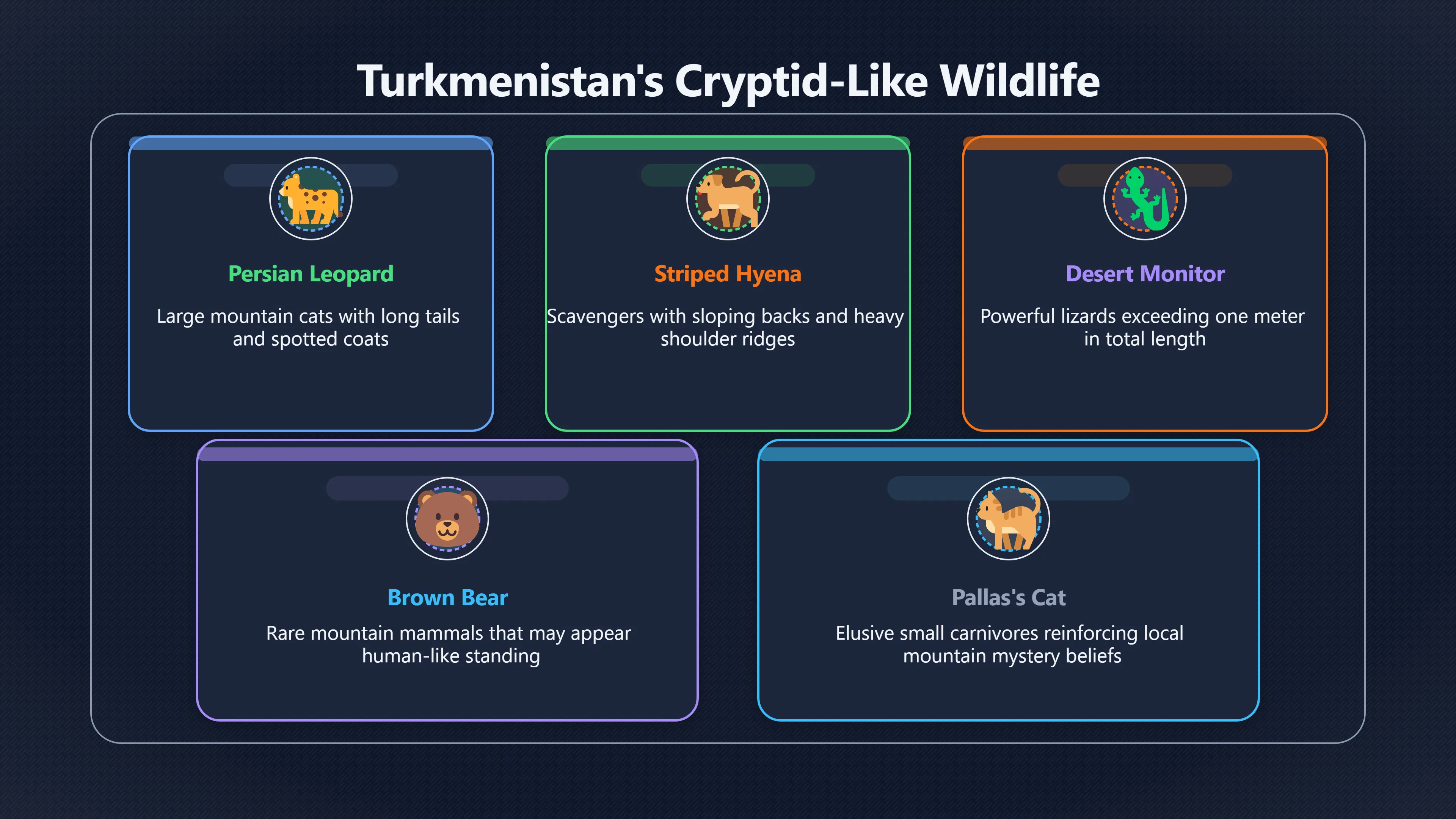
Leopards, bears, hyenas and large reptiles can create startling sightings when distance, darkness and desert conditions distort what people see.
On this page
- Persian Leopards and Phantom Cat Impressions
- Bears, Hyenas and Other Rare Mountain Animals
- Snakes, Monitors and Desert Size Illusions
Page outline Jump by section
Introduction
Many supposed “monster” encounters in Turkmenistan become less mysterious when viewed through the lens of the country’s real wildlife. Unlike countries that have a famous lake monster or ape-man legend, Turkmenistan’s most convincing mystery-beast explanations usually involve rare animals glimpsed briefly in difficult conditions. Vast deserts, broken mountain terrain, heat haze, dusk light and long viewing distances can make even known species appear strange, oversized or unfamiliar.
This is particularly true in the Kopet Dag Mountains along the Iranian border, the Badkhyz region and remote desert landscapes, where some of Central Asia’s most elusive predators still survive. Persian leopards, striped hyenas, bears, large snakes and monitor lizards are all uncommon enough that many people may never see one clearly. When they do appear unexpectedly, they can leave witnesses with stories that sound far more cryptid-like than the underlying animal really is.[ResearchGate]researchgate.netResearchGate(PDF) Assessment of Wildlife and Protected Areas of…Feb 4, 2026 — one in Uly Karanki within the Rukhabat section of Kopetd…
Which Real Animals Could Look Like Monsters?
The key mechanism behind many mystery-beast reports is not an unknown creature but an unusual encounter with a real one. Human perception works poorly under stress, in darkness and across long distances. Desert environments add extra complications: shimmering air distorts size and shape, while rocky slopes can hide parts of an animal’s body and create misleading silhouettes.
Turkmenistan is especially suited to this kind of confusion because several of its most impressive animals occur at low densities and are rarely observed. A witness may therefore have no mental reference point for what they are seeing. An animal that conservationists recognise immediately can appear extraordinary to someone encountering it unexpectedly for the first time.[Wikipedia]WikipediaWildlife of TurkmenistanWildlife of Turkmenistan
Persian Leopards and Phantom-Cat Impressions
The strongest candidate for generating “phantom cat” stories in Turkmenistan is the Persian leopard. This is not a small jungle cat but one of the largest leopard forms in the world, living in rugged mountain habitats across parts of Southwest and Central Asia. Turkmenistan holds one of the species’ most important populations outside Iran, with recent conservation surveys indicating roughly 60–80 animals and camera-trap records from several protected areas.[timesca.com]timesca.comThe majority of theseThe Times Of Central AsiaUp to Eighty Persian Leopards Now Roam TurkmenistanFeb 11, 2026 — Experts estimate that the total wild populatio…
A leopard seen under poor conditions can easily become something stranger in memory. Several factors contribute:
- Leopards move quietly and often appear suddenly.
- Their long tails can exaggerate perceived body length.
- Twilight conditions obscure the characteristic spotted coat.
- Mountain slopes make size estimates notoriously unreliable.
- Witnesses often observe only a partial silhouette before the animal disappears.
A fleeting glimpse may therefore be recalled as a giant black cat, an unusually large predator or an unidentified beast. Similar processes have contributed to phantom-cat legends in Britain, North America and elsewhere. In Turkmenistan, however, there is an actual large wild cat available to explain at least some reports.[catsg.org]catsg.orgIUCN CatSGPersian Leopard | IUCN CatSGThe wild Persian Leopard population size is estimated at 750–1,044 individuals, with 450–626 mature…
The leopard’s rarity strengthens the effect. An animal seen only once in a lifetime tends to acquire a larger-than-life reputation. Camera-trap projects in the Kopet Dag and Big Balkan regions continue to document leopards in places where casual visitors might assume no large predator remains.[Center for Large Landscape Conservation]largelandscapes.orgSouth of the Big Balkan range, in the Western Kopet Dag Mountains, camera traps…Read more…
Bears, Hyenas and Other Rare Mountain Animals
Leopards are not the only surprising mammals in Turkmenistan’s mountains. Striped hyenas survive in parts of the country, and conservation surveys have recorded them in both the Kopet Dag and Badkhyz regions. Although primarily scavengers, they possess a distinctive sloping back, heavy shoulders and unusual gait unlike that of wolves or dogs.[Center for Large Landscape Conservation]largelandscapes.orgStriped hyenas were observed on camera traps in Badhyz and Kopetdag (Gury Howdan, Bajgiran, Dushak. Karayalchi, Murzedag, Bakja and West…
For an observer unfamiliar with hyenas, especially at night, the animal can appear bizarre. Witnesses often focus on a few striking features rather than the whole body:
- An oversized head.
- A high shoulder ridge.
- A shambling or uneven walk.
- Pale grey colouring that reflects moonlight.
These traits can create impressions of a malformed wolf, an unknown predator or a creature that seems part dog and part bear. In regions where hyenas are scarce, local folklore can fill the gaps left by limited direct experience.[RadioFreeEurope/RadioLiberty]rferl.orgOpen source on rferl.org.
Bears provide another possible source of confusion. Turkmenistan’s mammal fauna includes rare populations of brown bears in mountain habitats. A bear standing briefly on its hind legs, partially hidden by vegetation or seen across a ravine can appear surprisingly human-like. Around the world, many “wild man” and ape-like reports have eventually been linked to bears observed under poor conditions. While Turkmenistan lacks a major ape-man tradition of its own, the same visual mechanism can occur wherever bears survive in remote terrain.[Wikipedia]WikipediaWildlife of TurkmenistanWildlife of Turkmenistan
Other elusive carnivores such as caracals, lynx and Pallas’s cats add to the picture. Most are too small to generate giant-monster legends on their own, but unusual sightings can reinforce local beliefs that something unidentified inhabits the mountains. Recent camera trapping has even recorded species that had gone decades without confirmed observations in some areas, demonstrating how easily wildlife can remain hidden from ordinary observers.[Center for Large Landscape Conservation]largelandscapes.orgSouth of the Big Balkan range, in the Western Kopet Dag Mountains, camera traps…Read more…

Snakes, Monitors and Desert Size Illusions
Reptiles are another rich source of exaggerated reports. Turkmenistan hosts large desert reptiles, including the Caspian or Central Asian desert monitor, one of the biggest lizards in the region. These powerful reptiles can exceed a metre in length and possess long tails, strong limbs and surprisingly fast movement.[wikipedia.org]WikipediaDesert monitorDesert monitor
Seen crossing open ground, a monitor lizard can look much larger than it really is. Several factors encourage overestimation:
- The tail may be mistaken for part of the body length.
- Heat haze blurs outlines and affects distance judgement.
- Observers often see the animal moving rapidly away.
- The low profile against the ground makes scale difficult to judge.
A monitor glimpsed from a vehicle or across a dune can therefore become a story about a giant reptile. The effect is not unique to Turkmenistan; similar reports occur throughout the deserts of North Africa, Arabia and Central Asia.[Wikipedia]WikipediaDesert monitorDesert monitor
Large snakes generate comparable misunderstandings. Even moderate-sized snakes appear longer when partly hidden in vegetation or viewed while moving through grass. Human memory also tends to increase reported length after a frightening encounter. A snake estimated at three metres can become four or five metres in later retellings, particularly when no measurement was ever made.
In a landscape already associated with remoteness and danger, these natural distortions can transform ordinary wildlife observations into tales of giant serpents or unexplained desert creatures.
Why Remote Landscapes Make Ordinary Animals Seem Extraordinary
Turkmenistan’s mystery-beast stories often emerge from a combination of rarity and environment rather than from evidence for unknown species. The country’s deserts and mountains support genuine large predators and reptiles, but they are spread across enormous areas and seldom seen clearly. Conservation studies repeatedly show that animals such as Persian leopards, striped hyenas and desert monitors persist in places where many people would never expect to encounter them.[researchgate.net]researchgate.netResearchGate(PDF) Assessment of Wildlife and Protected Areas of…Feb 4, 2026 — one in Uly Karanki within the Rukhabat section of Kopetd…
That creates ideal conditions for monster-like impressions. A witness catches a glimpse of something unusual, cannot identify it with confidence and fills in the missing details from memory, expectation or local storytelling. The result may sound like a cryptid encounter, yet the underlying explanation often lies in the remarkable wildlife that already inhabits Turkmenistan’s remote landscapes.
In that sense, the country’s rare animals are not merely alternatives to mystery beasts—they are one of the main reasons mystery-beast stories arise in the first place.[timesca.com]timesca.comThe majority of theseThe Times Of Central AsiaUp to Eighty Persian Leopards Now Roam TurkmenistanFeb 11, 2026 — Experts estimate that the total wild populatio…
Amazon book picks
Further Reading
Books and field guides related to Which Real Animals Could Look Like Monsters?. Use these as the next step if you want deeper reading beyond the article.
Field Guide to Lake Monsters, Sea Serpents, and Other Mystery...
Provides comparable cases of mistaken monster reports.

eBay marketplace picks
Marketplace Samples
Live-tested eBay searches with available results related to this page.



Endnotes
1.
Source: researchgate.net
Link:https://www.researchgate.net/publication/400430917_Assessment_of_Wildlife_and_Protected_Areas_of_Turkmenistan_2025
Source snippet
ResearchGate(PDF) Assessment of Wildlife and Protected Areas of...Feb 4, 2026 — one in Uly Karanki within the Rukhabat section of Kopetd...
2.
Source: Wikipedia
Title: Wildlife of Turkmenistan
Link:https://en.wikipedia.org/wiki/Wildlife_of_Turkmenistan
3.
Source: researchgate.net
Title: 362889852 Status of Persian leopards in northern Iran and Central Asia
Link:https://www.researchgate.net/publication/362889852_Status_of_Persian_leopards_in_northern_Iran_and_Central_Asia
Source snippet
Status of Persian leopards in northern Iran and Central AsiaAug 24, 2022 — Almost 80% of the population exists in Iran, follo...
4.
Source: catsg.org
Link:https://www.catsg.org/persianleopard
Source snippet
IUCN CatSGPersian Leopard | IUCN CatSGThe wild Persian Leopard population size is estimated at 750–1,044 individuals, with 450–626 mature...
5.
Source: Wikipedia
Title: Desert monitor
Link:https://en.wikipedia.org/wiki/Desert_monitor
6.
Source: Wikipedia
Title: Panthera pardus tulliana
Link:https://en.wikipedia.org/wiki/Panthera_pardus_tulliana
7.
Source: researchgate.net
Link:https://www.researchgate.net/publication/325152710_Persian_leopard_predation_patterns_and_kill_rates_in_the_Iran-Turkmenistan_borderland
8.
Source: researchgate.net
Title: 344297942 Status of large carnivores in the Caucasus
Link:https://www.researchgate.net/publication/344297942_Status_of_large_carnivores_in_the_Caucasus
9.
Source: researchgate.net
Link:https://www.researchgate.net/publication/337750950_The_Status_of_the_Desert_Monitor_Varanus_griseus_caspius_Squamata_Varanidae_in_the_Mangistau_region_of_the_Republic_of_Kazakhstan_and_some_features_of_the_preimaginal_stages_of_the_longhorn_beetles_Ne
10.
Source: animal.photos
Title: Desert Monitor
Link:https://www.animal.photos/reptamph/mon-des.htm
11.
Source: timesca.com
Title: The majority of these
Link:https://timesca.com/up-to-eighty-persian-leopards-now-roam-turkmenistan/
Source snippet
The Times Of Central AsiaUp to Eighty Persian Leopards Now Roam TurkmenistanFeb 11, 2026 — Experts estimate that the total wild populatio...
12.
Source: goodnewsnetwork.org
Link:https://www.goodnewsnetwork.org/endangered-persian-leopards-mount-comeback-in-central-asias-most-reclusive-nation/
Source snippet
Good News NetworkEndangered Persian Leopards Mount Comeback in...Mar 4, 2026 — There are now an estimated to be 60-80 Persian (aka, Cauc...
13.
Source: largelandscapes.org
Link:https://largelandscapes.org/news/connecting-leopards/
Source snippet
South of the Big Balkan range, in the Western Kopet Dag Mountains, camera traps...Read more...
14.
Source: largelandscapes.org
Link:https://largelandscapes.org/wp-content/uploads/Assessment-of-Wildlife-and-Protected-Areas-of-Turkmenistan-2023.pdf
Source snippet
Striped hyenas were observed on camera traps in Badhyz and Kopetdag (Gury Howdan, Bajgiran, Dushak. Karayalchi, Murzedag, Bakja and West...
15.
Source: rferl.org
Link:https://www.rferl.org/a/1074756.html
16.
Source: ayan-turkmenistan.travel
Title: Ayan Travel Agency Turkmenistan Central Asian gray monitor
Link:https://ayan-turkmenistan.travel/central-asian-gray-monitor.html
17.
Source: brcc.kz
Title: Persian leopard
Link:https://www.brcc.kz/en/key-species/leopard/
18.
Source: thezooscientist.com
Link:https://www.thezooscientist.com/persian-leopard
Additional References
19.
Source: youtube.com
Title: Turkmenistan’s Endangered Species: Conservation Challenges and Success Stories
Link:https://www.youtube.com/watch?v=WXbbKpkn5Kw
Source snippet
Striped Hyena: Secrets of the Night | Survival of the Desert Ghost...
20.
Source: youtube.com
Title: Striped Hyena: Secrets of the Night | Survival of the Desert Ghost
Link:https://www.youtube.com/watch?v=goe7wsDRiAw
Source snippet
12 Animals in Turkmenistan | Beast challenge Stories...
21.
Source: youtube.com
Title: The Desert Monitor: Turkmenistan’s Lizard King
Link:https://www.youtube.com/watch?v=w4Of8QLGe98
Source snippet
Turkmenistan's Endangered Species: Conservation Challenges and Success Stories...
22.
Source: youtube.com
Title: A Red List leopard was captured on a camera trap in Turkmenistan
Link:https://www.youtube.com/watch?v=X1u7InYYUmU
Source snippet
The Desert Monitor: Turkmenistan's Lizard King...
23.
Source: inaturalist.org
Link:https://www.inaturalist.org/blog/62709-in-iran-a-herpetologist-finds-a-colorful-caspian-monitor-lizard-observation-of-the-week
24.
Source: animalia.bio
Link:https://animalia.bio/turkmenistan-animals
25.
Source: tehranconvention.org
Link:https://tehranconvention.org/en/documents?f%5B0%5D=urf%3A146&f%5B1%5D=urf%3A184&f%5B2%5D=urf%3A191&results=
26.
Source: linkedin.com
Link:https://www.linkedin.com/posts/conservationxlabs_teambarsturkmenistan-activity-7437497697084850179-Bg7Q
27.
Source: facebook.com
Link:https://www.facebook.com/ayantour/posts/central-asian-gray-monitor-the-biggest-lizard-of-turkmenistan-the-central-asian-/835376905261606/
28.
Source: facebook.com
Link:https://www.facebook.com/thegoodnewsnetwork/posts/among-the-largest-bodied-leopards-in-the-world-theyre-growing-in-number-across-t/1333910272107452/
Topic Tree