Cryptids of Myanmar's Wildest Places
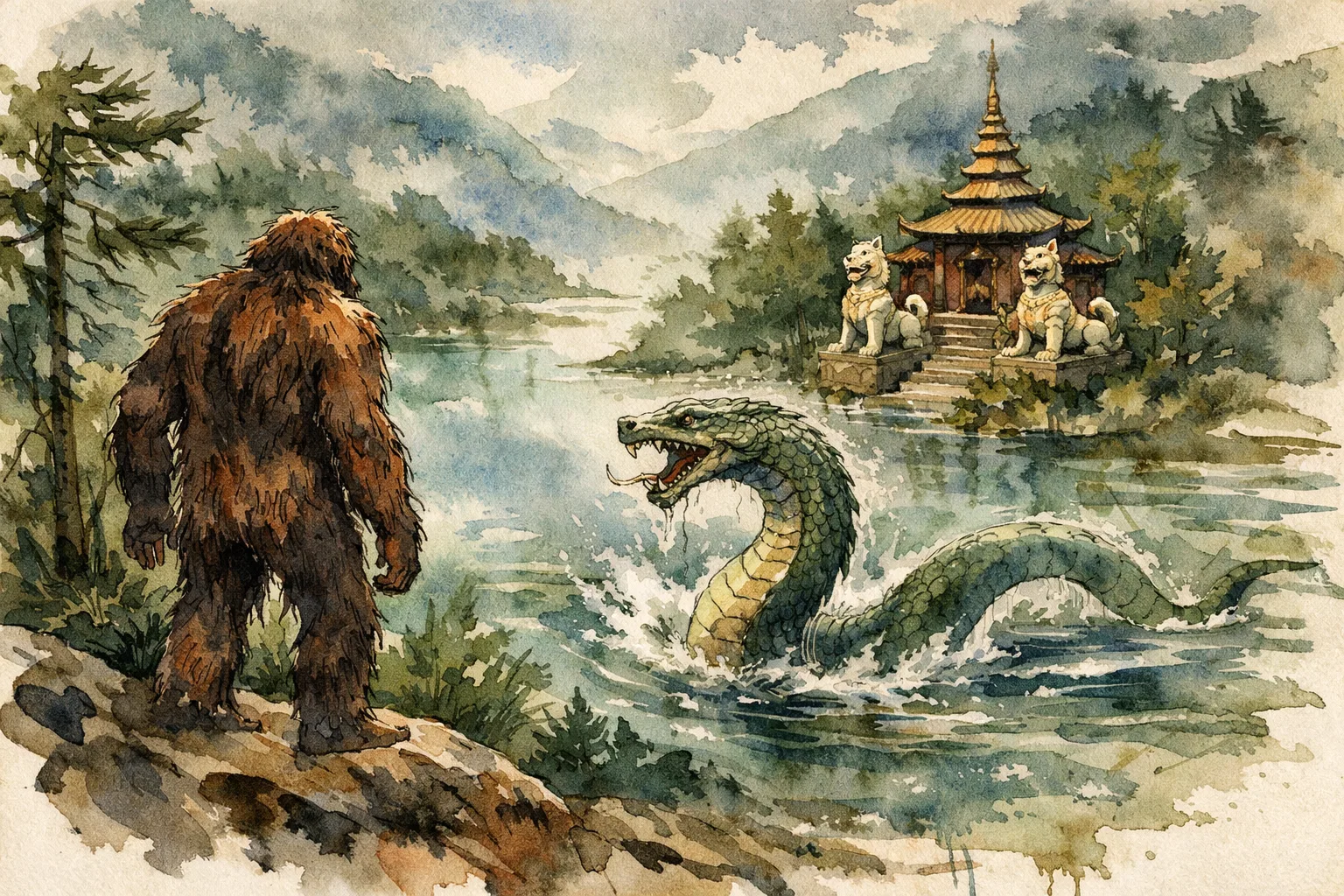
Myanmar’s strongest country-level mystery-beast tradition is not a famous lake monster or a modern tourist cryptid, but a scattered set of “wildman” reports from remote mountain forests, especially in northern Kachin State.
Page outline Jump by section
Introduction
Beyond that, Myanmar’s monster landscape is mostly folkloric rather than zoological: serpent beings, ogres, guardian lions, giant spiders, hybrid temple creatures, and local water-beast motifs. These are culturally rich, but they should not be treated as confirmed animals. The most evidence-aware reading is that Myanmar sits at a crossroads between underexplored wildlife habitat, Buddhist and local spirit traditions, colonial-era natural history, and modern cryptozoological retellings.
The Kachin “wildman” is Myanmar’s main cryptid-style case
The most substantial source on Myanmar mystery animals is Steven G. Platt and Thomas R. Rainwater’s 2015 review, “Wildmen in Myanmar”, which gathered published accounts from colonial writings, missionary reports, newspapers, and older natural-history literature. The authors found six accounts of wildmen or their tracks published between 1910 and 1974, in addition to an earlier 1891 report by W. T. Blanford of a reputed “tailless ape” near Mount Muleyit in the Tanintharyi region.[Idaho State University]isu.eduIdaho State University
The reported creature is not described like a ghost, demon, or spirit. It is usually presented as a physical forest animal: bipedal, hairy, sometimes reddish-brown or pale-orange, roughly human-sized to much taller, and associated with mountain forests, tracks, and vocalisations. The 2015 review notes that most reports cluster in mountainous northern Myanmar, chiefly Kachin State, with reported elevations ranging roughly from 1,800 to 4,800 metres.[Idaho State University]isu.eduIdaho State University
One memorable account, retold from missionary Robert Morse, concerns a hunter in the 1960s who followed tracks while hunting musk deer and reportedly came upon a seven- or eight-foot hairy figure that mimicked his movements before fleeing after being shot with a poisoned arrow. Morse also referred to earlier track finds east of Putao and concluded, cautiously but favourably, that a yeti-like animal might exist in very small numbers in inhospitable country.[Idaho State University]isu.eduIdaho State University
The striking part is not that the reports prove an unknown ape. They do not. No body, bone, photograph, DNA sample, cast track, or repeatable field evidence has established such an animal. The striking part is that Myanmar’s wildman stories are unusually grounded in named regions, older field literature, and ecological plausibility compared with many internet-era cryptid claims.
Why northern Myanmar keeps attracting “lost animal” stories
Kachin State gives the wildman tradition its atmosphere because it is genuinely remote, mountainous, biodiverse, and historically difficult to survey. The Hkakabo Razi Landscape includes Hkakabo Razi National Park, established in 1998, covering about 3,810 square kilometres and forming part of one of Myanmar’s most important northern protected landscapes. UNESCO’s tentative-list description presents the area as a major protected mountain landscape, while the Wildlife Conservation Society describes Myanmar’s northern forests as one of the region’s largest remaining expanses of natural forest.[UNESCO World Heritage Centre]whc.unesco.orgUNESCO World Heritage CentreHkakabo Razi LandscapeHkakabo Razi NP was established in 1998 and covers 3,810 km2, making it the second larg…
This matters because Myanmar has produced real zoological surprises. The Myanmar snub-nosed monkey was only described to science in the 2010s from remote northern forests, and conservation groups still treat it as a highly threatened species with a very restricted range.[Fauna & Flora]fauna-flora.orgFauna & FloraMyanmar snub-nosed monkeyThe Myanmar snub-nosed monkey is facing serious threats, with its forest habitat coming under press… That does not make a giant bipedal primate likely, but it does explain why “unknown animal” stories from northern Myanmar feel less silly than they might in a well-surveyed landscape.
The cautious explanation is that underexplored habitat can preserve both real discoveries and durable rumours. Hunters, porters, soldiers, missionaries, and forest workers may report strange tracks or fleeting glimpses because they are moving through places where visibility is poor, terrain is hard, and known animals can behave unexpectedly. The wildman tradition lives in that gap between local ecological knowledge and the absence of hard specimens.
Tracks, testimony, and the problem of proof
The Myanmar wildman evidence is almost entirely testimonial. Platt and Rainwater report that three published accounts mention tracks, described as broadly human-like and ranging from about human size to nearly twice human size; one account gives a length of about 14–16 inches. But the review also makes a key evidential point: no plaster casts or photographs of the tracks are known from Myanmar.[Idaho State University]isu.eduIdaho State University
That weakness is decisive. Footprints are only useful when documented carefully, measured, photographed, cast, and placed in context. Without that, they become memories of impressions, and memories can change, especially after surprise or fear. In forested mountains, possible sources of confusion include partial human tracks, bear sign, overlapping animal prints, mud distortion, erosion, and stories reshaped in retelling.
Even so, the wildman accounts are not easily reduced to a single hoax. The review argues that several reports predate the 1950s popularisation of the yeti and the later global sasquatch boom, which weakens the simple claim that Myanmar’s stories are only imported pop culture.[Idaho State University]isu.eduIdaho State University A fair conclusion is therefore modest: Myanmar has a real tradition of reported wildmen, but not a verified unknown primate.
Giant snakes, river beasts, and the thin trail of water monsters
Myanmar does not have a Loch Ness-style national lake monster. Instead, its watery monster material appears in three looser forms: serpent mythology, cryptozoological catalogue entries, and real large reptiles or river animals that can generate exaggerated stories.
The most cryptid-like water-beast entry is the Bu-Rin, usually described in cryptozoology references as a giant aquatic snake from near Putao, allegedly 40–50 feet long and aggressive towards swimmers and small boats. George Eberhart’s Mysterious Creatures traces the entry to Alan Rabinowitz’s Beyond the Last Village, but the available secondary references are brief and do not provide a developed case file.[National Digital Library of Ethiopia]ndl.ethernet.edu.etBu-Rin. Giant Snake of Southeast Asia. Physical description: Length, 40–50 feet. Behavior: Aquatic. Aggressive. Attacks swim- mers and sm…
There are also catalogue references to the Avagrah or Nyan, a huge water serpent associated with Bengal and Burma/Myanmar, said to inhabit estuaries and river mouths. These references are best treated as myth-and-legend material rather than modern eyewitness evidence, especially because the strongest accessible sources are encyclopaedic cryptid summaries rather than primary local testimony.[Cryptid Wiki]cryptidz.fandom.comCryptid Wiki AvagrahCryptid WikiAvagrah - Cryptid Wiki - FandomThe Avagrah, or Nyan in Burmese, is a huge water serpent from Bengal. The Avagrah preys on man…
Natural explanations are not hard to imagine. Myanmar has broad rivers, mangroves, deltas, tropical forests, large pythons in the wider region, crocodile folklore, and rare river dolphins. The Ayeyarwady population of Irrawaddy dolphins has been estimated in the dozens rather than hundreds, and older surveys recorded small groups concentrated in complex river reaches.[River Dolphins]riverdolphins.orgRiver Dolphins Irrawaddy dolphinRiver Dolphins Irrawaddy dolphin A surfacing dolphin, large snake, floating log, crocodile, or inflated oral retelling can all become “something huge in the water” without requiring an unknown monster.

Folklore creatures are not failed zoology
Many of Myanmar’s memorable monsters belong first to religion, literature, temple art, and folktale. Treating them as “cryptids” in the strict animal-search sense would flatten what makes them interesting.
Myanmar’s serpent beings connect with the wider South and Southeast Asian tradition of powerful water-linked serpents in Buddhist and Hindu-influenced cultures. Burmese folklore lists include serpent or dragon-like beings, crocodile-like water monsters, and giant crocodile figures, while Buddhist practice in Myanmar also includes serpent associations around protective figures and snake temples.[wikipedia.org]WikipediaMythical creatures in Burmese folkloreMythical creatures in Burmese folklore
The chinthe, the stylised guardian lion seen at pagodas and monasteries, is another good example. It is not a mystery animal skulking in the jungle; it is an architectural and symbolic creature, usually flanking sacred entrances and expressing protection, kingship, and Buddhist visual tradition. Museum descriptions of Burmese chinthe figures emphasise their role as Buddhist lions and temple guardians rather than zoological anomalies.[Philadelphia Museum of Art]philamuseum.orgOpen source on philamuseum.org.
The giant spider of Pindaya sits somewhere between legend and tourism. At Pindaya Caves, visitors encounter a large spider statue tied to the tale of princesses trapped in the cave by a giant spider and rescued by a prince. Travel accounts and site descriptions agree that the story now shapes the visitor experience, even though it functions as local legend rather than evidence for a giant arachnid.[Fodors Travel Guide]fodors.comTravel Guide The Bizarre Legend Behind Myanmar's Pindaya CavesTravel Guide The Bizarre Legend Behind Myanmar's Pindaya Caves
How Myanmar’s monster stories changed over time
Myanmar’s creature traditions have moved through several overlapping phases. Older Buddhist and local folklore supplied serpent beings, ogres, guardian animals, hybrid beasts, and cave monsters. Colonial-era naturalists and hunters then added a different kind of record: reports framed as unusual animals, tracks, “tailless apes”, or wild forest people. Later, international cryptozoology folded some of these accounts into global categories such as yeti-like wildmen, giant snakes, and unknown primates.
That change matters because a creature can shift category without changing its core story. A mountain being once discussed as local forest knowledge may later be compared with the yeti; a water-serpent motif may become a “river monster”; a temple guardian may appear in online lists of mythical beasts. The retelling does not necessarily make the story false, but it changes what readers think they are being asked to believe.
The most useful split is this:
- Folklore creatures belong to story, ritual, temple art, literature, and moral imagination.
- Witness claims describe alleged encounters with physical animals, but need documentation.
- Cryptozoological catalogue entries often preserve interesting names but may be thinly sourced.
- Plausible animal explanations include known wildlife, distorted tracks, rare sightings, and local ecological knowledge.
- Confirmed zoology requires specimens, photographs, DNA, repeatable surveys, or expert identification.
Myanmar has plenty of the first four. It does not currently have confirmed evidence for a surviving unknown giant ape, lake monster, or giant aquatic serpent.

What a fair-minded reader should take away
Myanmar’s cryptid history is strongest when it is read as a borderland subject: part folklore, part wildlife history, part mountain rumour, part colonial archive. The wildman reports from Kachin and nearby northern regions are the most serious mystery-animal material because they have a published review, a rough chronology, recurring geography, and repeated physical motifs. They remain unproven, but they are not just a modern internet invention.[Idaho State University]isu.eduIdaho State University
The water monsters are thinner. Bu-Rin and Avagrah/Nyan are interesting as cryptozoological names, but the accessible evidence is fragmentary and heavily dependent on secondary summaries. They belong on a Myanmar mystery-beast page, but with clear caution.[National Digital Library of Ethiopia]ndl.ethernet.edu.etBu-Rin. Giant Snake of Southeast Asia. Physical description: Length, 40–50 feet. Behavior: Aquatic. Aggressive. Attacks swim- mers and sm…
The folklore creatures are richer and more secure culturally than the cryptids are zoologically. Serpents, chinthe, ogres, giant spiders, and hybrid beings show how Myanmar’s monster imagination is tied to rivers, caves, pagodas, mountain forests, Buddhist storytelling, and local protective traditions. The country’s strangest animal stories are therefore best enjoyed with two ideas held together: Myanmar’s wild landscapes have genuinely surprised science, but its monsters remain legends, claims, and possibilities rather than proven hidden animals.
Amazon book picks
Further Reading
Books and field guides related to What Monsters Haunt Myanmar's Wildest Places?. Use these as the next step if you want deeper reading beyond the article.
The Mythology Book
Covers mythic creatures and belief systems relevant to Myanmar folklore.
Myths and Legends of the World
Helps place Myanmar creature traditions in a global context.
Abominable Science!
"A sharp analysis of the quest for unreal critters―cryptids, as they are called―and the people who pursue them . . . entertaining and tho...
eBay marketplace picks
Marketplace Samples
Live-tested eBay searches with available results related to this page.



Endnotes
1.
Source: isu.edu
Title: Idaho State University
Link:https://www.isu.edu/media/libraries/rhi/research-papers/WILDMEN-IN-MYANMAR.pdf
2.
Source: whc.unesco.org
Link:https://whc.unesco.org/en/tentativelists/5871/
Source snippet
UNESCO World Heritage CentreHkakabo Razi LandscapeHkakabo Razi NP was established in 1998 and covers 3,810 km2, making it the second larg...
3.
Source: Wikipedia
Title: Mythical creatures in Burmese folklore
Link:https://en.wikipedia.org/wiki/Mythical_creatures_in_Burmese_folklore
4.
Source: Wikipedia
Title: Shin Upagutta
Link:https://en.wikipedia.org/wiki/Shin_Upagutta
5.
Source: fodors.com
Title: Travel Guide The Bizarre Legend Behind Myanmar’s Pindaya Caves
Link:https://www.fodors.com/world/asia/myanmar/experiences/news/the-place-where-a-giant-spider-stands-guard-over-a-cave-filled-with-9000-buddha-statues
6.
Source: Wikipedia
Title: List of lake monsters
Link:https://en.wikipedia.org/wiki/List_of_lake_monsters
7.
Source: Wikipedia
Title: Wild man
Link:https://en.wikipedia.org/wiki/Wild_man
8.
Source: Wikipedia
Title: Pindaya Caves
Link:https://en.wikipedia.org/wiki/Pindaya_Caves
9.
Source: Wikipedia
Link:https://en.wikipedia.org/wiki/N%C4%81ga
10.
Source: Wikipedia
Link:https://en.wikipedia.org/wiki/Chinthe
11.
Source: Wikipedia
Title: Wiki Project Myanmar
Link:https://en.wikipedia.org/wiki/Wikipedia%3AWikiProject_Myanmar
12.
Source: Wikipedia
Title: Hkakaborazi National Park
Link:https://en.wikipedia.org/wiki/Hkakaborazi_National_Park
13.
Source: archive.org
Link:https://archive.org/details/xxVG_folk-elements-in-burmese-buddhism-by-maung-htin-aung-1959-rangoon-u-hla-maung-bu
14.
Source: archive.org
Link:https://archive.org/stream/Cryptozoology_201608/Cryptozoology_djvu.txt
15.
Source: archive.org
Link:https://archive.org/stream/CreepyStories/MysteriousCreatures-AGuideToCryptozoology_djvu.txt
16.
Source: fauna-flora.org
Link:https://www.fauna-flora.org/species/myanmar-snub-nosed-monkey/
Source snippet
Fauna & FloraMyanmar snub-nosed monkeyThe Myanmar snub-nosed monkey is facing serious threats, with its forest habitat coming under press...
17.
Source: ndl.ethernet.edu.et
Link:https://ndl.ethernet.edu.et/bitstream/123456789/46979/1/George%20M.%20Eberhart.pdf
Source snippet
Bu-Rin. Giant Snake of Southeast Asia. Physical description: Length, 40–50 feet. Behavior: Aquatic. Aggressive. Attacks swim- mers and sm...
18.
Source: cryptidz.fandom.com
Title: Cryptid Wiki Avagrah
Link:https://cryptidz.fandom.com/wiki/Avagrah
Source snippet
Cryptid WikiAvagrah - Cryptid Wiki - FandomThe Avagrah, or Nyan in Burmese, is a huge water serpent from Bengal. The Avagrah preys on man...
19.
Source: riverdolphins.org
Title: River Dolphins Irrawaddy dolphin
Link:https://www.riverdolphins.org/river-dolphins-worldwide/irrawaddy-dolphin/
20.
Source: lkcnhm.nus.edu.sg
Title: s10rbz067 073
Link:https://lkcnhm.nus.edu.sg/wp-content/uploads/sites/10/2020/12/s10rbz067-073.pdf
21.
Source: edgeeffects.net
Title: snake temples
Link:https://edgeeffects.net/snake-temples/
22.
Source: philamuseum.org
Link:https://www.philamuseum.org/objects/277507
23.
Source: cryptidz.fandom.com
Title: Lake Monsters
Link:https://cryptidz.fandom.com/wiki/Lake_Monsters
24.
Source: villains.fandom.com
Title: Ape Men
Link:https://villains.fandom.com/wiki/Ape-Men
25.
Source: cryptidz.fandom.com
Title: Bu Rin
Link:https://cryptidz.fandom.com/wiki/Bu-Rin
26.
Source: cryptidz.fandom.com
Title: Gray Dhole
Link:https://cryptidz.fandom.com/wiki/Gray_Dhole
27.
Source: cryptidz.fandom.com
Link:https://cryptidz.fandom.com/wiki/Xizi
28.
Source: cryptidz.fandom.com
Title: Category:Southeast Asia
Link:https://cryptidz.fandom.com/wiki/Category%3ASoutheast_Asia
29.
Source: cryptidz.fandom.com
Title: Cryptids of the Andaman Islands
Link:https://cryptidz.fandom.com/wiki/Cryptids_of_the_Andaman_Islands
30.
Source: cryptidz.fandom.com
Title: Chang Nam
Link:https://cryptidz.fandom.com/wiki/Chang_Nam
31.
Source: cryptidz.fandom.com
Link:https://cryptidz.fandom.com/wiki/Makara
32.
Source: cryptidz.fandom.com
Title: Giant Chinese Bamboo Rat
Link:https://cryptidz.fandom.com/wiki/Giant_Chinese_Bamboo_Rat
33.
Source: cryptidz.fandom.com
Link:https://cryptidz.fandom.com/wiki/Sphinx
34.
Source: naturerules1.fandom.com
Link:https://naturerules1.fandom.com/wiki/Avagrah
35.
Source: cryptidz.fandom.com
Title: Asian Mermaids (Matsyāṅganā and Ningyo)
Link:https://cryptidz.fandom.com/wiki/Asian_Mermaids_%28Matsy%C4%81%E1%B9%85gan%C4%81_and_Ningyo%29
36.
Source: youtube.com
Link:https://www.youtube.com/watch?v=AwW7HRZ4oh0
37.
Source: forestdepartment.gov.mm
Link:https://www.forestdepartment.gov.mm/content/preparation-process-myanmar%E2%80%99s-first-natural-world-heritage-site-hkakabo-razi-landscape
38.
Source: hcmussh.edu.vn
Link:https://hcmussh.edu.vn/static/document/ThesignificanceofNagainThaiOrnaments.pdf
39.
Source: supernaturalandthemakebelief.weebly.com
Link:https://supernaturalandthemakebelief.weebly.com/snakes.html
Additional References
40.
Source: programs.wcs.org
Link:https://programs.wcs.org/myanmar/Wild-Places/Northern-Forests.aspx
Source snippet
WCS Myanmar > Wild Places > Northern ForestsFour protected areas embrace one of the region's largest remaining expanses of natural forest...
41.
Source: neprimateconservancy.org
Title: myanmar snub nosed monkey
Link:https://neprimateconservancy.org/myanmar-snub-nosed-monkey/
Source snippet
New England Primate ConservancyMyanmar Snub-Nosed Monkey, Rhinopithecus strykeri24 Nov 2023 — Geographic Distribution and Habitat · The M...
42.
Source: youtube.com
Title: Nat Pwe: Burma’s Carnival of Spirit Soul
Link:https://www.youtube.com/watch?v=zCqBnKJJ3IY
Source snippet
Burmese mythology creatures monsters Top10 Ancient Creature In Myanmar|#youtubeshorts#shorts#trending #viral#top10#mythicalcreatures MR P...
43.
Source: youtube.com
Link:https://www.youtube.com/watch?v=DavtfmKa1ME
Source snippet
Mount Popa at Dusk: The Spirits Waiting by Shrine Posts...
44.
Source: occult-world.com
Title: bu rin
Link:https://occult-world.com/bu-rin/
Source snippet
Occult WorldBu-RinBu-Rin. Lux Ferre by Lux Ferre27 June 2021. Share this... Alan Rabinowitz, Beyond the Last Village: A Journey of Disco...
Published: June 2021
45.
Source: youtube.com
Title: MYANMAR: The World’s Most Mysterious Country
Link:https://www.youtube.com/watch?v=u2XHhLVkcQk
Source snippet
He Was Betrayed by a King... Then Became a Powerful Spirit...
46.
Source: instagram.com
Link:https://www.instagram.com/p/DXfsVkyj5UA/?hl=en
47.
Source: academia.edu
Link:https://www.academia.edu/119271329/Tai_Lands_Burma_Lands_Mon_Lands_Ming_China_borderlands_military_history
48.
Source: researchgate.net
Link:https://www.researchgate.net/publication/311002576_The_Critically_Endangered_Myanmar_snub-nosed_monkey_Rhinopithecus_strykeri_found_in_the_Salween_River_Basin_China
49.
Source: scribd.com
Link:https://www.scribd.com/document/483401219/9-Folk-Elements-in-Burmese-Buddhism-Maung-Htin-Aung-blank-pages-omitted-pdf
Topic Tree
Follow this branch
Related pages 192
- Antigua Cryptids
- Maldives Monsters
- Malta Monsters
- Qatar Monsters
- Argentina Monsters
- +187 more in sidebar