Within Tuvalu
Why Does Tuvalu Have So Few Cryptid Reports?
Tuvalu's monster record is dominated by sacred history and marine symbolism, with little evidence of modern sightings or media flaps.
On this page
- What a modern cryptid case would require
- Geography, reefs and maritime folklore
- Early records, missing evidence and misidentifications
Page outline Jump by section
Introduction
Tuvalu is unusual in the world of cryptids because it has remarkably few modern monster reports. While many countries have famous lake creatures, mystery apes, phantom cats or recurring sea-serpent sightings, Tuvalu’s strange-animal traditions are largely found in mythology, origin stories and sacred history rather than in contemporary eyewitness claims. The absence of modern cryptid reports is not simply a gap in the record. It reflects the country’s geography, culture, population size and the way unusual creatures are understood within local traditions. Rather than generating ongoing debates about unknown animals, Tuvalu’s most famous creature stories tend to explain how islands were formed, how ancestors arrived, or how people relate to the sea.[UNESCO World Heritage Centre]whc.unesco.orgUNESCO World Heritage CentreThe Pacific atoll-island cultural landscape of Tuvalu24 Jan 2024 — Oral tradition is important in Tuvalu and…
This makes Tuvalu an interesting case study. Instead of asking why there are so many monster stories, the more revealing question is why there are so few modern cryptid claims at all.
What a Modern Cryptid Case Would Require
A modern cryptid tradition usually leaves certain traces behind. Countries known for cryptid lore often have at least some combination of:
- Repeated sightings over many years.
- A named creature recognised by the public.
- Newspaper coverage or media campaigns.
- A specific location associated with encounters.
- Physical evidence such as photographs, tracks, carcasses or disputed specimens.
- Ongoing debates between believers and sceptics.
Tuvalu has little evidence of these patterns. Researchers, travellers and journalists have documented the country’s folklore and mythology, but there is no well-known Tuvaluan equivalent of the Loch Ness Monster, Bigfoot or the giant-anaconda legends found elsewhere. Searches of available historical and cultural records reveal stories about spirits, creators and legendary beings, yet very few reports describing an unknown animal repeatedly seen in modern times.[Wikipedia]WikipediaTuvaluan mythologyTuvaluan mythology
This absence is significant because cryptid traditions often grow through repetition. A single strange encounter can become a local mystery if later witnesses report similar experiences. In Tuvalu, that chain of modern reports appears largely missing.
Geography, Reefs and Maritime Folklore
One reason may be the physical environment itself. Tuvalu consists of nine small coral islands and atolls spread across a vast area of the Pacific Ocean. The islands are low-lying, surrounded by reefs and lagoons, and contain none of the large forests, mountain ranges or deep inland lakes that commonly become homes for mystery beasts in other countries.[thecommonwealth.org]thecommonwealth.orgCommonwealth TuvaluCommonwealthTuvalu - Commonwealth SecretariatIt is made up of a chain of 9 small coral islands. The islands are low lying. Many have larg…
This geography affects both folklore and opportunities for sightings.
In many regions, cryptid reports flourish because there are extensive wilderness areas where unknown animals can plausibly hide. Tuvalu offers very little equivalent terrain. Most land areas are small, heavily familiar to local residents and close to the sea. There are few places where a large undiscovered terrestrial animal could remain hidden for generations.[Commonwealth]thecommonwealth.orgCommonwealth TuvaluCommonwealthTuvalu - Commonwealth SecretariatIt is made up of a chain of 9 small coral islands. The islands are low lying. Many have larg…
The surrounding ocean is vast, but maritime cultures often interpret unusual marine encounters differently from inland societies. Strange creatures may become part of sacred narratives, navigation traditions or ancestral stories rather than evolving into modern zoological mysteries. In Tuvalu, the sea is central to daily life and cultural memory, and many legendary beings are connected to creation stories rather than eyewitness investigations.[UNESCO World Heritage Centre]whc.unesco.orgUNESCO World Heritage CentreThe Pacific atoll-island cultural landscape of Tuvalu24 Jan 2024 — Oral tradition is important in Tuvalu and…

Why Mythology Dominates Instead of Cryptozoology
Tuvalu’s best-known creature traditions illustrate this difference.
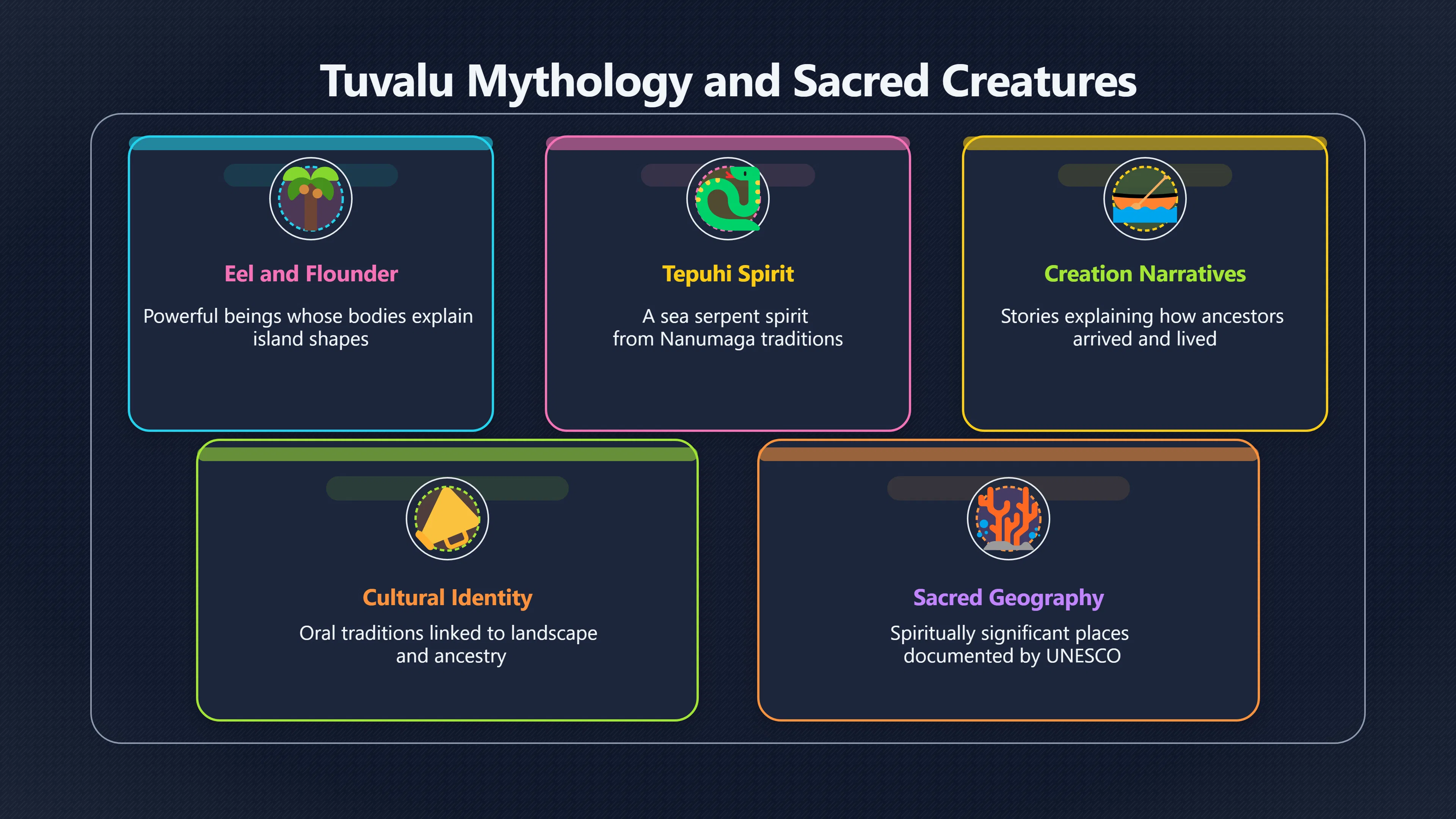
The famous story of the Eel and the Flounder describes powerful beings whose transformed bodies explain the shape of the islands and the importance of coconut palms. Likewise, traditions from Nanumaga describe Tepuhi, a spirit associated with the form of a sea serpent. These stories are important cultural narratives, but they are not presented as evidence that giant unknown animals still inhabit nearby waters.[Wikipedia]WikipediaTuvaluan mythologyTuvaluan mythology
This distinction matters. In many modern cryptid traditions, witnesses claim to have seen a creature that might still exist. In Tuvaluan mythology, creature figures usually belong to a sacred past that explains the world rather than a hidden present waiting to be discovered.
UNESCO’s documentation of Tuvalu’s cultural landscape notes the continuing importance of oral tradition and spiritually significant places. Stories remain connected to identity, ancestry and landscape rather than being framed as unsolved wildlife mysteries.[UNESCO World Heritage Centre]whc.unesco.orgUNESCO World Heritage CentreThe Pacific atoll-island cultural landscape of Tuvalu24 Jan 2024 — Oral tradition is important in Tuvalu and…
As a result, unusual creatures are often remembered as meaningful cultural figures rather than transformed into modern cryptid celebrities.
Early Records, Missing Evidence and Misidentifications
Another striking feature of Tuvalu’s record is the lack of historical reports that later evolved into cryptid legends.
Many famous monsters began with scattered newspaper stories, sailors’ accounts or reports from explorers. Over time, these accounts accumulated into larger legends. Tuvalu’s documented traditions contain legendary beings, but there is little evidence of sustained reporting about mysterious animals in lagoons, reefs or coastal waters.[Wikipedia]WikipediaTuvaluan mythologyTuvaluan mythology
That does not mean unusual observations never occurred. Coral-reef environments contain large fish, sharks, rays, turtles and moray eels. Under poor visibility or from a distance, these animals can appear strange or unexpectedly large. Tuvalu’s reefs support hundreds of fish species, providing many opportunities for ordinary wildlife to look extraordinary under unusual circumstances.[Wikipedia]WikipediaOpen source on wikipedia.org.
Yet even if occasional misidentifications happened, they do not seem to have generated enduring monster traditions. Reports either went unrecorded, remained local anecdotes, or were interpreted within existing cultural frameworks rather than becoming public cryptid mysteries.

Small Population, Small Media Footprint
Population size and media history also help explain the pattern.
Tuvalu has a population of roughly eleven thousand people spread across remote islands. In larger countries, even a tiny percentage of residents reporting strange animals can create a substantial body of sightings. In Tuvalu, the pool of potential witnesses is much smaller.[Reuters]reuters.comSinking Tuvalu fights to keep maritime boundaries as sea levels riseThis small nation has experienced a sea-level rise of 15 cm in the past 30 years, and with Funafuti, the main atoll, already experiencing…
Modern cryptid flaps often depend on newspapers, radio, television and now social media amplifying unusual claims. Remote locations with limited media infrastructure historically generated fewer documented reports. A strange sighting that might become a national sensation elsewhere could remain a local story or simply fade away.
The result is a much thinner archive of mystery-animal reports than researchers find in countries with larger populations and longer traditions of sensational wildlife reporting.
The Real Mystery Is the Absence
For cryptid researchers, Tuvalu’s most interesting feature may be what is missing. The country possesses rich folklore, deep maritime traditions and memorable creature imagery, yet almost none of the recurring modern sightings that define classic cryptozoology.
Rather than producing ongoing hunts for hidden animals, Tuvalu’s creature stories largely remain where they began: in origin myths, ancestral traditions and symbolic explanations of the natural world. The sea serpent Tepuhi, the Eel and the Flounder, and other legendary beings survive as cultural narratives rather than as targets of modern monster investigations.[Wikipedia]WikipediaTuvaluan mythologyTuvaluan mythology
In that sense, Tuvalu stands apart from many cryptid-rich countries. Its legendary creatures are remembered primarily as creators, ancestors and symbols, not as elusive animals waiting to be photographed. The scarcity of modern reports is therefore not a mystery to be solved so much as a reflection of how Tuvalu’s culture has traditionally understood extraordinary creatures in the first place.[unesco.org]whc.unesco.orgUNESCO World Heritage CentreThe Pacific atoll-island cultural landscape of Tuvalu24 Jan 2024 — Oral tradition is important in Tuvalu and…
Amazon book picks
Further Reading
Books and field guides related to Why Does Tuvalu Have So Few Cryptid Reports?. Use these as the next step if you want deeper reading beyond the article.
Abominable Science!
Explains why some regions generate cryptid traditions while evidence remains weak.
The United States of Cryptids
Shows how cryptid traditions emerge and persist in different cultures.

The Penguin Book of Dragons
Explores legendary creatures rather than modern zoological evidence.
eBay marketplace picks
Marketplace Samples
Live-tested eBay searches with available results related to this page.



Endnotes
1.
Source: whc.unesco.org
Link:https://whc.unesco.org/en/tentativelists/6707/
Source snippet
UNESCO World Heritage CentreThe Pacific atoll-island cultural landscape of Tuvalu24 Jan 2024 — Oral tradition is important in Tuvalu and...
2.
Source: Wikipedia
Title: Tuvaluan mythology
Link:https://en.wikipedia.org/wiki/Tuvaluan_mythology
3.
Source: Wikipedia
Link:https://en.wikipedia.org/wiki/Tuvalu
4.
Source: Wikipedia
Title: Geography of Tuvalu
Link:https://en.wikipedia.org/wiki/Geography_of_Tuvalu
Source snippet
Geography of TuvaluThe Tuvalu islands have a total land area of only about 26 km 2, less than 10 sq mi (30 km 2). The land is very low...
5.
Source: reuters.com
Title: Sinking Tuvalu fights to keep maritime boundaries as sea levels rise
Link:https://www.reuters.com/business/environment/sinking-tuvalu-fights-keep-maritime-boundaries-sea-levels-rise-2024-09-24/
Source snippet
This small nation has experienced a sea-level rise of 15 cm in the past 30 years, and with Funafuti, the main atoll, already experiencing...
6.
Source: youtube.com
Title: Te Pusi mo te Ali — Tuvalu Creation Myth (Eel & Flounder)
Link:https://www.youtube.com/watch?v=y2NEi8NnFVg
Source snippet
Wikipedia...
7.
Source: thecommonwealth.org
Title: Commonwealth Tuvalu
Link:https://thecommonwealth.org/our-member-countries/tuvalu
Source snippet
CommonwealthTuvalu - Commonwealth SecretariatIt is made up of a chain of 9 small coral islands. The islands are low lying. Many have larg...
8.
Source: pacificndc.org
Link:https://pacificndc.org/pacific-ndcs/tuvalu
9.
Source: youtube.com
Link:https://www.youtube.com/watch?v=WM1WhySdkaU
10.
Source: ebsco.com
Link:https://www.ebsco.com/research-starters/geography-and-cartography/tuvalu
11.
Source: unfccc.int
Link:https://unfccc.int/sites/default/files/resource/NAP_Tuvalu_2025.pdf
Additional References
12.
Source: theguardian.com
Link:https://www.theguardian.com/news/2025/aug/14/how-to-leave-a-sinking-nation-tuvalus-dreams-of-dry-land
Source snippet
Simon Kofe, Tuvalu's former foreign minister, launched a global campaign in 2022, proposing the creation of a "digital nation" to preserv...
13.
Source: worldbooktour.wordpress.com
Title: tuvalu part 2
Link:https://worldbooktour.wordpress.com/2017/04/21/tuvalu-part-2/
Source snippet
(Part 2) - theworldbooktour - WordPress.com21 Apr 2017 — After the creation story is established, the history of each of the eight island...
14.
Source: frieze.com
Link:https://www.frieze.com/article/celeste-olalquiaga-tuvalu-issue-234
15.
Source: facebook.com
Link:https://www.facebook.com/thecoconet/posts/find-out-how-the-islands-of-tuvalu-got-their-name-the-story-of-the-eel-flounders/1618815051589042/
16.
Source: manapacific.co.nz
Link:https://www.manapacific.co.nz/rising-story/nanumaga-story
17.
Source: facebook.com
Link:https://www.facebook.com/100063697794361/posts/tuvalu-is-one-of-the-smallest-and-most-remote-nations-in-the-world-located-in-th/1205372474929334/
18.
Source: cbd.int
Link:https://www.cbd.int/doc/world/tv/tv-nr-05-en.pdf
19.
Source: youtube.com
Link:https://www.youtube.com/watch?v=RSrmZA7XrM0
20.
Source: stage.openvirtualworlds.org
Title: tuvalu the sinking island and its living traditions
Link:https://stage.openvirtualworlds.org/worldheritage2025/tuvalu-the-sinking-island-and-its-living-traditions/
21.
Source: kaidravuni.com
Title: babale the sea serpent of much of my life
Link:https://kaidravuni.com/2017/02/23/babale-the-sea-serpent-of-much-of-my-life/
Topic Tree