The Creatures Behind Tanzania's Monster Legends
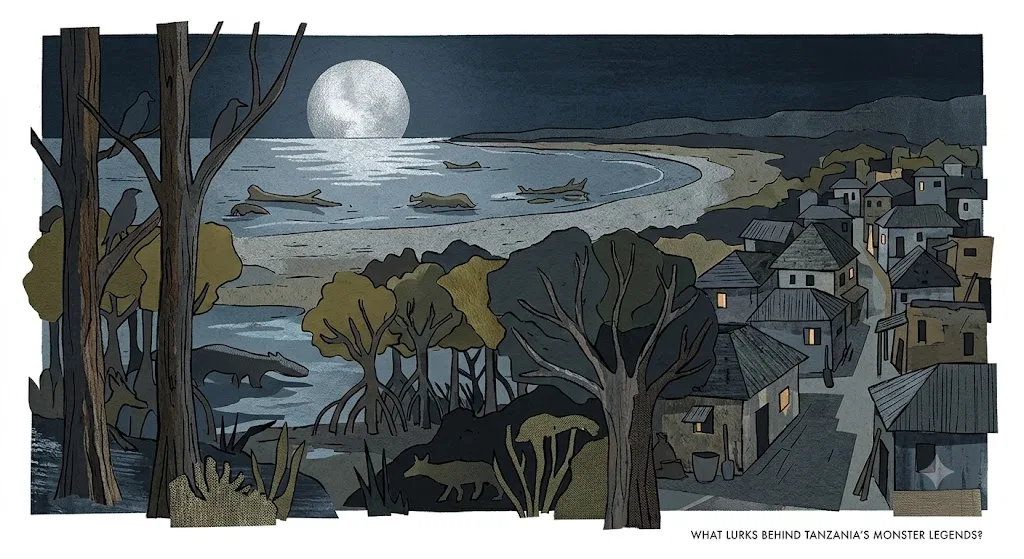
Tanzania’s mystery-creature tradition is not dominated by one national equivalent of the Loch Ness Monster.
Page outline Jump by section
Introduction
The most important distinction is between folklore and zoological claims. The Mngwa grew from both Swahili monster traditions and reports of lethal animal attacks. The Popobawa belongs primarily to spirit belief, collective fear and political history rather than hidden-animal zoology. The Agogwe rests on a handful of old eyewitness narratives, while the lake monsters survive chiefly as repeated stories detached from verifiable specimens, photographs or sustained local investigations. Together, they show how Tanzania’s real wildlife, oral traditions, colonial record-keeping and international monster culture have repeatedly overlapped.
The Mngwa: Tanzania’s mystery cat
The Mngwa, also called the Nunda in many retellings, is Tanzania’s clearest conventional cryptid: an allegedly unknown, exceptionally large cat said to prowl coastal woodland and settlements. Descriptions usually portray a grey or brindled feline, sometimes compared in size to a donkey and said to be recognisably different from both a lion and a leopard. Most modern accounts ultimately trace back to the writings of British colonial administrator William Hichens rather than to preserved specimens or independently documented field research.[Cryptid Archives]cryptidarchives.fandom.comCryptid ArchivesMngwa | Encyclopaedia of Cryptozoology - FandomA series of alleged mngwa attacks occurred in the village of Lindi, Tangan…
Hichens connected the creature with a series of fatal attacks around Lindi in what was then Tanganyika. In his 1937 article “African Mystery Beasts”, he recalled residents insisting that the killer was neither a lion nor a leopard but a Mngwa. He described local police as deeply reluctant to confront it, even though the same men were accustomed to dealing with lions. The account is memorable, but it was published about fifteen years after the reported events and offers no surviving carcass, photograph, skin, skull or securely documented hair sample.[Cryptid Archives]cryptidarchives.fandom.comCryptid Archives Project Crypto Resources/Hichens, W1937) African Mystery…On another occasion, at Lindi, another Tanganyika town, a mngwa took to prowling the village at night, killed s…
From Nunda folklore to an unknown animal
The Mngwa story did not emerge in an empty cultural landscape. Nunda appears in older Swahili storytelling as a monstrous or ferocious creature, sometimes a cat that grows into a human-eating beast. A version collected in Zanzibar and published by missionary Edward Steere in 1870 tells of a ruler’s cat progressing from killing livestock to killing people before it is hunted down. Later versions and literary studies treat the Nunda as part of a broader “devouring monster” story pattern rather than as a natural-history report.[A Book of Creatures]abookofcreatures.comA Book of Creatures NundaA Book of CreaturesNundaSeptember 2, 2015 — 2 Sept 2015 — Variations: Nundá, Eater of People. Nunda. The cat of Sultan Majnún was unusual…
That does not prove that every later Mngwa witness merely repeated a folktale. It does show, however, that the name already carried the idea of an unusually dangerous creature. A fatal leopard attack, a glimpse of an unfamiliar cat in poor light or a rumour spreading through a frightened settlement could therefore be interpreted through an existing monster tradition. The folklore may have shaped how real predator incidents were described, remembered and joined together.
Could it have been a leopard, lion or hyena?
Tanzania supports several large carnivores capable of causing exactly the sort of fear associated with the Mngwa. Lions, leopards and spotted hyenas attack livestock in different ways, and scientific work in northern Tanzania has documented all three as significant predators around human settlements. Lions tend to take larger animals such as cattle and donkeys, while leopards and hyenas more often attack smaller livestock and dogs.[wiley.com]zslpublications.onlinelibrary.wiley.comj.1469 1795.2008.00199.xj.1469 1795.2008.00199.x
A large leopard is the simplest candidate for many Mngwa reports. Leopards are elusive, predominantly nocturnal and capable of entering inhabited areas. Their coats can look grey under moonlight, while spots may blur into bands or indistinct dark markings at a distance. An unusually large individual, seen briefly after an attack, could easily be remembered as something outside normal experience.
Hyenas provide another possibility where witnesses saw little more than tracks, movement or the results of scavenging. Their sloping backs, heavy forequarters and strange calls can make them appear unlike familiar cats. Lions, meanwhile, can vary in colour and appearance, and young males or maneless individuals may not match the classic image of a fully maned adult.
The claim that the Mngwa is a surviving prehistoric cat or an undiscovered giant feline is far weaker. A breeding population of donkey-sized cats would be expected to leave bones, droppings, kills, camera-trap images and identifiable genetic material. Modern conservation surveys routinely study lions, leopards and hyenas in Tanzania, yet no recognised felid matching the Mngwa has emerged. The legend remains interesting because it combines genuine predator danger with an older monster name, not because the evidence presently points to a new species.
Popobawa: a monster panic rather than a hidden animal
The Popobawa is Tanzania’s most internationally famous monster, but calling it a cryptid can be misleading. It is generally described in Zanzibar as a spirit or shape-changer rather than an undiscovered animal. Accounts have portrayed it as a shadow, a one-eyed being, a bat-winged creature or an apparently human intruder. The story is particularly associated with Pemba and Unguja in the Zanzibar archipelago, with later reports reaching Dar es Salaam and other mainland locations.[Wikipedia]WikipediaOpen source on wikipedia.org.
Reported encounters involve nocturnal paralysis, physical pressure, assault and, in the most disturbing versions, sexual violence. The being is also said to punish victims who refuse to tell others what happened. This demand for public repetition matters: it gives the story a built-in mechanism for spreading from household to household.
Although some summaries date the earliest modern reports to the period following Zanzibar’s 1964 revolution, the best-known outbreak occurred in 1995. Contemporary observations published in Tanzanian Affairs describe sleepless neighbourhoods, crowds gathering at a hospital and the mob killing of a vulnerable man who was believed to be the Popobawa. It was subsequently reported that the victim was a psychiatric patient who had travelled from the mainland for treatment.[Tanzanian Affairs]tzaffairs.orgpopobawa is deadpopobawa is dead
The episode demonstrates that a monster panic can produce real victims even when the monster itself remains unverified. Residents stayed awake together, rumours moved quickly, suspected outsiders were placed in danger and ambiguous night-time events were absorbed into a shared explanation. Reports continued even after people were told that the alleged creature had been killed.[Tanzanian Affairs]tzaffairs.orgpopobawa is deadpopobawa is dead
Sleep paralysis explains only part of the story
Some Popobawa encounters resemble sleep paralysis, a well-documented condition in which a person becomes conscious while temporarily unable to move. Episodes may include pressure on the chest, a sensed presence, frightening figures or vivid hallucinations. Medical discussions of sleep paralysis note that cultures often interpret these sensations through locally familiar spirits, intruders or supernatural attackers.[Cambridge University Press & Assessment]cambridge.orgOpen source on cambridge.org.
That comparison is useful but incomplete. Popobawa narratives also include alleged waking sightings, community patrols, political rumours, spirit possession, accusations against named people and collective violence. Treating the entire tradition as a simple sleep disorder overlooks the social setting in which the stories were told.
Academic work on the subject has therefore emphasised how Tanzanian discussions of Popobawa have been simplified abroad. Western monster media often turn it into a straightforward “bat demon”, separating it from Zanzibari ideas about spirits, sexuality, public speech, social conflict and political anxiety. Anthropologist Katrina Daly Thompson’s work specifically examines the difference between local talk about Popobawa and the creature’s global reinterpretation.[wisc.edu]african.wisc.eduKatrina Daly ThompsonKatrina Daly Thompson
Popobawa is best understood as a changing cultural figure rather than a candidate animal species. Individual experiences may involve sleep phenomena, assault, mistaken identity, deliberate performance or sincere religious interpretation. At community level, the outbreaks resemble collective panics in which expectation makes every noise, shadow and stranger more threatening.
The Agogwe and Tanzania’s “little hairy people”
The Agogwe is usually described as a small, upright, human-like creature covered in brown or reddish hair. Once again, William Hichens supplied the best-known Tanzanian report. He claimed that while waiting in a forest clearing during a lion hunt in the Wembere region, he saw two small furry beings walk out of dense vegetation and disappear into cover. His account appeared first in the late 1920s and was expanded in Discovery in 1937.[fandom.com]cryptidarchives.fandom.comCryptid Archives Agogwe | Encyclopaedia of CryptozoologyCryptid Archives Agogwe | Encyclopaedia of Cryptozoology
Another European observer, Cuthbert Burgoyne, later wrote that he had seen comparable figures elsewhere in East Africa during the 1920s. The small number of reports and their publication after the alleged encounters make them difficult to test. There are no specimens, clear photographs, tracks or recent sequences of sightings. Even sympathetic summaries acknowledge that both men considered monkeys as a possible explanation.[Wikipedia]WikipediaOpen source on wikipedia.org.
A primate misidentification is plausible, particularly where distance, vegetation and anticipation distorted the witnesses’ impressions. Baboons usually move on all fours but can stand or walk briefly on two legs. A partially obscured person, a monkey seen at an unusual angle or an embellished hunting anecdote could produce the same general image.
More extravagant suggestions have proposed a surviving early human species. These ideas are unsupported. An unknown population of upright primates would need food, shelter and enough members to reproduce, leaving extensive physical traces. The near-total absence of reports after the 1920s is especially damaging to the hypothesis. Unlike the Mngwa, the Agogwe never developed into a sustained Tanzanian sighting tradition with repeated modern cases.
The Agogwe nevertheless occupies an important place in cryptozoological history because it shows how colonial travel writing could transform a brief observation into a durable creature category. Once a story entered English-language magazines and later cryptid encyclopaedias, it became detached from the original landscape and repeatedly presented as evidence for African “ape-men”.
Monsters beneath the great lakes
Tanzania borders three of Africa’s great lakes: Victoria, Tanganyika and Nyasa, also widely known as Lake Malawi. Their immense size, deep water and dangerous wildlife make them natural settings for monster stories. Yet Tanzania’s lake-creature tradition is fragmented. It consists more of scattered colonial-era reports than of a single continuous local legend.
Lake Tanganyika is particularly inviting to monster writers. It is one of the world’s deepest freshwater lakes and is shared by Tanzania, the Democratic Republic of the Congo, Burundi and Zambia. Reports grouped under the label “Lake Tanganyika monster” describe animals so different from one another that they are unlikely to concern a single supposed species.[Cryptid Archives]cryptidarchives.fandom.comLake Tanganyika monsterLake Tanganyika monster
One often-repeated account concerns a German doctor working near the lake in 1914 who allegedly saw an enormous furry or hump-backed creature in the water. Later retellings give extraordinary estimates of roughly 170 feet, or 51 metres. The event is usually placed on the Burundi side of the lake rather than in Tanzania, despite its frequent appearance in Tanzanian cryptid lists. The implausible dimensions, uncertain chain of publication and absence of corroborating material make it a very weak zoological case.[reddit.com]reddit.comOverview of Lake Tanganyika and its cryptidsOverview of Lake Tanganyika and its cryptids
Such “multiple hump” observations can arise when several animals swim in line, when waves break around partially submerged objects or when an observer mistakes separate surfaces for parts of one body. Otters, crocodiles, hippopotamuses, floating vegetation and groups of swimming animals all offer more economical explanations than a gigantic unknown mammal.
Lake Nyasa has a similarly thin sea-serpent tradition. A story published in a Canadian newspaper in June 1905 claimed that missionaries had reported a serpent-like animal attacking a British government boat and attempting to climb aboard until it was beaten away with oars. The story is striking but survives as a distant newspaper report rather than as a documented investigation with named witnesses, measurements or physical remains.[Cryptid Archives]cryptidarchives.fandom.comCryptid Archives Lake Nyasa monsterCryptid Archives Lake Nyasa monster
These cases illustrate a common problem in historical monster research. A short report moves from one newspaper or book to another, acquiring details and apparent authority through repetition. By the time it enters a cryptid encyclopaedia, readers may encounter a polished narrative without seeing how little primary evidence survives.

Why Tanzania produces convincing monster stories
Tanzania’s landscapes contain enough real danger and biological variety to make extraordinary animal reports feel credible. Large cats move at night, crocodiles strike from water, hippopotamuses can appear suddenly along shorelines and hyenas enter settlements. Dense vegetation, poor visibility and the difficulty of judging scale over water create ideal conditions for mistakes.
Several forces repeatedly shape the country’s mystery-creature stories:
- Real predator attacks: A badly seen leopard, lion or hyena can become an unfamiliar beast when it kills people or livestock.
- Established folklore: Names such as Nunda already carried associations with devouring monsters before colonial writers treated them as possible zoological species.
- Delayed publication: Key accounts were often written years after the alleged event, increasing the risk of memory distortion and narrative polishing.
- Colonial expectations: European writers frequently approached African landscapes as places where prehistoric animals or “missing links” might survive.
- Rumour during uncertainty: Popobawa outbreaks show how fear can spread through repeated testimony, political tension and pressure to interpret ambiguous experiences collectively.
- International repackaging: Tourism media, television programmes and online cryptid lists often convert complex local traditions into easily marketed monsters.
This does not mean witnesses were necessarily lying. People can sincerely misidentify animals, experience sleep-related hallucinations, repeat reports they trust or describe events using culturally meaningful language. The question is not simply whether a person “believed” the encounter, but whether the available evidence can distinguish an unknown creature from known wildlife, folklore and social contagion.
From local tradition to global monster culture
The Mngwa and Popobawa have followed almost opposite paths in popular culture. The Mngwa began as a mixture of coastal folklore and alleged predator reports, then became a specialist favourite in cryptozoology books. The Popobawa began as a spirit tradition embedded in Zanzibari society but was exported as a visually dramatic bat monster.
That transformation affects what foreign audiences expect. Illustrators commonly give the Mngwa a fixed striped-cat appearance even though the historical descriptions vary. Popobawa is routinely depicted with leathery wings and one eye, despite local accounts presenting it as changeable and sometimes human-looking. The image becomes more stable as the underlying story becomes less culturally specific.
Tourism has not turned either creature into a major official attraction comparable with Scotland’s Loch Ness industry. Tanzania’s wildlife reputation rests overwhelmingly on real animals and protected landscapes. Monster stories are more visible in podcasts, television, horror fiction and online lists than in mainstream destination marketing.
This may help preserve some mystery. There are few organised expeditions, visitor centres or commercial “monster hunts” demanding regular new sightings. At the same time, international entertainment can obscure the serious parts of the history, particularly the violence committed during Popobawa panics and the colonial assumptions embedded in accounts of alleged primitive humans.
What the evidence supports
Tanzania has a rich mystery-beast tradition, but the strength of the cases varies considerably.
The Mngwa is the most plausible example of real animal encounters being transformed into a cryptid legend. The reported attacks could involve known predators, especially leopards, filtered through an older tradition of the Nunda as a devouring beast. No physical evidence supports an undiscovered giant cat.
The Popobawa is culturally important but should not be treated mainly as zoology. Its history belongs to spirit belief, sleep experiences, social anxiety, sexual fear, politics and collective panic. The 1995 killing of an innocent man shows why the legend must be discussed with more care than a colourful “bat demon” story.[Tanzanian Affairs]tzaffairs.orgpopobawa is deadpopobawa is dead
The Agogwe rests on a few colonial-era observations that could not be independently tested. Monkeys, people seen indistinctly or embellished memories are more plausible than a surviving unknown human relative.
The lake monsters are the weakest coherent category. The reports are geographically scattered, biologically inconsistent and often preserved only through distant newspaper items or later compilations. They are valuable as examples of how monster stories travel, but not as persuasive evidence for giant unidentified animals.
Tanzania’s creature legends are therefore most revealing when treated as encounters between environment and imagination. Real predators supplied danger; older stories supplied names and forms; colonial authors supplied printed narratives; and modern entertainment supplied lasting images. The monsters remain memorable, but the evidence points more strongly towards folklore, misidentification and human fear than towards animals still awaiting scientific discovery.
Amazon book picks
Further Reading
Books and field guides related to What Lurks Behind Tanzania's Monster Legends?. Use these as the next step if you want deeper reading beyond the article.
Abominable Science!
Explains how monster legends and cryptid claims develop, matching Tanzania's creature traditions.
Field Guide To Bigfoot, Yeti, & Other Mystery Primates Worldwide
Covers global mystery-creature traditions including humanlike cryptids.
Mysterious Creatures
Provides context for creatures such as the Mngwa, Agogwe and similar reports.
eBay marketplace picks
Marketplace Samples
Live-tested eBay searches with available results related to this page.

Endnotes
1.
Source: ndl.ethernet.edu.et
Link:https://ndl.ethernet.edu.et/bitstream/123456789/46979/1/George%20M.%20Eberhart.pdf
Source snippet
William Hichens briefly observed two hairy men in north-central Tanza- nia... Mngwa; Qattara Cheetah; Spotted Lion;. Tigre de Montagne...
2.
Source: notesandrecords.blogspot.com
Link:https://notesandrecords.blogspot.com/2011/02/
Source snippet
African mystery beasts. Discovery 18: 369-73. Reynolds, Vernon 1967. The Apes: The Gorilla, Chimpanzee, Orangutan...Read more...
3.
Source: Wikipedia
Title: The Nunda, Eater of People
Link:https://en.wikipedia.org/wiki/The_Nunda%2C_Eater_of_People
4.
Source: cbs.umn.edu
Title: Kissui Tarangire paper online version
Link:https://cbs.umn.edu/sites/cbs.umn.edu/files/migrated-files/downloads/Kissui-Tarangire_paper_online_version.pdf
5.
Source: Wikipedia
Link:https://en.wikipedia.org/wiki/Popobawa
6.
Source: african.wisc.edu
Title: Katrina Daly Thompson
Link:https://african.wisc.edu/about/katrina-daly-thompson-2/
7.
Source: cambridge.org
Link:https://www.cambridge.org/core/books/parasomnias-and-other-sleeprelated-movement-disorders/recurrent-isolated-sleep-paralysis/C20152008D535C91B85249A321DBEDDF
8.
Source: cambridge.org
Link:https://www.cambridge.org/core/books/parasomnias-and-other-sleeprelated-movement-disorders/parasomnias-usually-associated-with-rem-sleep/2B98A513C00F24BB8912D487FD3B6779
9.
Source: notesandrecords.blogspot.com
Title: little furry men and women
Link:https://notesandrecords.blogspot.com/2011/02/little-furry-men-and-women.html
10.
Source: Wikipedia
Link:https://en.wikipedia.org/wiki/Agogwe
11.
Source: Wikipedia
Link:https://en.wikipedia.org/wiki/Lake_Tanganyika
12.
Source: reddit.com
Title: Overview of Lake Tanganyika and its cryptids
Link:https://www.reddit.com/r/Cryptozoology/comments/1o8j4dh/reported_from_the_lake_of_the_same_name_the_lake/
13.
Source: karlshuker.blogspot.com
Link:https://karlshuker.blogspot.com/2010/04/nunda-in-search-of-strange-one.html
14.
Source: karlshuker.blogspot.com
Link:https://karlshuker.blogspot.com/2021/03/is-this-mysterious-painting-portrait-of.html
15.
Source: Wikipedia
Title: List of lake monsters
Link:https://en.wikipedia.org/wiki/List_of_lake_monsters
16.
Source: reddit.com
Link:https://www.reddit.com/r/AskHistorians/comments/orjjh0/i_randomly_came_across_hundreds_of_newspaper/
17.
Source: reddit.com
Title: the agogwe captain w hichens little furry men
Link:https://www.reddit.com/r/Cryptozoology/comments/ggiyb2/the_agogwe_captain_w_hichens_little_furry_men/
18.
Source: youtube.com
Title: Agogwe: Ape Man of East Africa
Link:https://www.youtube.com/watch?v=f59WT1b4Iv0
Source snippet
Popobawa - The Bat Demon of Zanzibar - African Creatures...
19.
Source: youtube.com
Link:https://www.youtube.com/watch?v=7Eerrmdhx40
Source snippet
Hangar 1 Publishing...
20.
Source: cryptidarchives.fandom.com
Link:https://cryptidarchives.fandom.com/wiki/Mngwa
Source snippet
Cryptid ArchivesMngwa | Encyclopaedia of Cryptozoology - FandomA series of alleged mngwa attacks occurred in the village of Lindi, Tangan...
21.
Source: cryptidarchives.fandom.com
Title: Cryptid Archives Project Crypto Resources/Hichens, W
Link:https://cryptidarchives.fandom.com/wiki/Encyclopaedia_of_Cryptozoology%3AProject_CryptoResources/Hichens%2C_W.%281937%29_African_Mystery_Beasts._Discovery%28Dec%29
Source snippet
(1937) African Mystery...On another occasion, at Lindi, another Tanganyika town, a mngwa took to prowling the village at night, killed s...
22.
Source: cryptidarchives.fandom.com
Title: William Hichens
Link:https://cryptidarchives.fandom.com/wiki/William_Hichens
Source snippet
Cryptid ArchivesWilliam Hichens - Encyclopaedia of Cryptozoology - FandomHe claimed to have had sightings or close encounters with three...
23.
Source: abookofcreatures.com
Title: A Book of Creatures Nunda
Link:https://abookofcreatures.com/2015/09/02/nunda/
Source snippet
A Book of CreaturesNundaSeptember 2, 2015 — 2 Sept 2015 — Variations: Nundá, Eater of People. Nunda. The cat of Sultan Majnún was unusual...
Published: September 2, 2015
24.
Source: zslpublications.onlinelibrary.wiley.com
Title: j.1469 1795.2008.00199.x
Link:https://zslpublications.onlinelibrary.wiley.com/doi/abs/10.1111/j.1469-1795.2008.00199.x
25.
Source: tzaffairs.org
Title: popobawa is dead
Link:https://www.tzaffairs.org/1996/01/popobawa-is-dead/
26.
Source: tzaffairs.org
Title: 36 years of tanzanian affairs part 2
Link:https://www.tzaffairs.org/2011/09/36-years-of-tanzanian-affairs-part-2/
27.
Source: tzaffairs.org
Link:https://www.tzaffairs.org/wp-content/uploads/pdf/tzaffairs_53.pdf
28.
Source: tzaffairs.org
Link:https://www.tzaffairs.org/1996/01/page/2/
29.
Source: journals.sagepub.com
Link:https://journals.sagepub.com/doi/abs/10.1177/0891241618811535?journalCode=jcec
30.
Source: journals.sagepub.com
Link:https://journals.sagepub.com/doi/10.1177/0891241618811535
31.
Source: cryptidarchives.fandom.com
Title: Cryptid Archives Agogwe | Encyclopaedia of Cryptozoology
Link:https://cryptidarchives.fandom.com/wiki/Agogwe
32.
Source: cryptidarchives.fandom.com
Title: Lake Tanganyika monster
Link:https://cryptidarchives.fandom.com/wiki/Lake_Tanganyika_monster
33.
Source: cryptidarchives.fandom.com
Title: Cryptid Archives Lake Nyasa monster
Link:https://cryptidarchives.fandom.com/wiki/Lake_Nyasa_monster
34.
Source: cryptidz.fandom.com
Link:https://cryptidz.fandom.com/wiki/Mngwa
35.
Source: cryptidz.fandom.com
Link:https://cryptidz.fandom.com/wiki/Popobawa
36.
Source: cryptid-that-you-saw.fandom.com
Link:https://cryptid-that-you-saw.fandom.com/wiki/Agogwe
37.
Source: facebook.com
Link:https://www.facebook.com/groups/275114380263865/posts/363132351462067/
38.
Source: facebook.com
Link:https://www.facebook.com/groups/710759125608844/posts/2897165990301469/
39.
Source: tzaffairs.org
Title: archive index
Link:https://www.tzaffairs.org/archive-index/
40.
Source: tzaffairs.org
Link:https://www.tzaffairs.org/category/issue-number/page/156/
41.
Source: tzaffairs.org
Link:https://www.tzaffairs.org/1996/01/
42.
Source: tzaffairs.org
Title: tzaffairs 100
Link:https://www.tzaffairs.org/wp-content/uploads/pdf/tzaffairs_100.pdf
43.
Source: tzaffairs.org
Link:https://www.tzaffairs.org/page/84/
44.
Source: tzaffairs.org
Title: tzaffairs 95
Link:https://www.tzaffairs.org/wp-content/uploads/pdf/tzaffairs_95.pdf
45.
Source: youtube.com
Link:https://www.youtube.com/watch?v=F2QieNyETLk
Additional References
46.
Source: youtube.com
Title: Zanzibar Leopard || Tales Of Forgotten
Link:https://www.youtube.com/watch?v=pJ64CQImQAo
Source snippet
Forrest Galante Defies Witchcraft To Find Zanzibar Leopard | Extinct Or Alive S1 E4...
47.
Source: researchgate.net
Link:https://www.researchgate.net/publication/227606749_Livestock_predation_by_lions_leopards_spotted_hyenas_and_their_vulnerability_to_retaliatory_killing_in_the_Maasai_Steppe_Tanzania
48.
Source: researchgate.net
Link:https://www.researchgate.net/publication/272202097_The_politicisation_of_Popobawa_changing_explanations_of_a_collective_panic_in_Zanzibar
49.
Source: chakoten.dk
Link:https://www.chakoten.dk/wp-content/uploads/2023/05/About-the-English-flotilla-on-Lake-Nyasa-in-World-War-One.pdf
50.
Source: archive.org
Link:https://archive.org/stream/cryptidstuff/%28Cryptids%29%20On%20The%20Track%20Of%20Unknown%20Animals%20by%20Bernard%20Heuvelmans_djvu.txt
51.
Source: facebook.com
Link:https://www.facebook.com/GermanColonialEmpire/posts/hermann-von-wissmann-was-a-german-steamer-on-lake-nyasa-named-after-the-german-e/1354008526760266/
52.
Source: facebook.com
Link:https://www.facebook.com/groups/CetalFauna/posts/5043770932409745/
53.
Source: instagram.com
Link:https://www.instagram.com/p/DU-OQ-dDZVY/
54.
Source: instagram.com
Link:https://www.instagram.com/reel/DZYC2iKK_90/?hl=en
55.
Source: scilit.com
Link:https://www.scilit.com/publications/739dd074f8247c08e85df34b65ac0726
Topic Tree
Follow this branch
Related pages 192
- Antigua Cryptids
- Maldives Monsters
- Malta Monsters
- Qatar Monsters
- Argentina Monsters
- +187 more in sidebar