Within Guatemala Monsters
What Is the Sisimite Really Warning About?
The Sisimite is a hairy mountain-and-forest figure whose backwards feet and abduction tales mark it as folklore, not simple ape report.
On this page
- Hairy wild man features and backwards feet
- Guatemala within a wider Central American tradition
- Forest danger, tracks and survival rules
Page outline Jump by section
Introduction
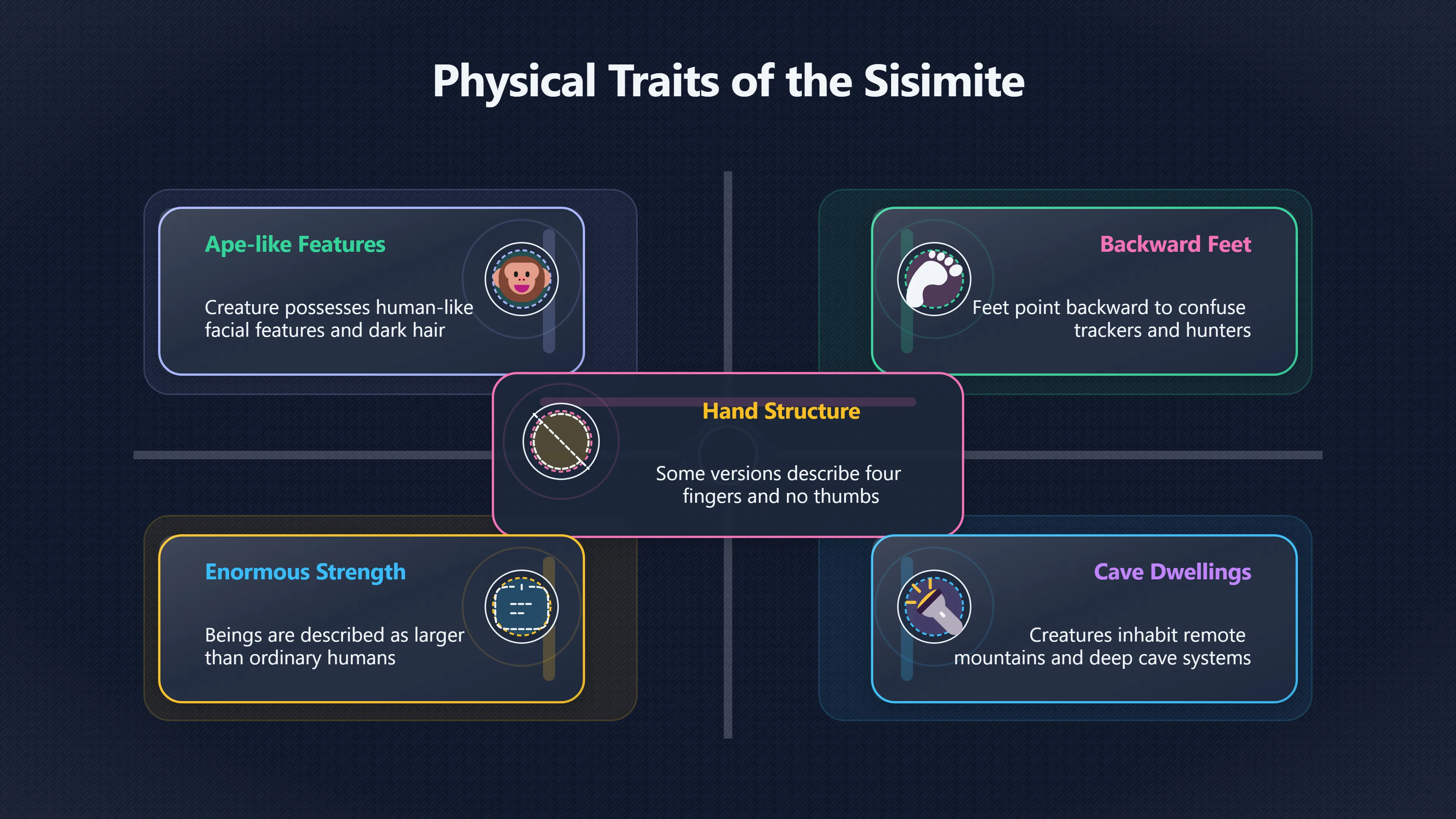
The Sisimite is one of the most distinctive wild-man figures in Central American folklore, and in Guatemala it occupies a space somewhere between monster story, cautionary tale and survival lesson. Unlike reports of unknown apes that are sometimes treated as possible mystery animals, the Sisimite’s defining features point firmly toward folklore. It is usually described as a hairy forest-dweller with enormous strength, a human-like face, and most famously, feet that point backwards. Those backwards feet are the clue that the story is not really about discovering an undiscovered creature. Instead, it is about getting lost, misreading the landscape, and crossing dangerous boundaries between settled communities and the deep forest.[Wikipedia]WikipediaFebruary 10, 2026 — It is said to have four fingers on each hand and no thumbs, ape-like facial features, and backward-facing feet with n…

Within Guatemala’s wider tradition of strange creatures, the Sisimite belongs to the mountains, caves, cloud forests and wooded highland margins where tracks disappear, directions become uncertain and ordinary rules seem less reliable. The legend helps explain why generations of people treated certain places with caution long before modern maps, roads and communications reduced their isolation.[Wikipedia]WikipediaOpen source on wikipedia.org.
What Makes the Sisimite Different From a Simple Ape-Man
Descriptions vary from region to region, but the recurring features are remarkably consistent. The creature is usually portrayed as heavily covered in dark hair, larger and stronger than an ordinary person, with ape-like characteristics combined with recognisably human traits. In some versions it has only four fingers and lacks thumbs. It is associated with caves, remote mountains and dense forest.[Wikipedia]WikipediaFebruary 10, 2026 — It is said to have four fingers on each hand and no thumbs, ape-like facial features, and backward-facing feet with n…
The most famous feature is its backwards feet. According to the legend, tracks that appear to lead away from the creature actually point in the opposite direction. A hunter, traveller or pursuer following the footprints would therefore become confused and walk deeper into danger rather than toward safety.[Wikipedia]WikipediaOpen source on wikipedia.org.
That detail matters because it changes the story from a simple monster encounter into a lesson about the unreliability of appearances. In practical terms, people navigating forests can easily misread signs, become disoriented and lose their way. The Sisimite turns that real-world hazard into a memorable character.
The legend is also tied to tales of abduction, particularly involving women. Across Central America, stories describe the creature carrying captives to remote caves in the mountains. These narratives are uncomfortable to modern readers, but folklorists often view them as reflecting social anxieties about isolation, wilderness and the risks associated with travelling beyond community protection.[Wikipedia]WikipediaFebruary 10, 2026 — It is said to have four fingers on each hand and no thumbs, ape-like facial features, and backward-facing feet with n…
Guatemala Within a Wider Central American Tradition
Although Guatemala has its own versions of the story, the Sisimite is not confined to one country. Closely related traditions appear across Honduras, Belize, Nicaragua and neighbouring regions. The creature’s name changes slightly from place to place, but the core image remains recognisable: a hairy mountain being associated with forests, caves and difficult terrain.[Wikipedia]WikipediaFebruary 10, 2026 — It is said to have four fingers on each hand and no thumbs, ape-like facial features, and backward-facing feet with n…
This wider distribution is important because it suggests the legend is not rooted in a single alleged sighting or local mystery. Instead, it belongs to a broader family of Central American wild-man traditions that evolved through oral storytelling over centuries. Different communities adapted the figure to local landscapes while preserving key traits such as enormous strength, backwards feet and a connection to remote wilderness.[Wikipedia]WikipediaFebruary 10, 2026 — It is said to have four fingers on each hand and no thumbs, ape-like facial features, and backward-facing feet with n…
Guatemalan versions tend to fit naturally into the country’s mountainous geography. The highlands contain steep valleys, cloud forests and cave systems that historically separated communities and made travel difficult. In such environments, stories about a powerful being lurking beyond the edge of settlement carried an obvious practical message: know where you are, respect the terrain and avoid wandering alone.[Wikipedia]WikipediaOpen source on wikipedia.org.
The Sisimite also resembles a wider pattern found across Latin American folklore. Several forest spirits and wilderness beings are said to possess reversed feet. These creatures often confuse hunters or lure people away from safe paths. The motif appears less concerned with zoology than with the symbolic power of disorientation.[Myth and Folklore]mythus.fandom.comMyth and Folklore CurupiraMyth and FolkloreCurupira - Myth and Folklore Wiki - FandomIt is an entity that protects the forests and animals from hunters. It inhabit…
Why Forest Boundaries Matter More Than Sightings
Modern cryptid discussions sometimes compare the Sisimite to Bigfoot, but that comparison can be misleading. Bigfoot traditions are often discussed as potential eyewitness reports of an unknown animal. The Sisimite functions differently. Its role is deeply tied to the edge between human settlement and untamed forest.[Wikipedia]WikipediaFebruary 10, 2026 — It is said to have four fingers on each hand and no thumbs, ape-like facial features, and backward-facing feet with n…
Many traditional stories begin at a boundary:
- A hunter goes farther into the woods than intended.
- A traveller takes a dangerous shortcut.
- Someone ignores local warnings about a cave or mountain.
- A person becomes separated from a group.
The creature appears when that boundary is crossed. Rather than representing a hidden species, it acts as the embodiment of what can happen when familiar social rules no longer apply.[penn.museum]penn.museumIf he captures a woman, she is…Read more…
This interpretation helps explain why caves feature so prominently. In many accounts, the Sisimite inhabits inaccessible caverns high in the mountains. Such locations were naturally mysterious, difficult to explore and potentially dangerous. They became ideal settings for stories that warned against reckless curiosity.[Wikipedia]WikipediaOpen source on wikipedia.org.
Tracks, Wilderness Skills and Survival Lessons
The backwards-foot motif may be the most revealing element of the entire legend. It transforms the creature into a lesson about reading the landscape correctly.
For people who depended on hunting, woodcutting or travel through forests, tracks were valuable information. Yet tracks can be misleading. Rain, erosion, animal movement and poor visibility all create confusion. The Sisimite legend exaggerates that problem into a supernatural trickster capable of defeating even experienced trackers.[Wikipedia]WikipediaFebruary 10, 2026 — It is said to have four fingers on each hand and no thumbs, ape-like facial features, and backward-facing feet with n…
In some regional versions, specific strategies are suggested for escaping or confusing the creature, including misleading trails or staying near water. Whether these details were ever treated as literal advice is less important than their broader function. They turn wilderness knowledge into memorable stories that can be passed between generations.[Wikipedia]WikipediaFebruary 10, 2026 — It is said to have four fingers on each hand and no thumbs, ape-like facial features, and backward-facing feet with n…
The result is folklore that operates on two levels simultaneously. On the surface, it is an entertaining monster tale. Beneath that, it preserves practical warnings about navigation, isolation and survival in difficult terrain.
Why the Sisimite Endures
The Sisimite survives because it expresses fears that remain recognisable even in the modern world. Dense forests still create uncertainty. Remote mountains still conceal what lies around the next ridge. People still become lost when they trust assumptions rather than evidence.
That helps explain why the creature continues to appear in folklore collections, local storytelling and modern cryptid discussions. Yet the strongest reading of the Sisimite is not as an undiscovered ape roaming Guatemala’s forests. The backwards feet, cave abductions and symbolic role at the edge of settlement all point toward something older and more culturally meaningful: a wilderness guardian, threat and teacher wrapped into a single memorable figure.[wikipedia.org]WikipediaOpen source on wikipedia.org.
In Guatemala’s monster tradition, the Sisimite is therefore best understood as a warning embodied in a creature. It marks the point where familiar paths end, where tracks become unreliable, and where the forest begins to play by its own rules.[Wikipedia]WikipediaOpen source on wikipedia.org.

Amazon book picks
Further Reading
Books and field guides related to What Is the Sisimite Really Warning About?. Use these as the next step if you want deeper reading beyond the article.
Sasquatch: Legend Meets Science
Readers interested in the Sisimite often cross-shop wildman and cryptid titles.
Gods and Symbols of Ancient Mexico and the Maya
Provides broader Mesoamerican mythological context for Guatemala's folklore beings.
Bigfoot
Last August, two men in rural Georgia announced that they had killed Bigfoot. The claim drew instant, feverish attention, leading to more...
Endnotes
1.
Source: Wikipedia
Link:https://en.wikipedia.org/wiki/Sisimito
Source snippet
February 10, 2026 — It is said to have four fingers on each hand and no thumbs, ape-like facial features, and backward-facing feet with n...
Published: February 10, 2026
2.
Source: Wikipedia
Link:https://es.wikipedia.org/wiki/Sisimite
3.
Source: penn.museum
Link:https://www.penn.museum/sites/journal/416/
Source snippet
If he captures a woman, she is...Read more...
4.
Source: Wikipedia
Link:https://en.wikipedia.org/wiki/Cipit%C3%ADo
5.
Source: cryptidarchives.fandom.com
Title: Cryptid Archives Sisemité
Link:https://cryptidarchives.fandom.com/wiki/Sisemit%C3%A9
Source snippet
Cryptid ArchivesSisemité - Encyclopaedia of Cryptozoology - FandomLike many other mythical creatures of South and Central America, the si...
6.
Source: mythus.fandom.com
Title: Myth and Folklore Curupira
Link:https://mythus.fandom.com/wiki/Curupira
Source snippet
Myth and FolkloreCurupira - Myth and Folklore Wiki - FandomIt is an entity that protects the forests and animals from hunters. It inhabit...
7.
Source: facebook.com
Link:https://www.facebook.com/unrulynationn/posts/sisimito-the-backward-footed-beast-of-belize/122118916436417000/
Source snippet
The Backward-Footed Beast of BelizeThe Sisimito - Lenca Folklore (also known as the Sisimite) is a legendary bipedal, ape-like creature o...
Additional References
8.
Source: facebook.com
Link:https://www.facebook.com/CorozalDaily/posts/the-legendary-sisimitebelize-yucatec-maya-sisimite-native-to-the-world-of-the-ma/2911652189051137/
Source snippet
***THE LEGENDARY SISIMITE*** Belize Yucatec MayaThe Sisimite has been described as a hairy ape-like creature, much larger than a human, w...
9.
Source: latinolife.co.uk
Link:https://www.latinolife.co.uk/articles/latin-american-myths-and-legends
Source snippet
Latin American Myths and LegendsSpookily, the feet of La Ciguapa face backwards, making it hard to see which way they are moving by looki...
10.
Source: youtube.com
Link:https://www.youtube.com/watch?v=8l3eFQ21vU0
Source snippet
The Dominican Republic's Most Infamous Monster Terrified MeSpeaking of backwards feet, here in Brazil there is a native mythological crea...
11.
Source: instagram.com
Link:https://www.instagram.com/p/DV6SYrtD5fD/
Source snippet
r, with feet backwards, that eats berries and kidnaps women, taking...Read more...
12.
Source: ambergriscaye.com
Title: El Sisimito was said to have his feet backwards
Link:https://ambergriscaye.com/25years/elsisimito.html
Source snippet
"El Sisimito"- San Pedro Folklore, 25 Years Ago, History of...El Sisimito was characterized as a very short but very strong man that wa...
13.
Source: thequestebooks.com
Title: staying close to a body of water. Sisimitos are
Link:https://www.thequestebooks.com/post/the-sisimito
Source snippet
The Quest eBooksSisimito: The Big Foot of Belize - The Quest eBooksOct 16, 2020 — He will try to follow you but because he has backward-f...
14.
Source: scribd.com
Link:https://www.scribd.com/document/623073026/Legends
Source snippet
Latin American Folklore Monsters Explained | PDF3) El Sisimite of Belize and Guatemala, a small hairy half-man, half-gorilla creature...
15.
Source: reddit.com
Link:https://www.reddit.com/r/Cryptozoology/comments/11rhbzy/the_sisimit%C3%A9_is_a_cryptid_primate_reported_from/
Source snippet
rned, so it looks like it walks backwards, some prehispanic...Read more...
16.
Source: facebook.com
Link:https://www.facebook.com/andycolonvo/videos/the-5-strangest-creatures-of-latin-america/1438464107354727/
Source snippet
lled or with gutteral howls and livestock found dead. unlike the...
17.
Source: instagram.com
Title: “Have you ever heard about the sisimite?
Link:https://www.instagram.com/p/DBp2O_Ts7yH/?hl=en
Source snippet
In Mexico and...There's stories about this ape-like creature that haunts mountains and forests and hides in caves. It varies in size, wi...
Topic Tree