Within Swiss Monsters
Was the Tatzelwurm Ever a Real Animal?
Switzerland's best-known cryptid grew from Alpine witness stories, early naturalists and uncertain encounters with real wildlife.
On this page
- What witnesses said the creature looked like
- How naturalists recorded the Alpine reports
- Snakes, salamanders and other possible explanations
Page outline Jump by section
Introduction
The Tatzelwurm is Switzerland’s most famous mystery animal, but the strongest evidence for it is not a body, skeleton or photograph. Instead, the creature survives through a chain of witness stories, folklore collections and natural-history records stretching back centuries. In Swiss Alpine tradition it is usually called the Stollenwurm or Stollwurm: a short, thick serpent with a cat-like head and either two tiny forelegs or several stubby limbs. Reports cluster in mountainous regions where brief, surprising encounters are common and where unusual animals can be difficult to identify from a distance.[Wikipedia]WikipediaOpen source on wikipedia.org.
The central question is not whether a hidden Alpine dragon has escaped science, but why so many people believed they had seen one. The Tatzelwurm sits at the boundary between folklore, eyewitness testimony and natural history. Its story reveals how real wildlife, mountain conditions and older dragon traditions combined to create one of Switzerland’s most enduring animal mysteries.[Wikipedia]WikipediaOpen source on wikipedia.org.
What Witnesses Said the Creature Looked Like
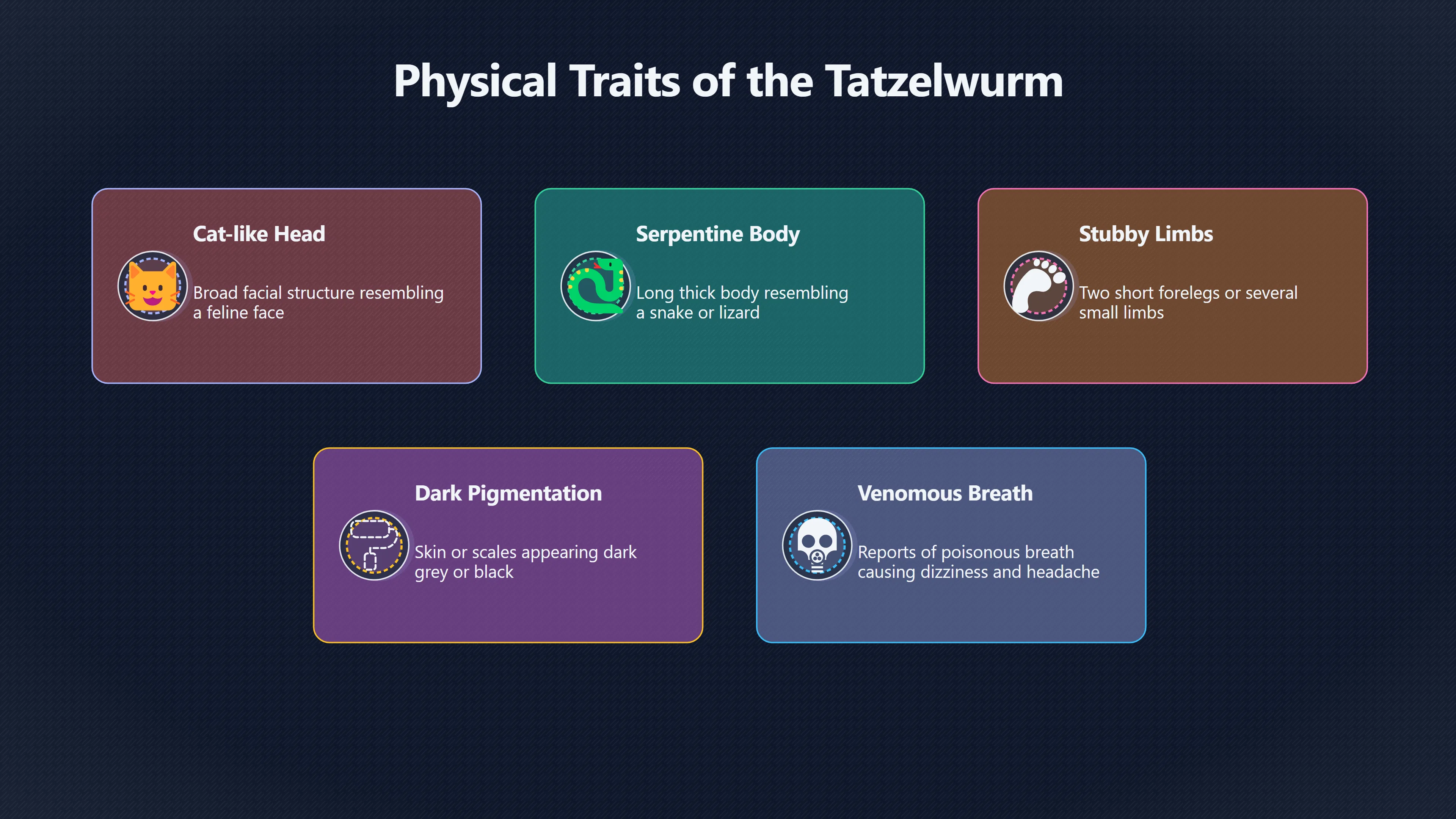
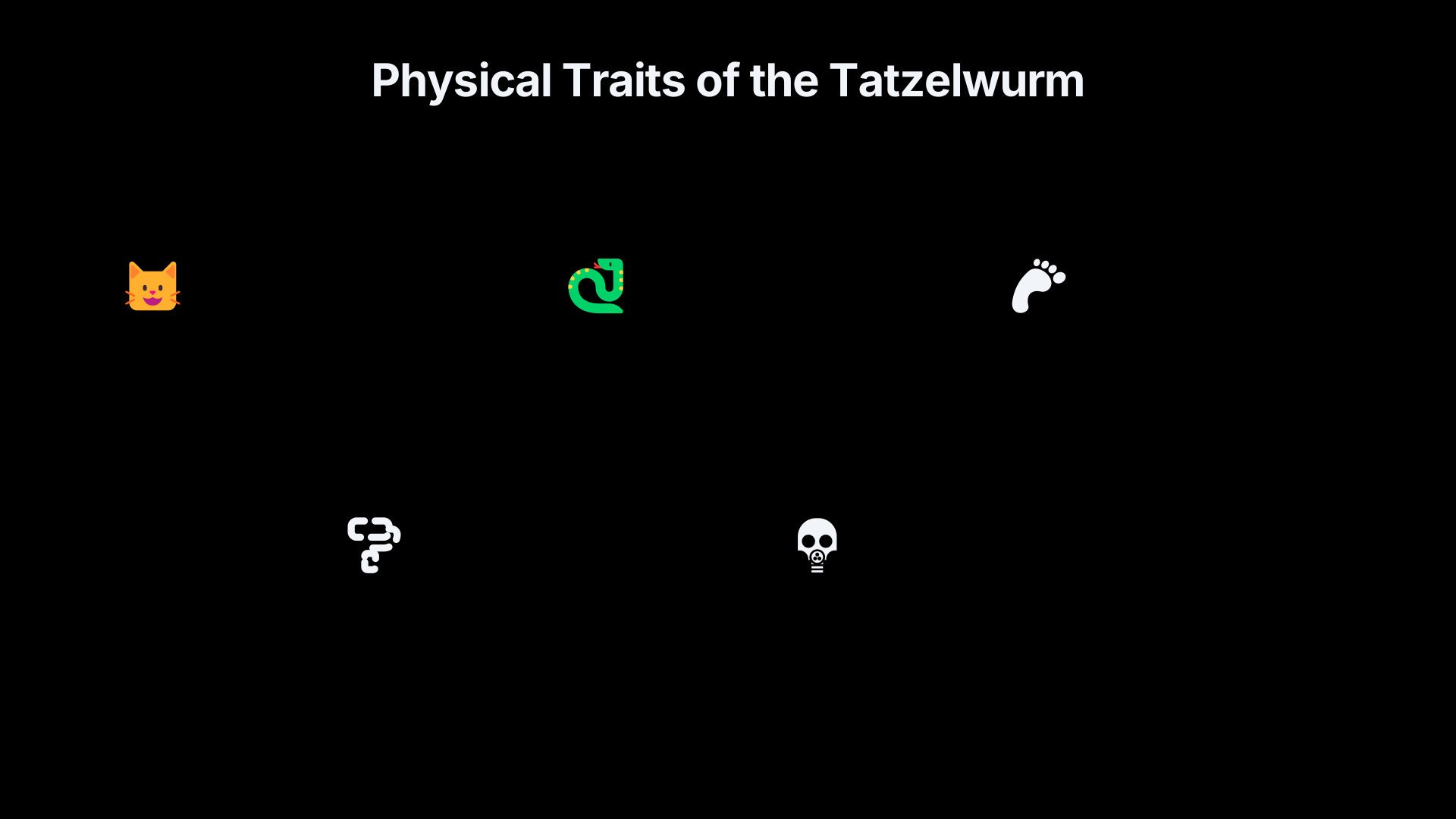
Descriptions of the Tatzelwurm vary, but certain features appear repeatedly in Swiss accounts. Witnesses commonly described:
- A long, snake-like or lizard-like body.
- A broad head resembling that of a cat.
- Two short forelegs, though some reports mention four or more limbs.
- Dark grey or black colouring.
- Hissing, shrieking or whistling sounds.
- Supposedly poisonous breath or venom.[Wikipedia]WikipediaOpen source on wikipedia.org.
These details make the creature memorable, but they also create a problem. Real animal species tend to be described consistently. The Tatzelwurm changes shape from story to story. In some reports it is almost legless; in others it resembles a squat lizard. Some witnesses claimed it was smooth-skinned, while others described hair. Such variation suggests that different experiences and traditions may have been merged into a single legendary creature over time.[Wikipedia]WikipediaOpen source on wikipedia.org.
The cat-like head is especially important. Many Alpine snakes can appear thicker or broader-headed when viewed briefly among rocks. A startled observer trying to describe an unfamiliar shape may focus on a face-like impression rather than precise anatomical details. Over repeated retellings, that impression became one of the defining features of the legend.[Wikipedia]WikipediaOpen source on wikipedia.org.
How Naturalists Recorded the Alpine Reports
Unlike many local monster traditions, the Tatzelwurm entered written natural history surprisingly early.
In 1680, Swiss physician and naturalist Johann Jakob Wagner recorded reports of strange dragon-like creatures seen in the Alps. These accounts were later reproduced by Johann Jakob Scheuchzer in his influential 1723 work on Switzerland’s mountains. Scheuchzer included illustrations and testimonies, preserving stories that might otherwise have vanished from oral tradition.[Wikipedia]WikipediaOpen source on wikipedia.org.
One of the most frequently repeated Swiss cases involved brothers from the region of Frümsen in eastern Switzerland. They reportedly encountered a black-grey serpent with a cat-like head measuring more than two metres long. The creature’s breath allegedly caused headache and dizziness. Whether the event happened as described is impossible to verify, but the account became one of the classic Tatzelwurm narratives.[Wikipedia]WikipediaOpen source on wikipedia.org.
The reports gained renewed attention in the early nineteenth century through the work of the Bernese scholar Samuel Studer. Studer collected local traditions and witness statements rather than treating the creature as simple folklore. He described the Stollenwurm as a short-legged serpent associated with humid weather and mountain valleys. Importantly, he attempted to gather testimony in a systematic way, reflecting a period when naturalists still considered the possibility that unknown animals might exist in remote Alpine regions.[Wikipedia]WikipediaOpen source on wikipedia.org.
A notable example appeared in 1811, when a schoolmaster in the Guttannen Valley claimed to have seen a creature with a broad serpent-like head, forked tongue and two short feet. He estimated its thickness as comparable to a man’s leg. No specimen followed the report, leaving only the witness account.[Wikipedia]WikipediaOpen source on wikipedia.org.
Why the Testimony Never Became Zoological Evidence
The Tatzelwurm legend contains numerous eyewitness claims but very little physical evidence.
No verified body, skeleton, skin or preserved specimen has ever been produced from Switzerland. Despite centuries of stories, the evidence remains almost entirely anecdotal. Reports often came from isolated locations and were recorded long after the encounters themselves. Many survive only through retellings in folklore collections rather than contemporary documentation.[Wikipedia]WikipediaOpen source on wikipedia.org.
This does not mean witnesses were necessarily inventing stories. Mountain environments create ideal conditions for misperception. Encounters are often brief. Animals may be partly hidden by rocks, vegetation or uneven terrain. Fear, surprise and distance can distort estimates of size and shape. A snake moving over broken ground can appear to have limbs, while a mammal glimpsed head-on may seem much longer than it really is.[Wikipedia]WikipediaOpen source on wikipedia.org.
The pattern of evidence is also significant. Reports are scattered across centuries without the continuous stream of observations that would normally accompany a large undiscovered animal population. If a breeding population of large cat-headed reptiles existed in the Alps, modern wildlife surveys, camera traps and scientific fieldwork would be expected to reveal stronger traces than folklore alone.[Wikipedia]WikipediaOpen source on wikipedia.org.
Snakes, Salamanders and Other Possible Explanations
Sceptical explanations generally focus on known Alpine animals rather than a genuinely unknown species.
Large Snakes
The simplest explanation is that some witnesses saw snakes. European adders and grass snakes occur in Alpine environments and can appear surprisingly large when encountered unexpectedly. A snake raising its head, flattening its neck or moving through vegetation may create the impression of a broader, mammal-like face. Reports of hissing also fit snake behaviour better than they fit a mysterious dragon-like creature.[Wikipedia]WikipediaOpen source on wikipedia.org.
Alpine Salamanders
Another frequently suggested candidate is the Alpine salamander. These animals are glossy black, inhabit mountain environments and can appear unexpectedly on paths after wet weather. They are much smaller than reported Tatzelwurms, but folklore often enlarges unusual animals. Their slow movements, dark colouration and mildly toxic skin secretions may have encouraged associations with poisonous mountain creatures.[Wikipedia]WikipediaAlpine salamanderAlpine salamander

Mustelids and Other Mammals
Stoats, martens and similar mammals can produce confusing impressions when seen briefly among rocks. Their long bodies and short legs roughly match some Tatzelwurm descriptions. A startled observer may focus on the head and body while missing the limbs, creating a more serpentine image in memory.[Wikipedia]WikipediaOpen source on wikipedia.org.
Otter Hypotheses
Some later investigators suggested that stray otters could account for certain reports. Otters have elongated bodies, short legs and can move with an undulating motion that appears reptilian when viewed at a distance. Although not a perfect match, they illustrate how ordinary wildlife can acquire extraordinary interpretations under unusual viewing conditions.[Wikipedia]WikipediaOpen source on wikipedia.org.
A Mixture Rather Than One Animal
Many historians and folklorists favour a combined explanation. Different witnesses probably saw different animals, while older dragon traditions supplied the supernatural details such as poisonous breath, deadly attacks and cat-like faces. Over generations, separate stories merged into a single creature recognised throughout the Alps.[Wikipedia]WikipediaOpen source on wikipedia.org.
Why the Tatzelwurm Endured
The Tatzelwurm survived because it occupied a believable middle ground. Unlike giant dragons, it was small enough to seem possible. Unlike ordinary snakes, it possessed just enough strange features to remain memorable. Early naturalists recorded the stories instead of dismissing them outright, giving the legend a documentary trail that many folk creatures lack.[Wikipedia]WikipediaOpen source on wikipedia.org.
Today, the Tatzelwurm is best understood not as evidence for a hidden Alpine reptile but as a case study in how mystery-animal traditions develop. The sightings reveal genuine encounters, local fears, changing ideas about nature and the difficulties of identifying animals in rugged mountain landscapes. The creature’s lasting appeal comes from that ambiguity: not a proven monster, but not merely a single invented tale either. It is a folklore creature built from centuries of real observations filtered through imagination, memory and the strange atmosphere of the Swiss Alps.[Wikipedia]WikipediaOpen source on wikipedia.org.
Amazon book picks
Further Reading
Books and field guides related to Was the Tatzelwurm Ever a Real Animal?. Use these as the next step if you want deeper reading beyond the article.
Field Guide to Lake Monsters, Sea Serpents, and Other Mystery...
Provides broader context for mystery-animal investigations.
Mystery Cats of the World Revisited
Touches on unusual animal reports and identification issues.
eBay marketplace picks
Marketplace Samples
Live-tested eBay searches with available results related to this page.

Endnotes
1.
Source: Wikipedia
Link:https://en.wikipedia.org/wiki/Tatzelwurm
2.
Source: Wikipedia
Title: Alpine salamander
Link:https://en.wikipedia.org/wiki/Alpine_salamander
3.
Source: cryptidz.fandom.com
Link:https://cryptidz.fandom.com/wiki/Tatzelwurm
Source snippet
Cryptid Wiki - FandomThe Tatzelwurm, also called the Alps Dragon, is a cryptid reported in several areas in Europe, including Germany...
Additional References
4.
Source: facebook.com
Link:https://www.facebook.com/groups/6390022156/posts/10161635162997157/
Source snippet
Tatzelwurm cryptid from alpine mythHowever, some biologists suggest it could be a misidentified animal, possibly a large salamander or sn...
5.
Source: youtube.com
Link:https://www.youtube.com/watch?v=PUfiyWcL8o8
Source snippet
When Cat Were Giant (and Weird) in The AlpsThere are creatures in this world that only a few have seen, yet they have never been official...
6.
Source: archive.org
Title: Full text of “Guide to Mysterious and Legendary Creatures”
Link:https://archive.org/stream/Cryptozoology_201608/Cryptozoology_djvu.txt
Source snippet
misidentification, and the mystery from reports of animals undescribed by science.... Alps Giant Salamander Andaman Wood Owl Mystery Bir...
7.
Source: instagram.com
Link:https://www.instagram.com/reel/DVx6NTik4km/
Source snippet
s have spoken of a creature that no one can explain: the Tatzelwurm...
8.
Source: instagram.com
Link:https://www.instagram.com/reel/DYCGtTajvvL/
Source snippet
, or even distorted sightings of wildcats—as the root of the myth...
9.
Source: vamzzz.com
Title: Occult Bookstore Haselwurm and Tatzelwurm
Link:https://vamzzz.com/blog/haselwurm-and-tatzelwurm/
Source snippet
Occult BookstoreHaselwurm and Tatzelwurm - Folklore17 Jan 2022 — In 1811, a Stollenwurm with a forked tongue, serpent-like but rather wid...
10.
Source: facebook.com
Link:https://www.facebook.com/curiosmuseum/posts/the-tatzelwurm-is-a-mysterious-alpine-creature-from-german-folklore-described-as/718911544481703/
Source snippet
rge salamander or snake species. Reports of Tatzelwurm...
11.
Source: archive.org
Link:https://archive.org/stream/cryptidstuff/%28Cryptids%29%20On%20The%20Track%20Of%20Unknown%20Animals%20by%20Bernard%20Heuvelmans_djvu.txt
Source snippet
animal exists also in New Guinea. And they point out...
12.
Source: instagram.com
Link:https://www.instagram.com/reel/DTxWc6wios-/
Source snippet
us, attacking livestock and frightening travelers...
13.
Source: youtube.com
Title: The Terrifying Legend of the Tatzelwurm: Alpine’s Forgotten Monster
Link:https://www.youtube.com/watch?v=tyqcllIO3q8
Source snippet
Tatzelwurm: The Alpine Cryptid - Mystery of the Stollenwurm...
Topic Tree