Cryptids of Cameroon's Waters And Forests
Cameroon does not have one single world-famous “national monster” in the way Scotland has Loch Ness or the United States has Bigfoot.
Page outline Jump by section
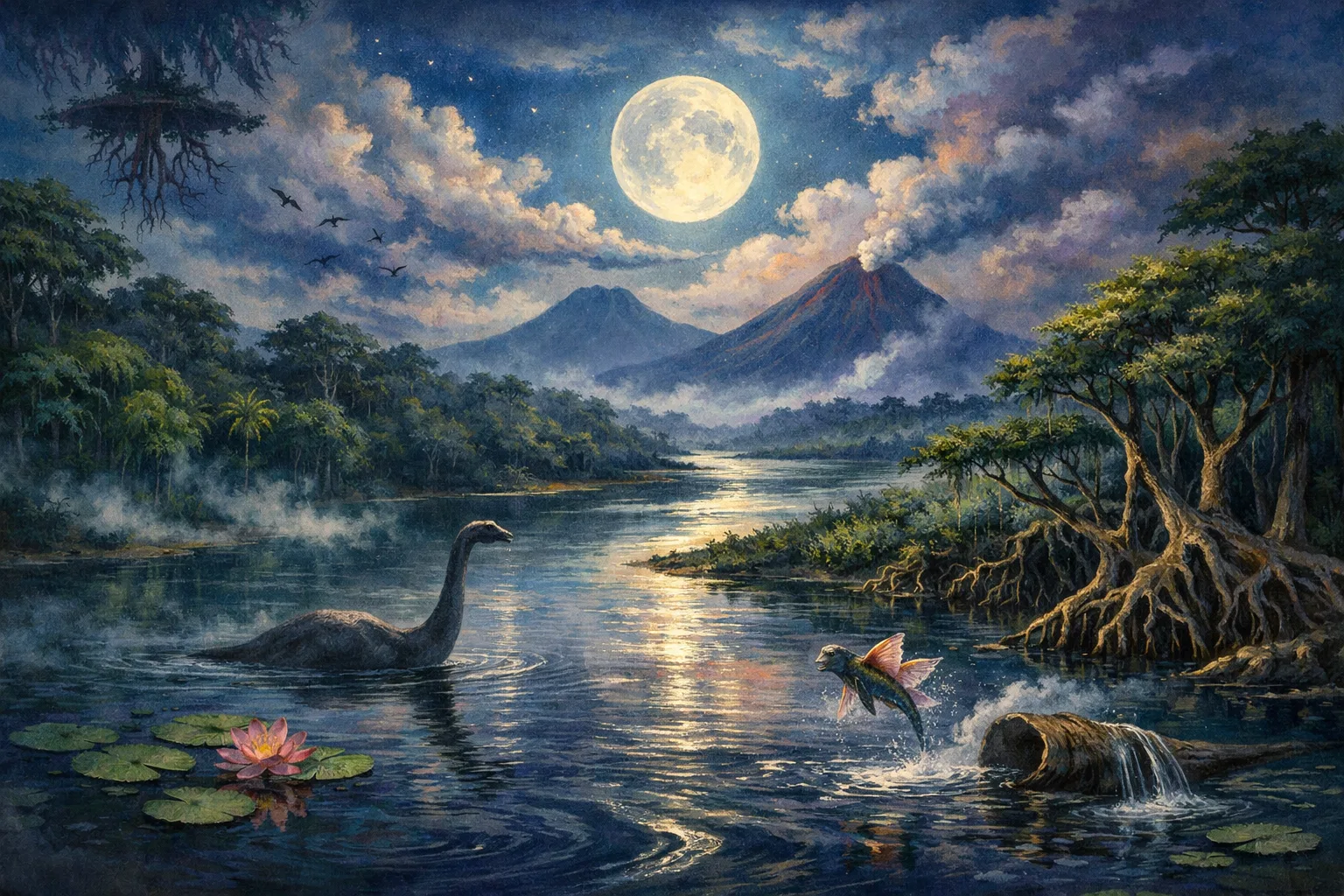
Cameroon’s creature map is mostly water, forest and borderland
Cameroon sits at a crossroads of habitats: Atlantic coast, mangroves, rivers, Congo Basin rainforest, savannah, volcanic highlands and lake country. That matters because mystery-animal traditions usually grow where people already have reason to respect a landscape. Rivers drown people. Forests hide large animals. Lakes can change colour, smell strange, or, in Cameroon’s most dramatic case, release deadly gas. The setting does much of the storytelling work.
For cryptid readers, the southern and eastern rainforest zones are the most relevant because they connect Cameroon to the wider Congo Basin, the home of the mokele-mbembe legend. Cameroon’s real wildlife also gives the stories texture: conservation mapping identifies priority great-ape areas such as the Sangha Tri-National complex, Dja, Boumba-Bek/Nki, Campo Ma’an and Ebo, with gorillas and chimpanzees threatened by hunting, logging, mining, roads and habitat fragmentation.[IIED]iied.orgOpen source on iied.org. A country where apes, forest elephants, crocodiles, hippos and huge snakes are all plausible parts of local ecological knowledge is also a country where a vague “large thing in the river” can be retold in many directions.
That does not make the monster claims true. It makes them understandable. Cameroon’s best-known creature material sits on a spectrum: sacred water beings, cautionary lake stories, expeditionary dinosaur claims and ordinary animal encounters reinterpreted through rumour.
The mokele-mbembe question: Cameroon’s borrowed “living dinosaur”
The mokele-mbembe is usually associated more strongly with the Republic of Congo and the wider Congo River Basin than with Cameroon itself. Modern descriptions tend to make it a large, water-dwelling, long-necked animal, sometimes imagined as a surviving sauropod dinosaur. But the Cameroon link exists because the southern rivers and forests sit within the same regional imaginative geography, and because modern expeditions and creationist writing have repeatedly extended the search area into Cameroon.
The important thing is that mokele-mbembe is not a confirmed animal. A recent report on the legend describes how a spiritual or symbolic river-being tradition became “dinosaurised” through colonial-era exploration, European paleontological excitement and later creationist interest. The same account notes that repeated expeditions have not produced a body, bones, clear photographs, environmental DNA, or any other mainstream zoological evidence.[New Lines Magazine]newlinesmag.comNew Lines Magazine The Congo’s Dinosaur of DiscordNew Lines Magazine The Congo’s Dinosaur of Discord
Cameroon enters the modern story most clearly through late twentieth- and early twenty-first-century expedition claims. Creationist explorer William Gibbons, after earlier Congo searches, reportedly turned to Cameroon and claimed to have collected eyewitness accounts in the south between 1986 and 2000; he later returned with what he described as a Christian expedition. A journalist summarising that history also records the blunt counterpoint from palaeontologist Darren Naish: the searchers “basically never found anything.”[New Lines Magazine]newlinesmag.comNew Lines Magazine The Congo’s Dinosaur of DiscordNew Lines Magazine The Congo’s Dinosaur of Discord
A fair Cameroon assessment is therefore cautious:
- What is claimed: a large aquatic or semi-aquatic creature in remote forest rivers, sometimes given a sauropod-like shape.
- Where it clusters: not in urban Cameroon or the north-western lakes, but in the southern rainforest imagination linked to Gabon, Congo and the Central African Republic.
- What the evidence is: testimony, expedition anecdotes and recycled cryptozoology literature, not physical proof.
- Most likely explanations: folklore reframed through Western dinosaur expectations, plus possible confusion with hippos, elephants, crocodiles, large snakes, rhinos in older regional memory, or indistinct river sightings.
- Why it persists: it is a perfect “lost world” story: dense forest, winding rivers, real megafauna and the romantic hope that prehistory is not finished.
The Cameroon angle is strongest when treated as part of a wider Congo Basin tradition, not as a creature uniquely rooted in Cameroonian national folklore.
Jengu and the water beings of the Sawa coast
Cameroon’s most culturally grounded “creature” tradition is not a dinosaur but a water-spirit complex associated with the Sawa peoples of the coast. In English-language summaries, a jengu is usually described as a water spirit in the traditional beliefs of Sawa groups such as the Duala, Bakweri, Malimba, Bakoko and Oroko; plural forms include miengu. These beings are often presented as beautiful, mermaid-like, associated with rivers and the sea, and linked with healing, fortune and communication between human communities and the spirit world.[Wikipedia]WikipediaOpen source on wikipedia.org.
This is not cryptozoology in the narrow “unknown animal” sense. It is folklore, religion and ritual tradition. That distinction matters. Turning jengu into a “Cameroonian mermaid cryptid” can flatten a living cultural practice into a monster entry. The better reading is that water beings express the social and spiritual importance of rivers, estuaries, fishing, trade, ancestry and danger.
The Ngondo festival in Douala makes this especially visible. UNESCO describes Ngondo as worship of water oracles and associated cultural traditions among the Sawa community of Cameroon, practised annually from September to the first Sunday in December.[UNESCO ICH]ich.unesco.orgOpen source on unesco.org. In popular descriptions of the ceremony, the climactic act involves a ritual specialist entering the Wouri River and returning with an oracular message. Whether a reader approaches this as religion, performance, heritage, or legend, it shows that Cameroon’s most durable water mystery is not a lake monster but a relationship between people and water.
For a cryptid page, jengu belongs here because it sits close to the border between “creature tradition” and “spirit tradition”. The mistake would be to ask whether jengu are zoologically real. The better question is why water is imagined as inhabited, responsive and morally significant.
Lake Nyos: when the “monster” was the lake itself
Cameroon also has one of the world’s most striking examples of a natural event that could easily sound like monster folklore if stripped of its science. On 21 August 1986, Lake Nyos in north-west Cameroon released a lethal cloud of carbon dioxide. A United States scientific team reported that at least 1,700 people died, along with thousands of cattle, after gas accumulated in the bottom waters of the crater lake and was suddenly released.[U.S. Geological Survey Publications]pubs.usgs.govU.S. Geological Survey Publications
The details are eerie enough without invention. Survivors reported rumbling sounds, strange smells, unconsciousness, extinguished lamps and dead animals. The investigation concluded that the victims died from asphyxiation after oxygen was displaced by high carbon dioxide levels, and that chemical, isotope and geological evidence pointed to deep magmatic carbon dioxide rather than a direct volcanic eruption.[U.S. Geological Survey Publications]pubs.usgs.govU.S. Geological Survey Publications
This matters for Cameroon’s mystery-creature history because Lake Nyos shows how a landscape can become legendary through real danger. The USGS report even noted local legends of possible earlier “exploding lake” or mass-death events in the same region.[U.S. Geological Survey Publications]pubs.usgs.govU.S. Geological Survey Publications Later monitoring confirmed that carbon dioxide levels in Lakes Nyos and Monoun were reduced after controlled degassing began, while also stressing that natural recharge meant engineering work and monitoring remained important.[U.S. Geological Survey Publications]pubs.usgs.govOpen source on usgs.gov.
So Lake Nyos is not a cryptid case. It is a cautionary example of how a “haunted” or “killer” lake can be a geological system. In a country-level monster guide, it belongs as the sceptical anchor: sometimes the strangest story is true, but the explanation is chemistry, gas pressure and topography rather than a beast.

Ape-like creatures and the problem of real hidden animals
Cameroon’s forests contain real animals that outsiders have often treated as almost mythical: gorillas, chimpanzees, forest elephants, mandrills, pangolins, pythons and crocodiles. This is fertile ground for mystery-animal claims, but it also makes misidentification more likely.
Great apes are especially important. Conservation work identifies several Cameroon landscapes as major gorilla and chimpanzee areas, including Dja, Boumba-Bek/Nki, Campo Ma’an and Ebo.[IIED]iied.orgOpen source on iied.org. The Ebo forest has attracted scientific attention because of its primate richness, including nocturnal primates and great apes, making it the kind of place where unfamiliar calls, partial tracks, night movement and brief sightings can become larger stories.[OpenEdition Journals]journals.openedition.orgOpen source on openedition.org.
For readers interested in “ape-men” or hairy forest beings, Cameroon is best approached with restraint. There is no strong public evidence for a Bigfoot-like unknown primate in the country. What exists is a combination of real primate diversity, dense habitat, local ecological knowledge, hunting stories, and the wider human tendency to enlarge ambiguous forest encounters in retelling.
That sceptical view does not dismiss local knowledge. In fact, the opposite is true. Indigenous and forest communities often know animal behaviour far better than visiting monster-hunters. The weak link is usually not local observation itself, but the later conversion of a complex account into a marketable cryptid.
Lake Chad and northern water-monster rumours
Lake Chad touches Cameroon, Chad, Niger and Nigeria, and any “Lake Chad monster” claim has to be treated as regional rather than purely Cameroonian. The evidence for a specific Cameroon-side lake monster is thin. Online cryptid catalogues mention lake or wetland monsters around Lake Chad, but those summaries are usually derivative and do not provide the kind of primary testimony or archival trail that would support a strong case.
The more useful Cameroon point is environmental. Large shallow lakes, marshes and floodplains are classic settings for monster rumour because they distort scale. A hippo surfacing, a crocodile wake, floating vegetation, a large fish, a bird flock lifting from reeds, or a half-seen animal at dusk can all become a “thing in the water”. In the Lake Chad basin, where national borders cut across a shared wetland region, stories also travel easily from one country’s side to another.
For this page, Lake Chad should be treated as a low-confidence regional mystery-beast setting, not as a confirmed Cameroonian monster tradition.
What sceptics can explain without draining the mystery
The most likely explanations for Cameroon’s mystery-beast material are not boring; they are part of the story’s intelligence. They show how real animals, real hazards and real beliefs become memorable legends.
Misidentified megafauna is the simplest explanation for many large-creature claims. Hippos, elephants, crocodiles and large snakes can all produce brief, alarming impressions, especially in water or forest. A submerged hippo or elephant seen at night can become a long-backed animal. A crocodile wake can become a serpent. A python story can grow with each telling.
Folklore reframed as zoology is central to the mokele-mbembe problem. A water being or river warning can be converted into a flesh-and-blood dinosaur when outsiders arrive with prehistoric pictures, leading questions and a hunger for discovery. New Lines’ reporting on mokele-mbembe argues that the modern “dinosaur” version owes much to colonial and creationist reinterpretation rather than stable local zoological description.[New Lines Magazine]newlinesmag.comNew Lines Magazine The Congo’s Dinosaur of DiscordNew Lines Magazine The Congo’s Dinosaur of Discord
Real landscape danger explains why water spirits and killer lakes feel compelling. Rivers and lakes give life, but they also drown, poison, flood and conceal. Lake Nyos proved that a calm lake can kill on a vast scale through natural processes, while the Sawa water-oracle traditions show water as socially and spiritually powerful rather than merely scenic.[U.S. Geological Survey Publications]pubs.usgs.govU.S. Geological Survey Publications
Media afterlives keep thin stories alive. Once a creature is placed into the global cryptid catalogue, it can detach from its local setting. Cameroon then becomes a word in a “lost dinosaur” itinerary, even when the stronger cultural and evidential centre of the story lies elsewhere.
The best way to read Cameroon’s cryptid tradition
Cameroon’s monster lore is best read as a layered map rather than a trophy list. The coastal jengu traditions show water as ancestral, healing and oracular. Lake Nyos shows how a landscape can become terrifying through a scientifically real but almost unbelievable event. The southern mokele-mbembe claims show how Central African river folklore was reshaped by outsiders into a dinosaur hunt. Ape-like and lake-monster rumours show how rich wildlife and difficult terrain can produce genuine ambiguity without requiring unknown species.
That makes Cameroon a fascinating country for cryptid history precisely because the evidence is uneven. There is no confirmed surviving dinosaur, no well-documented national lake monster and no reliable proof of an unknown ape. But there are powerful creature traditions, real ecological mysteries, dangerous waters, forest habitats that reward humility, and a clear lesson for monster-hunters: the strangest story is not always the one with the biggest beast.
Amazon book picks
Further Reading
Books and field guides related to What Monsters Haunt Cameroon'S Waters And Forests?. Use these as the next step if you want deeper reading beyond the article.
Field Guide To Bigfoot, Yeti, & Other Mystery Primates Worldwide
Surveys mystery-creature traditions from around the world.
Abominable Science!
Covers cryptids, folklore and evidence evaluation relevant to Cameroon stories.
The Mythical Creatures Bible
Places local monster traditions within broader mythic patterns.
eBay marketplace picks
Marketplace Samples
Live-tested eBay searches with available results related to this page.
Endnotes
1.
Source: iied.org
Link:https://www.iied.org/sites/default/files/pdfs/migrate/G04017.pdf
2.
Source: Wikipedia
Link:https://en.wikipedia.org/wiki/Jengu
3.
Source: ich.unesco.org
Link:https://ich.unesco.org/en/RL/ngondo-worship-of-water-oracles-and-associated-cultural-traditions-among-the-sawa-02140
4.
Source: pubs.usgs.gov
Title: U.S. Geological Survey Publications
Link:https://pubs.usgs.gov/of/1987/0097/report.pdf
5.
Source: pubs.usgs.gov
Link:https://pubs.usgs.gov/publication/70032981
6.
Source: journals.openedition.org
Link:https://journals.openedition.org/primatologie/37210?lang=en
7.
Source: Wikipedia
Title: Mokele mbembe
Link:https://en.wikipedia.org/wiki/Mokele-mbembe
8.
Source: Wikipedia
Title: West African mythology
Link:https://en.wikipedia.org/wiki/West_African_mythology
9.
Source: Wikipedia
Title: Lake Nyos disaster
Link:https://en.wikipedia.org/wiki/Lake_Nyos_disaster
10.
Source: Wikipedia
Title: Lake Barombi Mbo
Link:https://en.wikipedia.org/wiki/Lake_Barombi_Mbo
11.
Source: Wikipedia
Title: Mami Wata
Link:https://en.wikipedia.org/wiki/Mami_Wata
12.
Source: usgs.gov
Link:https://www.usgs.gov/publications/lake-nyos-was-rigged-disaster
13.
Source: usgs.gov
Link:https://www.usgs.gov/publications/gas-buildup-lake-nyos-cameroon-recharge-process-and-its-consequences
14.
Source: usgs.gov
Title: exploding lakes cameroon 2
Link:https://www.usgs.gov/media/images/exploding-lakes-cameroon-2
15.
Source: usgs.gov
Title: degassing lakes nyos and monoun defusing certain disaster
Link:https://www.usgs.gov/publications/degassing-lakes-nyos-and-monoun-defusing-certain-disaster
16.
Source: pubs.usgs.gov
Link:https://pubs.usgs.gov/publication/70017274
17.
Source: whc.unesco.org
Link:https://whc.unesco.org/uploads/activities/documents/activity-628-1.pdf
18.
Source: youtube.com
Title: Mokele-Mbembe | The Living Dinosaur
Link:https://www.youtube.com/watch?v=zcSxFeR3Ddk
Source snippet
Two Creatures, One Legend: The Biology of the Mokele Mbembe...
19.
Source: newlinesmag.com
Title: New Lines Magazine The Congo’s Dinosaur of Discord
Link:https://newlinesmag.com/reportage/the-congos-dinosaur-of-discord/
20.
Source: abookofcreatures.com
Link:https://abookofcreatures.com/category/cameroon/
21.
Source: facebook.com
Link:https://www.facebook.com/groups/930540941927100/posts/1281604643487393/
22.
Source: facebook.com
Link:https://www.facebook.com/groups/617208782275055/posts/1692074041455185/
23.
Source: cryptidarchives.fandom.com
Title: Lake Chad monster
Link:https://cryptidarchives.fandom.com/wiki/Lake_Chad_monster
24.
Source: the-demonic-paradise.fandom.com
Link:https://the-demonic-paradise.fandom.com/wiki/Jengu
25.
Source: childrenofcameroon.co.uk
Title: ngondo festival
Link:https://www.childrenofcameroon.co.uk/post/ngondo-festival
26.
Source: searchworks.stanford.edu
Link:https://searchworks.stanford.edu/view/12977011
Additional References
27.
Source: science.org
Link:https://www.science.org/doi/10.1126/science.292.5516.438a
28.
Source: who.int
Link:https://www.who.int/news-room/feature-stories/detail/the-transformative-power-of-community-action–improving-access-to-safe-drinking-water-in-douala–cameroon
29.
Source: youtube.com
Title: Cryptid Profile: Mokele-mbembe and the “Lost” Dinosaurs of the Congo
Link:https://www.youtube.com/watch?v=TI_9mN8JzpI
Source snippet
The Mokele-Mbembe Mystery: Dinosaur, Myth, or Unknown Animal?...
30.
Source: youtube.com
Title: Two Creatures, One Legend: The Biology of the Mokele Mbembe
Link:https://www.youtube.com/watch?v=uYbIP-aNpxY
Source snippet
Cryptid Profile: Mokele-mbembe and the “Lost” Dinosaurs of the Congo...
31.
Source: instagram.com
Link:https://www.instagram.com/p/Cr0gLi9qUf5/
32.
Source: lastplaces.com
Link:https://lastplaces.com/en/travel-is-knowledge/baka-people-cameroon/
33.
Source: creation.com
Link:https://creation.com/images/pdfs/tj/j15_2/j15_2_62-68.pdf
34.
Source: ptes.org
Link:https://ptes.org/wp-content/uploads/2015/02/Cameroon-cross-river-gorillas-and-chimpanzees-final-report.pdf
35.
Source: folktales.africa
Link:https://folktales.africa/category/african-folktales/central-african-folktales/cameroonian-folktales/
36.
Source: ambacongo-us.org
Link:https://www.ambacongo-us.org/en/about-congo/congo-basin
Topic Tree
Follow this branch
Related pages 192
- Antigua Cryptids
- Maldives Monsters
- Malta Monsters
- Qatar Monsters
- Argentina Monsters
- +187 more in sidebar