The Creatures Behind Kenya's Monster Stories
Kenya’s mystery-animal tradition is unusually rich because it sits at the meeting point of real megafauna, colonial-era hunting tales, local oral traditions, dense highland forests, Lake Victoria waterways and world-famous predator stories.
Page outline Jump by section
Why Kenya became a hotspot for mystery-beast stories
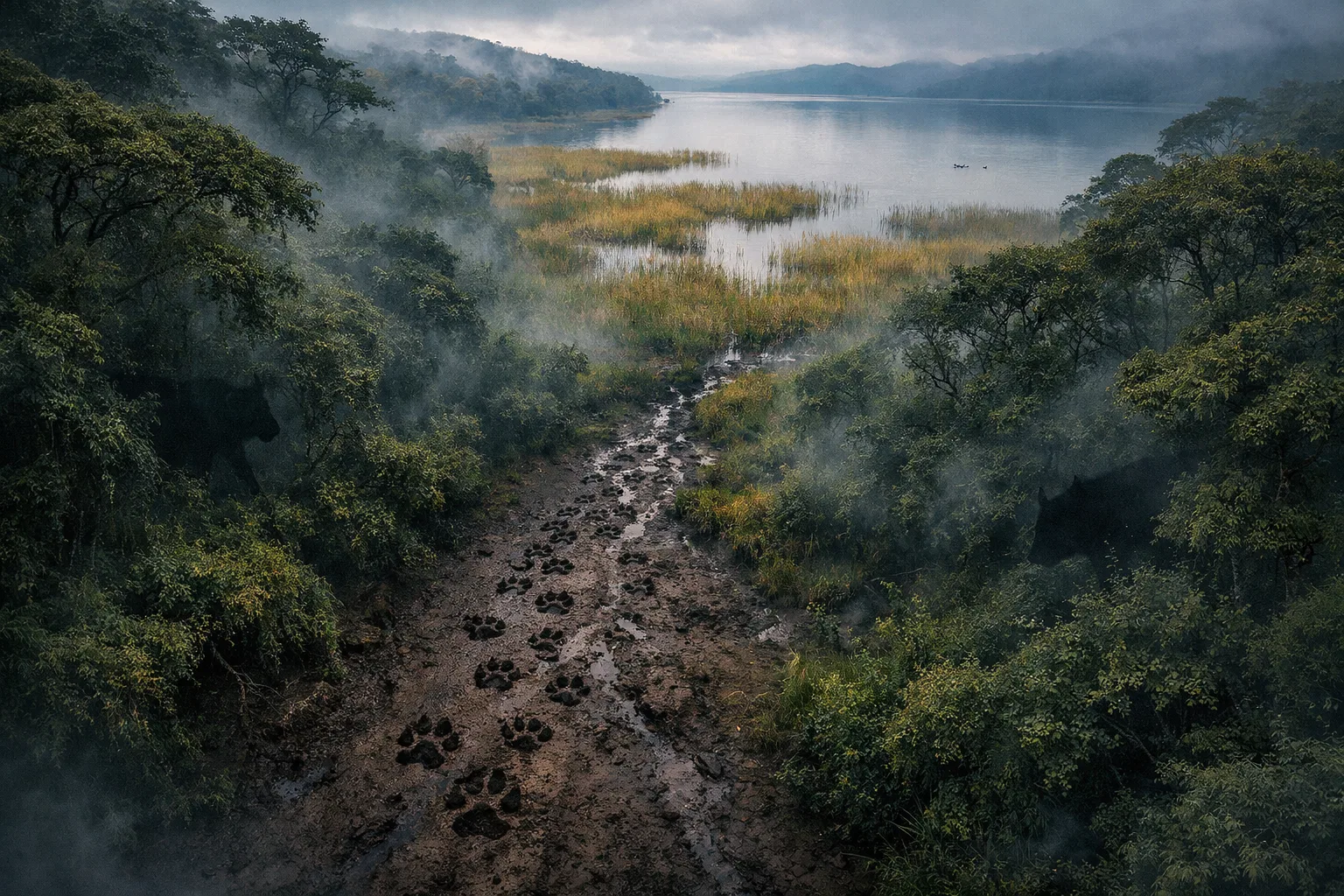
Kenya’s cryptid map follows its ecology. The western highlands and Nandi country produced stories of a shaggy, bear-like carnivore; the Aberdare Range and Mount Kenya gave rise to reports of unusual spotted lions; Lake Victoria and its tributaries generated serpent, reptile and “unknown water beast” accounts; and the Swahili coast connects Kenya to a wider East African tradition of giant cats and devouring monsters. These are not random settings. They are places where visibility is poor, wildlife is genuinely dangerous, and local knowledge, traveller accounts and colonial newspapers often interpreted the same encounter through very different assumptions.[archive.org]archive.orgOpen source on archive.org.
The key caution is that Kenya is already home to animals that can look monstrous under bad conditions. Spotted hyenas have high shoulders, powerful forequarters and an awkward sloping profile; honey badgers are low, tough, nocturnal and fearless; leopards and lions can attack livestock or people; Lake Victoria’s shores support crocodiles, hippos, snakes and reedland wildlife; and the Aberdare landscape is a cool, misty, forested volcanic range very unlike the open savannah most visitors imagine. Kenya Wildlife Service describes Aberdare National Park as a “cool, mist-cloaked” range along the Rift Valley, which helps explain why highland predator reports could take on a stranger atmosphere than ordinary safari sightings.[Kenya Wildlife Service]kws.go.keOpen source on go.ke.
The Nandi Bear: Kenya’s classic “unknown beast”
The Nandi Bear is the country’s most famous cryptid in international cryptozoology. It is usually placed in western Kenya, especially around Nandi country and neighbouring highland or forest regions, and is described as a dangerous, shaggy, bear-like or hyena-like animal with high front shoulders, a sloping back and sometimes a reputation for attacking people or livestock. Early twentieth-century colonial natural-history writing treated it as one of several “unidentified beasts” reported in British East Africa, with C. W. Hobley’s 1913 paper and later East African Natural History Society discussion becoming important reference points.[Internet Archive]archive.orgOpen source on archive.org.
The creature’s local names vary across accounts, including chemosit, kerit, koddoelo, ngoloko and related forms. That variety matters because it suggests the “Nandi Bear” label may have gathered several traditions and sightings into one convenient colonial-era monster. Some descriptions sound like a bear because witnesses emphasised a heavy front end and shambling gait; others sound more like a hyena, baboon, honey badger or folklore being. The name “bear” is itself misleading: bears are not part of Kenya’s living fauna, so the animal was being compared with something familiar to European readers rather than identified in a zoological sense.[Wikipedia]WikipediaNandi bearNandi bear
Sceptical explanations have long focused on misidentification. Reginald Innes Pocock and other zoological writers argued that many reports could be spotted hyenas; George Gaylord Simpson later suggested the honey badger or ratel as a source for at least some stories. The hyena explanation is especially plausible for sightings that stress high shoulders, a sloped back, nocturnal activity and livestock attacks. The honey-badger explanation works better for smaller, low-slung, fearless animals glimpsed briefly at night. Neither explanation fits every embellished tale, but that is the point: the Nandi Bear is best read as a bundle of reports, folklore and rumour rather than one stable biological claim.[Kenya Wildlife Service]kws.go.keOpen source on go.ke.
The more exotic theories have aged poorly. Some early writers speculated about a surviving chalicothere, an extinct clawed mammal, or an unknown ape-like animal. Those ideas helped make the story memorable, but they lack physical evidence. Modern Kenya is heavily studied by wildlife agencies, museums, researchers, camera traps and conservation projects; a large unknown highland carnivore would now need stronger evidence than old testimonies, lost specimens and repeated retellings. The Nandi Bear remains fascinating because it shows how a real landscape of hyenas, forests, night movement and oral warning stories became one of Africa’s best-known mystery beasts.[Google Arts & Culture]artsandculture.google.comOpen source on google.com.
The marozi: did Kenya have a spotted lion?
The marozi, often called the spotted lion, is a different kind of mystery. Unlike the Nandi Bear, it is not usually imagined as a completely bizarre animal. It is a lion-like cat said to be smaller, more forest-dwelling and marked with leopard-like spots or rosettes. The strongest Kenyan association is with the Aberdare Range and Mount Kenya highlands, where early twentieth-century hunters and game officials reported unusual spotted lions at high elevation.[Wikipedia]WikipediaOpen source on wikipedia.org.
The case became famous after Michael Trent shot two spotted lion-like animals in the Aberdare Mountains in 1931. Their skins reportedly drew the attention of the Nairobi Game Department because the animals seemed mature enough not to be ordinary cubs, yet retained striking spots. Kenneth Gandar Dower later mounted an expedition in search of more evidence and wrote about the quest in The Spotted Lion. The appeal of the case is obvious: unlike many cryptids, the marozi story involved alleged skins, named witnesses, a specific mountain region and a plausible animal family.[Wikipedia]WikipediaOpen source on wikipedia.org.
The mainstream explanation is still cautious. Lions can retain juvenile spotting for longer than casual observers expect, and unusual markings, age, sex, lighting, altitude and habitat can combine to make an ordinary lion look like a special race. Zoologist C. A. W. Guggisberg argued in the 1960s that there was no reliable proof of a distinct spotted-lion variety, and other writers treated the Aberdare animals as unusual lions rather than a new subspecies. That does not make the marozi story worthless; it makes it a useful example of how cryptid claims can sit close to real zoology without crossing the line into confirmed discovery.[Wikipedia]WikipediaOpen source on wikipedia.org.
The setting also helps the legend endure. Aberdare is not the open lion country of tourist postcards. It is forest, bamboo, moorland, valleys and mist, with rare wildlife and difficult sightlines. A spotted or partly maned lion in that environment would feel much stranger than a lion seen on open plains. Recent conservation attention to Aberdare’s forests and rare species, including mountain bongo recovery, reinforces the sense that Kenya’s highlands still hold animals that are real, elusive and easy to mythologise.[Kenya Wildlife Service]kws.go.keOpen source on go.ke.
Lake Victoria monsters: lukwata, dingonek and dangerous water
Kenya’s western edge touches Lake Victoria, and the lake has its own monster tradition. The lukwata is usually associated most strongly with Uganda and Baganda folklore, but older accounts place similar stories around Lake Victoria more broadly, including communities on both sides of the lake. Hobley’s 1913 discussion of unidentified beasts connected lake and river reports with stories of creatures attacking canoes, while later summaries describe the lukwata as a large water-dwelling serpent or lake monster.[Wikipedia]WikipediaOpen source on wikipedia.org.
The dingonek is the more dramatic colonial hunting tale. In Edgar Beecher Bronson’s 1910 In Closed Territory, hunter John Alfred Jordan is said to have encountered a strange aquatic beast near the Maggori or Migori River area connected to Lake Victoria. The description is an almost impossible composite: leopard-like head markings, long fangs, a broad body, scales and a powerful aquatic tail. Hobley later discussed the account alongside other Lake Victoria-region reports, and a 1918 magazine treatment presented the dingonek as if it might be a newly discovered animal.[Wikipedia]WikipediaOpen source on wikipedia.org.
The sceptical reading is straightforward: Lake Victoria does not need an unknown monster to be dangerous. Crocodiles, hippos, pythons, floods, reeds, poor visibility and fishing accidents already create the conditions for frightening water stories. Kenya News Agency reported in 2021 that Kenya Wildlife Service officers around Lake Victoria were dealing with attacks and panic linked to snakes, hippos and crocodiles as rising waters disturbed habitats. That modern report is not evidence for a monster, but it is excellent context for why lake-edge communities might preserve stories of powerful water beings.[Kenya News Agency]kenyanews.go.keOpen source on go.ke.

Coastal giant cats and the nunda tradition
Kenya’s coast belongs to the wider Swahili cultural world, so its monster traditions should not be sealed inside modern national borders. The nunda, often glossed in English as “eater of people”, appears in Swahili tale collections rather than as a straightforward field report. Edward Steere’s 1870 Swahili Tales: As Told by Natives of Zanzibar preserves the story of “Sultan Majnun”, later adapted in English as “The Nunda, Eater of People”, in which a monstrous cat-like being grows into a people-devouring threat.[Internet Archive]archive.orgOpen source on archive.org.
The mngwa or nunda of cryptozoological writing is a more modern mystery-cat version: a huge, striped or brindled East African feline said to be larger or more dangerous than known cats. The strongest attack-flap traditions are usually placed in Tanzania rather than Kenya, but the coastal language zone and later retellings often blur the range into “East Africa” or “Tanzania and Kenya”. For a Kenya page, the careful approach is to treat the mngwa as a neighbouring coastal mystery-cat tradition that overlaps with Kenyan Swahili folklore, not as a well-documented Kenyan animal case.[Cryptid Archives]cryptidarchives.fandom.comHichens, W. (1937) African Mystery Beasts. Discovery (DecHichens, W. (1937) African Mystery Beasts. Discovery (Dec
Here, folklore and cryptid claim have to be separated. The nunda of tale collections is a narrative monster: it belongs to story structure, moral danger and heroic overcoming. The mngwa of twentieth-century mystery-beast writing is framed more like a zoological puzzle, with suggested explanations including unusually large leopards, lions, misread tracks, exaggerated attack stories or unknown cats. Kenya’s relevance lies in the cultural and coastal connection, not in a strong body of Kenyan physical evidence.[Internet Archive]archive.orgOpen source on archive.org.
Real Kenyan predators that became “monsters”
No discussion of Kenyan mystery beasts can ignore the Tsavo man-eaters, even though they were not cryptids. In 1898, two male lions attacked workers building the railway bridge over the Tsavo River. Their preserved remains are now at Chicago’s Field Museum, and the episode became one of the most famous human-wildlife conflict stories in the world. Scientific work and museum interpretation have shifted attention away from lurid legend and towards practical causes: injury, dental disease, prey availability and the unusual circumstances of railway construction camps.[Field Museum]fieldmuseum.orgField Museum Tsavo LionsField Museum Tsavo Lions
The Tsavo lions matter because they show how quickly a confirmed animal can become a monster in public memory. They were real lions, not unknown beasts, yet their story gathered exaggeration, fear, imperial adventure writing and later film mythology. That pattern helps explain Kenyan cryptids more broadly. A hyena at night, a lion with odd markings, a crocodile attack, a huge python in reeds or an unfamiliar animal track can become something larger when retold across languages, newspapers, campfire accounts and popular books.[Field Museum]fieldmuseum.orgField Museum Tsavo LionsField Museum Tsavo Lions
This does not mean witnesses were foolish. Many reports came from people who knew local wildlife well. But good witnesses can still face bad viewing conditions, fear, distance, cultural translation and the pressure to fit an encounter into a known story. Kenya’s cryptids are strongest when read as records of uncertainty: moments when people recognised enough to be frightened, but not enough to classify what they had seen.

How Kenya’s cryptid traditions changed in retelling
Kenya’s mystery-animal stories changed as the country around them changed. Early reports were often filtered through colonial hunting culture, natural-history societies and newspapers hungry for “unknown Africa” stories. That is why many classic accounts sound like field notes mixed with adventure literature: exact locations, named hunters and measurements appear beside dramatic claims of fangs, brain-eating beasts and prehistoric survivals.[Internet Archive]archive.orgOpen source on archive.org.
Later cryptozoology reshaped those accounts into a canon. The Nandi Bear became a standard African cryptid; the marozi became a favourite mystery-cat case; the dingonek joined lists of lake and river monsters; and the nunda or mngwa circulated as a giant East African cat. Pop-culture afterlives then simplified them further, often dropping the local context and keeping only the monster silhouette: bear-hyena, spotted lion, lake serpent, man-eating cat.
The most evidence-aware modern reading is more interesting than either blind belief or easy dismissal. Kenya’s stories preserve traces of real animals, real fear, local folklore, colonial misunderstanding, ecological danger and occasional genuine zoological puzzles. The Nandi Bear probably tells us more about hyenas, honey badgers, highland forest fear and layered oral tradition than about a hidden bear. The marozi may record unusual lions rather than a lost species. Lake monsters reflect the hazards of living and fishing around powerful waters. Coastal giant cats sit between Swahili story, predator anxiety and regional folklore.
What would count as stronger evidence today?
For a Kenyan cryptid to move from legend to zoology, modern evidence would need to be much stronger than the classic material. A clear specimen, verified DNA, repeated camera-trap records, well-documented tracks with scale and location data, or independent observations by trained wildlife professionals would matter. Kenya’s conservation world already uses formal surveys, recovery plans, protected-area management and increasingly sophisticated monitoring for known wildlife, so a large unknown mammal would have to survive not just hunters and herders, but rangers, researchers, road networks, camera traps and habitat change.[go.ke]tourism.go.keNATIONAL WILDLIFE CENSUS 2021 REPORT ABRIDGED FINAL WEB VERSIONNATIONAL WILDLIFE CENSUS 2021 REPORT ABRIDGED FINAL WEB VERSION
That standard does not drain the stories of value. It makes them clearer. Kenya’s cryptids are best understood as a country-level mystery-beast tradition rooted in real places: Nandi and western highlands for the bear-like chemosit, Aberdare and Mount Kenya for the spotted marozi, Lake Victoria and its rivers for water monsters, the coast for giant-cat folklore, and Tsavo for the reminder that real predators can become legendary without being unknown animals. The enduring fascination comes from that borderland between wildlife and story, where Kenya’s landscapes are already strange enough to make monsters feel almost plausible.
Amazon book picks
Further Reading
Books and field guides related to What Lurks Behind Kenya's Monster Stories?. Use these as the next step if you want deeper reading beyond the article.
On the Track of Unknown Animals
Includes influential discussion of African mystery animals.
The Kingdon Field Guide to African Mammals
Helps identify animals commonly mistaken for cryptids.
The Rough Guide to Unexplained Phenomena
Places Kenyan monster stories in a global mystery tradition.
eBay marketplace picks
Marketplace Samples
Live-tested eBay searches with available results related to this page.

Endnotes
1.
Source: archive.org
Link:https://archive.org/stream/journalof345819121914east/journalof345819121914east_djvu.txt
2.
Source: Wikipedia
Link:https://en.wikipedia.org/wiki/Marozi
3.
Source: Wikipedia
Link:https://en.wikipedia.org/wiki/Dingonek
4.
Source: archive.org
Link:https://archive.org/details/swahilitalesasto00stee
5.
Source: Wikipedia
Title: Nandi bear
Link:https://en.wikipedia.org/wiki/Nandi_bear
6.
Source: artsandculture.google.com
Link:https://artsandculture.google.com/story/kenya-cradle-of-humankind-national-museums-of-kenya/vwURm3yPc05sKg?hl=en
7.
Source: Wikipedia
Link:https://en.wikipedia.org/wiki/Lukwata
8.
Source: Wikipedia
Title: The Nunda, Eater of People
Link:https://en.wikipedia.org/wiki/The_Nunda%2C_Eater_of_People
9.
Source: archive.org
Link:https://archive.org/details/in.ernet.dli.2015.57033
10.
Source: Wikipedia
Title: Nandi (Hinduism)
Link:https://en.wikipedia.org/wiki/Nandi_%28Hinduism%29
11.
Source: Wikipedia
Title: Honey badger
Link:https://en.wikipedia.org/wiki/Honey_badger
12.
Source: Wikipedia
Title: Lake Victoria
Link:https://en.wikipedia.org/wiki/Lake_Victoria
13.
Source: Wikipedia
Title: Myths and Legends of the Bantu
Link:https://en.wikipedia.org/wiki/Myths_and_Legends_of_the_Bantu
14.
Source: Wikipedia
Title: Tsavo Man Eaters
Link:https://en.wikipedia.org/wiki/Tsavo_Man-Eaters
15.
Source: books.google.de
Title: de Myths and Legends of the Bantu
Link:https://books.google.de/books?cad=1&hl=de&id=n4dToN0QBlsC&source=gbs_book_other_versions_r
16.
Source: archive.org
Link:https://archive.org/details/swahilitalesast00steegoog
17.
Source: books.google.com
Title: Myths and Legends of the Bantu
Link:https://books.google.com/books/about/Myths_and_Legends_of_the_Bantu.html?id=K4wrJ8-UtM0C
18.
Source: books.google.com
Title: Swahili Tales as Told by Natives of Zanz
Link:https://books.google.com/books/about/Swahili_Tales_as_Told_by_Natives_of_Zanz.html?id=UcgWAAAAYAAJ
19.
Source: youtube.com
Title: The FULL Story of the Nandi Bear
Link:https://www.youtube.com/watch?v=8w98_sall1A
Source snippet
The Nandi Bear | The Fierce Beasts of Western Kenya...
20.
Source: youtube.com
Title: The Nandi Bear | The Fierce Beasts of Western Kenya
Link:https://www.youtube.com/watch?v=oFkNhw3W8uI
Source snippet
Nandi Bear is Real | Nandi Bear Cryptozoology...
21.
Source: kws.go.ke
Link:https://kws.go.ke/park/aberdare-national-park/
22.
Source: kenyanews.go.ke
Link:https://www.kenyanews.go.ke/52878-2/
23.
Source: kws.go.ke
Link:https://kws.go.ke/wp-content/uploads/2026/02/LION_2020-2030.pdf
24.
Source: cryptidarchives.fandom.com
Title: Cryptid Archives Nandi bear
Link:https://cryptidarchives.fandom.com/wiki/Nandi_bear
25.
Source: kws.go.ke
Link:https://kws.go.ke/wp-content/uploads/2026/05/Hyena.pdf
26.
Source: cryptidarchives.fandom.com
Title: Cryptid Archives Marozi
Link:https://cryptidarchives.fandom.com/wiki/Marozi
27.
Source: abookofcreatures.com
Link:https://abookofcreatures.com/2019/07/29/lukwata/
28.
Source: abookofcreatures.com
Link:https://abookofcreatures.com/2019/06/17/dingonek/
29.
Source: en.wikisource.org
Title: Sultan Majnun
Link:https://en.wikisource.org/wiki/Swahili_Tales/Sultan_Majnun
30.
Source: cryptidarchives.fandom.com
Title: Hichens, W. (1937) African Mystery Beasts. Discovery (Dec)
Link:https://cryptidarchives.fandom.com/wiki/Encyclopaedia_of_Cryptozoology%3AProject_CryptoResources/Hichens%2C_W.%281937%29_African_Mystery_Beasts._Discovery%28Dec%29
31.
Source: fieldmuseum.org
Title: Field Museum Tsavo Lions
Link:https://www.fieldmuseum.org/blog/tsavo-lions
32.
Source: tourism.go.ke
Title: NATIONAL WILDLIFE CENSUS 2021 REPORT ABRIDGED FINAL WEB VERSION
Link:https://www.tourism.go.ke/wp-content/uploads/2021/08/NATIONAL-WILDLIFE-CENSUS-2021-REPORT-ABRIDGED-FINAL-WEB-VERSION.pdf
33.
Source: facebook.com
Title: Kenya Wildlife Service
Link:https://www.facebook.com/KenyaWildlifeService/
34.
Source: cryptidarchives.fandom.com
Link:https://cryptidarchives.fandom.com/wiki/Lukwata
35.
Source: cryptidarchives.fandom.com
Link:https://cryptidarchives.fandom.com/wiki/Mngwa
36.
Source: cryptidz.fandom.com
Link:https://cryptidz.fandom.com/wiki/Lukwata
37.
Source: cryptidz.fandom.com
Title: Nandi Bear
Link:https://cryptidz.fandom.com/wiki/Nandi_Bear
38.
Source: offbeat.fandom.com
Link:https://offbeat.fandom.com/wiki/Lukwata
39.
Source: cryptidarchives.fandom.com
Link:https://cryptidarchives.fandom.com/wiki/Koddoelo
40.
Source: cryptidarchives.fandom.com
Title: William Hichens
Link:https://cryptidarchives.fandom.com/wiki/William_Hichens
41.
Source: weirdnwildcreatures.fandom.com
Link:https://weirdnwildcreatures.fandom.com/wiki/Mngwa
42.
Source: itsmth.fandom.com
Title: Spotted Lion
Link:https://itsmth.fandom.com/wiki/Spotted_Lion
43.
Source: cryptidarchives.fandom.com
Link:https://cryptidarchives.fandom.com/wiki/Dingonek
44.
Source: livedinopedia.fandom.com
Link:https://livedinopedia.fandom.com/wiki/Dingonek
45.
Source: offbeat.fandom.com
Link:https://offbeat.fandom.com/wiki/Dingonek
46.
Source: offbeat.fandom.com
Link:https://offbeat.fandom.com/wiki/Mngwa
47.
Source: reddit.com
Title: The Lukwata
Link:https://www.reddit.com/r/Cryptozoology/comments/13tooe7/the_lukwata_debating_if_it_could_be_real_or_not/
48.
Source: kws.go.ke
Link:https://kws.go.ke/
49.
Source: abookofcreatures.com
Link:https://abookofcreatures.com/page/15/
50.
Source: abookofcreatures.com
Link:https://abookofcreatures.com/page/50/
51.
Source: abookofcreatures.com
Link:https://abookofcreatures.com/2015/09/02/nunda/
52.
Source: libguides.fieldmuseum.org
Link:https://libguides.fieldmuseum.org/lions
53.
Source: youtube.com
Link:https://www.youtube.com/watch?v=2QW5I0xPwGA
54.
Source: library.eshikshya.org
Link:https://library.eshikshya.org/kiwix/content/wikipedia_en_all_maxi_2023-05/A/Marozi
55.
Source: lairweb.org.nz
Link:https://www.lairweb.org.nz/tiger/marozi.html
56.
Source: online-literature.com
Title: The Nunda, Eater of People
Link:https://www.online-literature.com/andrew_lang/violet_fairy/22/
57.
Source: aberdarenationalparks.com
Link:https://www.aberdarenationalparks.com/
58.
Source: atlasobscura.com
Link:https://www.atlasobscura.com/articles/dingonek
59.
Source: openlibrary.org
Title: Swahili tales
Link:https://openlibrary.org/books/OL23344295M/Swahili_tales
60.
Source: national-parks.org
Link:https://national-parks.org/kenya/aberdare/
61.
Source: cryptidnomi.com
Link:https://cryptidnomi.com/entries/dingonek
62.
Source: catalog.hathitrust.org
Link:https://catalog.hathitrust.org/Record/012326422
63.
Source: altezzatravel.com
Title: lake victoria
Link:https://altezzatravel.com/articles/lake-victoria
64.
Source: news.mongabay.com
Title: east africa
Link:https://news.mongabay.com/list/east-africa/
Additional References
65.
Source: apnews.com
Link:https://apnews.com/article/ebb168684b408dbd34d663e88c17bc53
Source snippet
Recent efforts include the arrival of four new male bongos from European zoos to expand genetic diversity and reduce inbreeding. The cons...
66.
Source: youtube.com
Title: The Marozi: Mutant Lion, Leopon, or an undiscovered species?
Link:https://www.youtube.com/watch?v=yFje4KNUnr4
Source snippet
Nandi Bear Kenya cryptid What Is the Nandi Bear? Africa’s Most Terrifying Cryptid #cryptids #nandibear #africanfolktales Dr. Dread...
67.
Source: arxiv.org
Link:https://arxiv.org/abs/2607.00804
68.
Source: youtube.com
Title: The Marozi (Panthera leo maculatus) The spotted Lion
Link:https://www.youtube.com/watch?v=oywNPe5KHHc
Source snippet
The Marozi: Mutant Lion, Leopon, or an undiscovered species?...
69.
Source: instagram.com
Link:https://www.instagram.com/p/CylP6v6OAnt/
70.
Source: facebook.com
Link:https://www.facebook.com/opiyo.levin/posts/photosartists-impressions-of-how-the-nandi-bear-looked-likethe-legend-of-the-nan/10222728766589107/
71.
Source: ebay.it
Link:https://www.ebay.it/itm/117222908133?mkevt=1&mkcid=1&mkrid=710-53481-19255-0&campid=5339151051&customid=endnote-source&toolid=10001
72.
Source: istockphoto.com
Link:https://www.istockphoto.com/photos/bull-worshipped-as-nandi-shiva
73.
Source: messybeast.com
Link:https://messybeast.com/genetics/anomalous-bigcats.html
74.
Source: aberdarepark.org
Link:https://aberdarepark.org/
Topic Tree
Follow this branch
Related pages 192
- Antigua Cryptids
- Maldives Monsters
- Malta Monsters
- Qatar Monsters
- Argentina Monsters
- +187 more in sidebar