Within Tuvalu
Was Tepuhi a Sea Serpent or Creator Spirit?
Tepuhi resembles a sea monster, but the Nanumaga tradition presents a world-forming spirit rather than a repeatedly sighted animal.
On this page
- The Nanumaga creation story
- Why Tepuhi is not a modern cryptid
- Pacific voyaging and serpent imagery
Page outline Jump by section
Introduction
Tepuhi is often described as Tuvalu’s closest equivalent to a sea monster, but that description can be misleading. In the traditions of Nanumaga, one of Tuvalu’s northern islands, Tepuhi is not a mysterious animal repeatedly seen at sea. Instead, Tepuhi is remembered as a powerful spirit being whose serpent-like form was tied to the creation and ordering of the world. According to recorded accounts of Tuvaluan mythology, Tepuhi was the founding ancestral spirit of Nanumaga, a supernatural figure associated with the separation of sky, land and sea and the establishment of human society.[Wikipedia]WikipediaTuvaluan mythologyTuvaluan mythology

For readers interested in cryptids and sea-serpent legends, Tepuhi is fascinating precisely because it sits on the boundary between monster imagery and sacred tradition. The creature’s appearance resembles that of a giant sea serpent, yet its role belongs firmly to mythology rather than to the world of eyewitness reports, newspaper sightings or zoological mysteries.
Was Tepuhi a Sea Serpent or Creator Spirit?
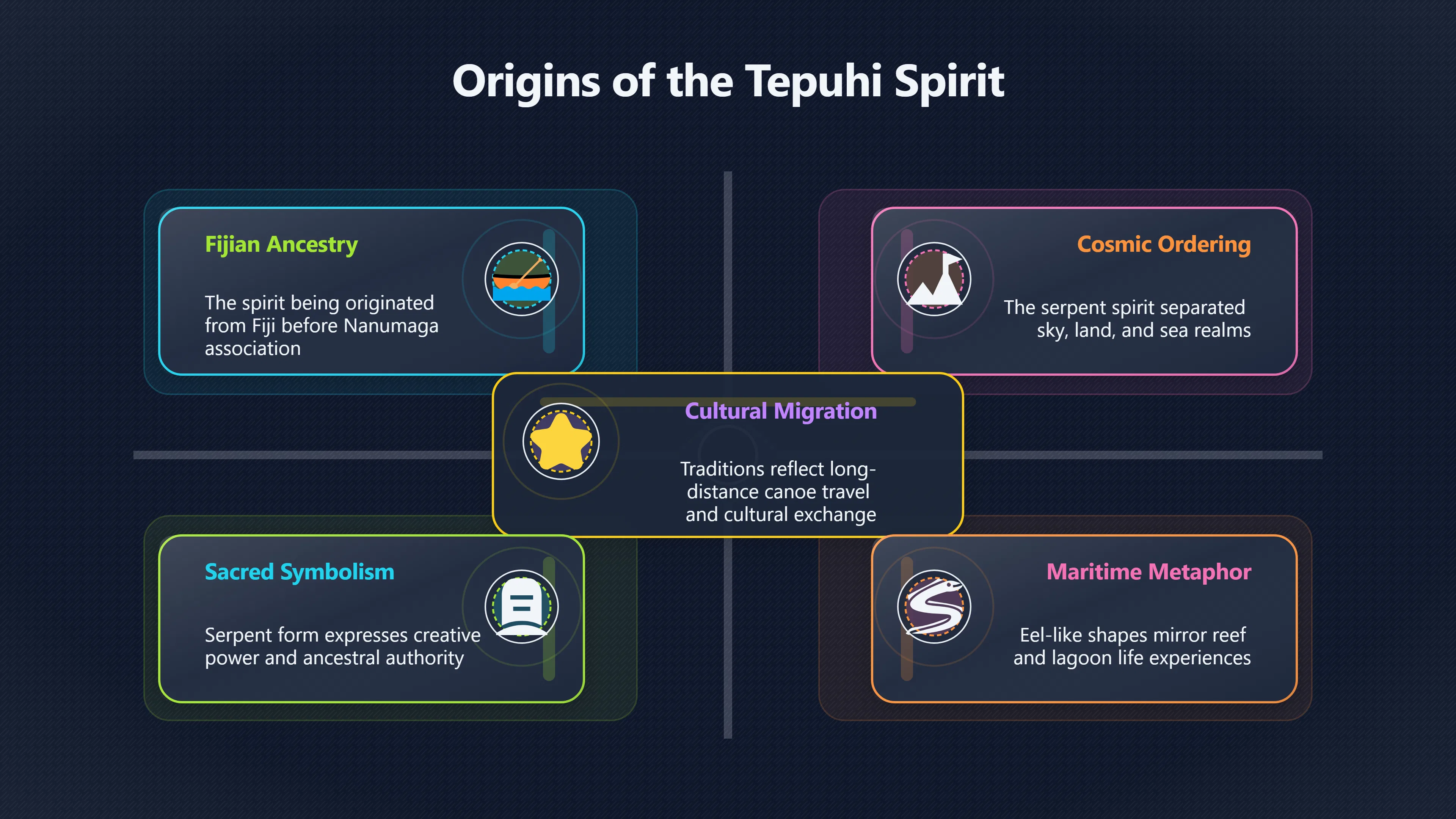
The surviving traditions of Nanumaga describe Tepuhi as a spirit being that took the form of a sea serpent. Accounts collected in studies of Tuvaluan mythology identify Tepuhi as the ancestral founder of the island, a supernatural figure said to have come from Fiji before becoming associated with Nanumaga.[Wikipedia]WikipediaTuvaluan mythologyTuvaluan mythology
What makes Tepuhi unusual is that the figure combines several roles that are often separated in other traditions:
- An ancestral founder connected to the origins of a community.
- A serpent-shaped being linked to the sea.
- A creator or ordering spirit involved in shaping the world.
- A bridge between human ancestry and the supernatural realm.
In popular discussions of strange creatures, serpent-shaped beings are often treated as possible hidden animals. Tepuhi belongs to a very different category. The stories do not present the serpent as an unknown species inhabiting a lagoon or reef. Instead, the serpent form acts as a sacred symbol expressing creative power and ancestral authority.[Wikipedia]WikipediaTuvaluan mythologyTuvaluan mythology
This distinction is important because it explains why Tepuhi appears in histories of Tuvaluan mythology but not in records of modern cryptid investigations. There are no known clusters of sightings, no descriptions of encounters by fishermen, and no attempts to identify Tepuhi as a surviving biological creature.
The Nanumaga Creation Story
Different retellings vary in detail, as is common in Pacific oral traditions. The broad theme is that Tepuhi existed before the world took its familiar form and played a role in separating and organising the major elements of existence.
Rather than depicting creation from nothing, the story describes a process of ordering. Sky, sea and land were distinguished from one another through the actions of the serpent spirit. This type of narrative is common across Polynesian and wider Pacific mythology, where creation often involves the separation of previously connected realms.[Wikipedia]WikipediaTuvaluan mythologyTuvaluan mythology
The serpent shape is significant. In an island world surrounded by ocean, long eel-like and snake-like creatures are visually striking. The body of a giant serpent can serve as a natural metaphor for movement, transformation and the linking of different parts of the cosmos. The image would have been immediately understandable to communities whose lives were closely tied to reefs, lagoons and ocean voyaging.
Recorded traditions also place Nanumaga within wider networks of Pacific migration. Stories linking Tepuhi to origins outside Tuvalu reflect the reality that Polynesian societies were connected by long-distance canoe travel and cultural exchange. Mythological founders often mirror those historical connections, blending ancestral memory with sacred storytelling.[Wikipedia]WikipediaTuvaluan mythologyTuvaluan mythology
Why Tepuhi Is Not a Modern Cryptid
At first glance, a giant sea-serpent associated with an island community sounds very much like a cryptid. However, the evidence places Tepuhi in a different category.
Several features separate the tradition from classic sea-monster reports:
No recurring sightings. Modern sea-serpent legends usually involve repeated observations over years or centuries. No comparable body of reports exists for Tepuhi.[Wikipedia]WikipediaTuvaluan mythologyTuvaluan mythology
No physical evidence claims. There are no known accounts of carcasses, tracks, photographs or other evidence being presented as proof of Tepuhi’s existence.[Wikipedia]WikipediaTuvaluan mythologyTuvaluan mythology
A cosmological role. Tepuhi’s main function is explaining origins and the structure of the world rather than describing a living creature encountered by witnesses.[Wikipedia]WikipediaTuvaluan mythologyTuvaluan mythology
Sacred ancestry. The figure is tied to identity, heritage and traditional history. It is remembered as an ancestral being, not as an animal awaiting scientific discovery.[Wikipedia]WikipediaTuvaluan mythologyTuvaluan mythology
For these reasons, Tepuhi is best understood as part of Tuvalu’s mythological heritage rather than as an unresolved zoological mystery.
Pacific Voyaging and Serpent Imagery
Although Tepuhi is unique to Nanumaga, serpent-shaped creator beings appear in many parts of the Pacific and beyond. These similarities do not necessarily mean the stories share a single origin, but they reveal recurring ways that human societies use serpent imagery.
Across Oceania, long-bodied creatures are frequently associated with:
- Water and the sea.
- Creation and transformation.
- Ancestral power.
- Boundaries between the human and spiritual worlds.
Polynesian cultures developed within vast maritime networks connected by skilled navigation and canoe voyaging. Traditions moved with people, adapted to new islands and acquired local meanings. Scholars note that Tuvalu’s mythology contains influences from wider Polynesian cultural spheres, including Tonga and Samoa, while retaining distinct island traditions of its own.[Wikipedia]WikipediaTuvaluan mythologyTuvaluan mythology
Comparisons can also be drawn with creator-serpent traditions elsewhere in the Pacific region. Famous examples such as Australia’s Rainbow Serpent are likewise portrayed as world-shaping beings rather than ordinary animals. In both cases, the serpent serves as a symbol of creative force and environmental transformation rather than a hidden species.[ebsco.com]ebsco.comRainbow Serpent (deity) | Religion and PhilosophyThe Rainbow Serpent is a significant deity in the mythologies of various Aboriginal…
The comparison should not be taken as evidence of direct connection, but it illustrates how serpent imagery repeatedly emerges in cultures that place great importance on water, landscape and origins.

What Tepuhi Reveals About Tuvalu’s Monster Traditions
Tepuhi highlights a broader pattern in Tuvaluan folklore. The islands possess many stories involving extraordinary beings, yet most of them function as explanations of ancestry, landscape and community rather than as reports of unknown animals.
This helps explain why Tuvalu lacks a strong tradition of modern cryptid hunting despite possessing rich supernatural folklore. The most memorable creatures are usually creators, ancestors or spirits. Their importance lies not in whether they can be found, photographed or captured, but in what they reveal about how island communities understood their world.
Seen from that perspective, Tepuhi is both a sea serpent and something much more significant. The figure occupies the role of a creator spirit whose serpent form links the ocean, the origins of Nanumaga and the wider tradition of maritime mythmaking across the Pacific.[Wikipedia]WikipediaTuvaluan mythologyTuvaluan mythology
Amazon book picks
Further Reading
Books and field guides related to Was Tepuhi a Sea Serpent or Creator Spirit?. Use these as the next step if you want deeper reading beyond the article.
The First Fossil Hunters
Examines how cultures interpret extraordinary creature traditions.
The Hero with a Thousand Faces
Provides frameworks for understanding creator spirits and mythic founders.
Polynesian Mythology:
Directly relevant to serpent-like creator beings in Pacific traditions.
The Oxford Companion to World Mythology
Helps place Tepuhi within broader creator-spirit traditions.
eBay marketplace picks
Marketplace Samples
Live-tested eBay searches with available results related to this page.

Endnotes
1.
Source: Wikipedia
Title: Tuvaluan mythology
Link:https://en.wikipedia.org/wiki/Tuvaluan_mythology
2.
Source: ebsco.com
Link:https://www.ebsco.com/research-starters/religion-and-philosophy/rainbow-serpent-deity
Source snippet
Rainbow Serpent (deity) | Religion and PhilosophyThe Rainbow Serpent is a significant deity in the mythologies of various Aboriginal...
3.
Source: Wikipedia
Title: Rainbow Serpent
Link:https://en.wikipedia.org/wiki/Rainbow_Serpent
4.
Source: japingkaaboriginalart.com
Link:https://japingkaaboriginalart.com/articles/rainbow-serpent/
Source snippet
Japingka Aboriginal Art GalleryRainbow Serpent Dreamtime StoryRainbow Serpent is an ancient Aboriginal spirit force from the Dreaming – h...
5.
Source: mythus.fandom.com
Title: Sea serpent
Link:https://mythus.fandom.com/wiki/Sea_serpent
Additional References
6.
Source: kateowengallery.com
Link:https://www.kateowengallery.com/page/rainbow-serpent?srsltid=AfmBOoqbBFKs8eL6s3DN7eJIZGajFctbLvu4wkofE5B63X2hDwzTz9SP
Source snippet
The Rainbow Serpent Dreamtime StoryThe story describes a time long ago when the Earth was flat. The serpent was one of the Dreamtime crea...
7.
Source: artshouse.com.au
Link:https://www.artshouse.com.au/the-return-of-the-rainbow-serpent/
Source snippet
The Return of the Rainbow SerpentRainbow Serpent receded deep into the earth to try and escape the sickness and from that movement, the l...
8.
Source: facebook.com
Link:https://www.facebook.com/NathansArtPageO/posts/creation-the-rainbow-serpent-moving-across-the-land-forming-the-the-mountains-va/1555835614548368/
Source snippet
eamtime stories. It is often depicted as a creator god...
9.
Source: youtube.com
Title: Rising Stories Tuvalu
Link:https://www.youtube.com/watch?v=Q5heXoVF39E
Source snippet
NanumagaNanumaga, Tuvalu, family views on climate change and mobility. This digital story was created as part of the Rising Stories: Inve...
10.
Source: australian.museum
Title: save our ngatyi
Link:https://australian.museum/learn/first-nations/barka/save-our-ngatyi/
Source snippet
The Australian MuseumSave our Ngatyi (Rainbow Serpents)10 May 2023 — That's why we fight for the river, because the Ngatyi is our creator...
Published: May 2023
11.
Source: whc.unesco.org
Link:https://whc.unesco.org/en/tentativelists/6707/
Source snippet
UNESCO World Heritage CentreThe Pacific atoll-island cultural landscape of Tuvalu24 Jan 2024 — While Tuvaluan society is not timelessly t...
12.
Source: youtube.com
Title: The Eel and The Flounder: The Creation Story of Tuvalu
Link:https://www.youtube.com/watch?v=vjXxaq6aTes
Source snippet
The Legend of Tauasa and the Stolen Garland...
13.
Source: facebook.com
Link:https://www.facebook.com/100050990597130/videos/alofaga-fanau-nanumaga-salalau-kite-fenua-tonu/1886877505204368/
14.
Source: frieze.com
Link:https://www.frieze.com/article/celeste-olalquiaga-tuvalu-issue-234
15.
Source: facebook.com
Link:https://www.facebook.com/groups/237989025570727/posts/590294697006823/
Topic Tree