Where Greek Monsters Meet Real Places
Greece is not short of monsters, but its cryptid story is different from countries built around one famous modern “beast”.
Page outline Jump by section
Why Greece’s monster tradition feels older than cryptozoology
In many countries, cryptid history begins with newspapers, blurry photographs, or local tourism campaigns. In Greece, it begins much earlier, because monster stories were part of the classical imagination long before anyone used modern terms such as “cryptid”. That matters because readers looking for Greek mystery animals are often really asking two questions at once: did Greece have modern unexplained animal reports, and how do those reports sit beside the country’s huge mythological bestiary?
The answer is that modern Greek cryptid evidence is comparatively thin, while Greece’s legendary creature tradition is exceptionally strong. The Hydra, sea monsters, dragons and giant beasts were not “reports” in the same sense as a twentieth-century lake-monster sighting. They were mythic beings embedded in stories about heroes, gods, dangerous places and moral order. Still, they shaped the way later readers, tourists and folklore collectors interpret Greek landscapes: a marsh can be a monster lair, a mountain lake can be a dragon’s home, and a strange shape in the water can quickly become “Greece’s Nessie”.[theoi.com]theoi.comHESIOD, THEOGONYHESIOD, THEOGONY
The useful way to read Greek monster lore is therefore not to ask whether the Hydra or a dragon lake creature is a zoological species. It is to separate four layers: ancient myth, local folklore, modern media mystery, and plausible animal explanation. Greece has examples of all four, but they are not equally evidenced.
The Hydra: Greece’s most famous lake monster was a mythic swamp beast
The Lernaean Hydra is the closest thing Greece has to a world-famous lake monster. In the classical story, it haunted the swamps of Lerna in the Argolid and was destroyed by Heracles with help from Iolaus. Theoi’s classical-source summary describes it as a gigantic multi-headed water serpent; Hesiod’s Theogony places the Hydra of Lerna among the monstrous offspring associated with Typhon and Echidna.[Theoi]theoi.comLERNAEAN HYDRALERNAEAN HYDRA
For a modern cryptid reader, the important point is that the Hydra is not a recorded animal encounter. It is a mythic creature fixed to a real landscape. Lerna was a marshy, watery place near the Argolic Gulf, and the monster’s setting matters: swamps, springs and standing water are exactly the kinds of places where people imagine hidden dangers. Later versions of the myth gave the Hydra regenerative heads, deadly breath and blood so poisonous that it remained dangerous even after death.[Greece Is]greece-is.comGreece Is An Archaeological Guide to Prehistoric LernaGreece Is An Archaeological Guide to Prehistoric Lerna
The Hydra’s afterlife is also unusually strong. Ancient and modern art repeatedly returns to the scene of Heracles battling the creature, and museum collections preserve later interpretations of the labour. The Metropolitan Museum of Art, for example, catalogues works showing Hercules and the Hydra of Lerna, demonstrating how the monster moved from Greek myth into a broader European visual tradition.[The Metropolitan Museum of Art]metmuseum.orgOpen source on metmuseum.org.
As an “evidence” case, the Hydra tells us little about unknown animals. As a cultural case, it tells us a lot. It is the template for a Greek monster tied to a named place, a dangerous wetland, a heroic encounter, and a story that becomes more elaborate over time.

Dragon Lakes: where folklore, newts and mountain tourism meet
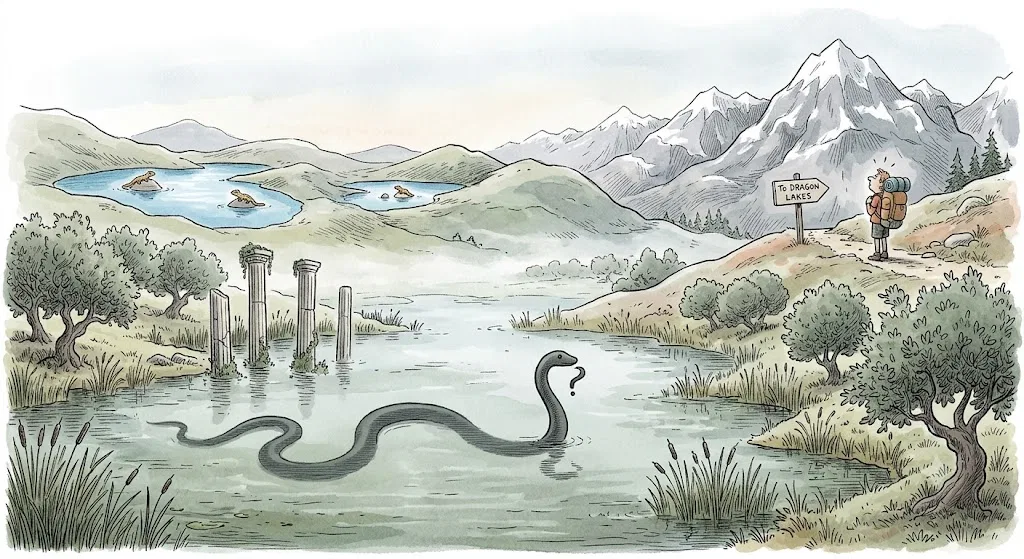
The most cryptid-like living folklore in Greece may be found not in the sea but high in the Pindus mountains. The Dragon Lakes of Epirus, especially those of Tymfi and Smolikas, are alpine or sub-alpine lakes associated with stories of dragons fighting from neighbouring mountains. UNESCO’s page for the Vikos-Aoos Global Geopark presents Drakolimni, or Dragon Lake, as a hiking highlight and notes the local legend that its depression was formed during battles between dragons hurling boulders.[UNESCO]unesco.orgOpen source on unesco.org.
This is not just a tourist label pasted onto scenery. The folklore explains the landscape itself: scattered stones, bare slopes, contrasting lake shores and the dramatic feeling of high mountain basins. Travel and regional sources repeat variants in which rival dragons from Tymfi and Smolikas throw rocks, logs or other missiles at each other, leaving visible marks in the terrain.[All Over Greece]allovergreece.comOpen source on allovergreece.com.
The biological explanation is smaller, stranger and more interesting than a hoax. Drakolimni lakes are known for alpine newts. Sources on Vikos-Aoos note that the alpine newts living in the high lakes are associated with local folktales of dragons and dragon battles; a 2021 veterinary study also records mass mortality events among alpine newts in Drakolimni Lake on Smolikas and mentions a similar incident in the nearby Tymfi lake in 1998.[Wikipedia]WikipediaVikos–Aoös National ParkVikos–Aoös National Park
That does not mean the newts “are” dragons in any simple way. It means Greece has a classic folklore mechanism: a striking habitat, unusual small animals, and a landscape that invites explanation through story. The result is a creature tradition that still has a public afterlife, because hikers visit the lakes partly for their beauty and partly for the legend attached to them.
Prespa Lake’s “monster”: Greece’s thinnest but most modern lake-beast claim
The Prespa Lakes, shared by Greece, Albania and North Macedonia, have occasionally been pulled into modern lake-monster culture. In 2017, a short video from the Albanian side of Great Prespa Lake circulated in tabloid and weird-news outlets as a possible “Nessie”-type creature, with Greek coverage noting that the lake is shared across the borders of Greece, Albania and North Macedonia.[Keep Talking Greece]keeptalkinggreece.comloch ness prespa lake videoloch ness prespa lake video
This is the weakest major case, and that should be said clearly. The public material is mostly a brief video, secondary reporting, social-media repetition and cryptid-wiki style summaries. There is no robust body of repeated, well-documented Greek eyewitness reports, no carcass, no clear biological trace, and no serious scientific case for a large unknown animal in the lake.
Prespa itself, however, is a perfect setting for such a rumour. It is remote-feeling, mountainous, transboundary and rich in wildlife. Conservation and tourism sources describe it as a major biodiversity area, especially for pelicans and other birds, while recent travel reporting emphasises its ancient lakes, mountains, oak forests, bears, butterflies and traditional villages.[Περιφέρεια Δυτικής Μακεδονίας]visitwestmacedonia.grΠεριφέρεια Δυτικής ΜακεδονίαςPrespa National ParkΠεριφέρεια Δυτικής ΜακεδονίαςPrespa National Park
A sceptical reading is therefore straightforward: the Prespa “monster” is best treated as a modern media mystery attached to a dramatic lake landscape, not as a well-supported Greek cryptid. If anything, it shows how quickly the Loch Ness template travels. A long neck-like shape on a lake, especially in a beautiful border region, is enough for the story to become a Balkan cousin of Nessie.
Sifis the Cretan crocodile: when the monster was real, but not mysterious
The best modern “mystery animal” story in Greece is Sifis, the crocodile found in an artificial lake at the Potami dam near Rethymno, Crete, in 2014. Unlike the Hydra or Prespa monster, this was a real animal. The mystery was not whether it existed, but how a crocodile ended up in a Cretan reservoir.
Sifis became famous because crocodiles are not native to Greece, and because he repeatedly evaded capture. Greek newspaper Kathimerini reported that he was first spotted by forest rangers at the Potami dam on the Amari plain in June and that his fame drew visitors hoping to see him. The Guardian reported that he was about six feet long, survived for months in the reservoir, resisted repeated capture attempts and was later found dead after a harsh winter.[eKathimerini]ekathimerini.comOpen source on ekathimerini.com.
This is a useful case because it shows how a cryptid-like flap can form around a confirmed animal. Local people had sightings. Media arrived. Experts tried to catch it. Tourism interest grew. Some people treated the crocodile as a hazard, others as an attraction. Yet the explanation was not a hidden native population or a prehistoric survivor. The most plausible account was that Sifis had been an abandoned or escaped exotic pet that grew too large or inconvenient for an owner to keep.[The Guardian]theguardian.comsifis the cretan crocodile is found deadsifis the cretan crocodile is found dead
Sifis belongs on a Greek cryptid page because he shows the boundary between mystery animal and misplaced animal. Many “monster” reports around the world eventually become this kind of story: not imaginary, but not unknown either.
Sea monsters, seals and the Aegean imagination
Greece’s coasts have always invited sea-monster thinking. Ancient Greek and Roman culture used the idea of the cetus or great sea monster in myth and art, and scholarship on whales and sea monsters in the Greek world notes the overlap between fantastic sea creatures, real whales and the language used to describe large marine animals.[ResearchGate]researchgate.netOpen source on researchgate.net.
The modern Aegean does contain animals that can look startling if seen briefly: dolphins, whales, large fish, monk seals and basking marine life. The Mediterranean monk seal is especially relevant because it is rare, large, cave-associated and deeply embedded in Greek marine conservation. The Marine Mammal Commission estimates the total Mediterranean monk seal population at roughly 815–997 individuals, with Greece holding a major share, while recent reporting describes Greece as home to around 500 of them and highlights their use of sea caves away from human disturbance.[Marine Mammal Commission]mmc.govOpen source on mmc.gov.
That gives Greece a plausible source for some “strange animal in the water” impressions, but not a reason to inflate seal sightings into sea-serpent claims. The more evidence-aware conclusion is that Greek sea-monster tradition is culturally ancient, while modern marine mysteries are usually better approached through known Mediterranean wildlife, poor viewing conditions, distance, waves, floating debris, and the power of expectation.
Phantom predators and old memories of real big cats
Greece does not have a strong modern phantom-panther tradition like Britain, but big cats still matter to Greek monster history because the ancient landscape may genuinely have held large predators now absent. This is where folklore, archaeology and historical ecology overlap.
Recent popular reporting has revived the idea that lions and panthers once roamed parts of ancient Greece, including discussion of fossils from caves near Vravrona in Attica. Wider summaries of lion history in Europe describe modern lions occupying parts of south-eastern Europe in the Holocene and disappearing from Greek regions at different times, although the exact chronology is debated.[GreekReporter.com]greekreporter.comGreek Reporter.com The Lion's Den: When Big Cats Roamed Ancient GreeceGreek Reporter.com The Lion's Den: When Big Cats Roamed Ancient Greece
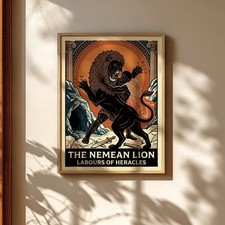
This does not make every Greek lion myth a field report. The Nemean Lion, like the Hydra, is a mythic opponent for Heracles rather than a zoological record. But it does mean Greek monster tradition had access to real predator memories. A huge lion in a story lands differently in a society that knows large cats either from local experience, trade, art, imported animals or inherited regional memory.
Modern Greece’s real large carnivores are more likely to be bears and wolves. Recent AP reporting notes that brown bears and wolves have rebounded in parts of Greece, creating new rural tensions as conservation success meets livestock loss and fear. That is not cryptozoology, but it helps explain why “beast” stories persist: large predators are not just symbols in Greece; in some regions, they are living neighbours again.[AP News]apnews.comAP News Rural Greece struggles to cope with predator comebackThe boom in wild boars, driven by reduced hunting and favorable breeding conditions, has further exacerbated tensions, with calls to exte…
Invasive “monsters”: the toxic pufferfish panic
A country’s mystery-animal culture also changes when new species arrive. In Greece today, one of the most monster-like real animals is not hidden in a lake but spreading through warm Mediterranean waters: the silver-cheeked toadfish, a toxic invasive pufferfish.
The species has been reported as one of the Mediterranean’s most harmful invasive fish, with studies documenting its toxicity in European waters of the Aegean and later work describing its strong bite force and tetrodotoxin content. EU material on the LagoMeal project describes the pufferfish as originating from the Red Sea and spreading through the Mediterranean after the opening of the Suez Canal enabled large-scale movement of Indo-Pacific species.[sciencedirect.com]sciencedirect.comOpen source on sciencedirect.com.
In 2026, Greek authorities and coastal communities were dealing with the fish as a public and fishing problem rather than a legend. AP reported that Greece began paying fishermen to catch toxic toadfish from 26 June 2026, while also noting that authorities said the fish had not been sighted in Greek island resort bathing areas. The Guardian reported that floating barriers were being installed in parts of the Gulf of Euboea amid concern over the species.[AP News]apnews.comOpen source on apnews.com.
This is not a cryptid, because the animal is identified and scientifically studied. But it is exactly the kind of creature that can feed future folklore: toxic flesh, strong teeth, damaged nets, alarming videos and climate-linked range expansion. Greece’s “monsters” are no longer only ancient; some are ecological arrivals.
What counts as evidence in Greek creature stories?
Greek mystery-beast material is best read by evidence type rather than by excitement level. The country has spectacular creature stories, but they do not all make the same claim.
Ancient myth: The Hydra and Greek sea monsters are foundational cultural creatures, not confirmed animal reports. Their value lies in place, symbolism and longevity.
Local folklore: The Dragon Lakes preserve mountain stories that explain landscape features and unusual animals such as alpine newts. These are living place legends rather than sightings of unknown megafauna.
Modern media claims: The Prespa Lake “monster” is a thinly evidenced lake-beast rumour, amplified by video culture and the global Nessie template.
Confirmed out-of-place animals: Sifis the Cretan crocodile was real, photographed, pursued and eventually found dead, but he was almost certainly not evidence of a hidden Greek crocodile population.
Known wildlife mistaken for monsters: Seals, large fish, wolves, bears, boars, birds and invasive species can all produce alarming encounters without requiring unknown animals.
This framework keeps the fun intact while preventing category mistakes. Greece’s monster tradition is richer when the Hydra is allowed to be myth, Drakolimni dragons are allowed to be folklore, Sifis is allowed to be a misplaced crocodile, and Prespa remains an unresolved but weak modern curiosity.
The takeaway: Greece is a land of monster landscapes, not proven hidden beasts
Greece’s strongest contribution to cryptid history is not a single well-evidenced unknown animal. It is the depth of its monster landscapes: Lerna’s swamp, Epirus’s dragon lakes, Prespa’s border waters, Crete’s reservoir, the Aegean’s caves and coasts, and the mountain country where real predators still shape rural imagination.
That makes Greece especially useful for understanding how monster stories evolve. Some begin as myth and become tourism. Some begin as folklore and find a biological echo in small animals. Some begin as shaky video clips and travel through the internet. Some, like Sifis, begin as an impossible-sounding sighting and turn out to be entirely real — just not mysterious in the way people first hoped.
eBay marketplace picks
Marketplace Samples
Live-tested eBay searches with available results related to this page.
Endnotes
1.
Source: theoi.com
Title: LERNAEAN HYDRA
Link:https://www.theoi.com/Ther/DrakonHydra.html
2.
Source: unesco.org
Link:https://www.unesco.org/en/iggp/vikos-aoos-unesco-global-geopark
3.
Source: theoi.com
Title: HESIOD, THEOGONY
Link:https://www.theoi.com/Text/HesiodTheogony.html
4.
Source: researchgate.net
Link:https://www.researchgate.net/publication/274417447_A_Ketos_in_Early_Athens_An_Archaeology_of_Whales_and_Sea_Monsters_in_the_Greek_World
5.
Source: greece-is.com
Title: Greece Is An Archaeological Guide to Prehistoric Lerna
Link:https://www.greece-is.com/the-hydras-lair-archaeological-guide-prehistoric-lerna/
6.
Source: Wikipedia
Title: Vikos–Aoös National Park
Link:https://en.wikipedia.org/wiki/Vikos%E2%80%93Ao%C3%B6s_National_Park
7.
Source: greekreporter.com
Title: mystery sea creature spotted in prespes northern greece video
Link:https://greekreporter.com/2017/12/29/mystery-sea-creature-spotted-in-prespes-northern-greece-video/
8.
Source: ekathimerini.com
Link:https://www.ekathimerini.com/news/168658/subject-of-many-snaps-sifis-the-crocodile-found-dead-in-crete/
9.
Source: Wikipedia
Title: Cetus (mythology)
Link:https://en.wikipedia.org/wiki/Cetus_%28mythology%29
10.
Source: greekreporter.com
Title: Greek Reporter.com The Lion’s Den: When Big Cats Roamed Ancient Greece
Link:https://greekreporter.com/2026/01/27/the-lions-den-when-big-cats-roamed-greece-video/
11.
Source: Wikipedia
Title: History of lions in Europe
Link:https://en.wikipedia.org/wiki/History_of_lions_in_Europe
12.
Source: sciencedirect.com
Link:https://www.sciencedirect.com/science/article/abs/pii/S0041010109001640
13.
Source: pmc.ncbi.nlm.nih.gov
Link:https://pmc.ncbi.nlm.nih.gov/articles/PMC10608560/
14.
Source: Wikipedia
Title: Sea serpent
Link:https://en.wikipedia.org/wiki/Sea_serpent
15.
Source: Wikipedia
Title: List of lake monsters
Link:https://en.wikipedia.org/wiki/List_of_lake_monsters
16.
Source: Wikipedia
Title: Phantom cat
Link:https://en.wikipedia.org/wiki/Phantom_cat
17.
Source: Wikipedia
Title: Lernaean Hydra
Link:https://en.wikipedia.org/wiki/Lernaean_Hydra
18.
Source: Wikipedia
Title: Andromeda (mythology)
Link:https://en.wikipedia.org/wiki/Andromeda_%28mythology%29
19.
Source: Wikipedia
Link:https://en.wikipedia.org/wiki/Drakolimni
20.
Source: Wikipedia
Link:https://en.wikipedia.org/wiki/Charybdis
21.
Source: Wikipedia
Title: Panther (legendary creature)
Link:https://en.wikipedia.org/wiki/Panther_%28legendary_creature%29
22.
Source: Wikipedia
Title: Ancient history
Link:https://en.wikipedia.org/wiki/Ancient_history
23.
Source: Wikipedia
Link:https://en.wikipedia.org/wiki/Society
24.
Source: Wikipedia
Title: World Wildlife Fund
Link:https://en.wikipedia.org/wiki/World_Wildlife_Fund
25.
Source: Wikipedia
Title: Lagocephalus sceleratus
Link:https://en.wikipedia.org/wiki/Lagocephalus_sceleratus
26.
Source: Wikipedia
Link:https://en.wikipedia.org/wiki/Theogony
27.
Source: researchgate.net
Title: 307909943 The Myth of the Lernaean Hydra
Link:https://www.researchgate.net/publication/307909943_The_Myth_of_the_Lernaean_Hydra
28.
Source: researchgate.net
Link:https://www.researchgate.net/publication/350955574_Mass_mortality_of_unknown_etiology_in_alpine_newts_Ichtyosaura_alperstris_veluchiensis_in_an_alpine_lake_in_Greece
29.
Source: researchgate.net
Link:https://www.researchgate.net/figure/The-frequency-of-large-carnivores-mentioned-in-eight-classical-Greek-texts-written-in-the_fig1_250007417
30.
Source: researchgate.net
Title: 258914936 Caves and fossils palaeontology in Greek caves and fissures
Link:https://www.researchgate.net/publication/258914936_Caves_and_fossils_palaeontology_in_Greek_caves_and_fissures
31.
Source: researchgate.net
Link:https://www.researchgate.net/publication/369411315_Rapid_expansion_of_the_golden_jackal_in_Greece_research_management_and_conservation_priorities
32.
Source: greekreporter.com
Title: sifis the crocodile found dead
Link:https://greekreporter.com/2015/03/30/sifis-the-crocodile-found-dead/
33.
Source: theoi.com
Title: ETHIOPIA N CETUS (Ketos Aithiopios)
Link:https://www.theoi.com/Ther/KetosAithiopios.html
34.
Source: sciencedirect.com
Link:https://www.sciencedirect.com/science/article/pii/S0895717708003397
35.
Source: sciencedirect.com
Link:https://www.sciencedirect.com/org/science/article/pii/S1619003321000323
36.
Source: travel.gr
Link:https://www.travel.gr/en/experiences-ee/unknown-greece/smolikas-drakolimni-sub-alpine-lake-with-wild-orchids-on-greeces-second-tallest-mountain/
37.
Source: greece-is.com
Title: petralona cavehome 200000 year old man
Link:https://www.greece-is.com/petralona-cavehome-200000-year-old-man/
38.
Source: ekathimerini.com
Title: marine scientists urge calm amid pufferfish panic
Link:https://www.ekathimerini.com/news/environment/1307174/marine-scientists-urge-calm-amid-pufferfish-panic/
39.
Source: keeptalkinggreece.com
Title: loch ness prespa lake video
Link:https://www.keeptalkinggreece.com/2017/12/30/loch-ness-prespa-lake-video/
40.
Source: theguardian.com
Title: sifis the cretan crocodile is found dead
Link:https://www.theguardian.com/world/2015/mar/30/sifis-the-cretan-crocodile-is-found-dead
41.
Source: metmuseum.org
Link:https://www.metmuseum.org/art/collection/search/397673
42.
Source: metmuseum.org
Link:https://www.metmuseum.org/art/collection/search/625055
43.
Source: allovergreece.com
Link:https://www.allovergreece.com/Region-Nature/Wetland/46/en
44.
Source: visitwestmacedonia.gr
Title: Περιφέρεια Δυτικής ΜακεδονίαςPrespa National Park
Link:https://visitwestmacedonia.gr/en/places-box/prespa-national-park/
45.
Source: theguardian.com
Link:https://www.theguardian.com/travel/2025/aug/06/balkan-bounty-the-little-known-corner-of-greece-now-ripe-for-walkers-and-nature-tourism
Source snippet
Prespa offers a unique blend of natural and cultural attractions, from Byzantine ruins and cliffside hermitages to village tavernas servi...
46.
Source: mmc.gov
Link:https://www.mmc.gov/priority-topics/species-of-concern/mediterranean-monk-seal/
47.
Source: theguardian.com
Link:https://www.theguardian.com/environment/2025/dec/17/seals-caves-tourists-experiences-greece-marine-protected-areas-endangered-monk-seals
Source snippet
Although decades of conservation efforts have improved seal numbers—Greece now hosts around 500 individuals—growing threats from unregula...
48.
Source: apnews.com
Title: AP News Rural Greece struggles to cope with predator comeback
Link:https://apnews.com/article/17643359603619c1eb87d944d6f57570
Source snippet
The boom in wild boars, driven by reduced hunting and favorable breeding conditions, has further exacerbated tensions, with calls to exte...
49.
Source: apnews.com
Link:https://apnews.com/article/ff2aa993abe69fe33ef1c401e95fc115
50.
Source: theguardian.com
Link:https://www.theguardian.com/world/2026/jul/06/greece-floating-barrier-pufferfish-warming-waters
Source snippet
Municipal officials in Chalkida led the initiative, with plans to deploy 7 kilometers of netting along various bays. The project has rapi...
51.
Source: facebook.com
Link:https://www.facebook.com/GreekReporter/videos/greece-is-home-to-what-is-called-dragon-lakes-or-simply-put-alpine-lakes-which-w/957002936293260/
52.
Source: dictionary.cambridge.org
Link:https://dictionary.cambridge.org/dictionary/english/ancient
53.
Source: dictionary.cambridge.org
Link:https://dictionary.cambridge.org/dictionary/english/society
54.
Source: eternalgreece.com
Link:https://eternalgreece.com/lerna/
55.
Source: instagram.com
Link:https://www.instagram.com/reel/DDg7DaZPnO5/?hl=en
56.
Source: keeptalkinggreece.com
Title: the crocodile wont bite croco dundees in crete see poll results
Link:https://www.keeptalkinggreece.com/2014/07/14/the-crocodile-wont-bite-croco-dundees-in-crete-see-poll-results/
57.
Source: belleelene.com
Link:https://belleelene.com/2024/06/27/tymfi/
58.
Source: wwf.gr
Link:https://www.wwf.gr/en/our_work/nature/marine/endangered_species/seals/
59.
Source: tripadvisor.com
Link:https://www.tripadvisor.com/Attraction_Review-g970274-d8745583-Reviews-or20-Drakolimni-Papigko_Zagorohoria_Ioannina_Region_Epirus.html
60.
Source: birdwing.eu
Title: prespa lakes
Link:https://www.birdwing.eu/sites-of-northern-greece/prespa-lakes
61.
Source: atlasobscura.com
Link:https://www.atlasobscura.com/places/drakolimni
62.
Source: athensattica.com
Link:https://athensattica.com/highlight/vravrona/
Additional References
63.
Source: youtube.com
Title: Every Mythical Creature From Greece Explained in 48 Minutes
Link:https://www.youtube.com/watch?v=Y5EiN-LKAzU
Source snippet
Every Greek Mythological Creature Explained in 10 Minutes...
64.
Source: academia.edu
Link:https://www.academia.edu/80174503/Lake_Lerna_investigating_Hercules_ancient_myth
65.
Source: monachus-guardian.org
Link:https://www.monachus-guardian.org/library/karam09a.pdf
66.
Source: natgeokids.com
Link:https://www.natgeokids.com/uk/discover/history/greece/greek-myths/
67.
Source: history.co.uk
Link:https://www.history.co.uk/articles/strange-sea-serpent-sightings-from-history
68.
Source: academia.edu
Link:https://www.academia.edu/256746/A_Ketos_In_Early_Athens_An_Archaeology_of_Whales_and_Sea_Monsters_In_the_Greek_World
69.
Source: reddit.com
Link:https://www.reddit.com/r/TrueCryptozoology/comments/1oiefdm/a_strange_lake_monster_was_spotted_in_lake_prespa/
70.
Source: instagram.com
Link:https://www.instagram.com/reel/DTXx0YAk_Bc/
71.
Source: merriam-webster.com
Link:https://www.merriam-webster.com/dictionary/ancient
72.
Source: collinsdictionary.com
Link:https://www.collinsdictionary.com/dictionary/english/ancient
Topic Tree
Follow this branch
Related pages 192
- Antigua Cryptids
- Maldives Monsters
- Malta Monsters
- Qatar Monsters
- Argentina Monsters
- +187 more in sidebar