Within Kenya Cryptids
What Haunted Kenya's Lake Victoria Waters?
Lake Victoria monster tales turned crocodiles, hippos, snakes and colonial hunting stories into some of East Africa's strangest water-beast claims.
On this page
- Lukwata and lake serpent traditions
- The dingonek hunting tale
- Crocodiles, hippos and reedland danger
Page outline Jump by section
Introduction
Lake Victoria has inspired some of East Africa’s strangest monster stories. Along Kenya’s western shoreline, fishermen, travellers and colonial-era hunters told tales of enormous serpents, mysterious water beasts and creatures lurking in reed-choked channels. Yet these legends emerged in a place where genuinely dangerous animals already ruled the water. Nile crocodiles, territorial hippos, large pythons and vast wetlands created an environment where unusual sightings could quickly become monster stories.

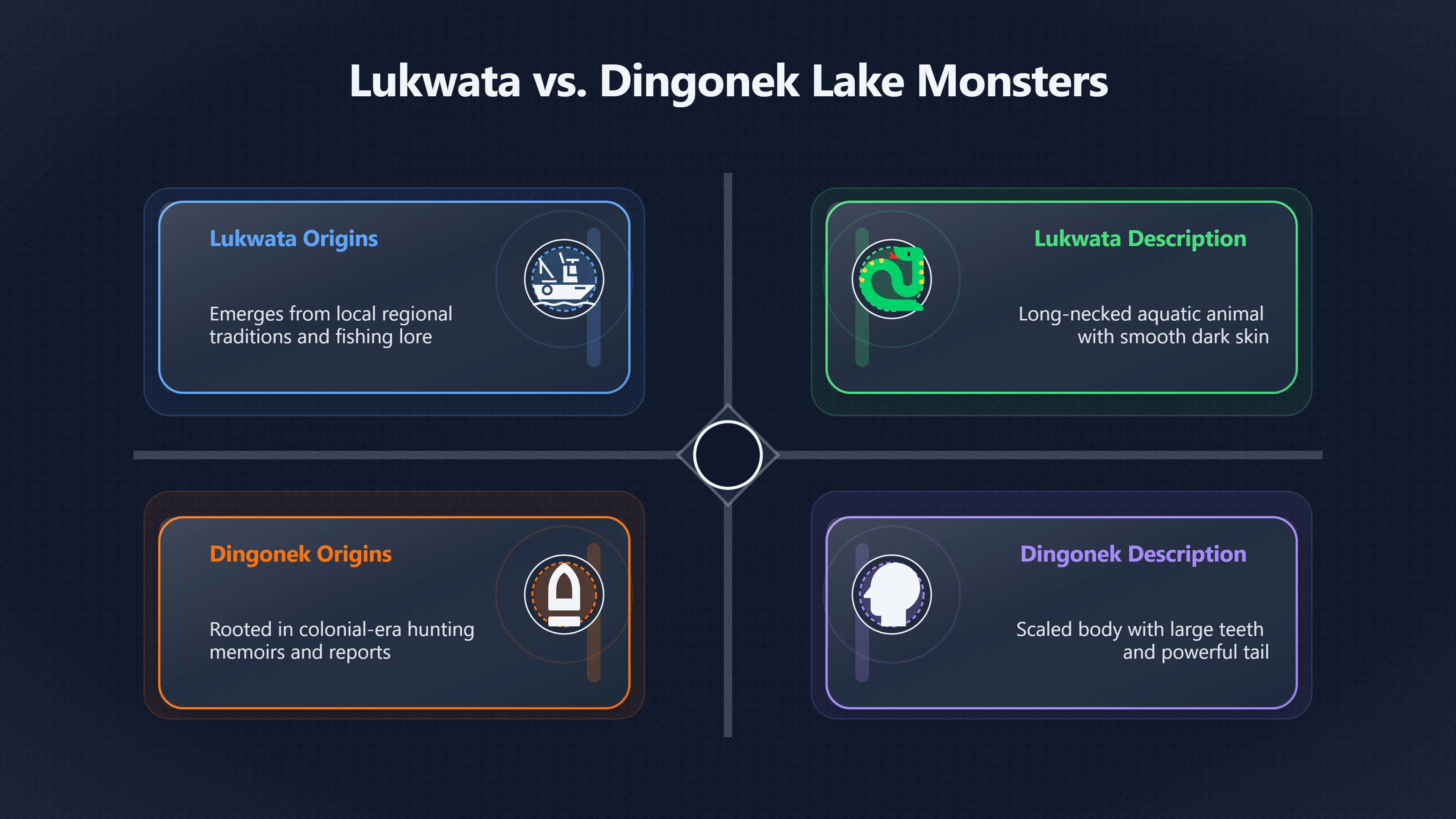
The result is a blend of folklore, eyewitness claims and natural hazards. Some accounts describe the famous lake monster known as the Lukwata. Others centre on the Dingonek, an alleged reptilian beast reported by hunters in the early twentieth century. Together, these stories form the Lake Victoria branch of Kenya’s wider mystery-animal tradition, where real danger and imagination often overlap.[Wikipedia]WikipediaOpen source on wikipedia.org.
What Made Lake Victoria Feel Monstrous?
Lake Victoria is immense, stretching across Kenya, Uganda and Tanzania and covering nearly 60,000 square kilometres. Its shoreline includes papyrus swamps, hidden channels, islands, shallow bays and fishing grounds where visibility can change rapidly.[Wikipedia]WikipediaLake VictoriaLake Victoria
For generations, people travelling these waters encountered hazards that could easily be interpreted as something uncanny:
- Crocodiles surfacing unexpectedly beside canoes.
- Hippos overturning boats or charging fishermen.
- Large snakes moving through reeds.
- Floating logs and vegetation taking strange shapes in poor light.
- Sudden waves, whirlpools and storms on open water.
In such conditions, reports of unknown creatures did not emerge from empty fantasy. They developed in landscapes where people already expected the water to conceal threats.
Lukwata and the Lake-Serpent Tradition
The best-known Lake Victoria monster is the Lukwata, a creature often described as a giant serpent or lake beast associated with attacks on boats and fishermen. Stories are most strongly documented around the northern and western parts of Lake Victoria, but colonial writers recorded similar traditions from communities around the lake, including groups connected to the Kenyan shoreline.[Wikipedia]WikipediaOpen source on wikipedia.org.
Descriptions varied considerably. Some accounts portrayed a long-necked aquatic animal twenty to thirty feet in length. Others described a powerful serpent-like creature with smooth dark skin. The Lukwata was sometimes said to attack canoes, seize fishermen or create disturbances on the water.[Wikipedia]WikipediaOpen source on wikipedia.org.
One reason the Lukwata became important in regional folklore is that it was never merely an animal. In some traditions it occupied a space between monster, spirit and sacred being. Early twentieth-century reports noted that stories about the creature could be linked to beliefs surrounding fishing, water power and supernatural protection.[Wikipedia]WikipediaOpen source on wikipedia.org.
Colonial administrator C. W. Hobley wrote in 1913 that people living around Lake Victoria repeatedly told stories of such a creature. He noted that fishermen reported attacks on canoes but also wondered whether sightings might have originated from encounters with exceptionally large pythons or other known animals.[Wikipedia]WikipediaOpen source on wikipedia.org.
The Lukwata therefore occupies an unusual position. It is both a folkloric lake monster and a recurring attempt to explain frightening events on dangerous waters.
The Dingonek Hunting Tale
If the Lukwata emerged mainly from local tradition, the Dingonek owes much of its fame to a specific colonial-era hunting story.
The creature entered cryptozoological history through reports connected to hunter John Alfred Jordan, who claimed to have encountered a bizarre animal near waterways feeding into Lake Victoria in 1907. The account later appeared in hunting memoirs and natural-history discussions, becoming one of East Africa’s most famous monster reports.[Wikipedia]WikipediaOpen source on wikipedia.org.
According to the story, Jordan observed a large animal partly in the water. Different retellings describe it as having scales, a powerful tail, large teeth and an unusual head combining features of several animals. When Jordan fired at it, the creature allegedly escaped into the water. Despite later searches, no physical evidence was found.[Wikipedia]WikipediaOpen source on wikipedia.org.
The tale spread quickly because it arrived during an era when European explorers were still discovering animals unfamiliar to Western science. The recent recognition of the okapi encouraged speculation that other large creatures might remain hidden in remote African habitats. Writers and magazines soon promoted the Dingonek as a possible unknown species or even a surviving prehistoric reptile.[Wikipedia]WikipediaOpen source on wikipedia.org.
Yet the evidence remained remarkably thin. The entire tradition rests largely on a handful of reported sightings and repeated retellings rather than specimens, tracks, photographs or biological remains. Modern researchers generally treat the Dingonek as a folklore-rich mystery rather than evidence for an undiscovered animal.[Wikipedia]WikipediaOpen source on wikipedia.org.
Why Crocodiles and Hippos Explain So Many Reports
The simplest explanation for many Lake Victoria monster stories is that witnesses encountered real animals under difficult conditions.
Large Nile crocodiles can reach impressive lengths and often appear only partially above the surface. A glimpse of a head, tail or moving wake may create a misleading impression of size or shape. Crocodiles can also disappear quickly beneath the water, reinforcing the feeling that something mysterious has been seen.[Wikipedia]WikipediaOpen source on wikipedia.org.
Hippos are equally important to understanding the folklore. Although they are herbivores, they are among Africa’s most dangerous large animals. They overturn boats, attack people who enter their territory and can move surprisingly fast. Modern reports from East African lakes continue to document serious encounters involving hippos and people.[Condé Nast Traveler]cntraveler.comCondé Nast Traveler Tourist Killed by Hippo Near Kenya's Lake NaivashaAnother tourist, Wu Peng Te, sustained minor injuries. The incident occurred shortly after a fisherman was killed by another hippo in the…
A witness seeing only part of a hippo’s body in reeds or rough water could easily struggle to identify what they were observing. Multiple animals surfacing in sequence can create the illusion of a single long creature moving through the water.
Large pythons provide another possible source for serpent stories. While they are not common open-water sights, a substantial snake moving between shoreline vegetation can appear startlingly large and may fit aspects of some Lukwata descriptions.[Wikipedia]WikipediaOpen source on wikipedia.org.
How Dangerous Waters Became Monster Waters
One striking feature of Lake Victoria folklore is that monster stories cluster around places where real danger already existed.
Fishing communities lived with drowning risks, storms, wildlife attacks and disappearances. When a canoe vanished or a fisherman failed to return, a supernatural explanation could coexist with practical knowledge of the lake’s hazards. A monster story was not necessarily intended as zoology; it could also be a way of expressing the unpredictability of life on the water.
This pattern appears in many lake-monster traditions worldwide. Reports often flourish in environments where visibility is poor, the water is dangerous and witnesses regularly encounter large animals only briefly. Lake Victoria fits that pattern remarkably well. Its vast size, extensive wetlands and powerful wildlife provide a setting where folklore can remain believable long after specific sightings fade from memory.[Wikipedia]WikipediaLake VictoriaLake Victoria
What Remains Unexplained?
No scientific evidence supports the existence of a giant unknown lake monster in Lake Victoria. No specimen, skeleton, clear photograph or verified biological trace has ever confirmed either the Lukwata or the Dingonek as a distinct species.[Wikipedia]WikipediaOpen source on wikipedia.org.
What survives instead is a fascinating record of how people interpreted a dangerous landscape. The Lukwata reflects older regional traditions linking mysterious creatures to fishing and the power of the lake. The Dingonek reflects a colonial-era fascination with unexplored Africa and the possibility of hidden animals. Both stories gained strength because Lake Victoria already felt unpredictable and hazardous.
For Kenya’s cryptid history, that combination is the real mystery. The monsters themselves remain unproven, but the fears, sightings and legends that produced them reveal how one of Africa’s greatest lakes became associated with some of East Africa’s most enduring water-beast tales.[Wikipedia]WikipediaOpen source on wikipedia.org.
Amazon book picks
Further Reading
Books and field guides related to What Haunted Kenya's Lake Victoria Waters?. Use these as the next step if you want deeper reading beyond the article.
Field Guide to Lake Monsters, Sea Serpents, and Other Mystery...
Directly aligns with Lake Victoria monster traditions.
On the Track of Unknown Animals
Covers classic reports of mysterious aquatic creatures.
eBay marketplace picks
Marketplace Samples
Live-tested eBay searches with available results related to this page.
Endnotes
1.
Source: Wikipedia
Link:https://en.wikipedia.org/wiki/Lukwata
2.
Source: Wikipedia
Link:https://en.wikipedia.org/wiki/Dingonek
3.
Source: Wikipedia
Title: Lake Victoria
Link:https://en.wikipedia.org/wiki/Lake_Victoria
4.
Source: cntraveler.com
Title: Condé Nast Traveler Tourist Killed by Hippo Near Kenya’s Lake Naivasha
Link:https://www.cntraveler.com/story/tourist-killed-by-hippo-near-kenyas-lake-naivasha
Source snippet
Another tourist, Wu Peng Te, sustained minor injuries. The incident occurred shortly after a fisherman was killed by another hippo in the...
Published: August 13, 2018
Additional References
5.
Source: reddit.com
Title: The Lukwata
Link:https://www.reddit.com/r/Cryptozoology/comments/13tooe7/the_lukwata_debating_if_it_could_be_real_or_not/
Source snippet
Debating if it could be real or not.: r...The Lukwata is 20 feet to 30 feet long, has a long neck, a dolphin like body, and makes bello...
6.
Source: abookofcreatures.com
Link:https://abookofcreatures.com/2019/06/17/dingonek/
Source snippet
17 Jun 2019 — The Dingonek is a creature that lives in the Maggori River in Kenya, as well as in Lake Nyanza (Victoria). Our primary sour...
7.
Source: facebook.com
Title: the dingonek was a creature which was said to have been seen in 1907 by a huntin
Link:https://www.facebook.com/TheFolklorePodcast/posts/the-dingonek-was-a-creature-which-was-said-to-have-been-seen-in-1907-by-a-huntin/1461062369368012/
Source snippet
The Folklore PodcastThe Dingonek was a creature which was said to have been seen in 1907 by a hunting expedition led by John Alfred Jorda...
8.
Source: facebook.com
Link:https://www.facebook.com/Inside.Edition/posts/watch-out-thats-one-angry-angry-hippo-tourists-aboard-a-boat-on-lake-victoria-in/10157782776940723/
Source snippet
they spotted a hippopotamus eyeing them from several meters away...
9.
Source: facebook.com
Link:https://www.facebook.com/bbcworldservice/posts/winnie-kebens-leg-was-bitten-off-by-a-crocodile-as-she-fetched-water-from-lake-b/689352223219013/
Source snippet
e Baringo in Kenya. Local communities say these kinds of...
10.
Source: imdb.com
Link:https://www.imdb.com/news/ni56658243/
Source snippet
edly sighted in 1907 in Kenya by explorer John Alfred Jordan – who claims he was...Read more...
11.
Source: instagram.com
Link:https://www.instagram.com/reel/DVQ-tgKD9qj/
Source snippet
s, a giant responsible for countless deadly encounters … the calm...
12.
Source: instagram.com
Link:https://www.instagram.com/reel/DYcltnBIjEM/
Source snippet
Watch how Crocodile killed #tourism#whitedovecollege...In 2014, a reported crocodile attack at Lake Victoria, Uganda, drew widespread at...
13.
Source: cryptidarchives.fandom.com
Title: Cryptid Archives Dingonek
Link:https://cryptidarchives.fandom.com/wiki/Dingonek
Source snippet
Karl Shuker has noted that Jordan "seemed very emphatic that this creature was genuinely scaled" in his...Read more...
14.
Source: youtube.com
Link:https://www.youtube.com/watch?v=AUtTSOHZEHQ
Source snippet
The Solved Unsolved Mystery | Monsters...The Dingonek is among the relatively numerous monsters that originate from exaggerated or incor...
Topic Tree